
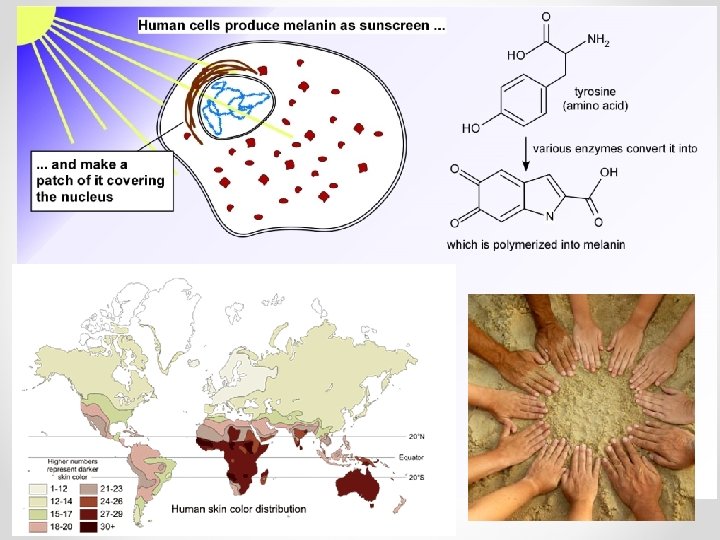
Red Black Melanin control color of skin hair
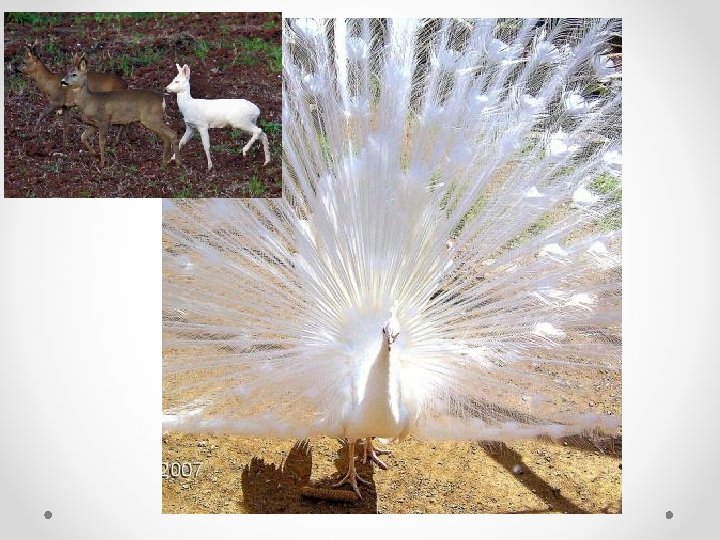
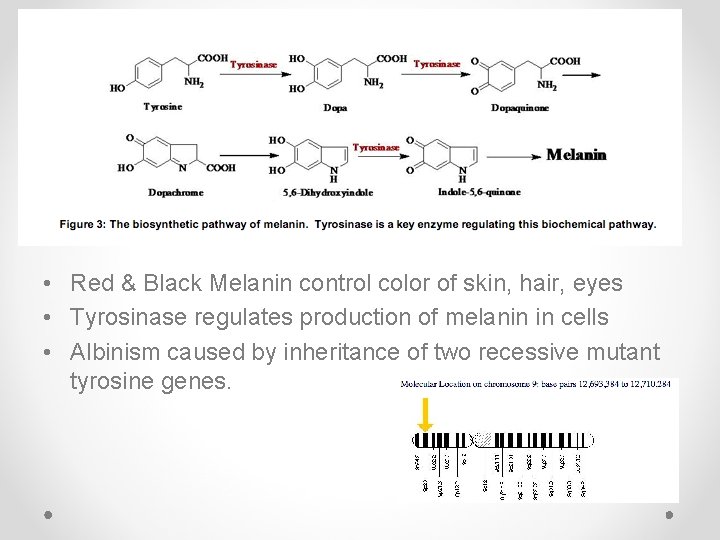
• Red & Black Melanin control color of skin, hair, eyes • Tyrosinase regulates production of melanin in cells • Albinism caused by inheritance of two recessive mutant tyrosine genes.
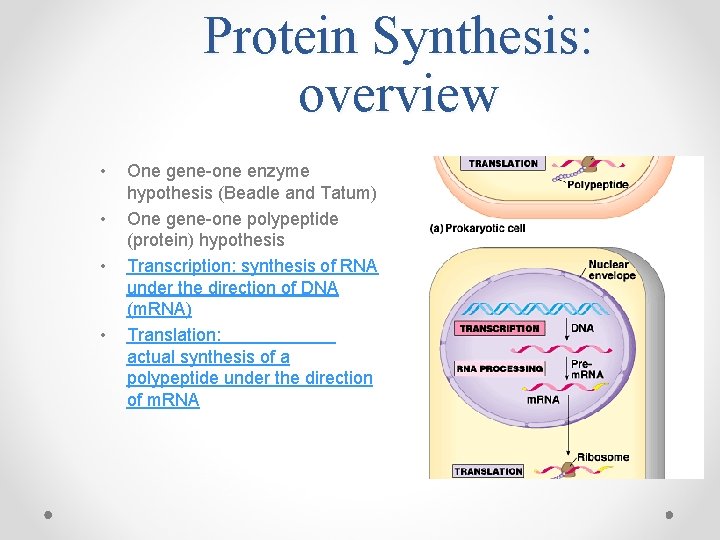
Protein Synthesis: overview • • One gene-one enzyme hypothesis (Beadle and Tatum) One gene-one polypeptide (protein) hypothesis Transcription: synthesis of RNA under the direction of DNA (m. RNA) Translation: actual synthesis of a polypeptide under the direction of m. RNA
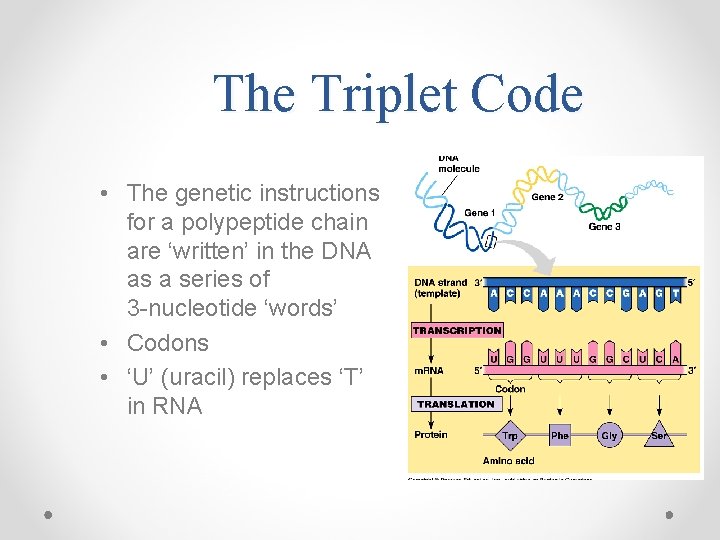
The Triplet Code • The genetic instructions for a polypeptide chain are ‘written’ in the DNA as a series of 3 -nucleotide ‘words’ • Codons • ‘U’ (uracil) replaces ‘T’ in RNA


Transcription, I • RNA polymerase: pries DNA apart and hooks RNA nucleotides together from the DNA code • Promoter region on DNA: where RNA polymerase attaches and where initiation of RNA begins • Terminator region: sequence that signals the end of transcription • Transcription unit: stretch of DNA transcribed into an RNA molecule
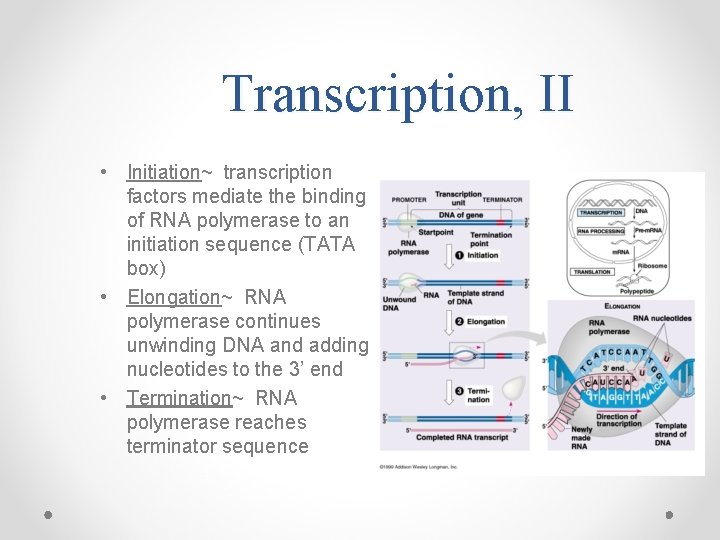
Transcription, II • Initiation~ transcription factors mediate the binding of RNA polymerase to an initiation sequence (TATA box) • Elongation~ RNA polymerase continues unwinding DNA and adding nucleotides to the 3’ end • Termination~ RNA polymerase reaches terminator sequence
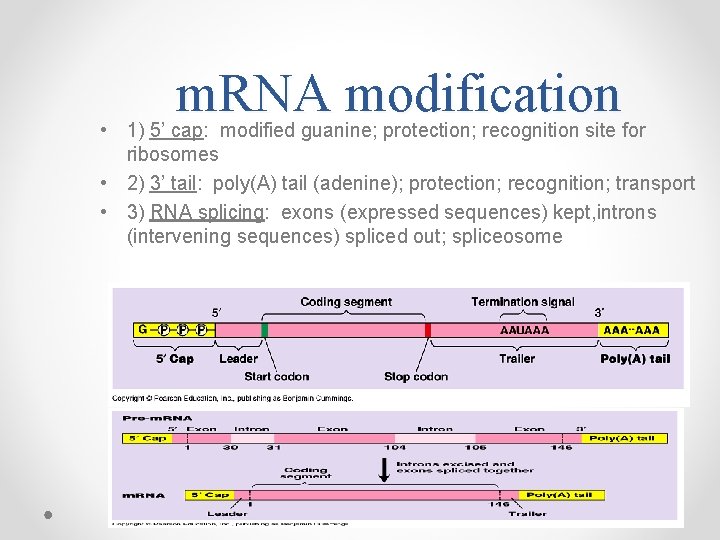
m. RNA modification • 1) 5’ cap: modified guanine; protection; recognition site for ribosomes • 2) 3’ tail: poly(A) tail (adenine); protection; recognition; transport • 3) RNA splicing: exons (expressed sequences) kept, introns (intervening sequences) spliced out; spliceosome

Translation, I • m. RNA from nucleus is ‘read’ along its codons by t. RNA’s anticodons at the ribosome • t. RNA anticodon (nucleotide triplet); amino acid
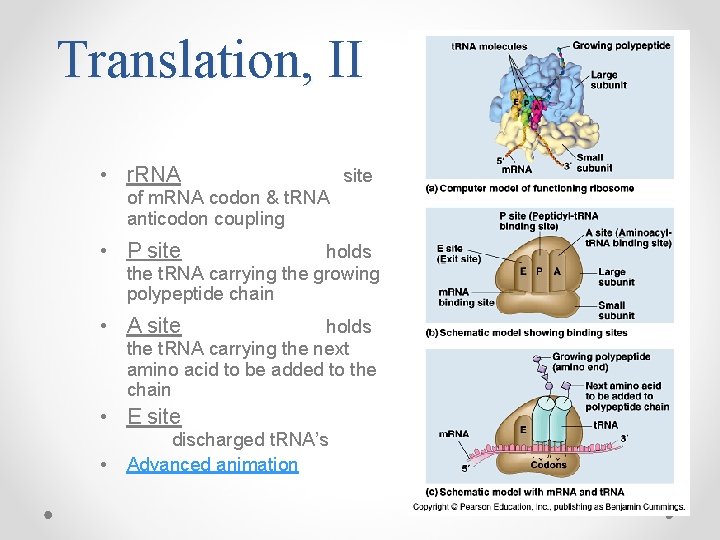
Translation, II • r. RNA site of m. RNA codon & t. RNA anticodon coupling • P site holds the t. RNA carrying the growing polypeptide chain • A site holds the t. RNA carrying the next amino acid to be added to the chain • E site • discharged t. RNA’s Advanced animation
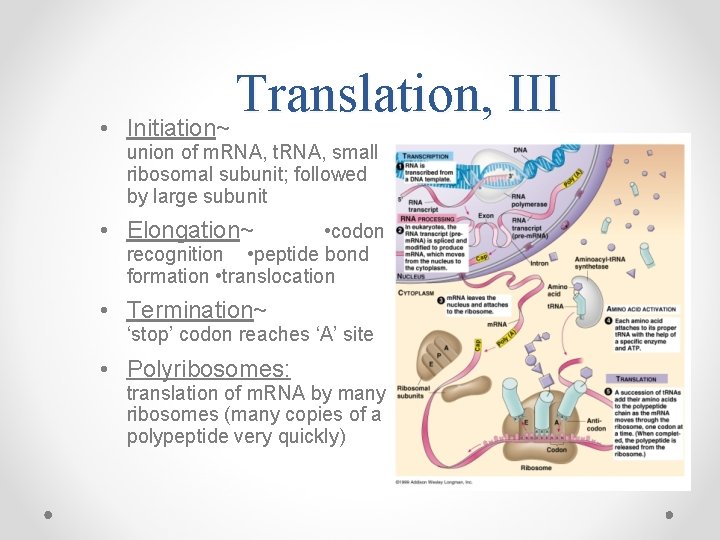
• Translation, III Initiation~ union of m. RNA, t. RNA, small ribosomal subunit; followed by large subunit • Elongation~ • codon recognition • peptide bond formation • translocation • Termination~ ‘stop’ codon reaches ‘A’ site • Polyribosomes: translation of m. RNA by many ribosomes (many copies of a polypeptide very quickly)
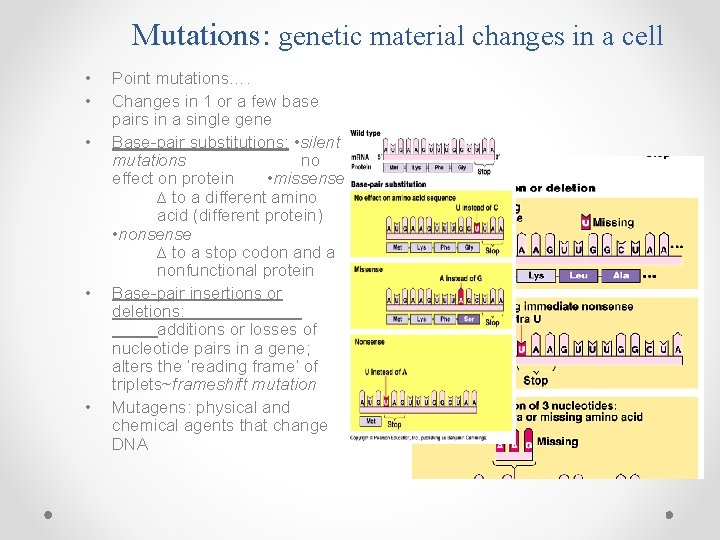
Mutations: genetic material changes in a cell • • • Point mutations…. Changes in 1 or a few base pairs in a single gene Base-pair substitutions: • silent mutations no effect on protein • missense ∆ to a different amino acid (different protein) • nonsense ∆ to a stop codon and a nonfunctional protein Base-pair insertions or deletions: additions or losses of nucleotide pairs in a gene; alters the ‘reading frame’ of triplets~frameshift mutation Mutagens: physical and chemical agents that change DNA
- Slides: 13