
Recycling Homework 1 Review the curbside recycling calculation
Recycling Homework #1 Review the curbside recycling calculation and Porter’s Ch 9, then answer the following questions: 1. Recycling looks uneconomical. Is this calculation right? 2. Explore options on how to improve on this situation. Express them as cost equations. The basic issues here are: a) scaling the costs with the amount, b) two pick-ups instead of one, and c) compacting and sorting. 3. What does this development leave out? 1
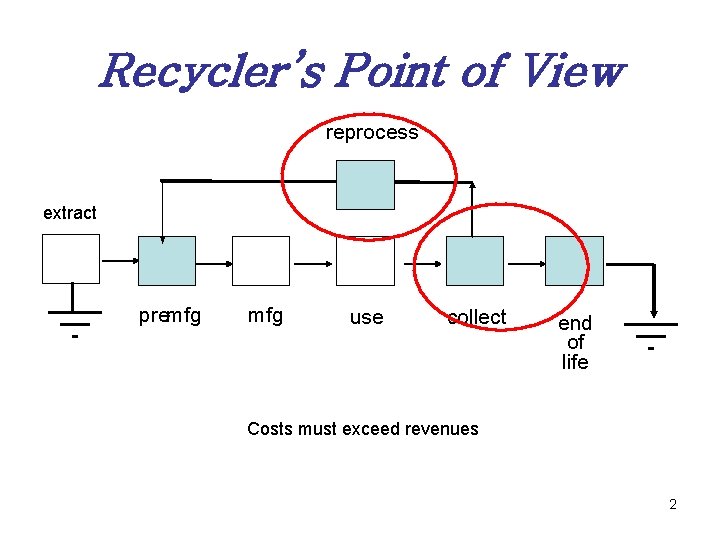
Recycler’s Point of View reprocess extract pre-mfg use collect end of life Costs must exceed revenues 2
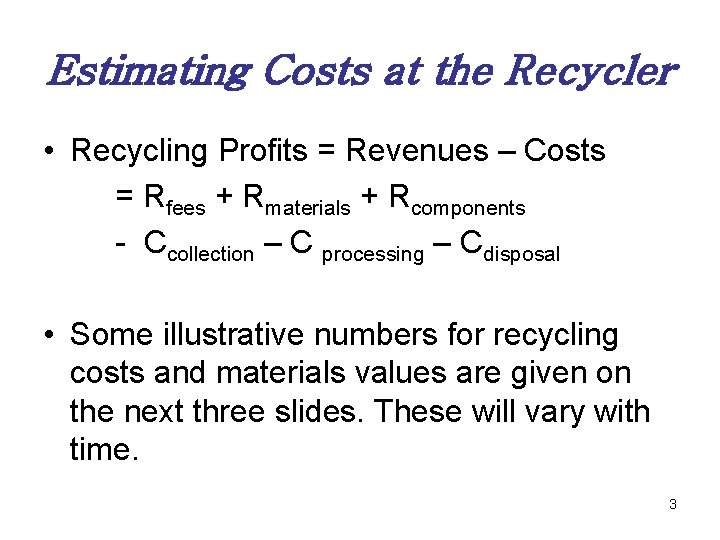
Estimating Costs at the Recycler • Recycling Profits = Revenues – Costs = Rfees + Rmaterials + Rcomponents - Ccollection – C processing – Cdisposal • Some illustrative numbers for recycling costs and materials values are given on the next three slides. These will vary with time. 3
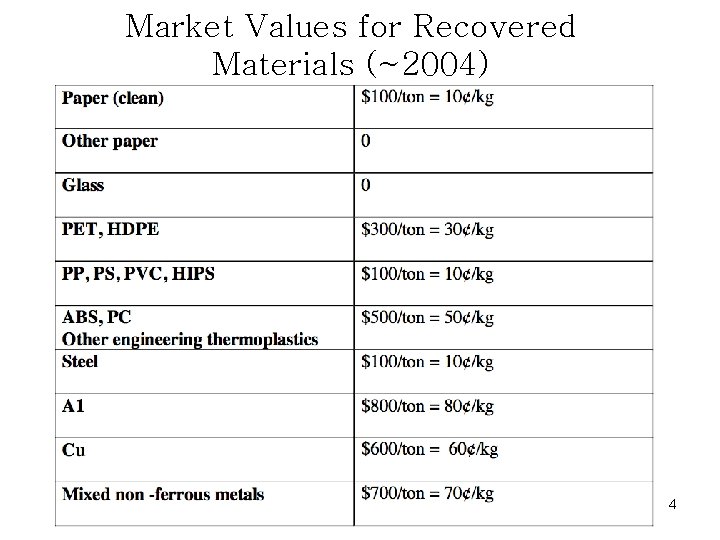
Market Values for Recovered Materials (~2004) 4
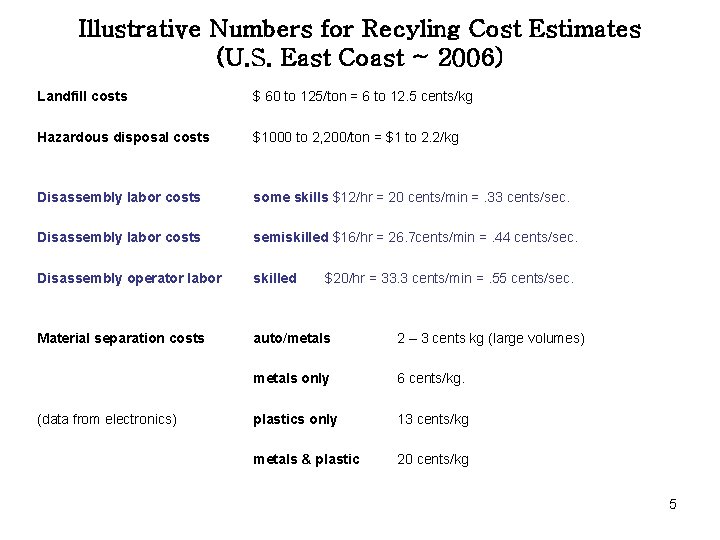
Illustrative Numbers for Recyling Cost Estimates (U. S. East Coast ~ 2006) Landfill costs $ 60 to 125/ton = 6 to 12. 5 cents/kg Hazardous disposal costs $1000 to 2, 200/ton = $1 to 2. 2/kg Disassembly labor costs some skills $12/hr = 20 cents/min =. 33 cents/sec. Disassembly labor costs semiskilled $16/hr = 26. 7 cents/min =. 44 cents/sec. Disassembly operator labor skilled Material separation costs auto/metals 2 – 3 cents kg (large volumes) metals only 6 cents/kg. plastics only 13 cents/kg metals & plastic 20 cents/kg (data from electronics) $20/hr = 33. 3 cents/min =. 55 cents/sec. 5
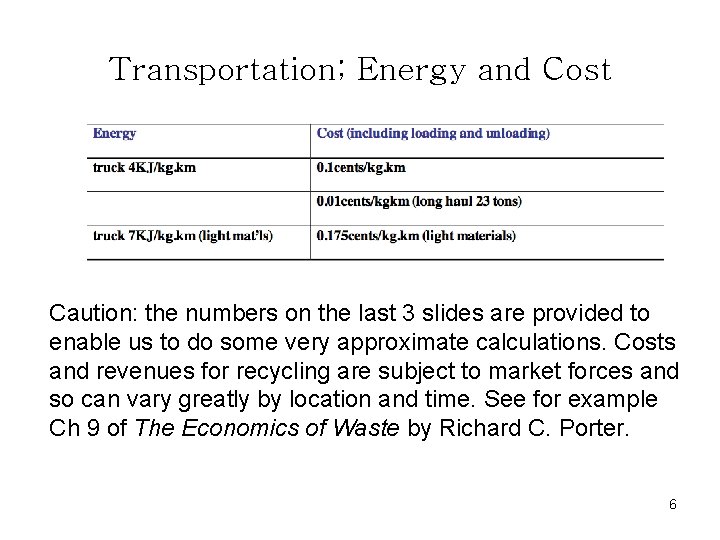
Transportation; Energy and Cost Caution: the numbers on the last 3 slides are provided to enable us to do some very approximate calculations. Costs and revenues for recycling are subject to market forces and so can vary greatly by location and time. See for example Ch 9 of The Economics of Waste by Richard C. Porter. 6
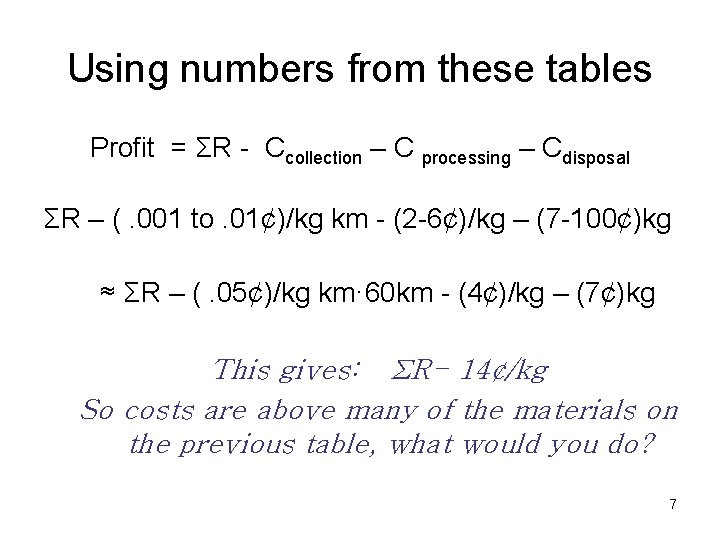
Using numbers from these tables Profit = ΣR - Ccollection – C processing – Cdisposal ΣR – (. 001 to. 01¢)/kg km - (2 -6¢)/kg – (7 -100¢)kg ≈ ΣR – (. 05¢)/kg km· 60 km - (4¢)/kg – (7¢)kg This gives: ΣR- 14¢/kg So costs are above many of the materials on the previous table, what would you do? 7
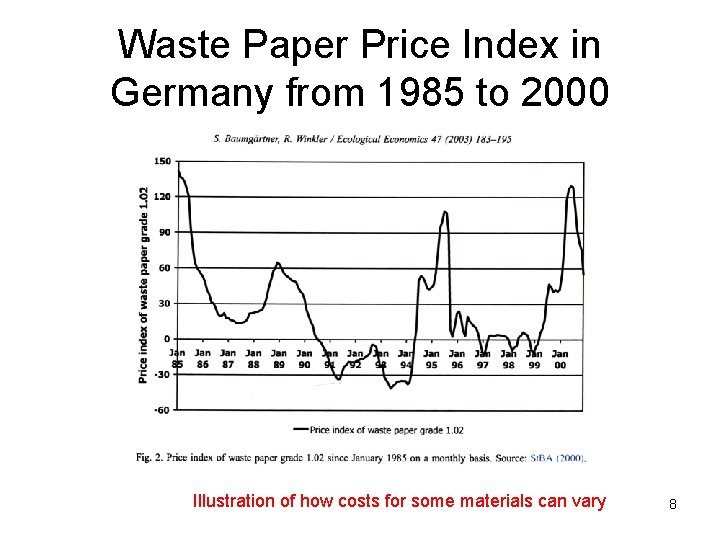
Waste Paper Price Index in Germany from 1985 to 2000 Illustration of how costs for some materials can vary 8
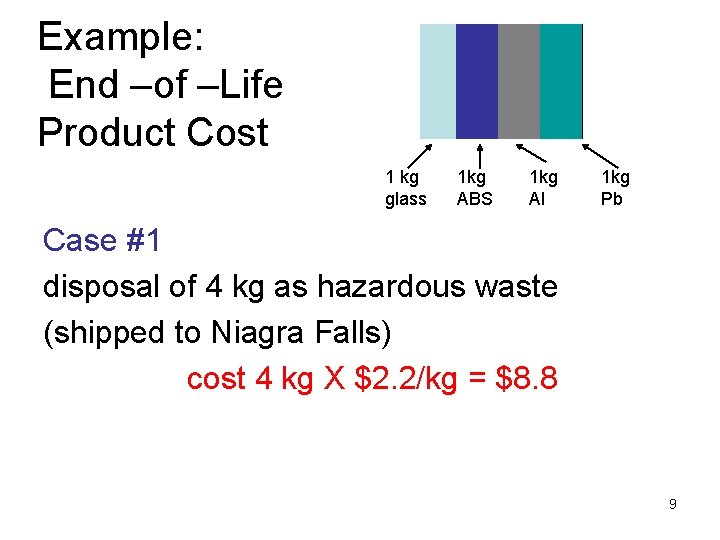
Example: End –of –Life Product Cost 1 kg glass 1 kg ABS 1 kg Al 1 kg Pb Case #1 disposal of 4 kg as hazardous waste (shipped to Niagra Falls) cost 4 kg X $2. 2/kg = $8. 8 9
10
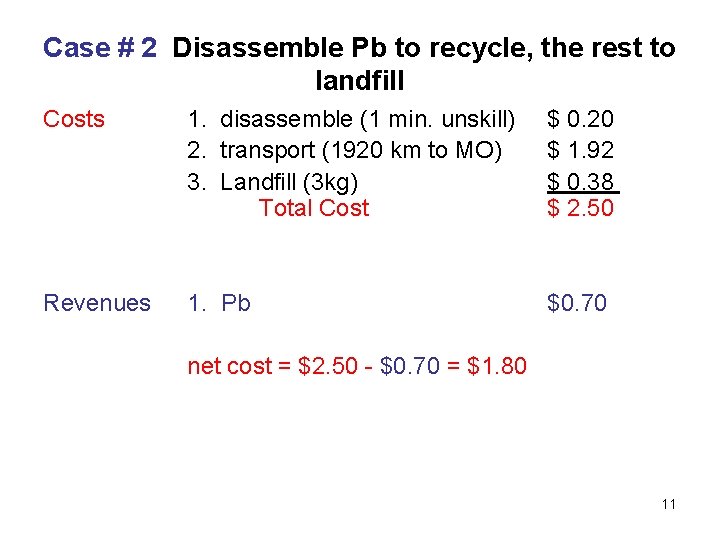
Case # 2 Disassemble Pb to recycle, the rest to landfill Costs 1. disassemble (1 min. unskill) 2. transport (1920 km to MO) 3. Landfill (3 kg) Total Cost $ 0. 20 $ 1. 92 $ 0. 38 $ 2. 50 Revenues 1. Pb $0. 70 net cost = $2. 50 - $0. 70 = $1. 80 11
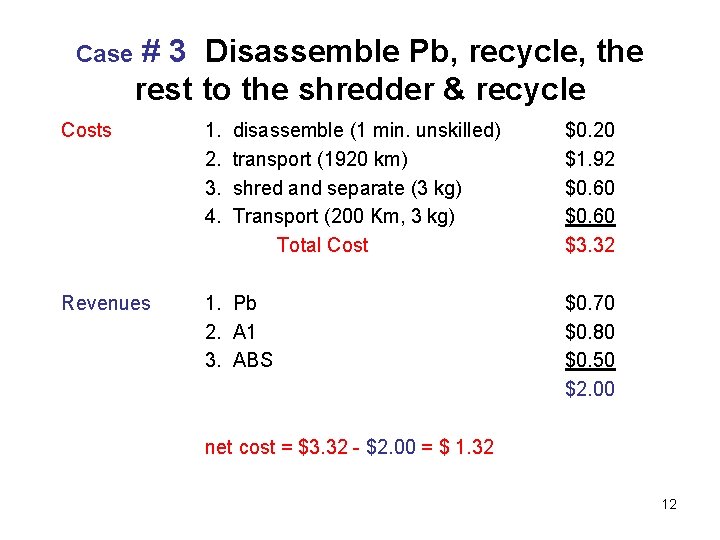
Case # 3 Disassemble Pb, recycle, the rest to the shredder & recycle Costs 1. 2. 3. 4. disassemble (1 min. unskilled) transport (1920 km) shred and separate (3 kg) Transport (200 Km, 3 kg) Total Cost Revenues 1. Pb 2. A 1 3. ABS $0. 20 $1. 92 $0. 60 $3. 32 $0. 70 $0. 80 $0. 50 $2. 00 net cost = $3. 32 - $2. 00 = $ 1. 32 12
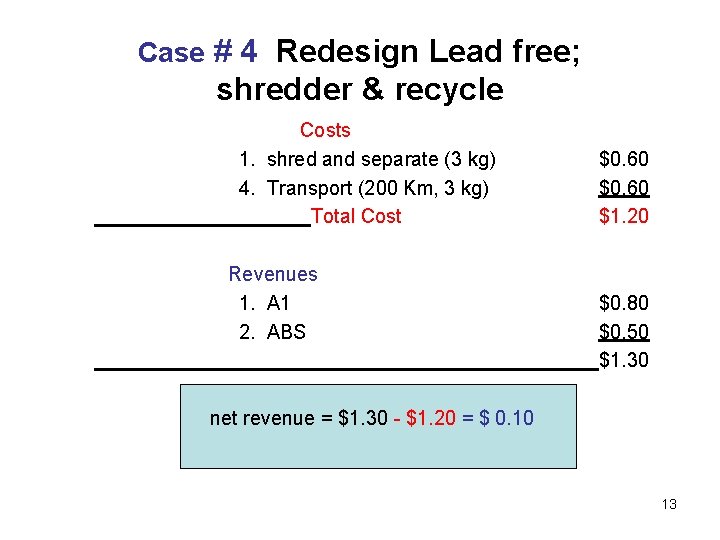
Case # 4 Redesign Lead free; shredder & recycle Costs 1. shred and separate (3 kg) 4. Transport (200 Km, 3 kg) Total Cost Revenues 1. A 1 2. ABS $0. 60 $1. 20 $0. 80 $0. 50 $1. 30 net revenue = $1. 30 - $1. 20 = $ 0. 10 13
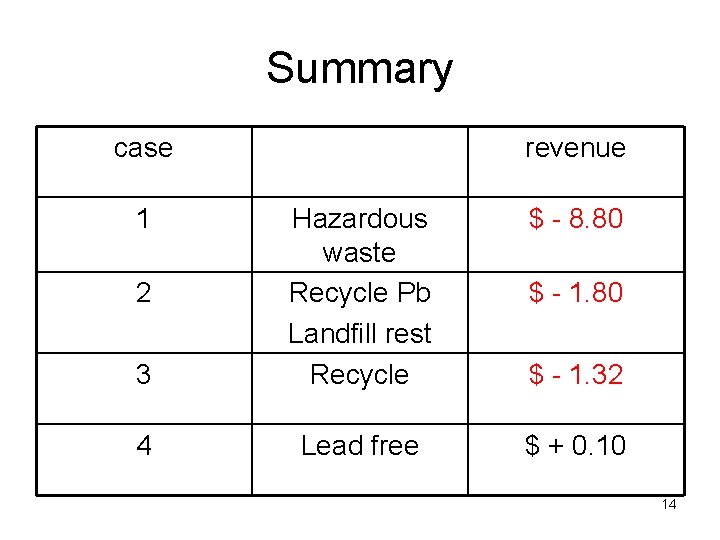
Summary case 1 revenue $ - 8. 80 3 Hazardous waste Recycle Pb Landfill rest Recycle 4 Lead free $ + 0. 10 2 $ - 1. 80 $ - 1. 32 14
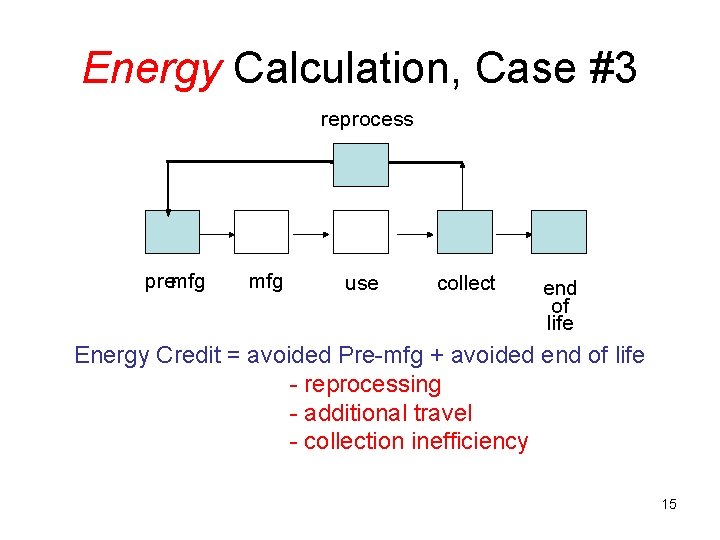
Energy Calculation, Case #3 reprocess pre-mfg use collect end of life Energy Credit = avoided Pre-mfg + avoided end of life - reprocessing - additional travel - collection inefficiency 15
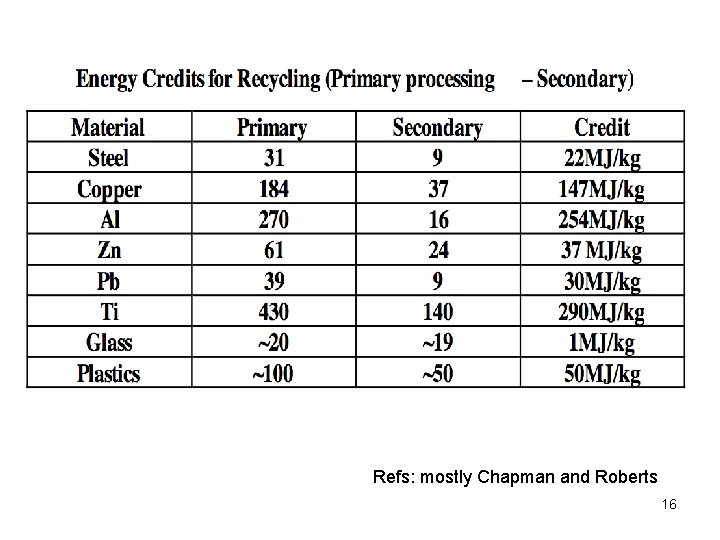
Refs: mostly Chapman and Roberts 16
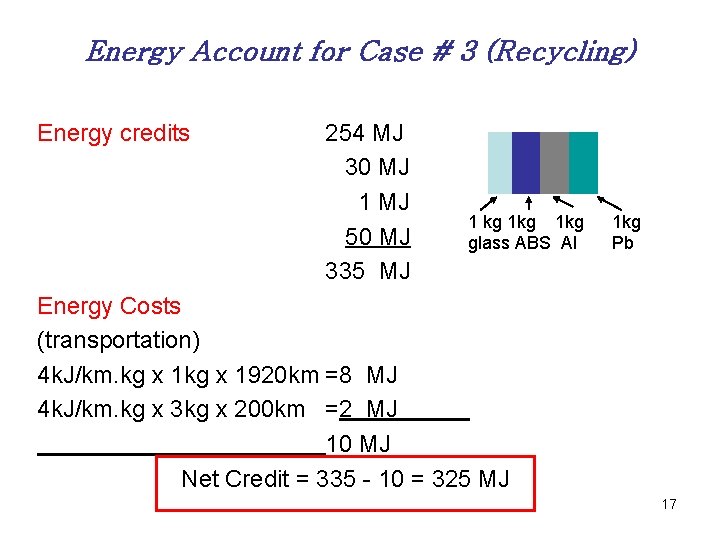
Energy Account for Case # 3 (Recycling) Energy credits 254 MJ 30 MJ 1 MJ 50 MJ 335 MJ 1 kg 1 kg glass ABS Al 1 kg Pb Energy Costs (transportation) 4 k. J/km. kg x 1920 km =8 MJ 4 k. J/km. kg x 3 kg x 200 km =2 MJ 10 MJ Net Credit = 335 - 10 = 325 MJ 17
Recycling Homework #2 • Consider a product made up of four parts as in the example, but in this case the materials are: 1) printed and glued paper, 2) PS plastic, 3) glass, and 4) steel. • Using similar scenarios as above, which one has the lowest cost? • What modifications would you suggest to the scenarios, if any? 18
Recycling Homework #3 • Please plot the 4 material example given in these slides, on the value Vs mixing plot (Dahmus paper) (#1). Also plot the 3 material redesign (#2). • Also plot the 4 material example in homework 2 on the value Vs mixing plot (#3). • Suggest how to redesign these “products” to enhance the possibility they are recycled. 19
Recycling Homework #4 • Consider the recycling of a product, as when it is reused or remanufactured. Under what circumstance is it appropriate for the manufacture to claim an “environmental credit” for extending the life of their product? Please refer to the paper by Valerie Thomas. • Why is 1 + k/v > L in the paper by Valerie Thomas? 20
- Slides: 20