
Recursive Data Types Koen Lindstrm Claessen Modelling Arithmetic
- Slides: 41
Recursive Data Types Koen Lindström Claessen
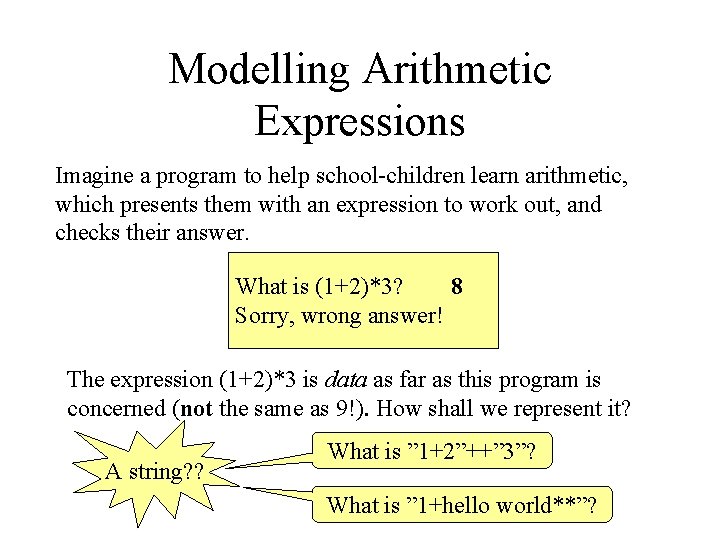
Modelling Arithmetic Expressions Imagine a program to help school-children learn arithmetic, which presents them with an expression to work out, and checks their answer. What is (1+2)*3? 8 Sorry, wrong answer! The expression (1+2)*3 is data as far as this program is concerned (not the same as 9!). How shall we represent it? A string? ? What is ” 1+2”++” 3”? What is ” 1+hello world**”?
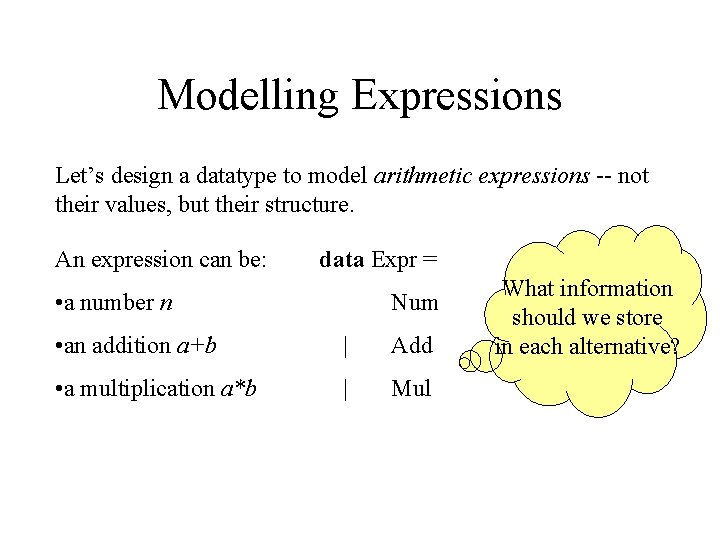
Modelling Expressions Let’s design a datatype to model arithmetic expressions -- not their values, but their structure. An expression can be: data Expr = • a number n Num • an addition a+b | Add • a multiplication a*b | Mul What information should we store in each alternative?
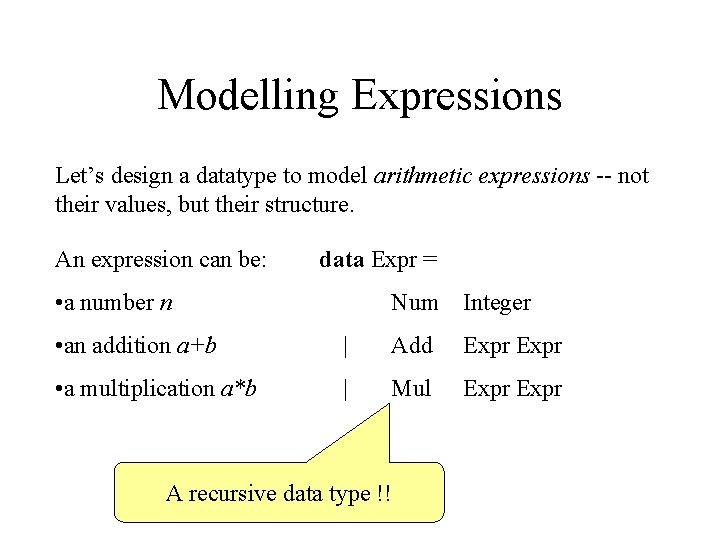
Modelling Expressions Let’s design a datatype to model arithmetic expressions -- not their values, but their structure. An expression can be: data Expr = • a number n Num Integer • an addition a+b | Add Expr • a multiplication a*b | Mul Expr A recursive data type !!
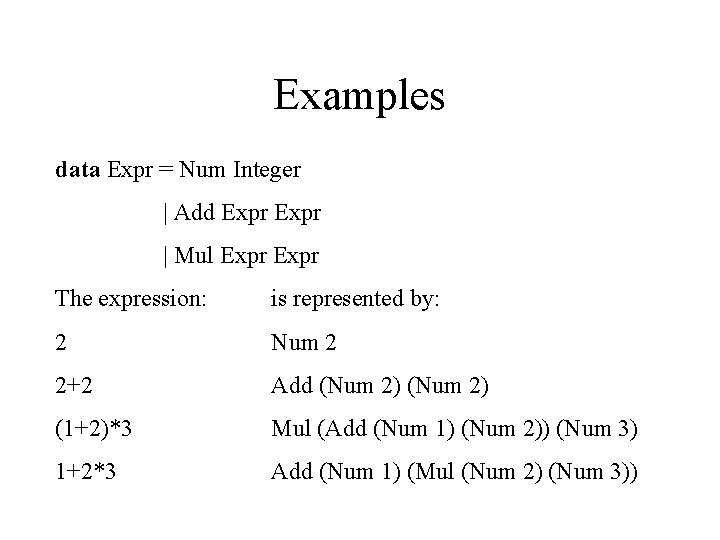
Examples data Expr = Num Integer | Add Expr | Mul Expr The expression: is represented by: 2 Num 2 2+2 Add (Num 2) (1+2)*3 Mul (Add (Num 1) (Num 2)) (Num 3) 1+2*3 Add (Num 1) (Mul (Num 2) (Num 3))
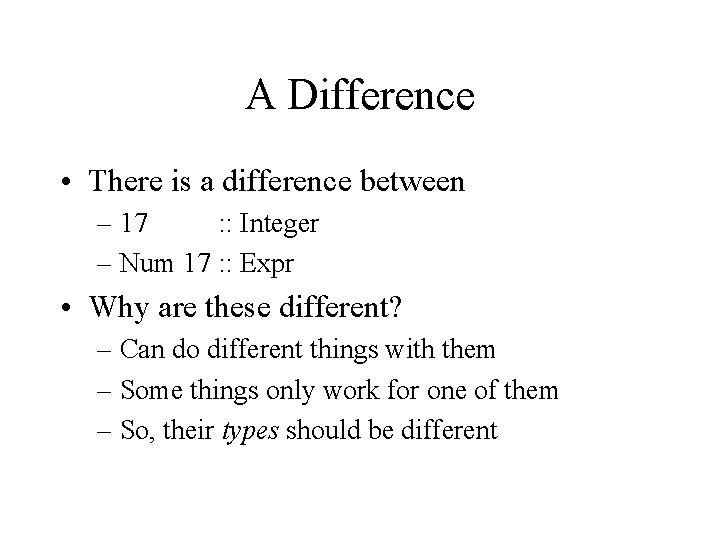
A Difference • There is a difference between – 17 : : Integer – Num 17 : : Expr • Why are these different? – Can do different things with them – Some things only work for one of them – So, their types should be different
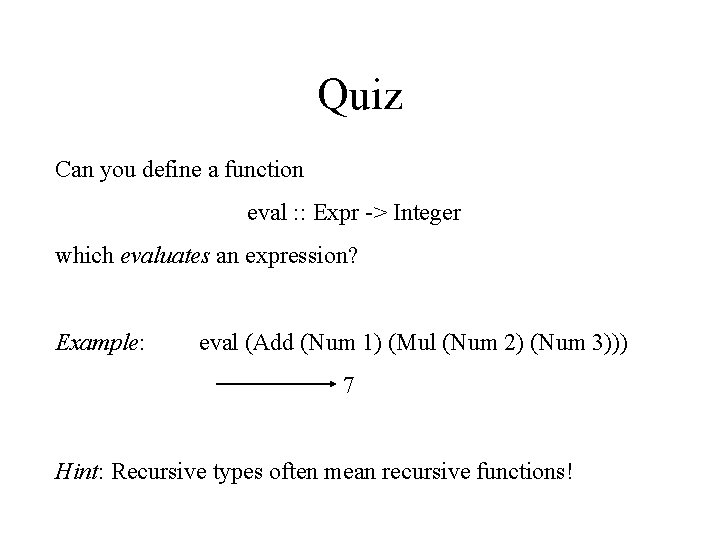
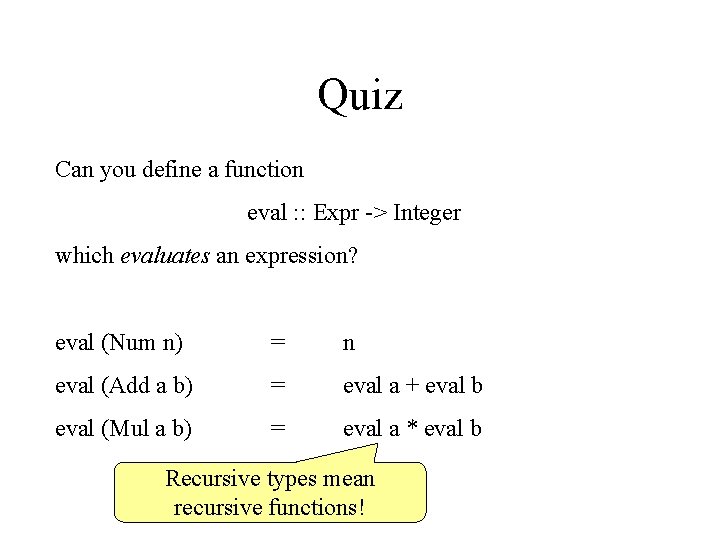
Quiz Can you define a function eval : : Expr -> Integer which evaluates an expression? Example: eval (Add (Num 1) (Mul (Num 2) (Num 3))) 7 Hint: Recursive types often mean recursive functions!
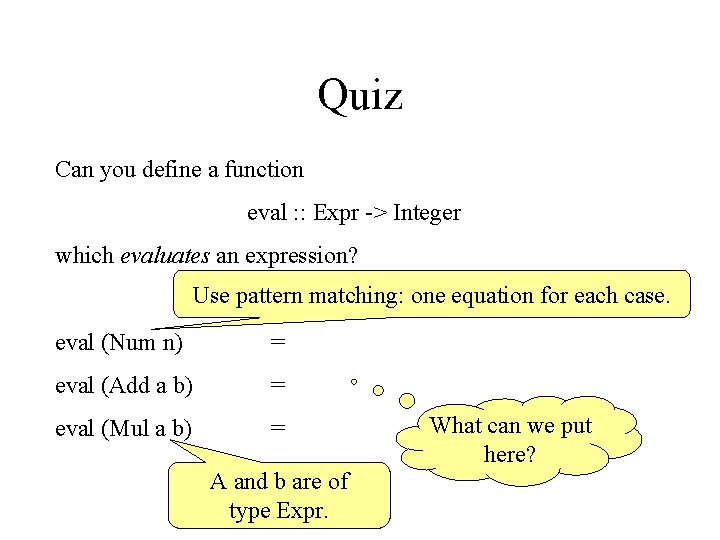
Quiz Can you define a function eval : : Expr -> Integer which evaluates an expression? Use pattern matching: one equation for each case. eval (Num n) = eval (Add a b) = eval (Mul a b) = A and b are of type Expr. What can we put here?
Quiz Can you define a function eval : : Expr -> Integer which evaluates an expression? eval (Num n) = n eval (Add a b) = eval a + eval b eval (Mul a b) = eval a * eval b Recursive types mean recursive functions!
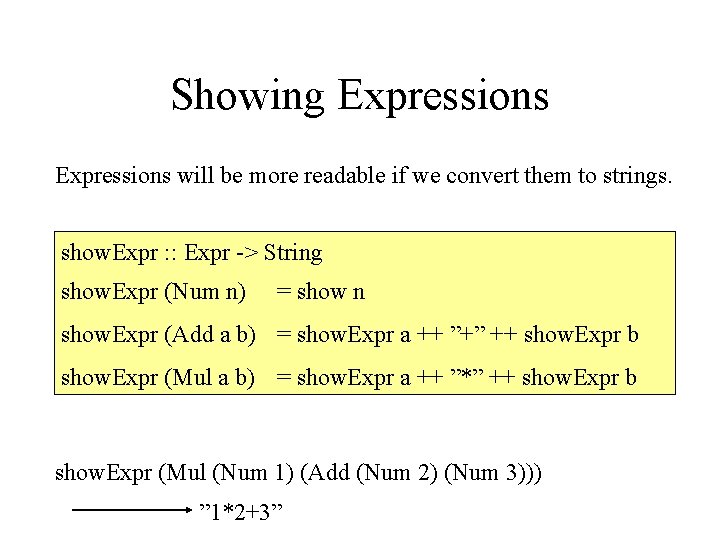
Showing Expressions will be more readable if we convert them to strings. show. Expr : : Expr -> String show. Expr (Num n) = show n show. Expr (Add a b) = show. Expr a ++ ”+” ++ show. Expr b show. Expr (Mul a b) = show. Expr a ++ ”*” ++ show. Expr b show. Expr (Mul (Num 1) (Add (Num 2) (Num 3))) ” 1*2+3”
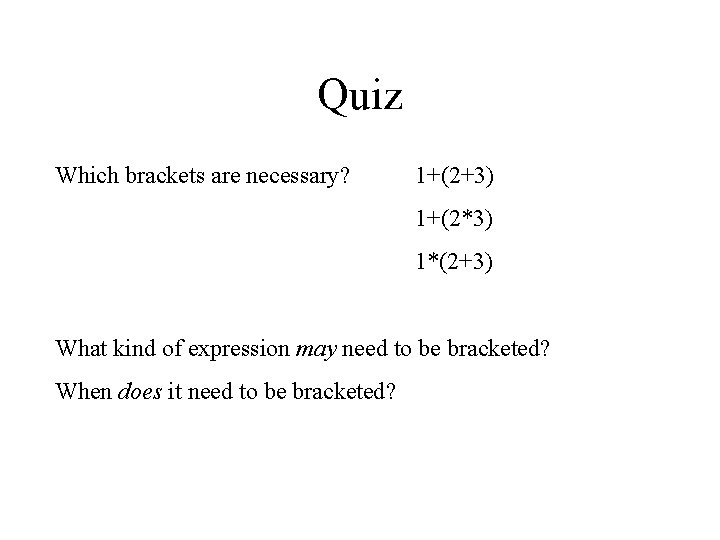
Quiz Which brackets are necessary? 1+(2+3) 1+(2*3) 1*(2+3) What kind of expression may need to be bracketed? When does it need to be bracketed?
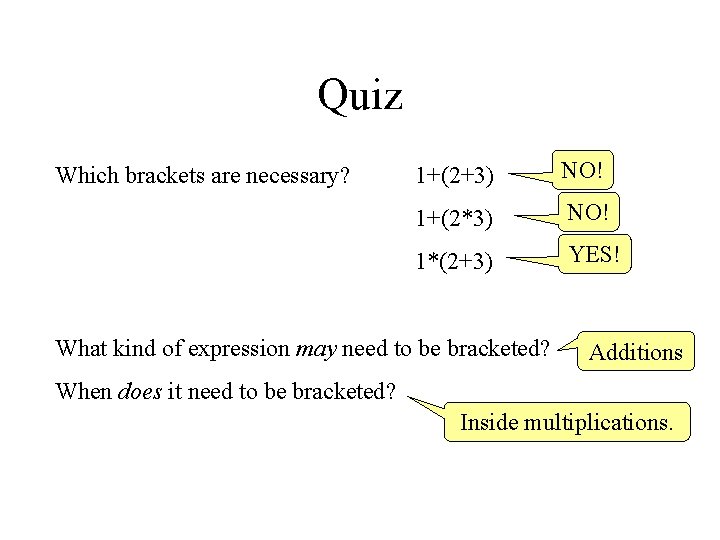
Quiz Which brackets are necessary? 1+(2+3) NO! 1+(2*3) NO! 1*(2+3) YES! What kind of expression may need to be bracketed? Additions When does it need to be bracketed? Inside multiplications.
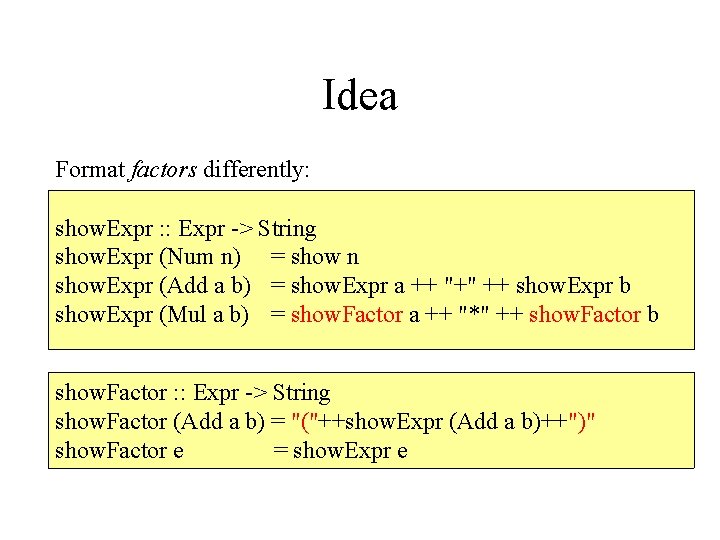
Idea Format factors differently: show. Expr : : Expr -> String show. Expr (Num n) = show n show. Expr (Add a b) = show. Expr a ++ "+" ++ show. Expr b show. Expr (Mul a b) = show. Factor a ++ "*" ++ show. Factor b show. Factor : : Expr -> String ? show. Factor (Add a b) = "("++show. Expr (Add a b)++")" show. Factor e = show. Expr e
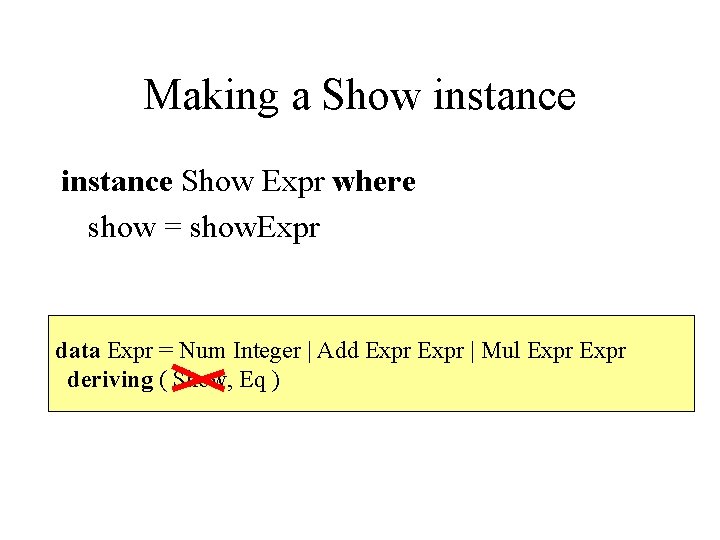
Making a Show instance Show Expr where show = show. Expr data Expr = Num Integer | Add Expr | Mul Expr deriving ( Show, Eq )
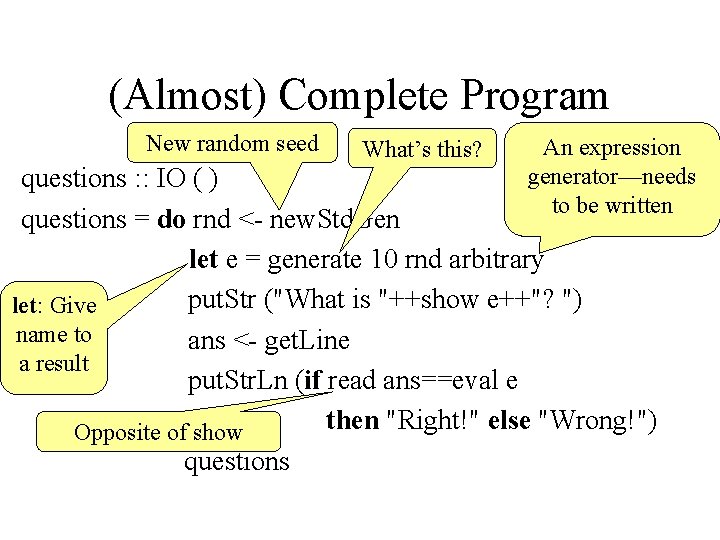
(Almost) Complete Program New random seed What’s this? An expression generator—needs to be written questions : : IO ( ) questions = do rnd <- new. Std. Gen let e = generate 10 rnd arbitrary put. Str ("What is "++show e++"? ") let: Give name to ans <- get. Line a result put. Str. Ln (if read ans==eval e then "Right!" else "Wrong!") Opposite of show questions
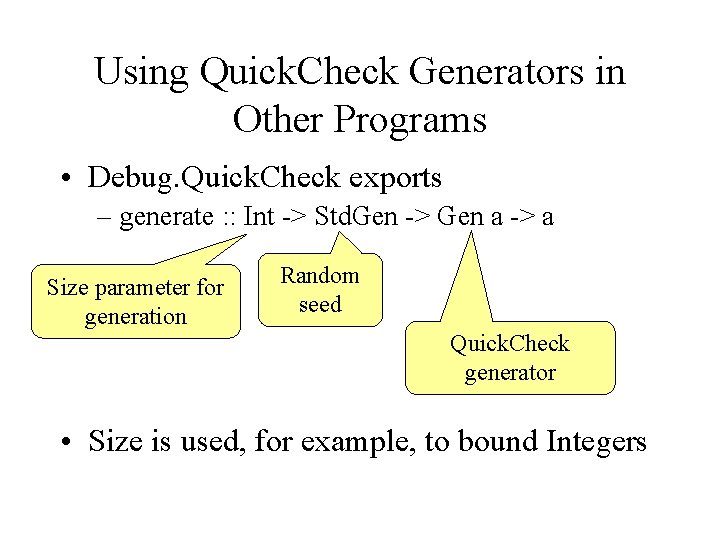
Using Quick. Check Generators in Other Programs • Debug. Quick. Check exports – generate : : Int -> Std. Gen -> Gen a -> a Size parameter for generation Random seed Quick. Check generator • Size is used, for example, to bound Integers
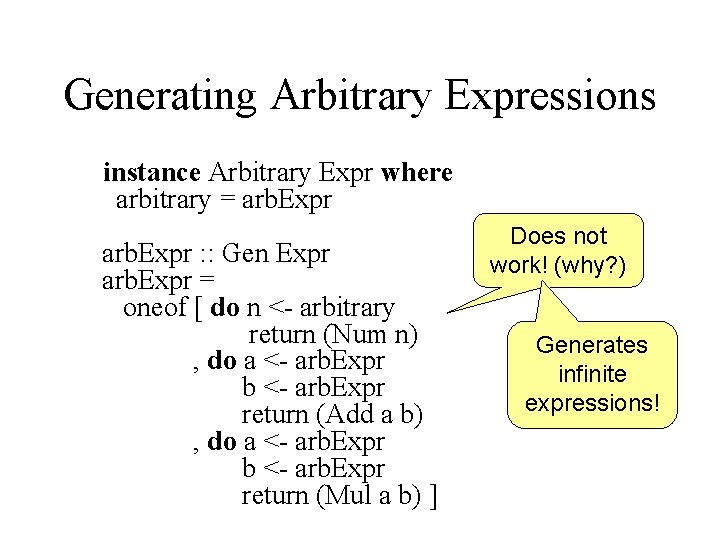
Generating Arbitrary Expressions instance Arbitrary Expr where arbitrary = arb. Expr : : Gen Expr arb. Expr = oneof [ do n <- arbitrary return (Num n) , do a <- arb. Expr b <- arb. Expr return (Add a b) , do a <- arb. Expr b <- arb. Expr return (Mul a b) ] Does not work! (why? ) Generates infinite expressions!
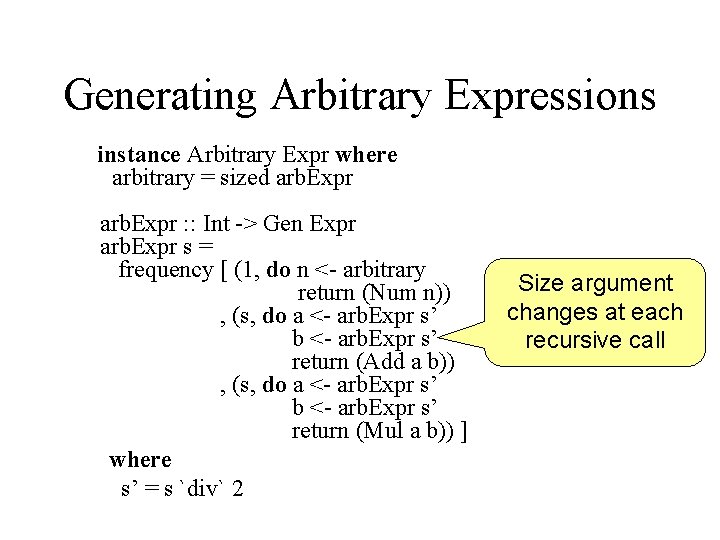
Generating Arbitrary Expressions instance Arbitrary Expr where arbitrary = sized arb. Expr : : Int -> Gen Expr arb. Expr s = frequency [ (1, do n <- arbitrary return (Num n)) , (s, do a <- arb. Expr s’ b <- arb. Expr s’ return (Add a b)) , (s, do a <- arb. Expr s’ b <- arb. Expr s’ return (Mul a b)) ] where s’ = s `div` 2 Size argument changes at each recursive call
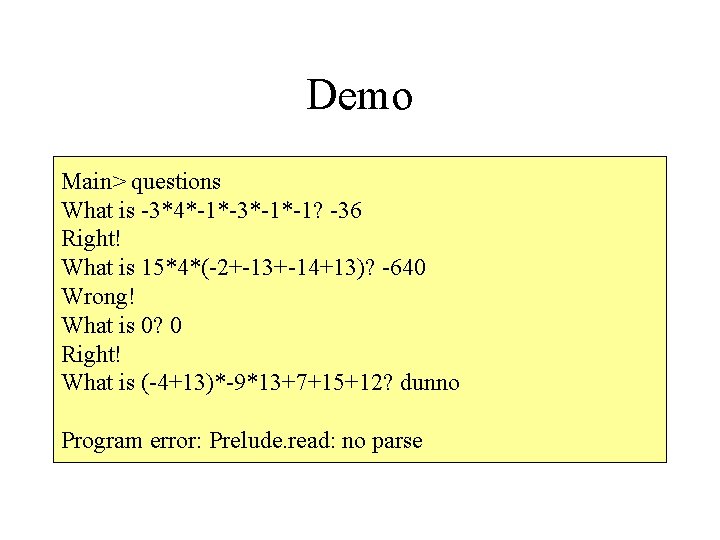
Demo Main> questions What is -3*4*-1*-3*-1*-1? -36 Right! What is 15*4*(-2+-13+-14+13)? -640 Wrong! What is 0? 0 Right! What is (-4+13)*-9*13+7+15+12? dunno Program error: Prelude. read: no parse
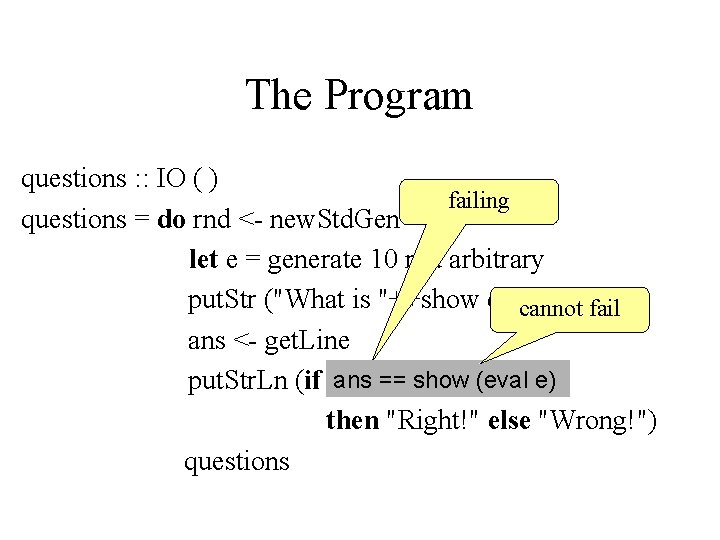
The Program questions : : IO ( ) failing questions = do rnd <- new. Std. Gen let e = generate 10 rnd arbitrary put. Str ("What is "++show e++"? ") fail cannot ans <- get. Line ans == show (eval put. Str. Ln (if read ans==eval e e) then "Right!" else "Wrong!") questions
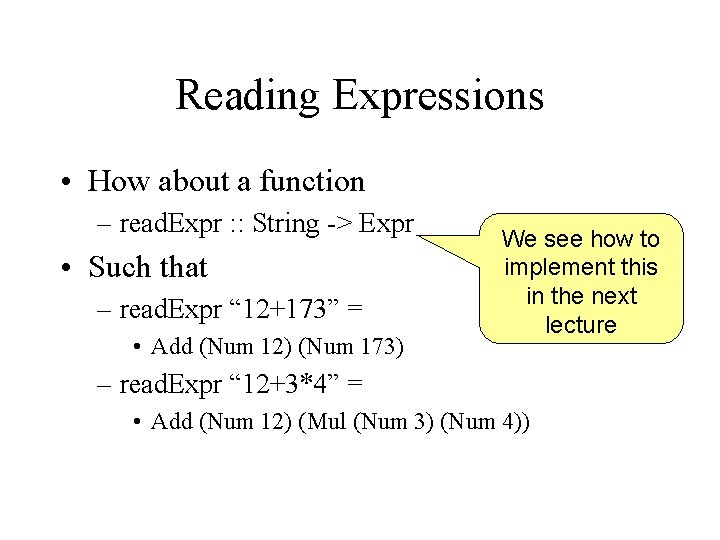
Reading Expressions • How about a function – read. Expr : : String -> Expr • Such that – read. Expr “ 12+173” = • Add (Num 12) (Num 173) We see how to implement this in the next lecture – read. Expr “ 12+3*4” = • Add (Num 12) (Mul (Num 3) (Num 4))
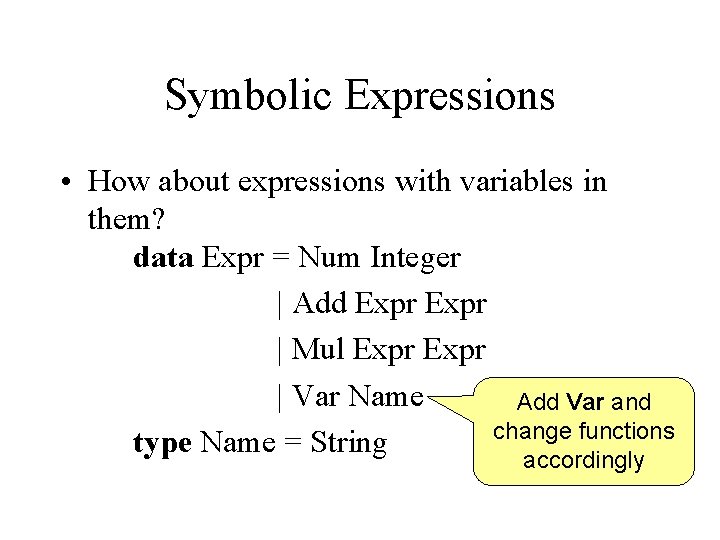
Symbolic Expressions • How about expressions with variables in them? data Expr = Num Integer | Add Expr | Mul Expr | Var Name Add Var and change functions type Name = String accordingly
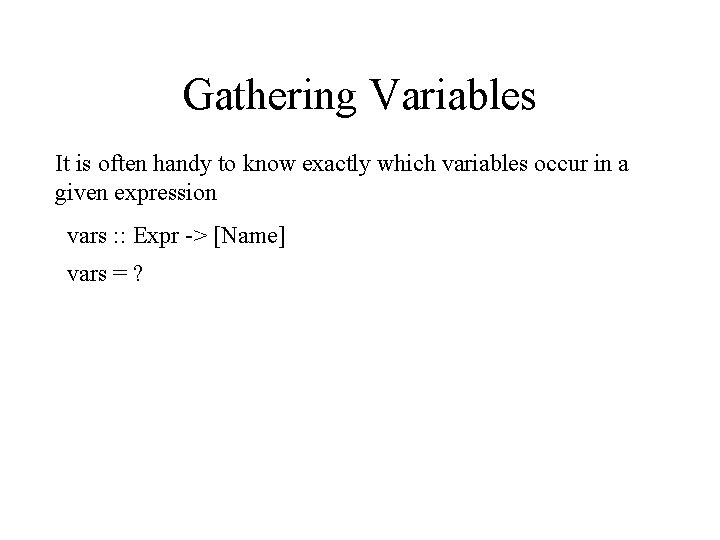
Gathering Variables It is often handy to know exactly which variables occur in a given expression vars : : Expr -> [Name] vars = ?
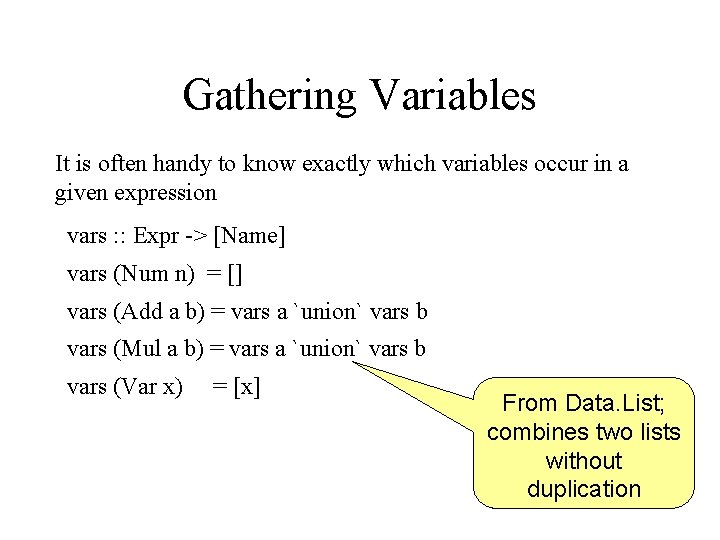
Gathering Variables It is often handy to know exactly which variables occur in a given expression vars : : Expr -> [Name] vars (Num n) = [] vars (Add a b) = vars a `union` vars b vars (Mul a b) = vars a `union` vars b vars (Var x) = [x] From Data. List; combines two lists without duplication
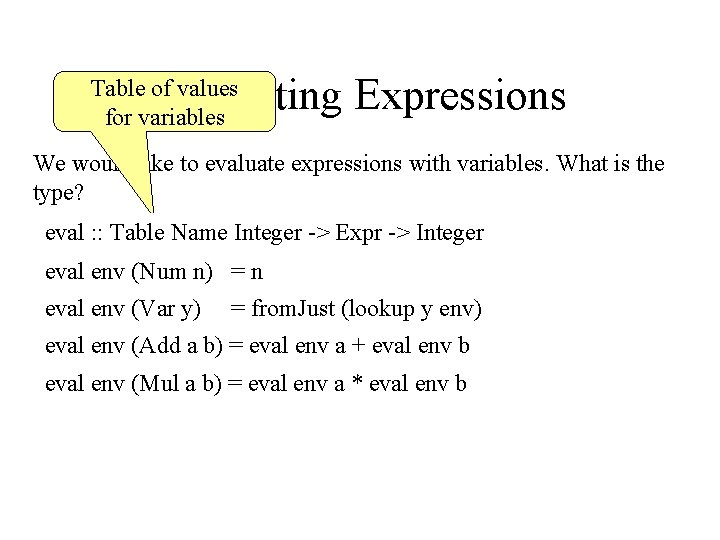
Evaluating Expressions Table of values for variables We would like to evaluate expressions with variables. What is the type? eval : : Table Name Int Expr -> ? Integer -> Expr -> Integer eval env (Num n) = n eval env (Var y) = from. Just (lookup y env) eval env (Add a b) = eval env a + eval env b eval env (Mul a b) = eval env a * eval env b
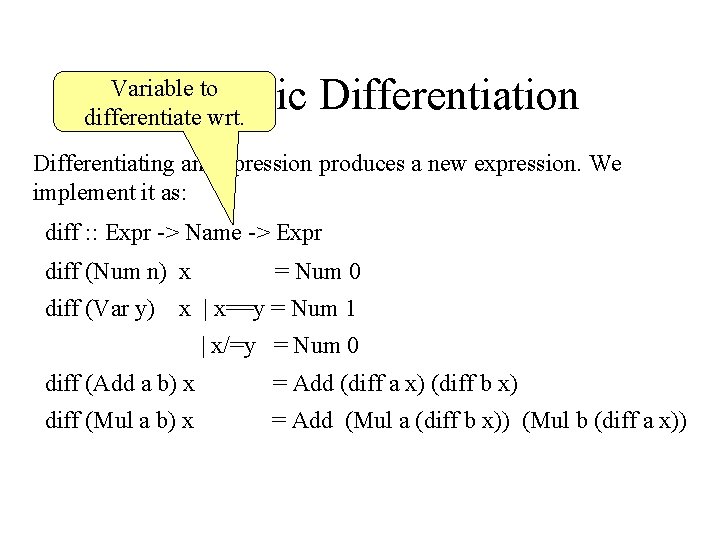
Symbolic Differentiation Variable to differentiate wrt. Differentiating an expression produces a new expression. We implement it as: diff : : Expr -> Name -> Expr diff (Num n) x diff (Var y) = Num 0 x | x==y = Num 1 | x/=y = Num 0 diff (Add a b) x = Add (diff a x) (diff b x) diff (Mul a b) x = Add (Mul a (diff b x)) (Mul b (diff a x))
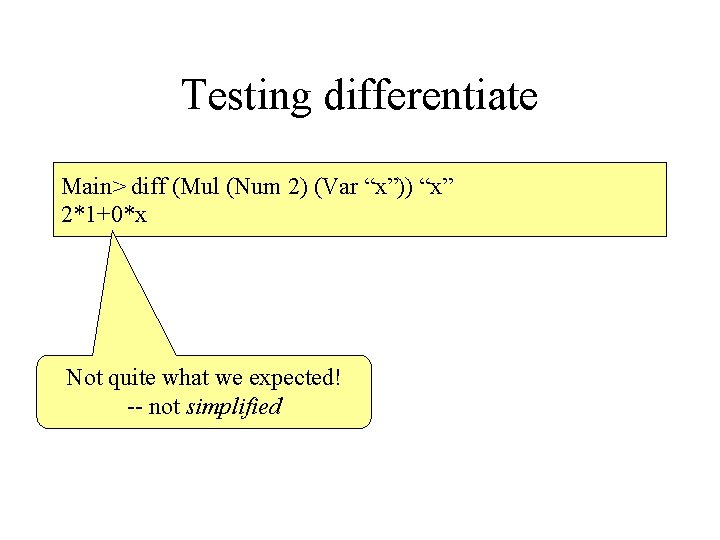
Testing differentiate Main> diff (Mul (Num 2) (Var “x”)) “x” 2*1+0*x Not quite what we expected! -- not simplified
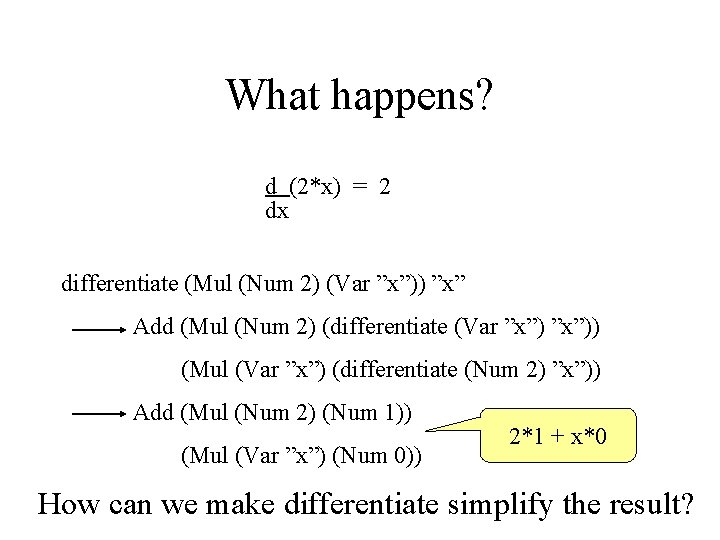
What happens? d (2*x) = 2 dx differentiate (Mul (Num 2) (Var ”x”)) ”x” Add (Mul (Num 2) (differentiate (Var ”x”)) (Mul (Var ”x”) (differentiate (Num 2) ”x”)) Add (Mul (Num 2) (Num 1)) (Mul (Var ”x”) (Num 0)) 2*1 + x*0 How can we make differentiate simplify the result?
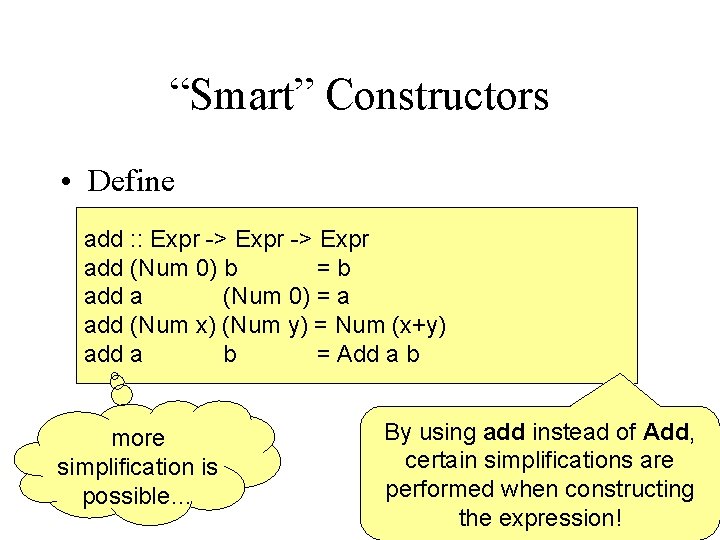
“Smart” Constructors • Define add : : Expr -> Expr add (Num 0) b =b add a (Num 0) = a add (Num x) (Num y) = Num (x+y) add a b = Add a b more simplification is possible… By using add instead of Add, certain simplifications are performed when constructing the expression!
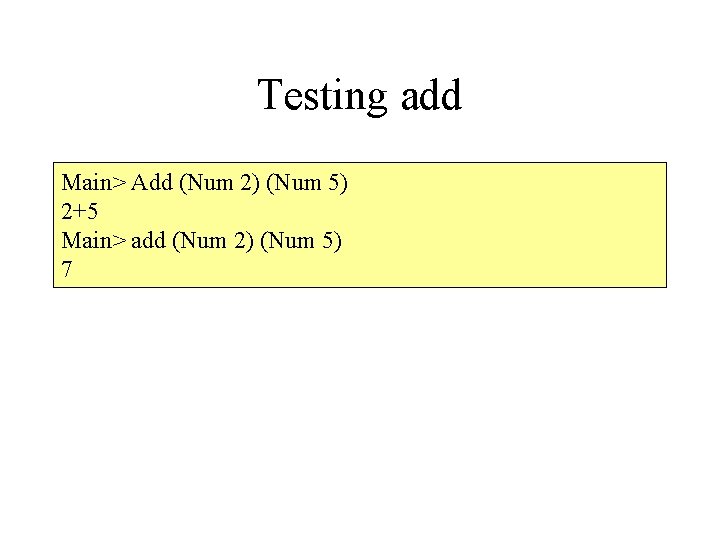
Testing add Main> Add (Num 2) (Num 5) 2+5 Main> add (Num 2) (Num 5) 7
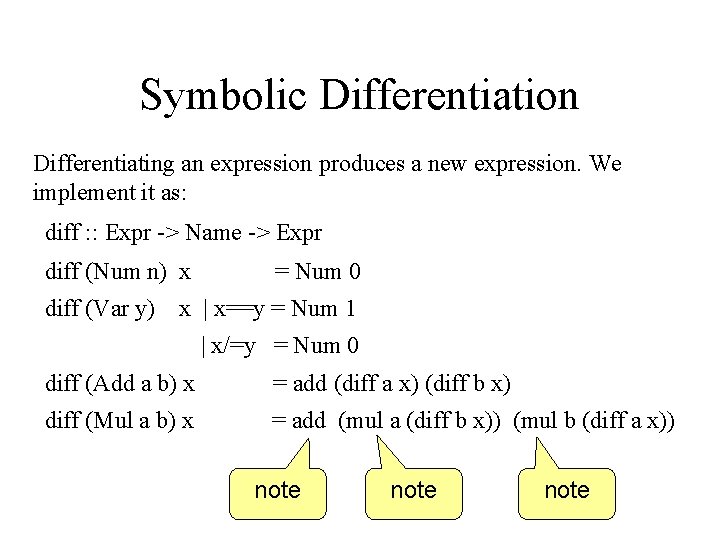
Symbolic Differentiation Differentiating an expression produces a new expression. We implement it as: diff : : Expr -> Name -> Expr diff (Num n) x diff (Var y) = Num 0 x | x==y = Num 1 | x/=y = Num 0 diff (Add a b) x = add (diff a x) (diff b x) diff (Mul a b) x = add (mul a (diff b x)) (mul b (diff a x)) note
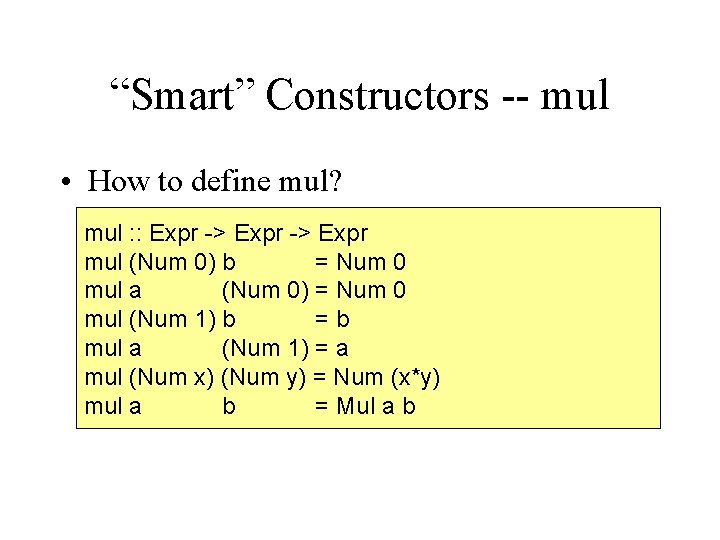
“Smart” Constructors -- mul • How to define mul? mul : : Expr -> Expr mul (Num 0) b = Num 0 mul a (Num 0) = Num 0 mul (Num 1) b =b mul a (Num 1) = a mul (Num x) (Num y) = Num (x*y) mul a b = Mul a b
Expressions • Expr as a datatype can represent expressions – Unsimplified – Simplified – Results – Data presented to the user • Need to be able to convert between these
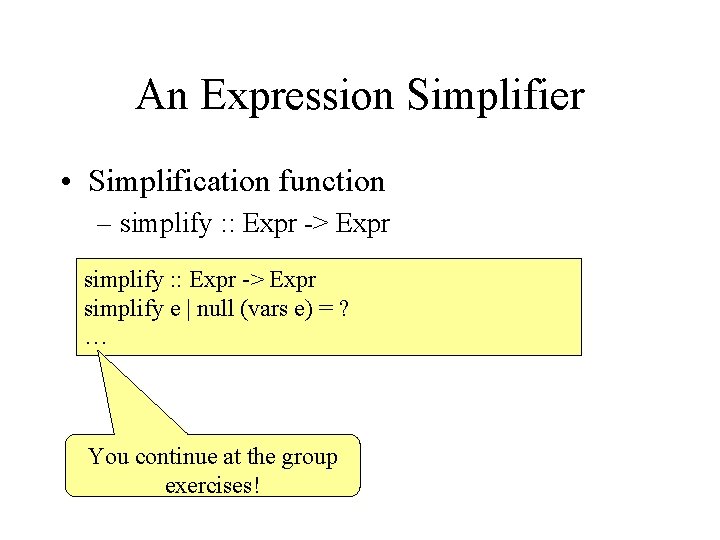
An Expression Simplifier • Simplification function – simplify : : Expr -> Expr simplify e | null (vars e) = ? … You continue at the group exercises!
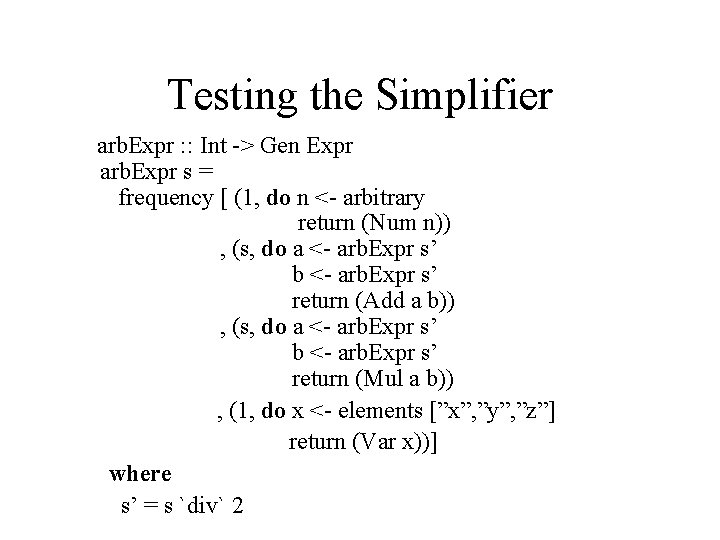
Testing the Simplifier arb. Expr : : Int -> Gen Expr arb. Expr s = frequency [ (1, do n <- arbitrary return (Num n)) , (s, do a <- arb. Expr s’ b <- arb. Expr s’ return (Add a b)) , (s, do a <- arb. Expr s’ b <- arb. Expr s’ return (Mul a b)) , (1, do x <- elements [”x”, ”y”, ”z”] return (Var x))] where s’ = s `div` 2
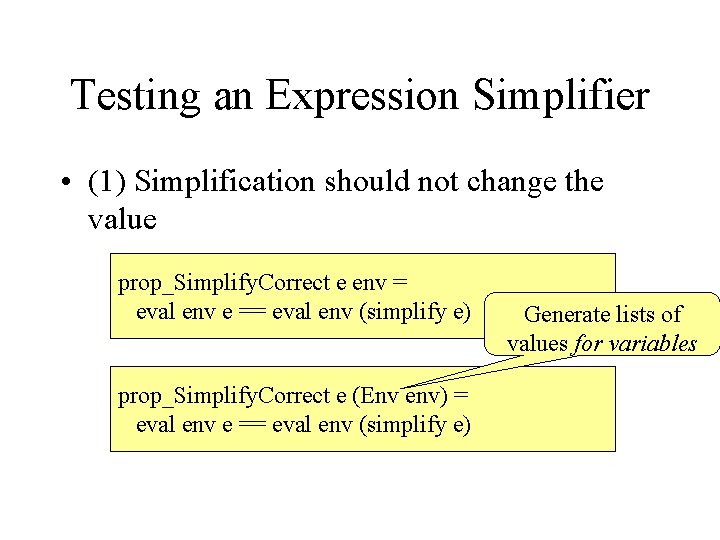
Testing an Expression Simplifier • (1) Simplification should not change the value prop_Simplify. Correct e env = eval env e == eval env (simplify e) prop_Simplify. Correct e (Env env) = eval env e == eval env (simplify e) Generate lists of values for variables
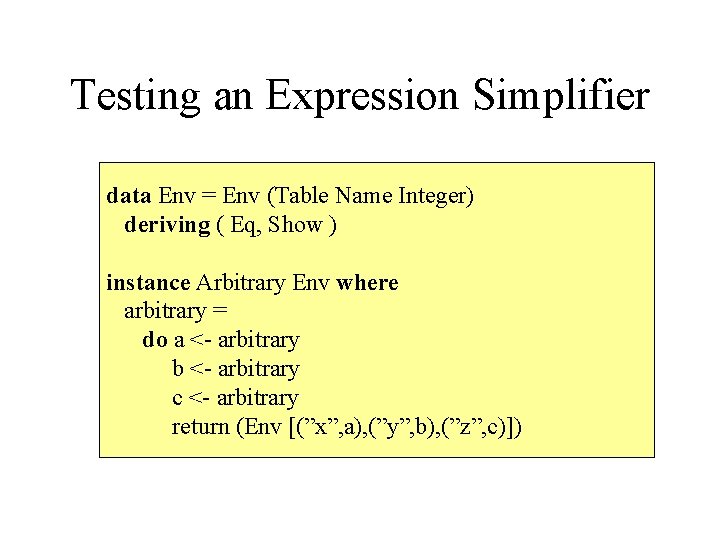
Testing an Expression Simplifier data Env = Env (Table Name Integer) deriving ( Eq, Show ) instance Arbitrary Env where arbitrary = do a <- arbitrary b <- arbitrary c <- arbitrary return (Env [(”x”, a), (”y”, b), (”z”, c)])
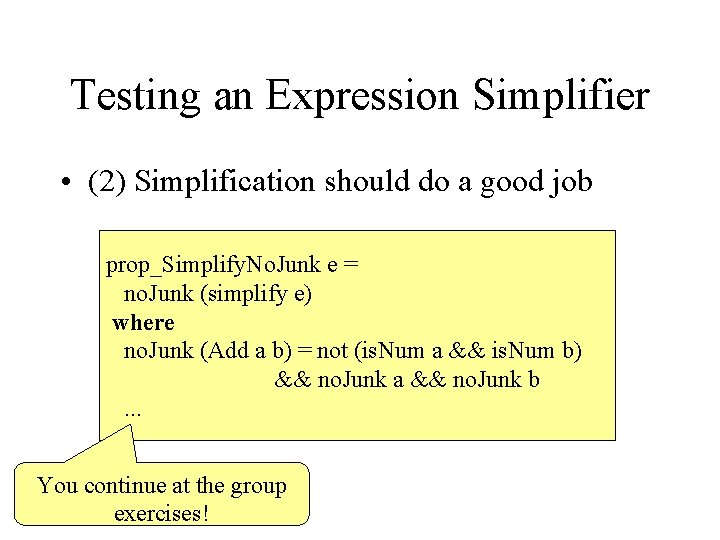
Testing an Expression Simplifier • (2) Simplification should do a good job prop_Simplify. No. Junk e = no. Junk (simplify e) where no. Junk (Add a b) = not (is. Num a && is. Num b) && no. Junk a && no. Junk b. . . You continue at the group exercises!
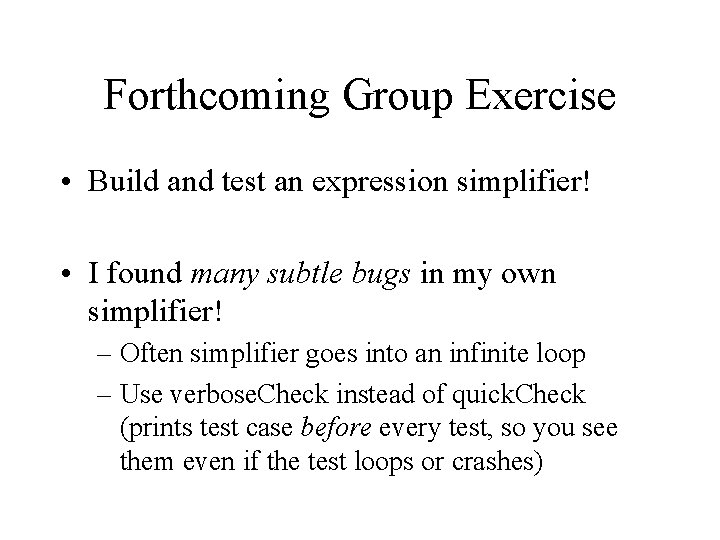
Forthcoming Group Exercise • Build and test an expression simplifier! • I found many subtle bugs in my own simplifier! – Often simplifier goes into an infinite loop – Use verbose. Check instead of quick. Check (prints test case before every test, so you see them even if the test loops or crashes)
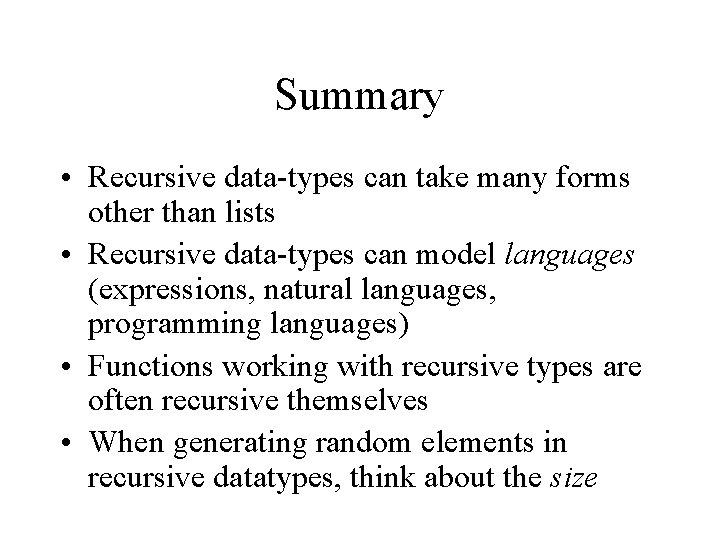
Summary • Recursive data-types can take many forms other than lists • Recursive data-types can model languages (expressions, natural languages, programming languages) • Functions working with recursive types are often recursive themselves • When generating random elements in recursive datatypes, think about the size
Next Time • How to write parsers – read. Expr : : String -> Expr • Case study: example of other recursive datatype – a simple game: ”the zoo” – guessing animals using yes/no questions