
Recursive 1 Introduction Repetitive algorithm is a process
- Slides: 27
Recursive 1
Introduction • Repetitive algorithm is a process wherby a sequence of operations is executed repeatedly until certain condition is achieved. • Repetition can be implemented using loop : while, for or do. . while. • Besides repetition using loop, C++ allow programmers to implement recursive. • Recursive is a repetitive process in which an algorithm calls itself.
introduction • Recursion can be used to replace loops. • Recursively defined data structures, like lists, are very well-suited to processing by recursive procedures and functions • A recursive procedure is mathematically more elegant than one using loops. • Sometimes procedures that would be tricky to write using a loop are straightforward using recursion.
introduction • Drawback : Execution running time for recursive function is not efficient compared to loop, since every time a recursive function calls itself, it requires multiple memory to store the internal address of the function
introduction • Not all problem can be solved using recursive. • Problem that can be solved using recursive is a problem that can be solved by breaking the problem into smaller instances of problem, solve & combine
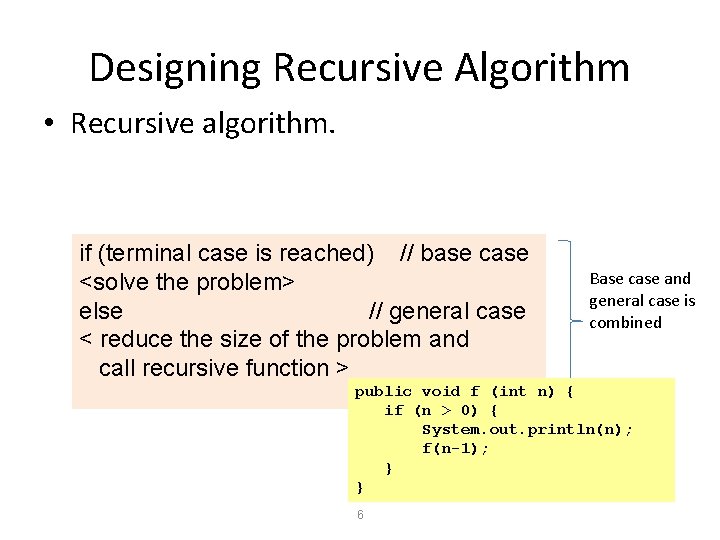
Designing Recursive Algorithm • Recursive algorithm. if (terminal case is reached) // base case <solve the problem> else // general case < reduce the size of the problem and call recursive function > Base case and general case is combined public void f (int n) { if (n > 0) { System. out. println(n); f(n-1); } } 6
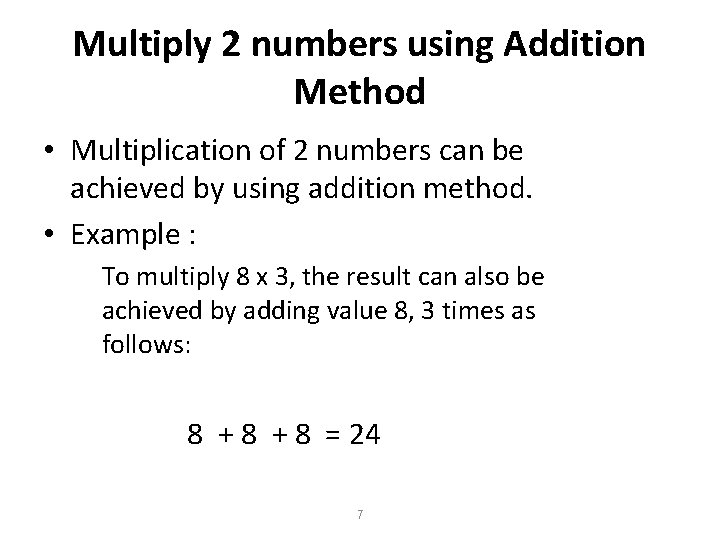
Multiply 2 numbers using Addition Method • Multiplication of 2 numbers can be achieved by using addition method. • Example : To multiply 8 x 3, the result can also be achieved by adding value 8, 3 times as follows: 8 + 8 = 24 7
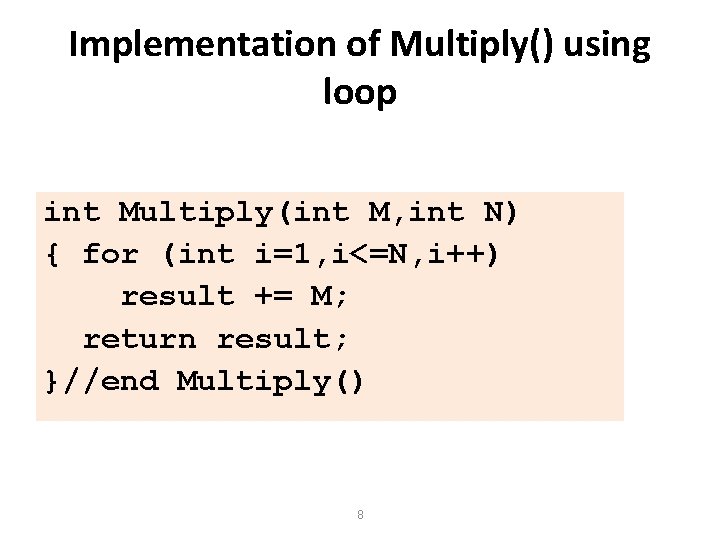
Implementation of Multiply() using loop int Multiply(int M, int N) { for (int i=1, i<=N, i++) result += M; return result; }//end Multiply() 8
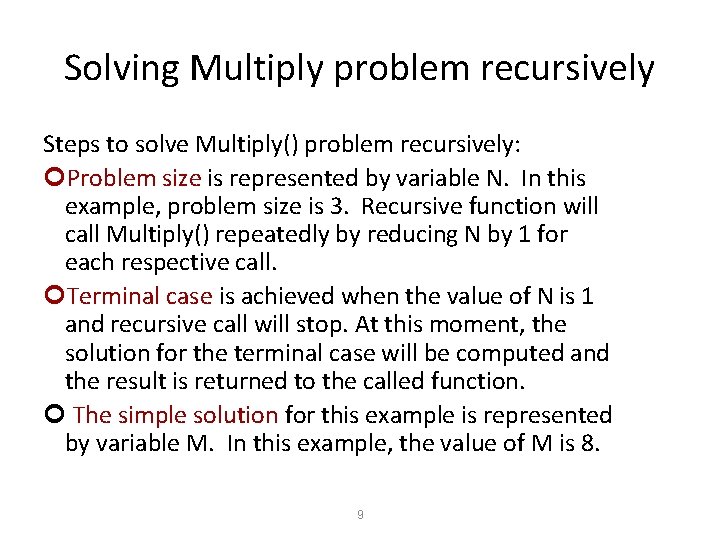
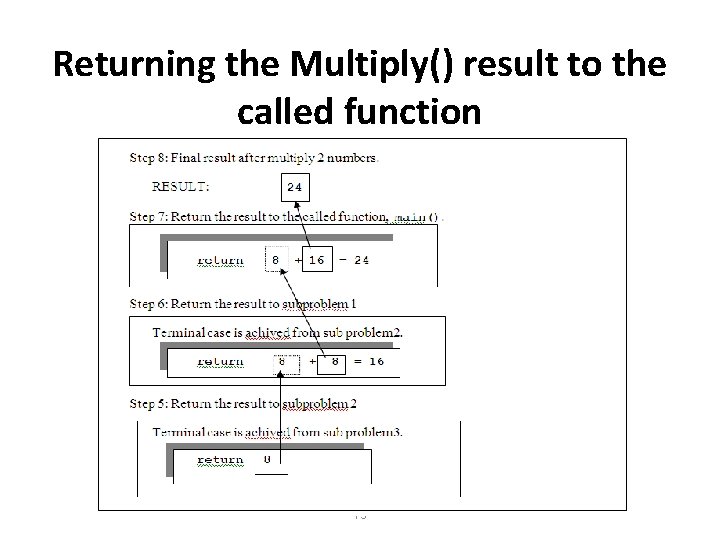
Solving Multiply problem recursively Steps to solve Multiply() problem recursively: Problem size is represented by variable N. In this example, problem size is 3. Recursive function will call Multiply() repeatedly by reducing N by 1 for each respective call. Terminal case is achieved when the value of N is 1 and recursive call will stop. At this moment, the solution for the terminal case will be computed and the result is returned to the called function. The simple solution for this example is represented by variable M. In this example, the value of M is 8. 9
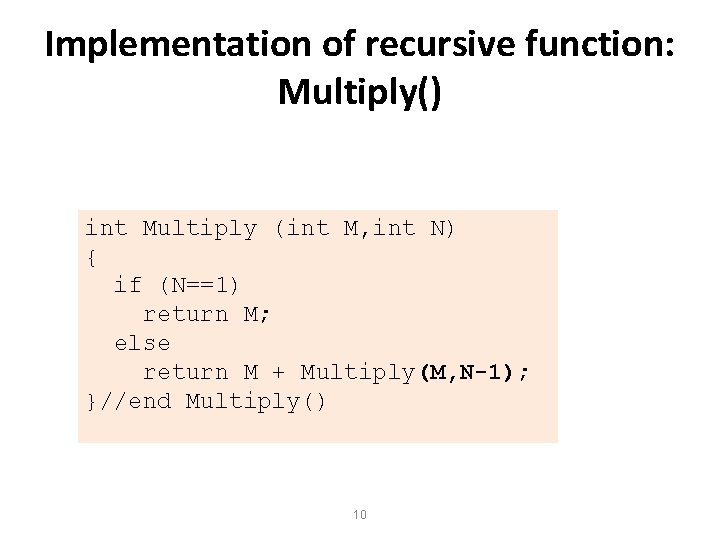
Implementation of recursive function: Multiply() int Multiply (int M, int N) { if (N==1) return M; else return M + Multiply(M, N-1); }//end Multiply() 10
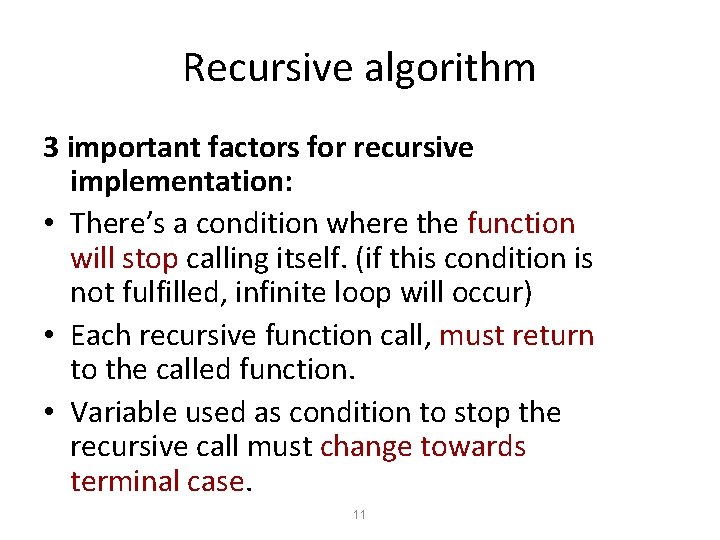
Recursive algorithm 3 important factors for recursive implementation: • There’s a condition where the function will stop calling itself. (if this condition is not fulfilled, infinite loop will occur) • Each recursive function call, must return to the called function. • Variable used as condition to stop the recursive call must change towards terminal case. 11
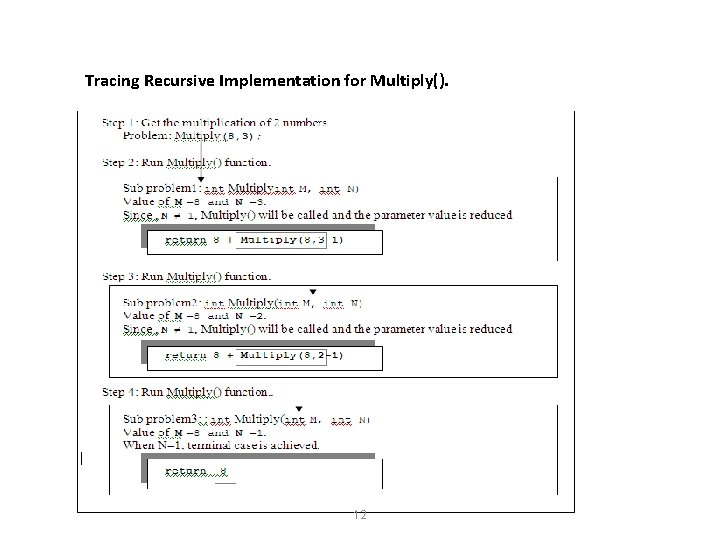
Tracing Recursive Implementation for Multiply(). 12
Returning the Multiply() result to the called function 13
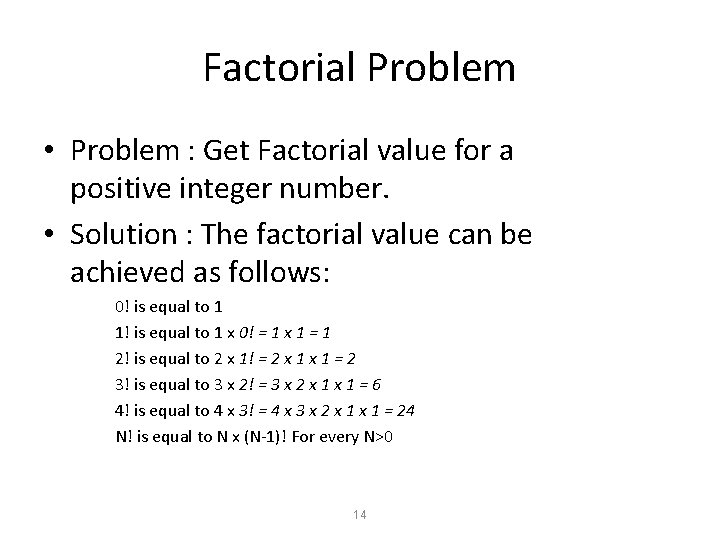
Factorial Problem • Problem : Get Factorial value for a positive integer number. • Solution : The factorial value can be achieved as follows: 0! is equal to 1 1! is equal to 1 x 0! = 1 x 1 = 1 2! is equal to 2 x 1! = 2 x 1 = 2 3! is equal to 3 x 2! = 3 x 2 x 1 = 6 4! is equal to 4 x 3! = 4 x 3 x 2 x 1 = 24 N! is equal to N x (N-1)! For every N>0 14
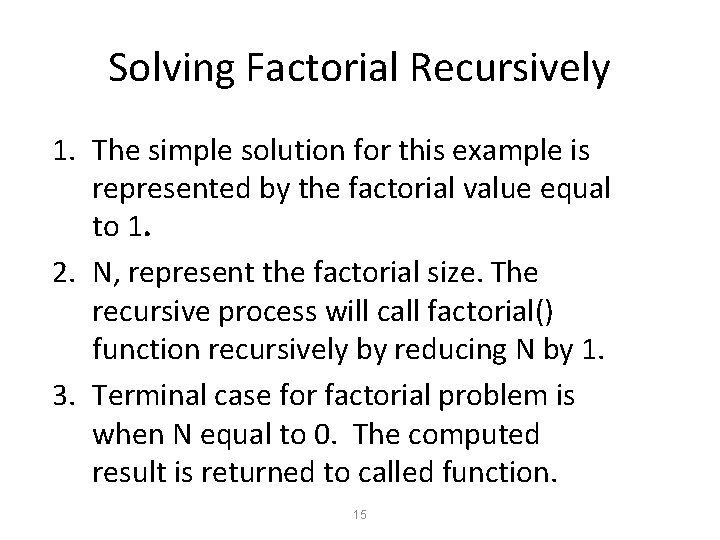
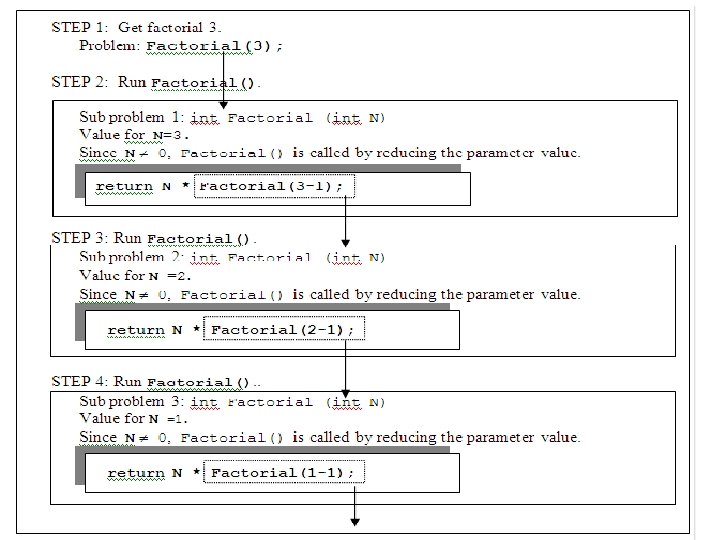
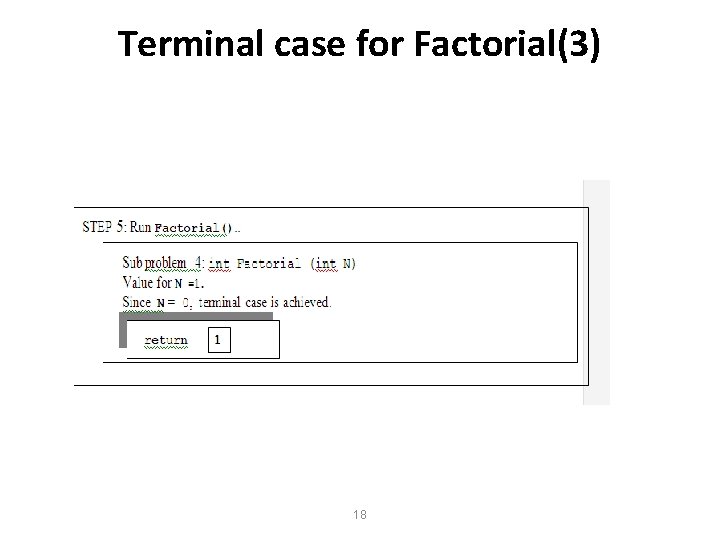
Solving Factorial Recursively 1. The simple solution for this example is represented by the factorial value equal to 1. 2. N, represent the factorial size. The recursive process will call factorial() function recursively by reducing N by 1. 3. Terminal case for factorial problem is when N equal to 0. The computed result is returned to called function. 15
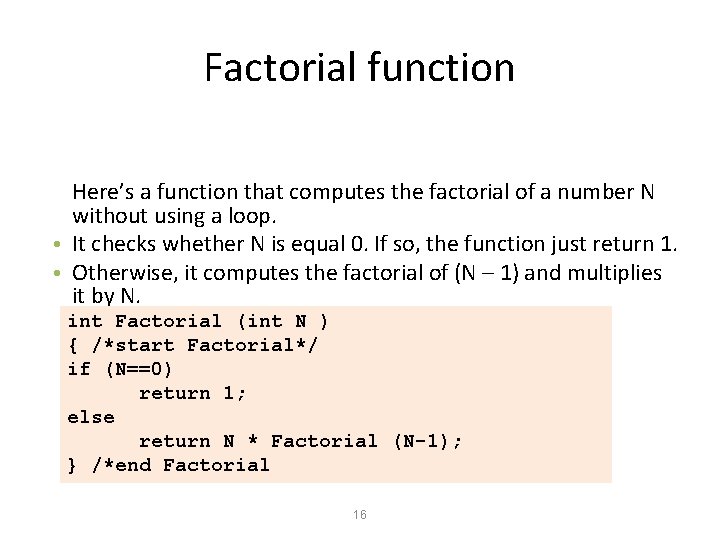
Factorial function Here’s a function that computes the factorial of a number N without using a loop. • It checks whether N is equal 0. If so, the function just return 1. • Otherwise, it computes the factorial of (N – 1) and multiplies it by N. int Factorial (int N ) { /*start Factorial*/ if (N==0) return 1; else return N * Factorial (N-1); } /*end Factorial 16
17 Dr. Aysh Alhroob
Terminal case for Factorial(3) 18
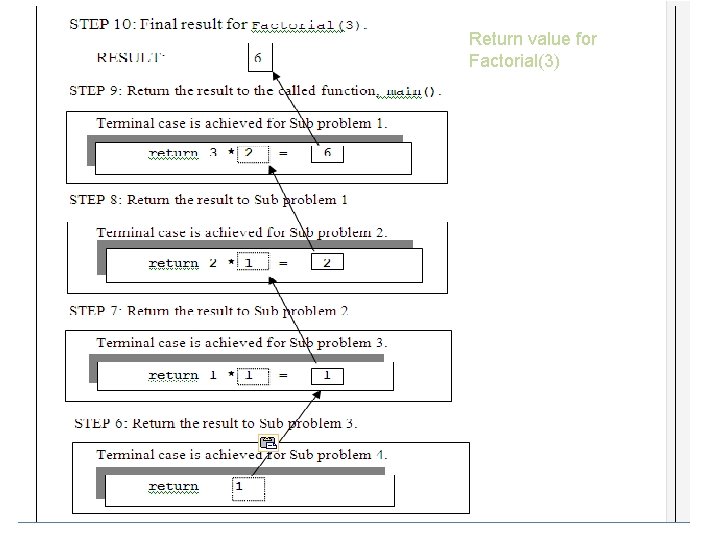
Return value for Factorial(3) 19 Dr. Aysh Alhroob
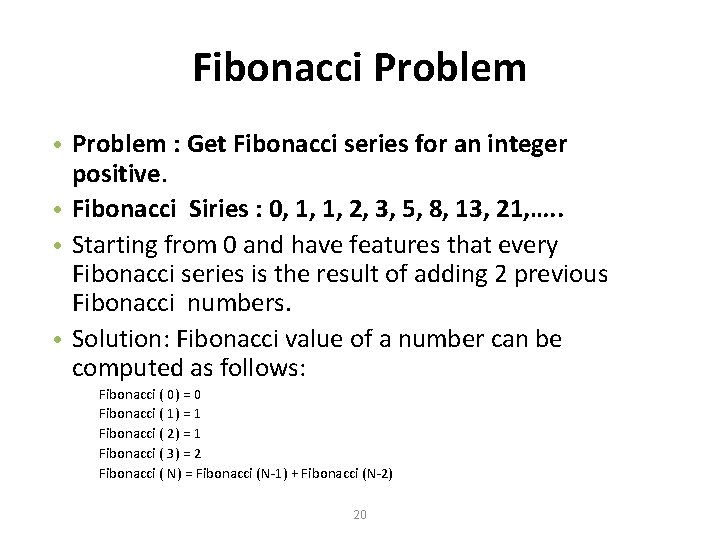
Fibonacci Problem • Problem : Get Fibonacci series for an integer positive. • Fibonacci Siries : 0, 1, 1, 2, 3, 5, 8, 13, 21, …. . • Starting from 0 and have features that every Fibonacci series is the result of adding 2 previous Fibonacci numbers. • Solution: Fibonacci value of a number can be computed as follows: Fibonacci ( 0) = 0 Fibonacci ( 1) = 1 Fibonacci ( 2) = 1 Fibonacci ( 3) = 2 Fibonacci ( N) = Fibonacci (N-1) + Fibonacci (N-2) 20
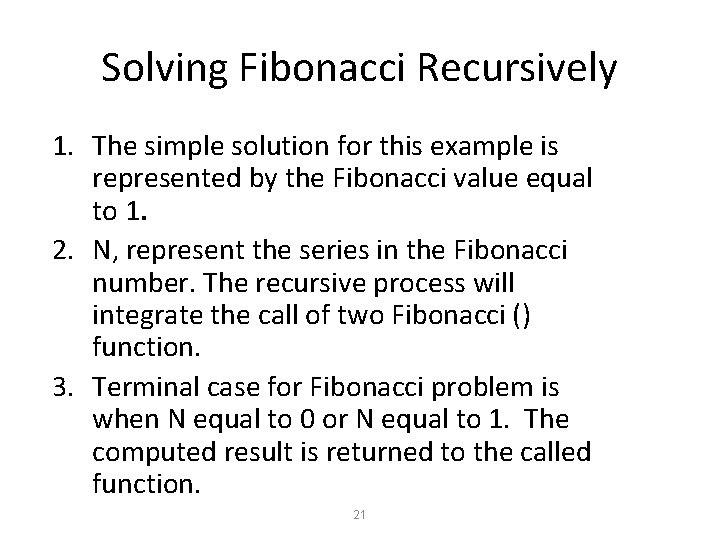
Solving Fibonacci Recursively 1. The simple solution for this example is represented by the Fibonacci value equal to 1. 2. N, represent the series in the Fibonacci number. The recursive process will integrate the call of two Fibonacci () function. 3. Terminal case for Fibonacci problem is when N equal to 0 or N equal to 1. The computed result is returned to the called function. 21
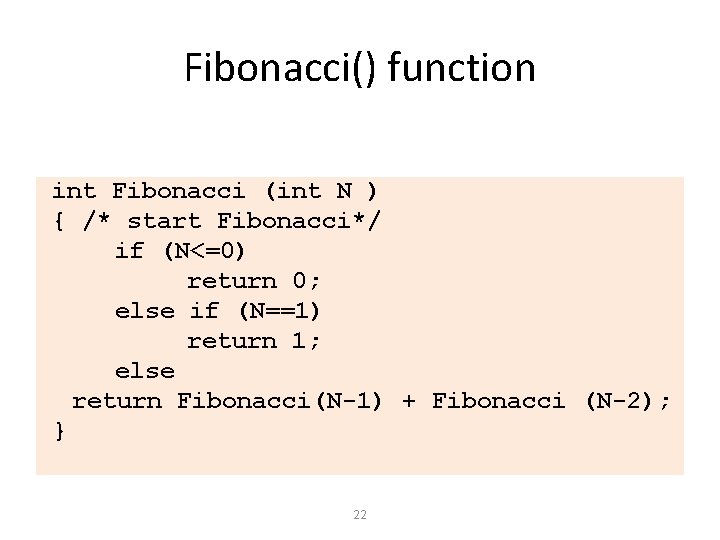
Fibonacci() function int Fibonacci (int N ) { /* start Fibonacci*/ if (N<=0) return 0; else if (N==1) return 1; else return Fibonacci(N-1) + Fibonacci (N-2); } 22
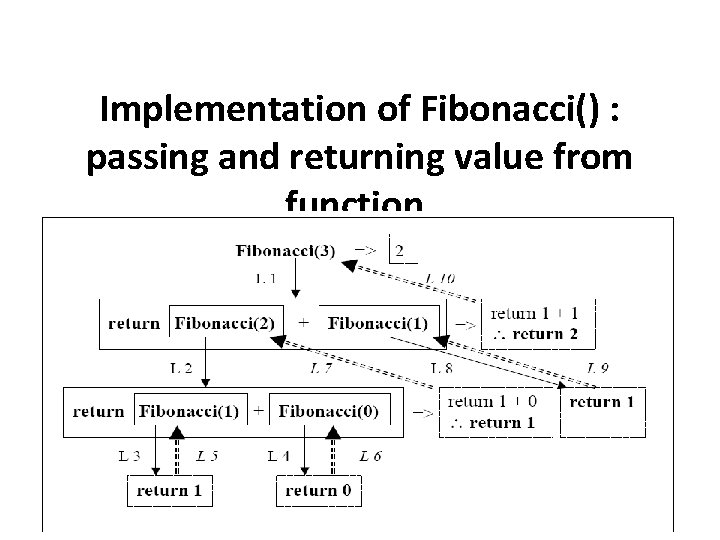
Implementation of Fibonacci() : passing and returning value from function. 23 Dr. Aysh Alhroob
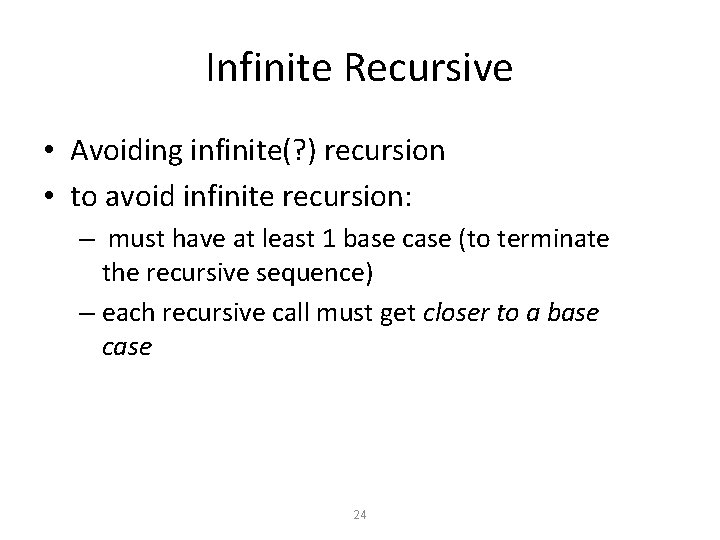
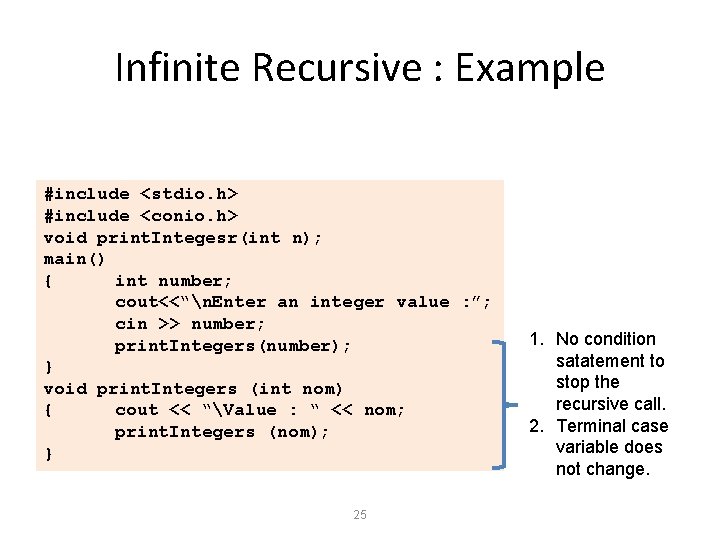
Infinite Recursive • Avoiding infinite(? ) recursion • to avoid infinite recursion: – must have at least 1 base case (to terminate the recursive sequence) – each recursive call must get closer to a base case 24
Infinite Recursive : Example #include <stdio. h> #include <conio. h> void print. Integesr(int n); main() { int number; cout<<“n. Enter an integer value : ”; cin >> number; print. Integers(number); } void print. Integers (int nom) { cout << “Value : “ << nom; print. Integers (nom); } 25 1. No condition satatement to stop the recursive call. 2. Terminal case variable does not change.
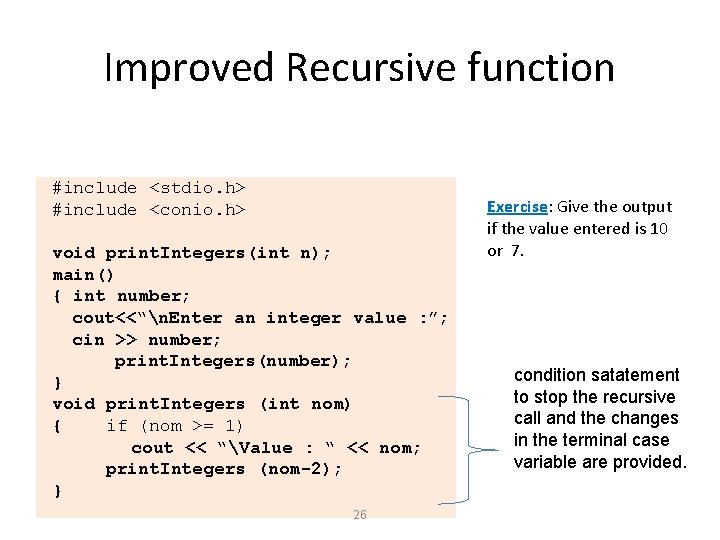
Improved Recursive function #include <stdio. h> #include <conio. h> void print. Integers(int n); main() { int number; cout<<“n. Enter an integer value : ”; cin >> number; print. Integers(number); } void print. Integers (int nom) { if (nom >= 1) cout << “Value : “ << nom; print. Integers (nom-2); } 26 Exercise: Give the output if the value entered is 10 or 7. condition satatement to stop the recursive call and the changes in the terminal case variable are provided.
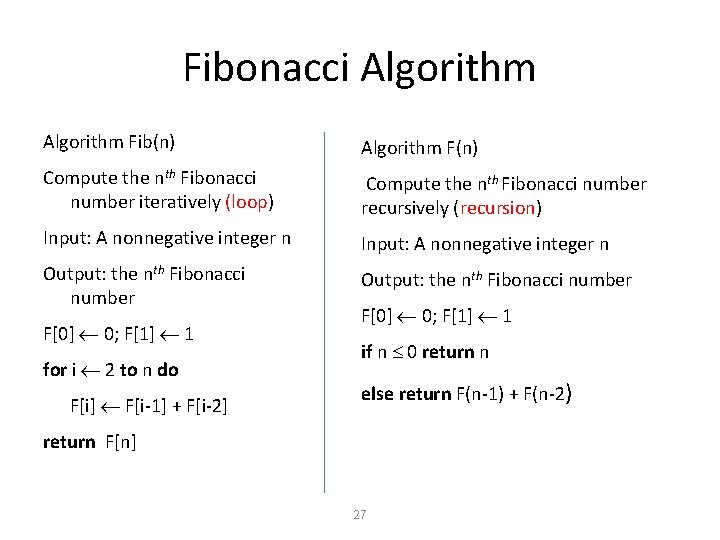
Fibonacci Algorithm Fib(n) Algorithm F(n) Compute the nth Fibonacci number iteratively (loop) Compute the nth Fibonacci number recursively (recursion) Input: A nonnegative integer n Output: the nth Fibonacci number F[0] 0; F[1] 1 for i 2 to n do F[i] F[i-1] + F[i-2] F[0] 0; F[1] 1 if n 0 return n else return F(n-1) + F(n-2) return F[n] 27