
Recursion What Does this Program Do void func

- Slides: 29
Recursion
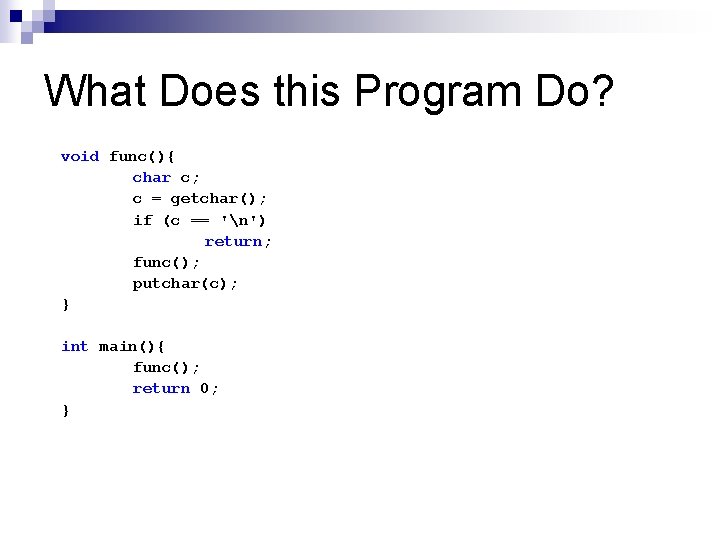
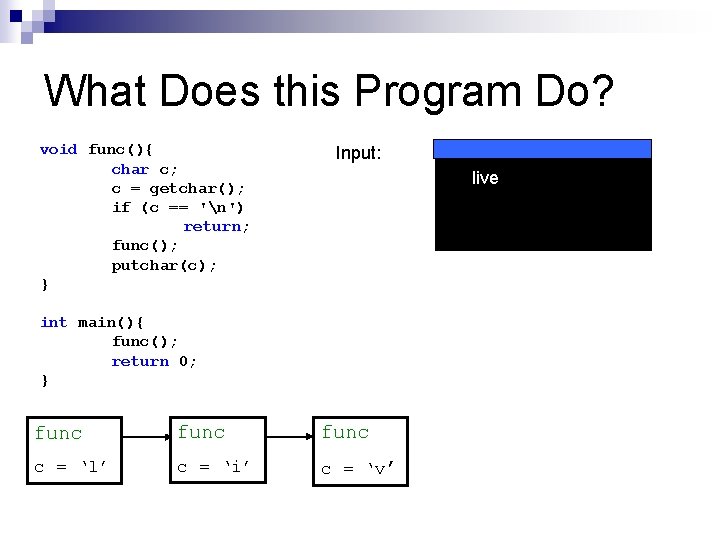
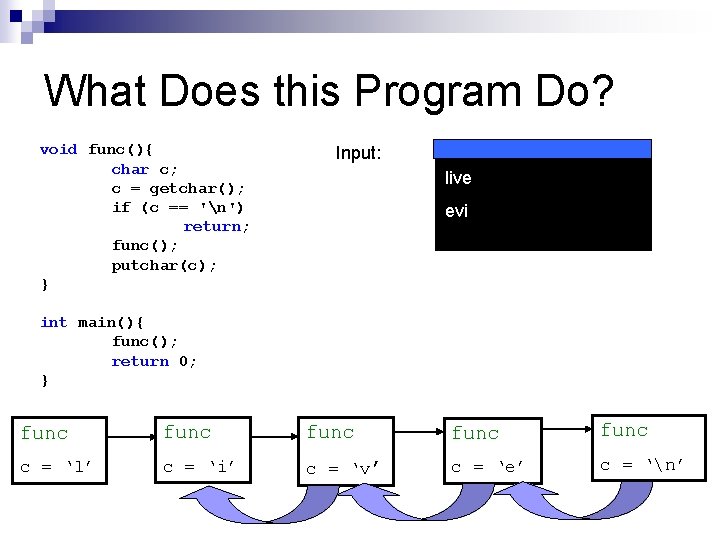
What Does this Program Do? void func(){ char c; c = getchar(); if (c == 'n') return; func(); putchar(c); } int main(){ func(); return 0; }
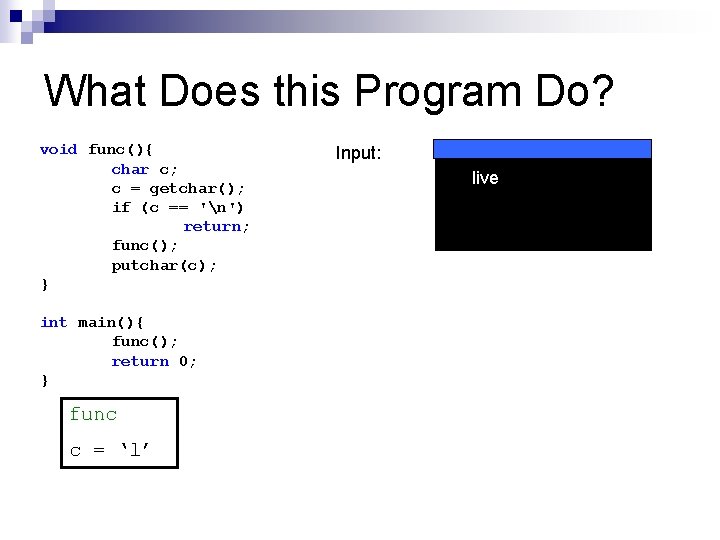
What Does this Program Do? void func(){ char c; c = getchar(); if (c == 'n') return; func(); putchar(c); } int main(){ func(); return 0; } func c = ‘l’ Input: live
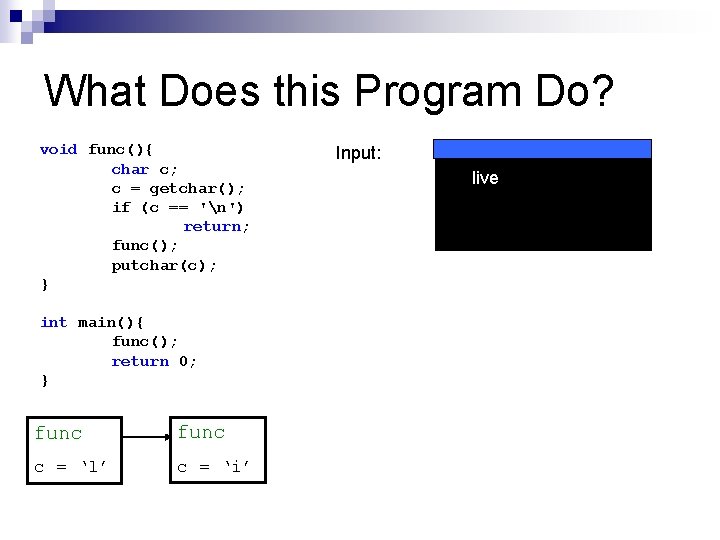
What Does this Program Do? void func(){ char c; c = getchar(); if (c == 'n') return; func(); putchar(c); } int main(){ func(); return 0; } func c = ‘l’ c = ‘i’ Input: live
What Does this Program Do? void func(){ char c; c = getchar(); if (c == 'n') return; func(); putchar(c); } Input: live int main(){ func(); return 0; } func c = ‘l’ c = ‘i’ c = ‘v’
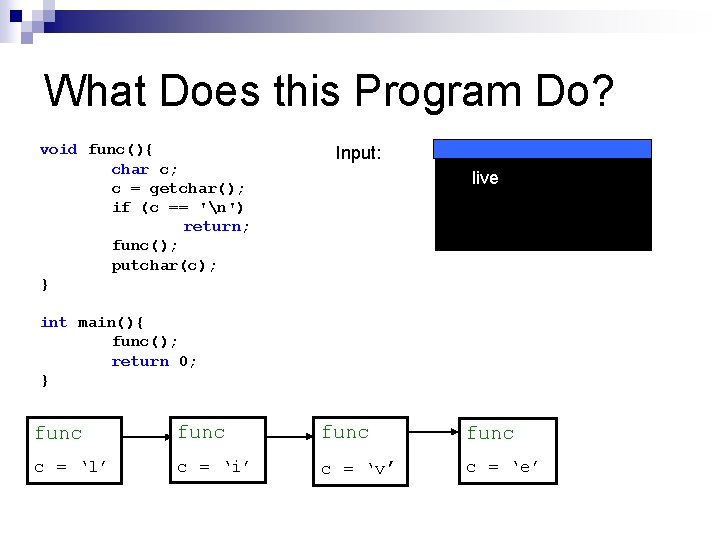
What Does this Program Do? void func(){ char c; c = getchar(); if (c == 'n') return; func(); putchar(c); } Input: live int main(){ func(); return 0; } func c = ‘l’ c = ‘i’ c = ‘v’ c = ‘e’
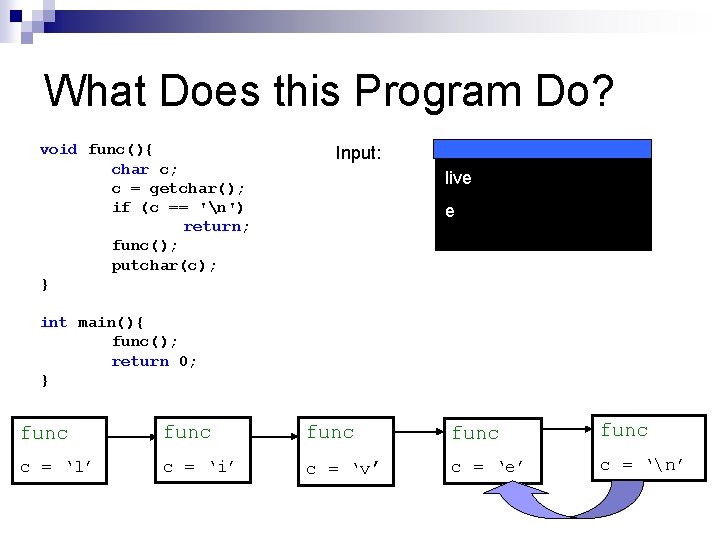
What Does this Program Do? void func(){ char c; c = getchar(); if (c == 'n') return; func(); putchar(c); } Input: live e int main(){ func(); return 0; } func func c = ‘l’ c = ‘i’ c = ‘v’ c = ‘e’ c = ‘n’
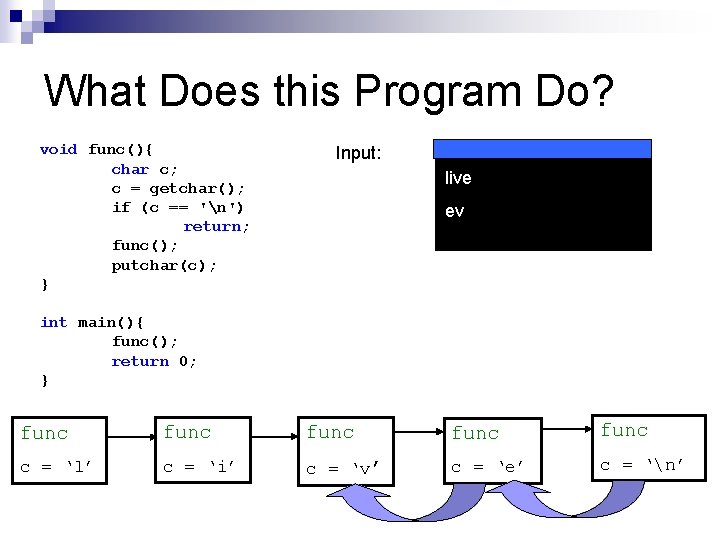
What Does this Program Do? void func(){ char c; c = getchar(); if (c == 'n') return; func(); putchar(c); } Input: live ev int main(){ func(); return 0; } func func c = ‘l’ c = ‘i’ c = ‘v’ c = ‘e’ c = ‘n’
What Does this Program Do? void func(){ char c; c = getchar(); if (c == 'n') return; func(); putchar(c); } Input: live evi int main(){ func(); return 0; } func func c = ‘l’ c = ‘i’ c = ‘v’ c = ‘e’ c = ‘n’
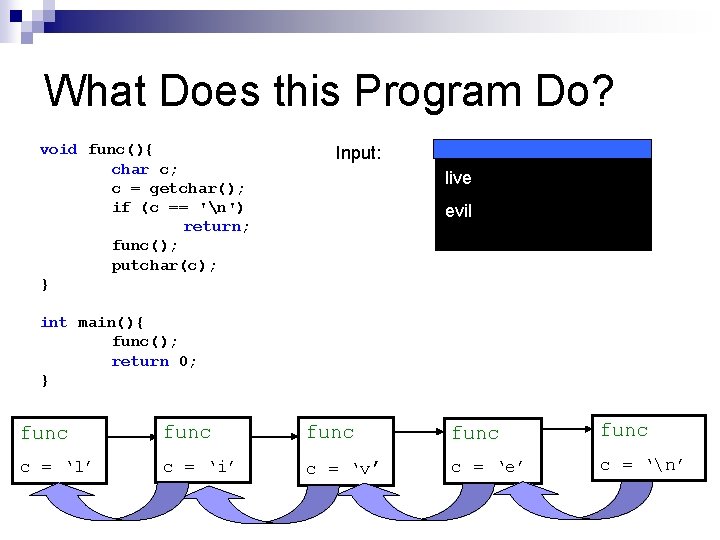
What Does this Program Do? void func(){ char c; c = getchar(); if (c == 'n') return; func(); putchar(c); } Input: live evil int main(){ func(); return 0; } func func c = ‘l’ c = ‘i’ c = ‘v’ c = ‘e’ c = ‘n’
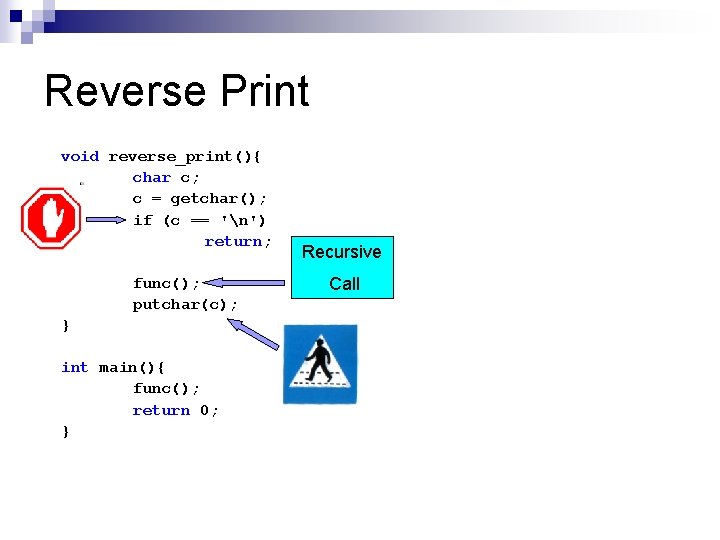
Reverse Print void reverse_print(){ char c; c = getchar(); if (c == 'n') return; func(); putchar(c); } int main(){ func(); return 0; } Recursive Call
Exercise Write a program that receives an integer and returns its sum of digits. n We do not know the number of digits in advance. n Example: the sum of digits of 369 is 18. n Before we begin, let us recall the recursion “rules”. n
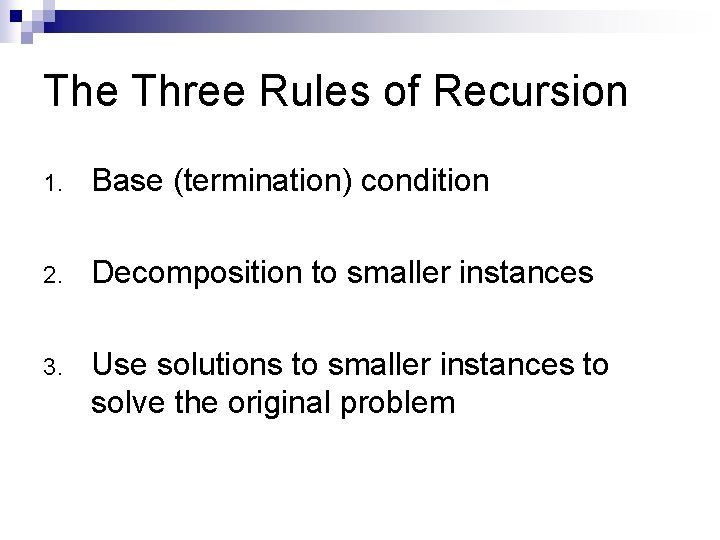
The Three Rules of Recursion 1. Base (termination) condition 2. Decomposition to smaller instances 3. Use solutions to smaller instances to solve the original problem
Solution sum_digits. c
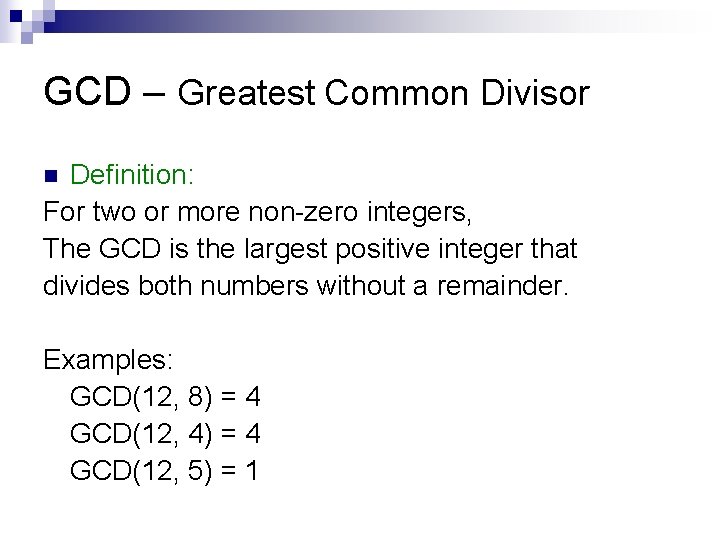
GCD – Greatest Common Divisor Definition: For two or more non-zero integers, The GCD is the largest positive integer that divides both numbers without a remainder. n Examples: GCD(12, 8) = 4 GCD(12, 4) = 4 GCD(12, 5) = 1
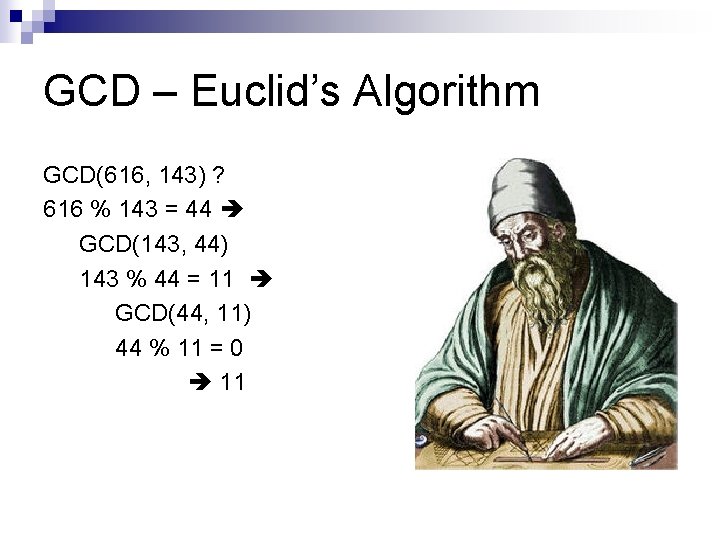
GCD – Euclid’s Algorithm GCD(616, 143) ? 616 % 143 = 44 GCD(143, 44) 143 % 44 = 11 GCD(44, 11) 44 % 11 = 0 11
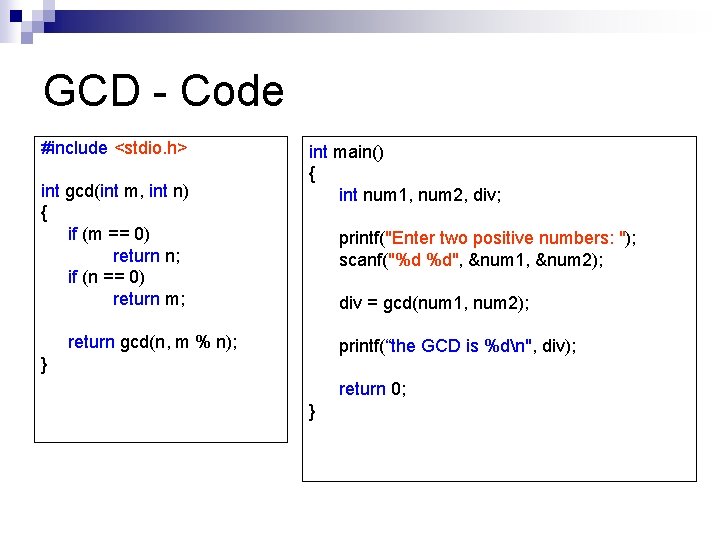
GCD - Code #include <stdio. h> int gcd(int m, int n) { if (m == 0) return n; if (n == 0) return m; return gcd(n, m % n); } int main() { int num 1, num 2, div; printf("Enter two positive numbers: "); scanf("%d %d", &num 1, &num 2); div = gcd(num 1, num 2); printf(“the GCD is %dn", div); return 0; }
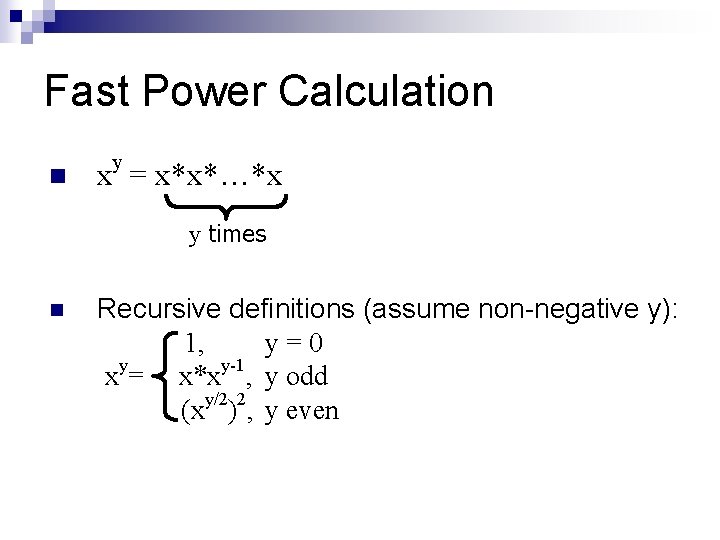
Fast Power Calculation n y x = x*x*…*x y times n Recursive definitions (assume non-negative y): 1, y=0 y y-1 x = x*x , y odd (xy/2)2, y even
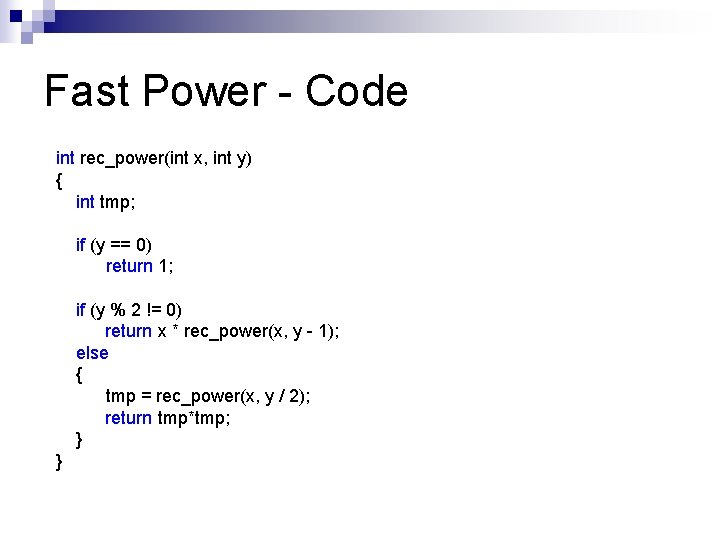
Fast Power - Code int rec_power(int x, int y) { int tmp; if (y == 0) return 1; if (y % 2 != 0) return x * rec_power(x, y - 1); else { tmp = rec_power(x, y / 2); return tmp*tmp; } }
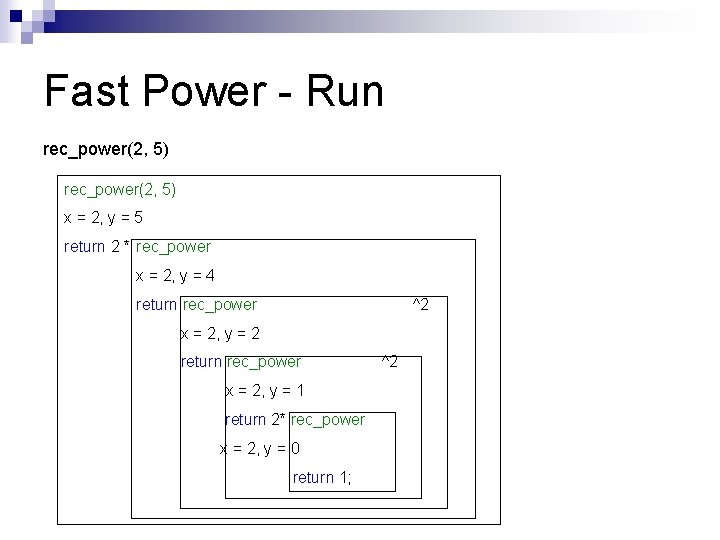
Fast Power - Run rec_power(2, 5) x = 2, y = 5 return 2 * rec_power x = 2, y = 4 return rec_power ^2 x = 2, y = 2 return rec_power ^2 x = 2, y = 1 return 2* rec_power x = 2, y = 0 return 1;
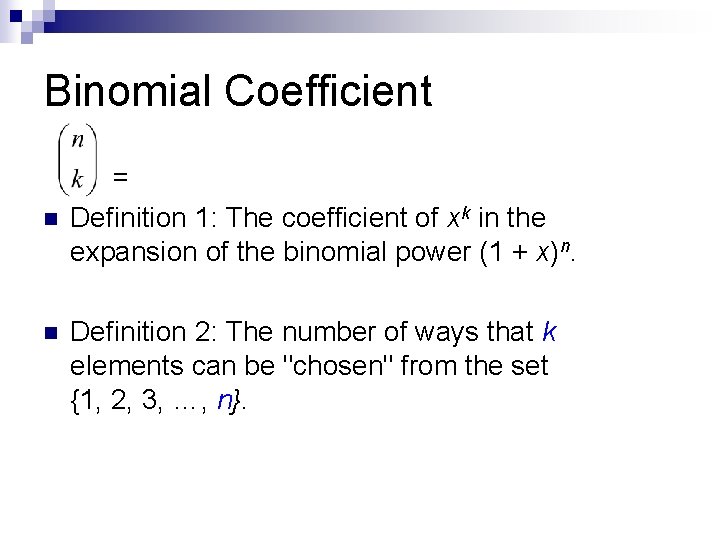
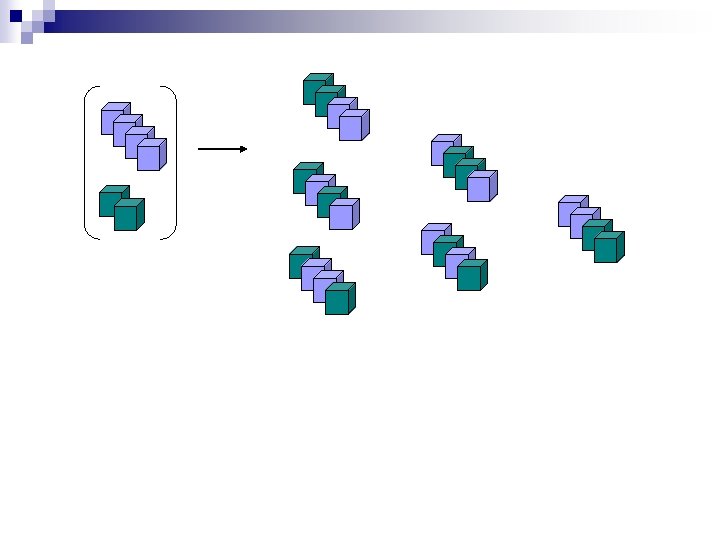
Binomial Coefficient = n Definition 1: The coefficient of xk in the expansion of the binomial power (1 + x)n. n Definition 2: The number of ways that k elements can be "chosen" from the set {1, 2, 3, …, n}.
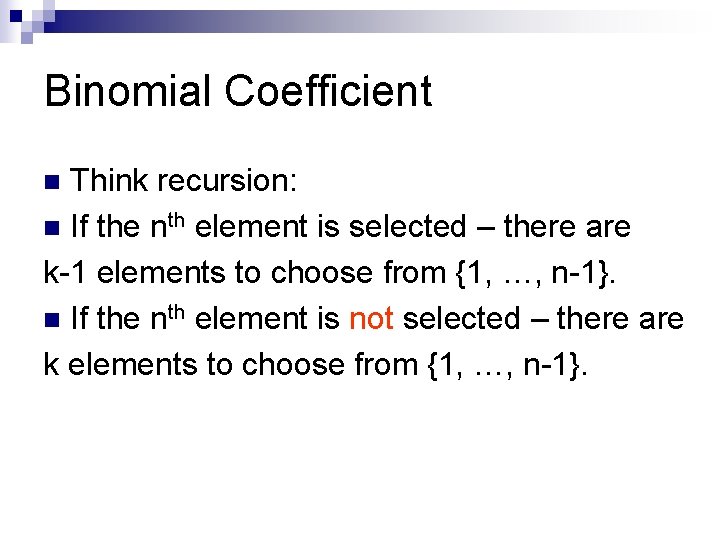
Binomial Coefficient Think recursion: n If the nth element is selected – there are k-1 elements to choose from {1, …, n-1}. n If the nth element is not selected – there are k elements to choose from {1, …, n-1}. n
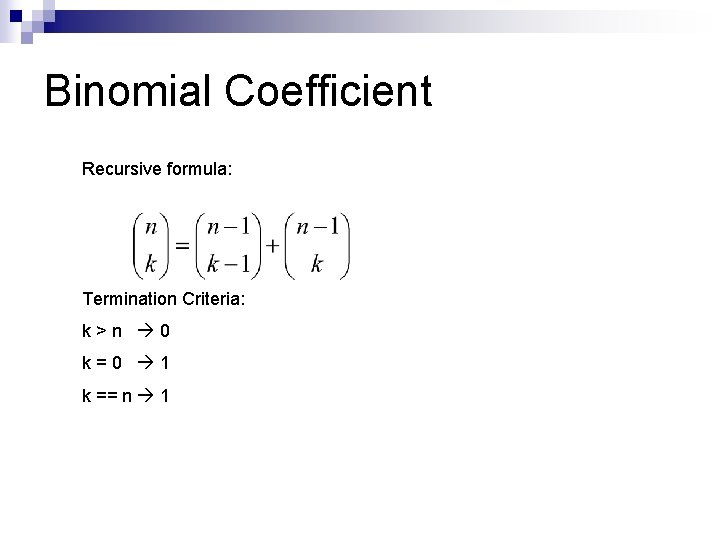
Binomial Coefficient Recursive formula: Termination Criteria: k > n 0 k = 0 1 k == n 1
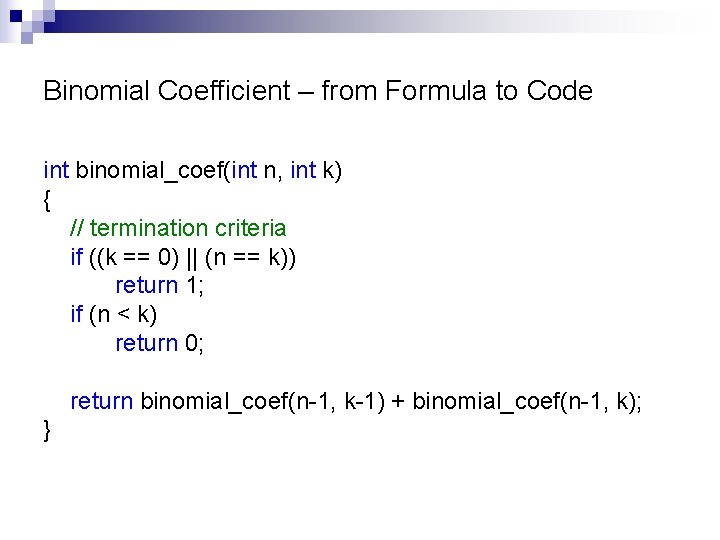
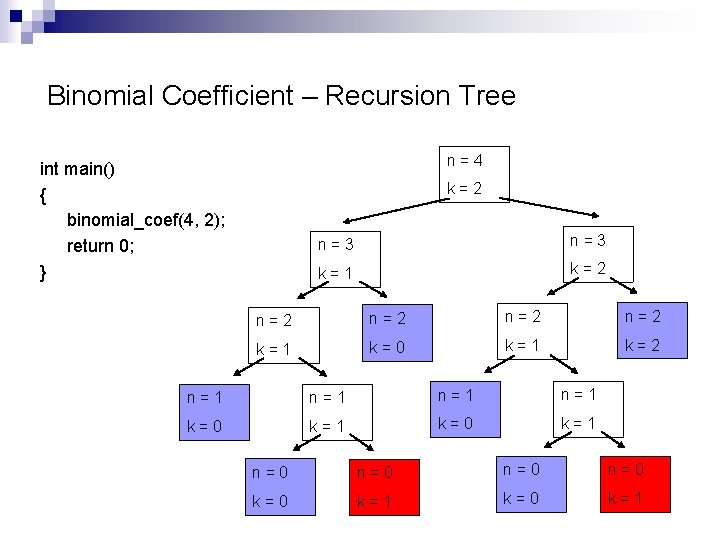
Binomial Coefficient – from Formula to Code int binomial_coef(int n, int k) { // termination criteria if ((k == 0) || (n == k)) return 1; if (n < k) return 0; return binomial_coef(n-1, k-1) + binomial_coef(n-1, k); }
Binomial Coefficient – Recursion Tree n = 4 int main() { binomial_coef(4, 2); return 0; } k = 2 n = 3 k = 1 k = 2 n = 2 k = 1 k = 0 k = 1 k = 2 n = 1 k = 0 k = 1 n = 0 k = 0 k = 1
Reverse digits Receive an Integer number, reverse the order of its digits n We already wrote the iterative version. How can we solve it recursively? n
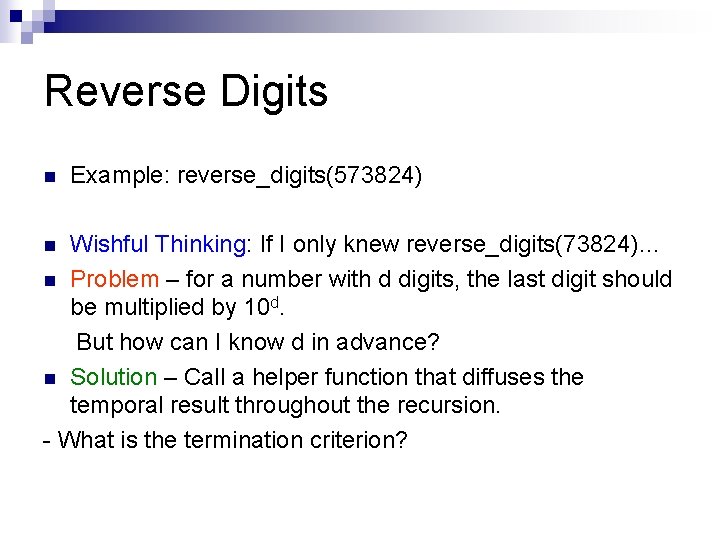
Reverse Digits n Example: reverse_digits(573824) Wishful Thinking: If I only knew reverse_digits(73824)… n Problem – for a number with d digits, the last digit should be multiplied by 10 d. But how can I know d in advance? n Solution – Call a helper function that diffuses the temporal result throughout the recursion. - What is the termination criterion? n
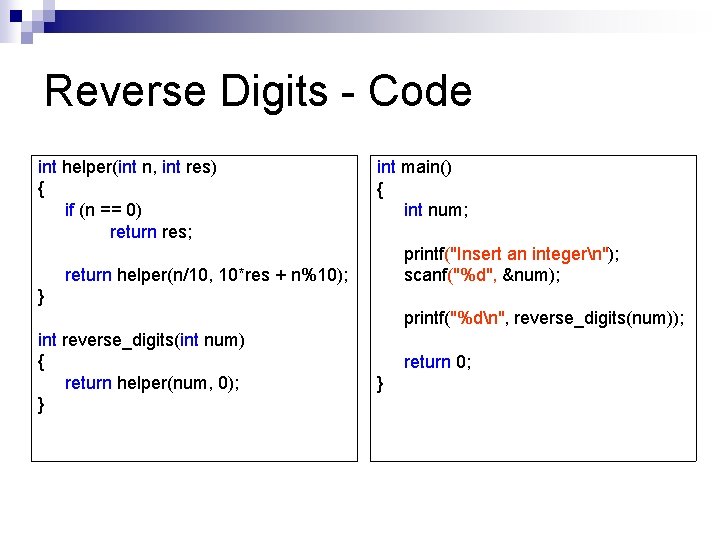
Reverse Digits - Code int helper(int n, int res) { if (n == 0) return res; return helper(n/10, 10*res + n%10); } int reverse_digits(int num) { return helper(num, 0); } int main() { int num; printf("Insert an integern"); scanf("%d", &num); printf("%dn", reverse_digits(num)); return 0; }