
Recursion Introduction to Computing Science and Programming I



- Slides: 19
Recursion Introduction to Computing Science and Programming I
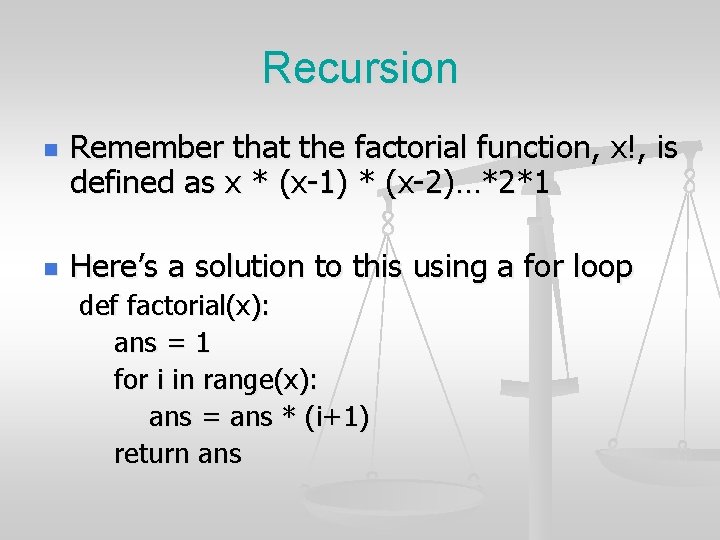
Recursion n n Remember that the factorial function, x!, is defined as x * (x-1) * (x-2)…*2*1 Here’s a solution to this using a for loop def factorial(x): ans = 1 for i in range(x): ans = ans * (i+1) return ans
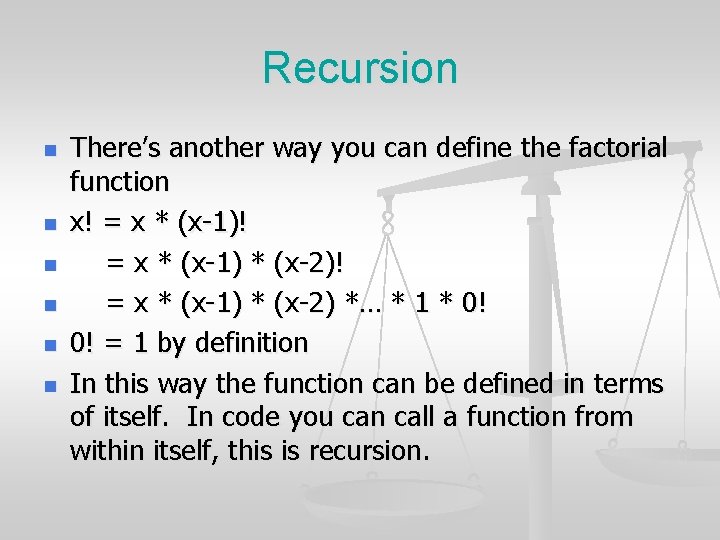
Recursion n n n There’s another way you can define the factorial function x! = x * (x-1) * (x-2)! = x * (x-1) * (x-2) *… * 1 * 0! 0! = 1 by definition In this way the function can be defined in terms of itself. In code you can call a function from within itself, this is recursion.
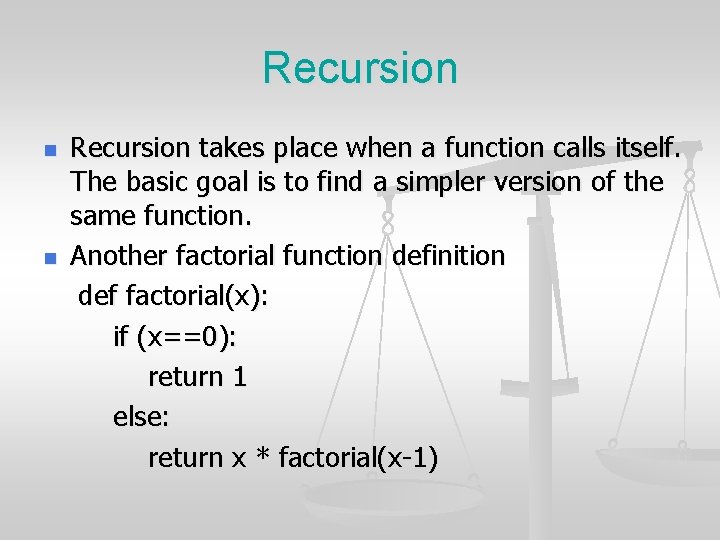
Recursion n n Recursion takes place when a function calls itself. The basic goal is to find a simpler version of the same function. Another factorial function definition def factorial(x): if (x==0): return 1 else: return x * factorial(x-1)
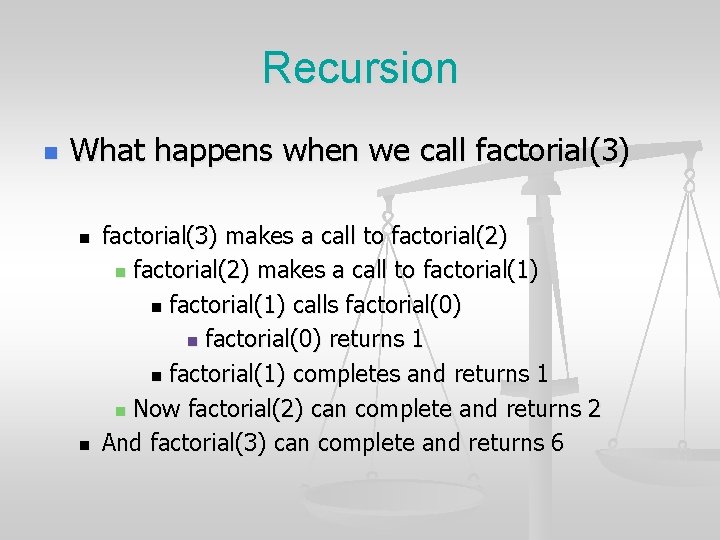
Recursion n What happens when we call factorial(3) n n factorial(3) makes a call to factorial(2) n factorial(2) makes a call to factorial(1) n factorial(1) calls factorial(0) n factorial(0) returns 1 n factorial(1) completes and returns 1 n Now factorial(2) can complete and returns 2 And factorial(3) can complete and returns 6
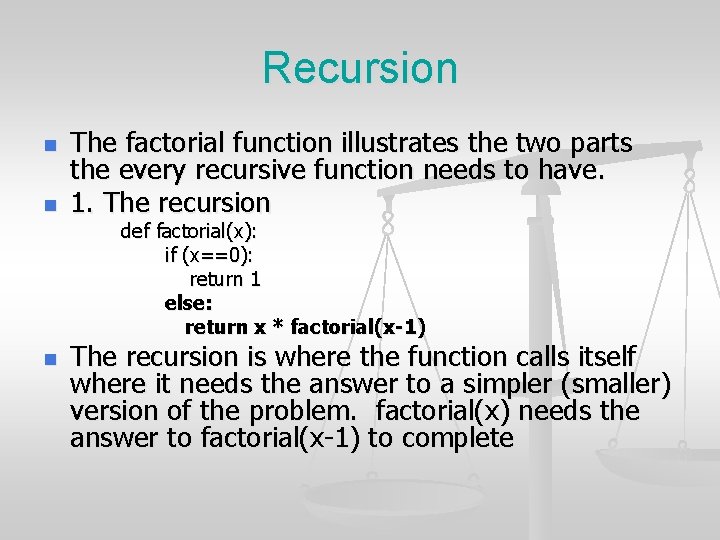
Recursion n n The factorial function illustrates the two parts the every recursive function needs to have. 1. The recursion def factorial(x): if (x==0): return 1 else: return x * factorial(x-1) n The recursion is where the function calls itself where it needs the answer to a simpler (smaller) version of the problem. factorial(x) needs the answer to factorial(x-1) to complete
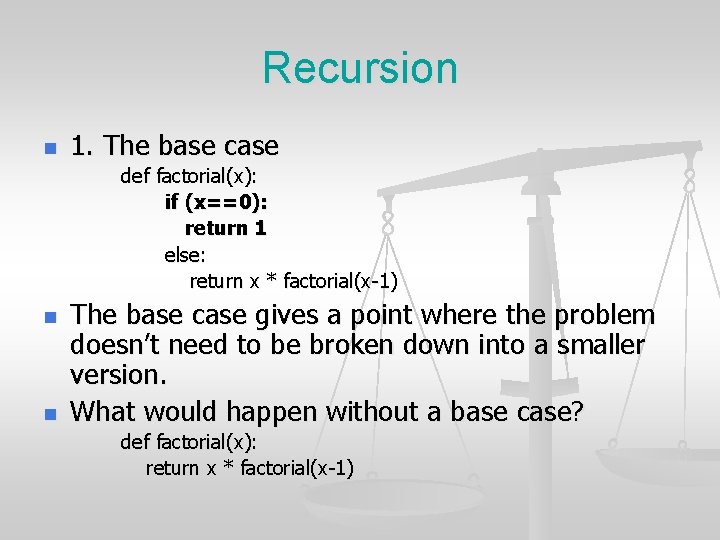
Recursion n 1. The base case def factorial(x): if (x==0): return 1 else: return x * factorial(x-1) n n The base case gives a point where the problem doesn’t need to be broken down into a smaller version. What would happen without a base case? def factorial(x): return x * factorial(x-1)
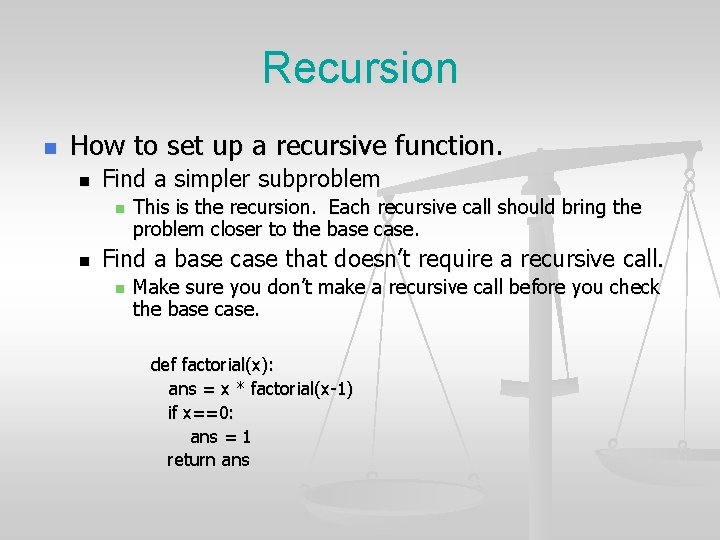
Recursion n How to set up a recursive function. n Find a simpler subproblem n n This is the recursion. Each recursive call should bring the problem closer to the base case. Find a base case that doesn’t require a recursive call. n Make sure you don’t make a recursive call before you check the base case. def factorial(x): ans = x * factorial(x-1) if x==0: ans = 1 return ans
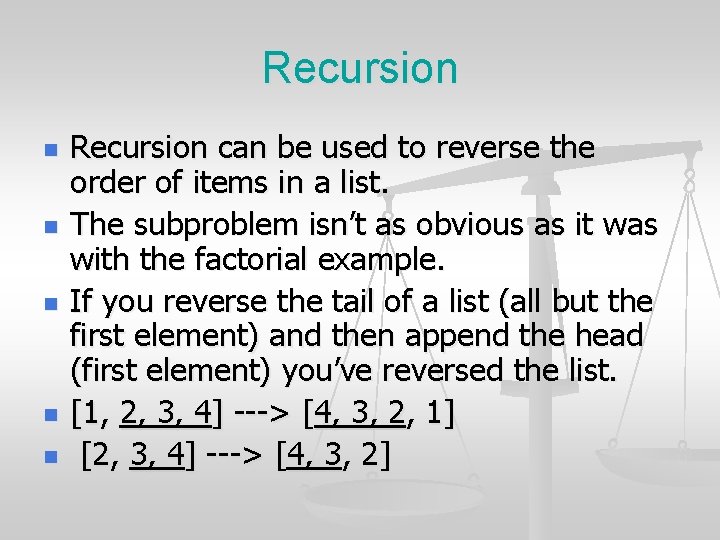
Recursion n n Recursion can be used to reverse the order of items in a list. The subproblem isn’t as obvious as it was with the factorial example. If you reverse the tail of a list (all but the first element) and then append the head (first element) you’ve reversed the list. [1, 2, 3, 4] ---> [4, 3, 2, 1] [2, 3, 4] ---> [4, 3, 2]
Recursion n So we have our recursion. We’ll repeatedly call reverse for the tail of the list. At what point do we reach a base case? A list that is empty or has one element is the reverse of itself, so this would be a good spot to end the recursion.
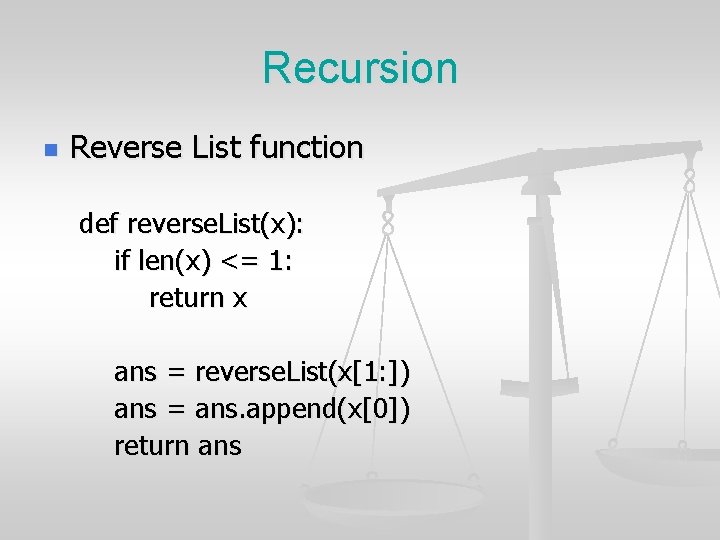
Recursion n Reverse List function def reverse. List(x): if len(x) <= 1: return x ans = reverse. List(x[1: ]) ans = ans. append(x[0]) return ans
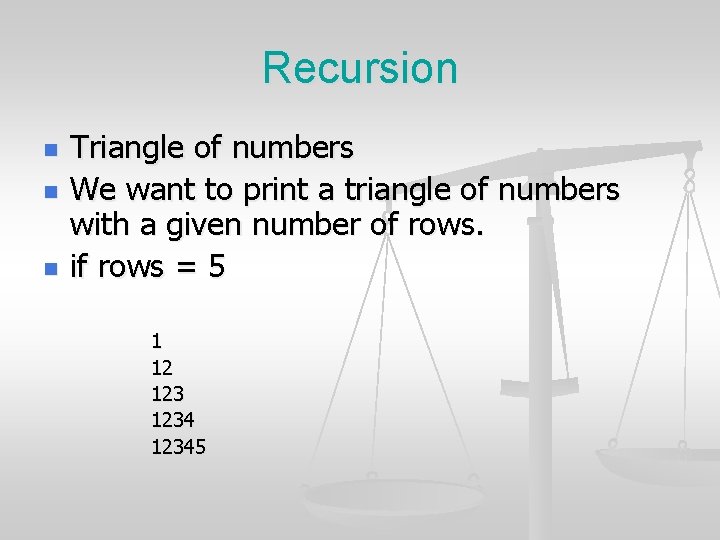
Recursion n Triangle of numbers We want to print a triangle of numbers with a given number of rows. if rows = 5 1 12 12345
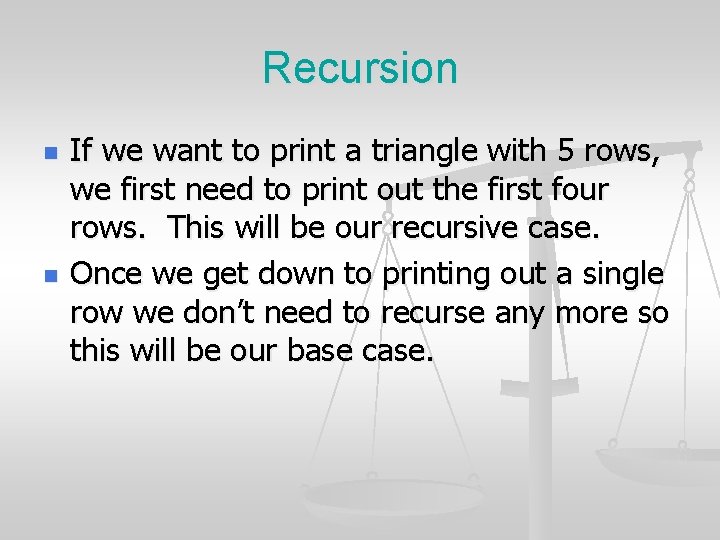
Recursion n n If we want to print a triangle with 5 rows, we first need to print out the first four rows. This will be our recursive case. Once we get down to printing out a single row we don’t need to recurse any more so this will be our base case.
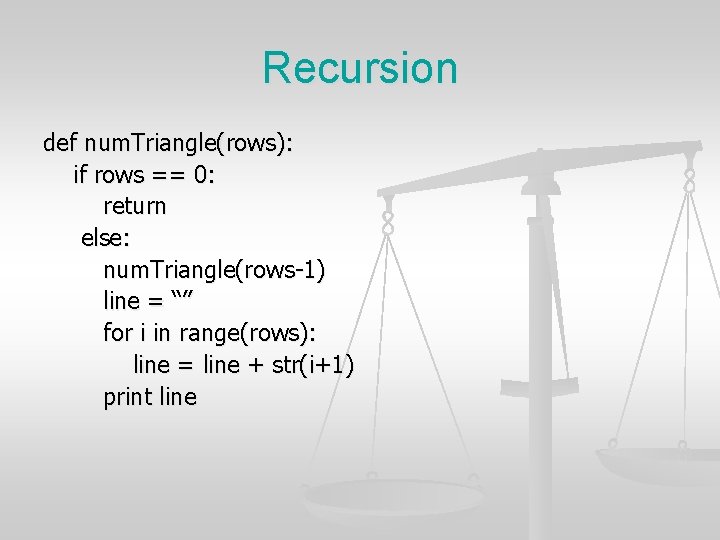
Recursion def num. Triangle(rows): if rows == 0: return else: num. Triangle(rows-1) line = “” for i in range(rows): line = line + str(i+1) print line
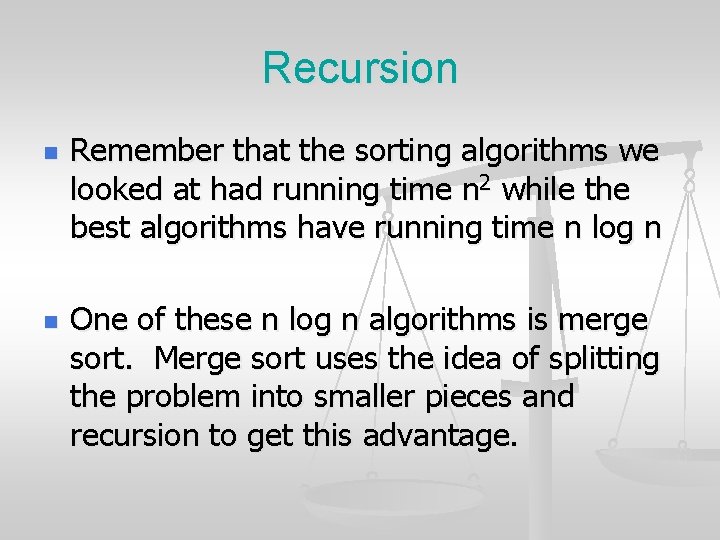
Recursion n n Remember that the sorting algorithms we looked at had running time n 2 while the best algorithms have running time n log n One of these n log n algorithms is merge sort. Merge sort uses the idea of splitting the problem into smaller pieces and recursion to get this advantage.
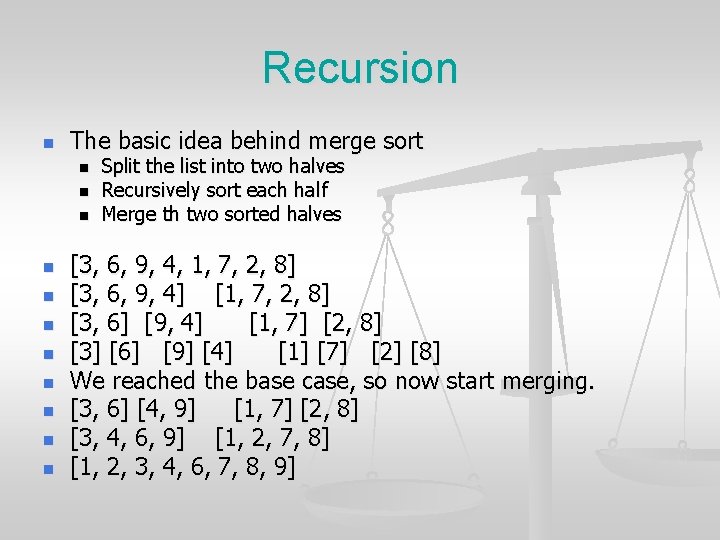
Recursion n The basic idea behind merge sort n n n Split the list into two halves Recursively sort each half Merge th two sorted halves [3, 6, 9, 4, 1, 7, 2, 8] [3, 6, 9, 4] [1, 7, 2, 8] [3, 6] [9, 4] [1, 7] [2, 8] [3] [6] [9] [4] [1] [7] [2] [8] We reached the base case, so now start merging. [3, 6] [4, 9] [1, 7] [2, 8] [3, 4, 6, 9] [1, 2, 7, 8] [1, 2, 3, 4, 6, 7, 8, 9]