
Recurrent EncoderDecoder Networks for TimeVarying Dense Predictions Presented

- Slides: 10
Recurrent Encoder-Decoder Networks for Time-Varying Dense Predictions Presented By: Chanon Chantaduly
Time-Varying Dense Predictions • When we predict a label for each of the input units rather than the entire • input Example: predicting the pixels that represent a cat • Time-varying dataset • Spatial and Temporal • Example: video analysis, medical imaging
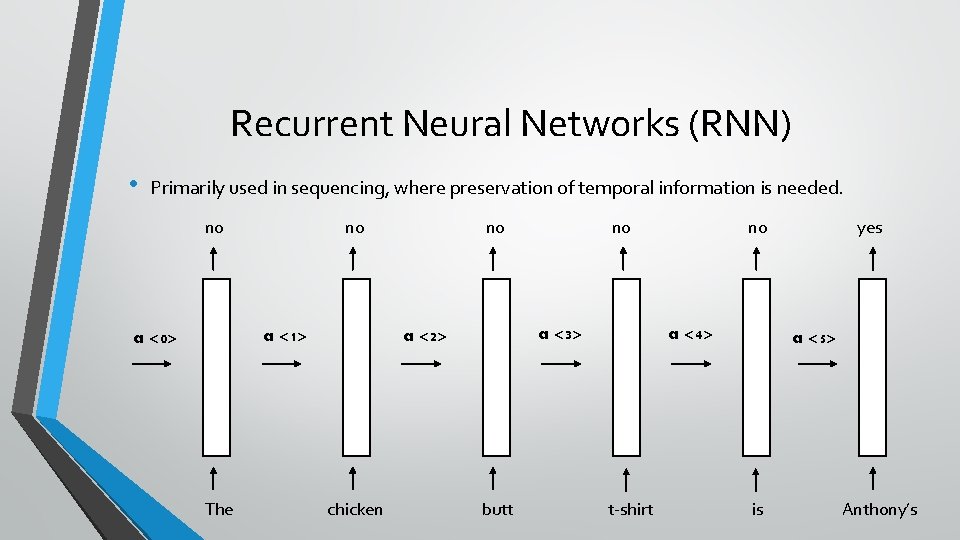
Recurrent Neural Networks (RNN) • Primarily used in sequencing, where preservation of temporal information is needed. no no a <1> a <0> The no a <3> a <2> chicken no butt no a <4> t-shirt yes a <5> is Anthony’s
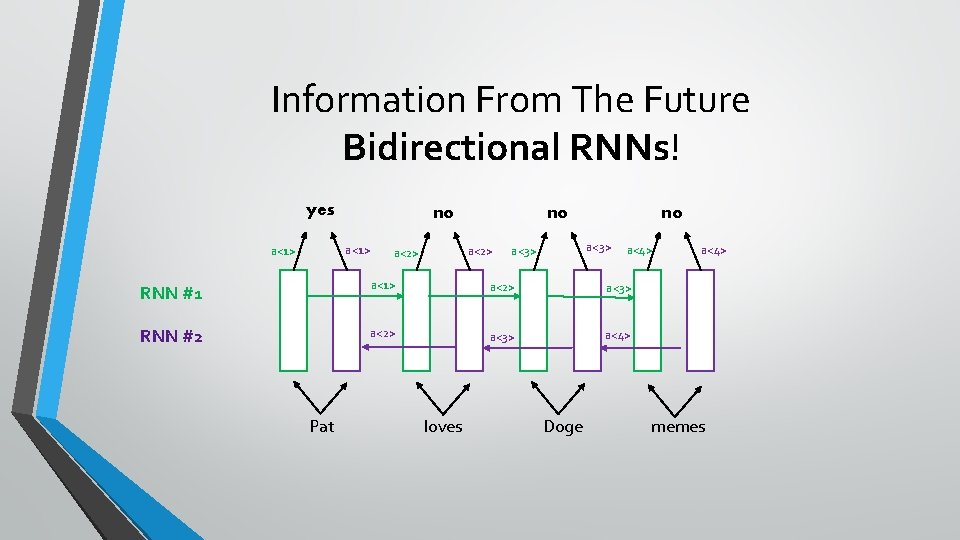
Problems with RNNs • Not very good at capturing long term dependencies • Vanishing/exploding gradient problem • Next layer gets information only from the previous layer • What if we need information from later on in the sequence?
Modified RNNs – Two main types • Gated Recurrent Unit (GRU) • • Two gates Simpler model, which allows for building bigger models • Long Short Term Memory (LSTM) • • Three gates More powerful historically, but higher computational costs
Information From The Future Bidirectional RNNs! yes a<1> no no a<2> no a<3> a<4> RNN #1 a<1> a<2> a<3> RNN #2 a<2> a<3> a<4> Pat loves Doge a<4> memes
Spatial vs Temporal • Convolutional Neural Networks (CNN) are very good at preserving spatial information. • Recurrent Neural Networks (RNN) are very good at processing temporal information. • So how do we process datasets that require preserving both spatial and temporal information?
Convolutional Recurrent Neural Networks (CRNN) • Combines together CNN and RNN by replacing the fully connected layers in the RNN with convolutional connections. • Transforms GRU/LSTM to CGRU/CLSTM by adding the convolutional connections. • Limitation: Very high computational cost/high memory consumption.
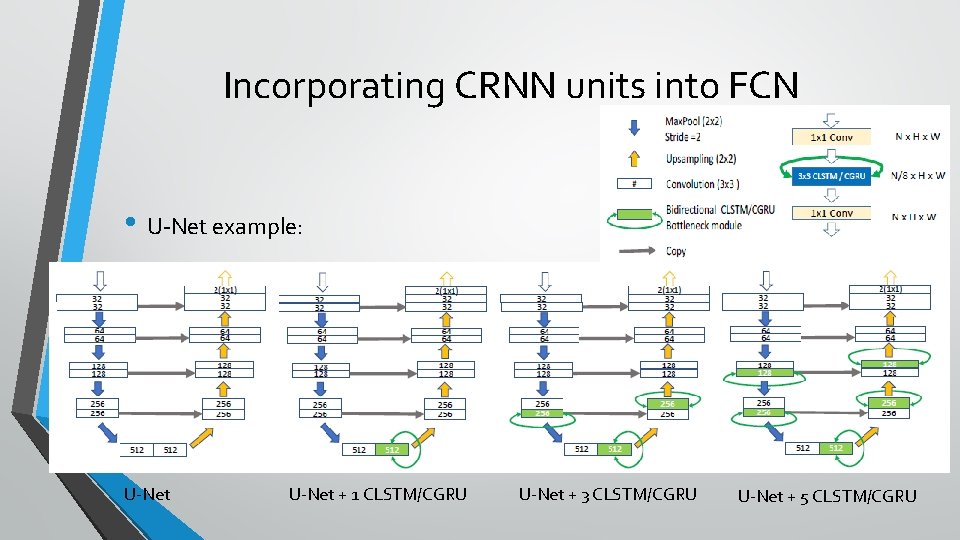
Incorporating CRNN units into FCN • U-Net example: U-Net + 1 CLSTM/CGRU U-Net + 3 CLSTM/CGRU U-Net + 5 CLSTM/CGRU
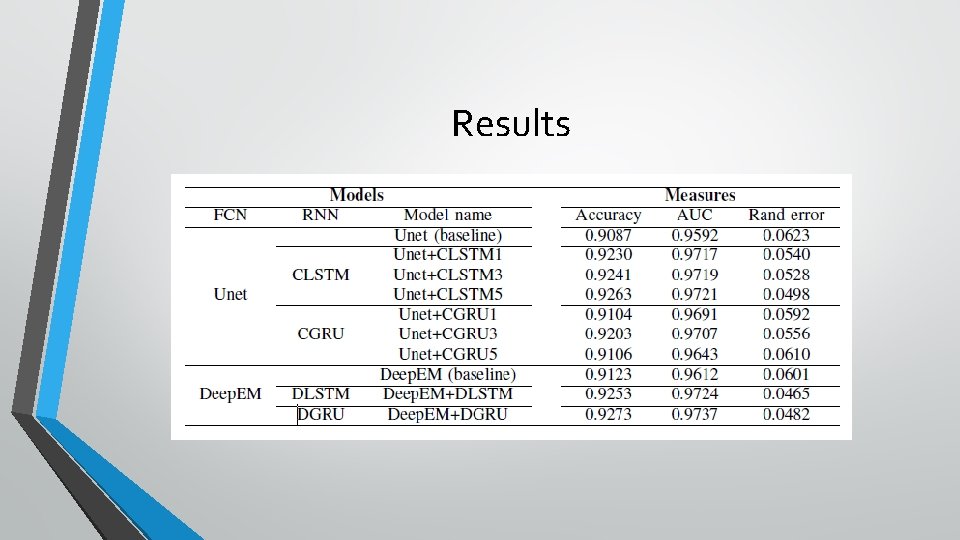
Results