
Rectal Bleeding pathway Dr Rob Palmer GPw SI
Rectal Bleeding pathway Dr Rob Palmer - GPw. SI Gastroenterology - C&H Gastro CCG lead Miss Tamzin Cuming - Consultant Colorectal Surgeon, Homerton

Rectal Bleeding �Up to 38% of people will experience rectal bleeding at some point in their lives �Only 13 -40% of these will consult a doctor about it �The majority of cases are benign and caused by minor problems that can be managed in primary care
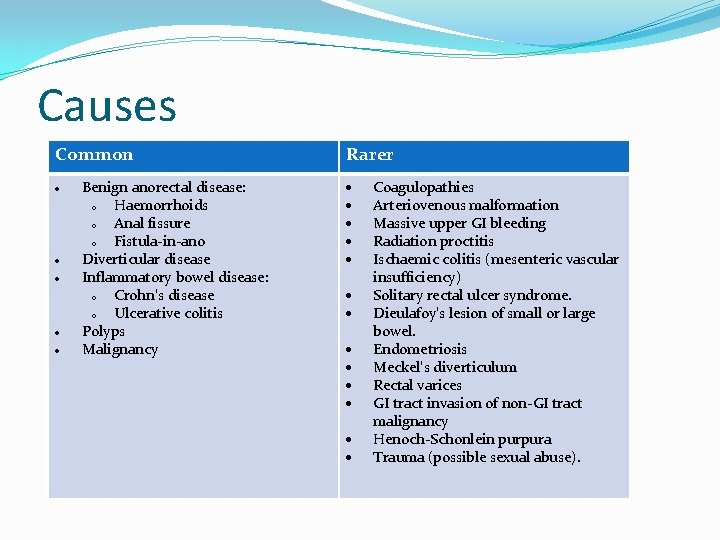
Causes Common Benign anorectal disease: o Haemorrhoids o Anal fissure o Fistula-in-ano Diverticular disease Inflammatory bowel disease: o Crohn’s disease o Ulcerative colitis Polyps Malignancy Rarer Coagulopathies Arteriovenous malformation Massive upper GI bleeding Radiation proctitis Ischaemic colitis (mesenteric vascular insufficiency) Solitary rectal ulcer syndrome. Dieulafoy's lesion of small or large bowel. Endometriosis Meckel’s diverticulum Rectal varices GI tract invasion of non-GI tract malignancy Henoch-Schonlein purpura Trauma (possible sexual abuse).

Rectal Bleeding pathway
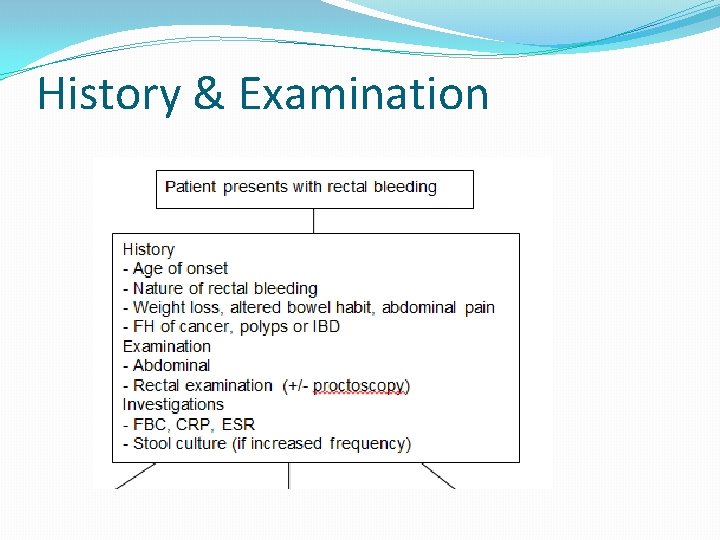
History & Examination
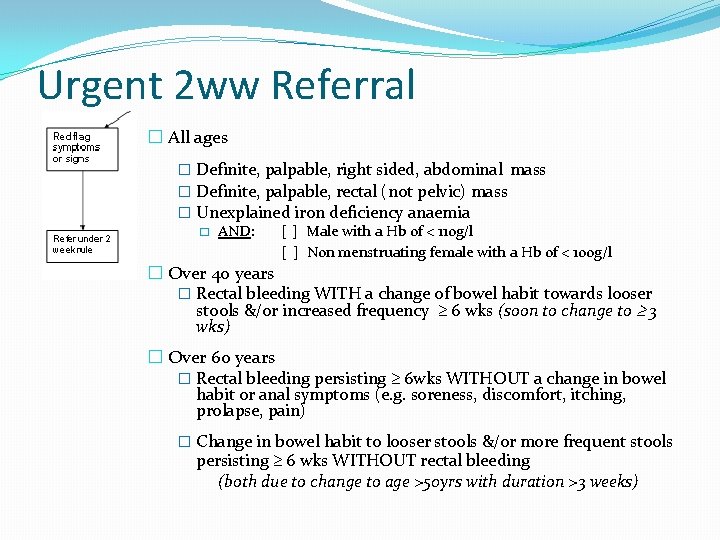
Urgent 2 ww Referral � All ages � Definite, palpable, right sided, abdominal mass � Definite, palpable, rectal (not pelvic) mass � Unexplained iron deficiency anaemia � AND: [ ] Male with a Hb of < 110 g/l [ ] Non menstruating female with a Hb of < 100 g/l � Over 40 years � Rectal bleeding WITH a change of bowel habit towards looser stools &/or increased frequency 6 wks (soon to change to 3 wks) � Over 60 years � Rectal bleeding persisting 6 wks WITHOUT a change in bowel habit or anal symptoms (e. g. soreness, discomfort, itching, prolapse, pain) � Change in bowel habit to looser stools &/or more frequent stools persisting 6 wks WITHOUT rectal bleeding (both due to change to age >50 yrs with duration >3 weeks)
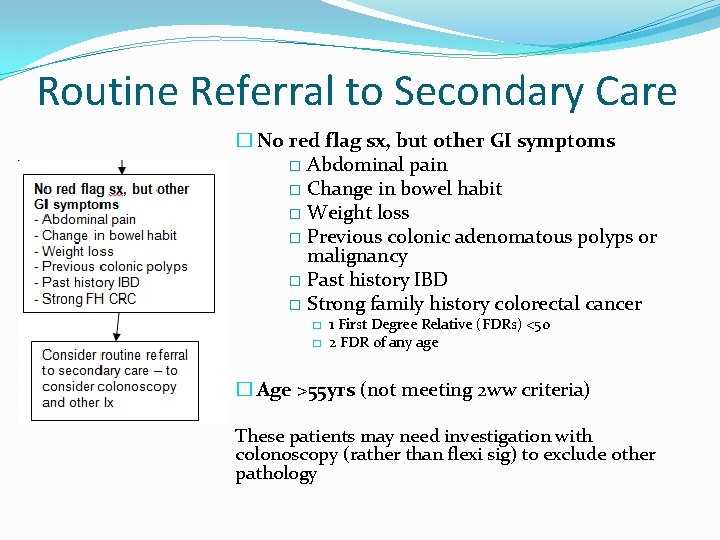
Routine Referral to Secondary Care � No red flag sx, but other GI symptoms � Abdominal pain � Change in bowel habit � Weight loss � Previous colonic adenomatous polyps or malignancy � Past history IBD � Strong family history colorectal cancer � � 1 First Degree Relative (FDRs) <50 2 FDR of any age � Age >55 yrs (not meeting 2 ww criteria) These patients may need investigation with colonoscopy (rather than flexi sig) to exclude other pathology
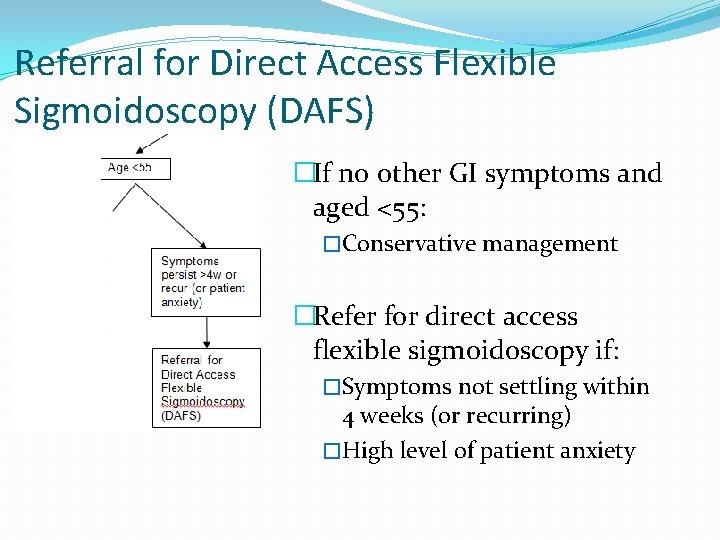
Referral for Direct Access Flexible Sigmoidoscopy (DAFS) �If no other GI symptoms and aged <55: �Conservative management �Refer for direct access flexible sigmoidoscopy if: �Symptoms not settling within 4 weeks (or recurring) �High level of patient anxiety
Results of DAFS � 174 patients attended so far �Colonic pathology found in 39/174 22% � 16 hyperplastic polyps �Significant pathology in 23/174 � 3 cancers � 10 adenomatous polyps � 10 new diagnoses of IBD proctitis 13%

DAFS Patient Satisfaction �Procedure done quickly enough: � 78% yes, 22% no �Helpful to have test on one visit to hospital: � 87% - yes, prefer one visit � 4% - no, prefer to see dr in OPD first (9% don’t mind) �Overall satisafaction: �Very satisfied 61%, Satisfied 13%, Neutral 9%, Dissatisfied 9%, Very dissatisfied 9%
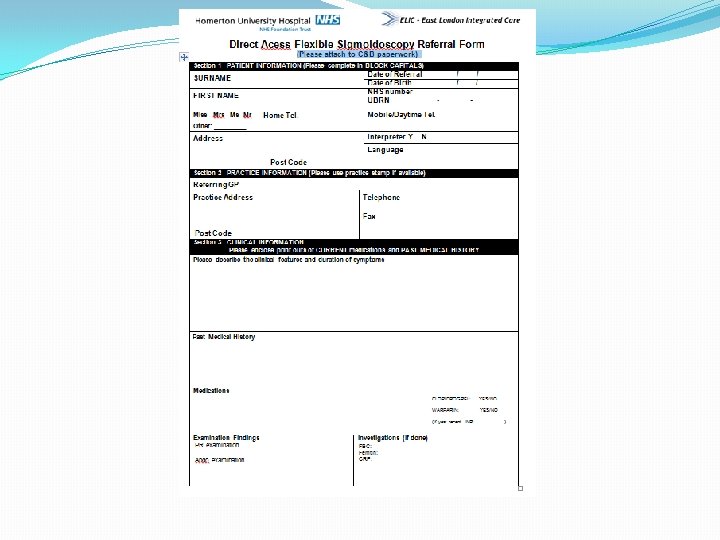
Referral for DAFS �Choose and Book �Under Diagnostic Endoscopy – Flexible Sigmoidoscopy – Homerton (only available if <55 yrs) �Directly bookable appointment �Appointments available on Tuesday mornings �Complete referral form and send electronically with CAB �Give patient information leaflet to patient
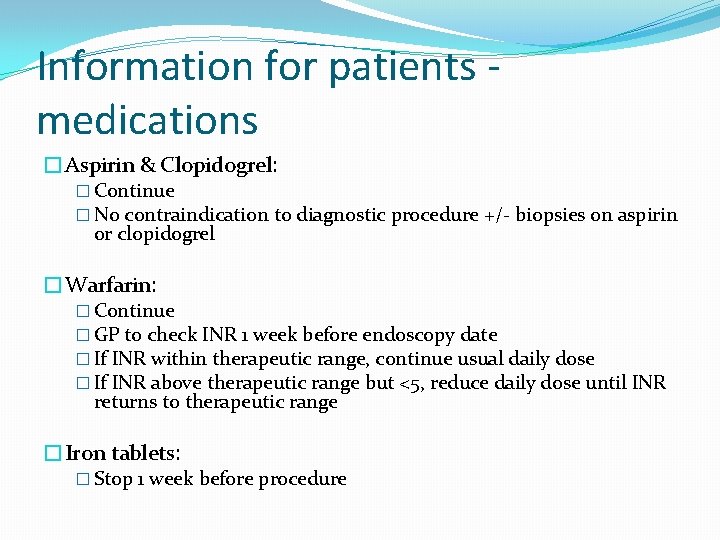
Information for patients medications �Aspirin & Clopidogrel: � Continue � No contraindication to diagnostic procedure +/- biopsies on aspirin or clopidogrel �Warfarin: � Continue � GP to check INR 1 week before endoscopy date � If INR within therapeutic range, continue usual daily dose � If INR above therapeutic range but <5, reduce daily dose until INR returns to therapeutic range �Iron tablets: � Stop 1 week before procedure
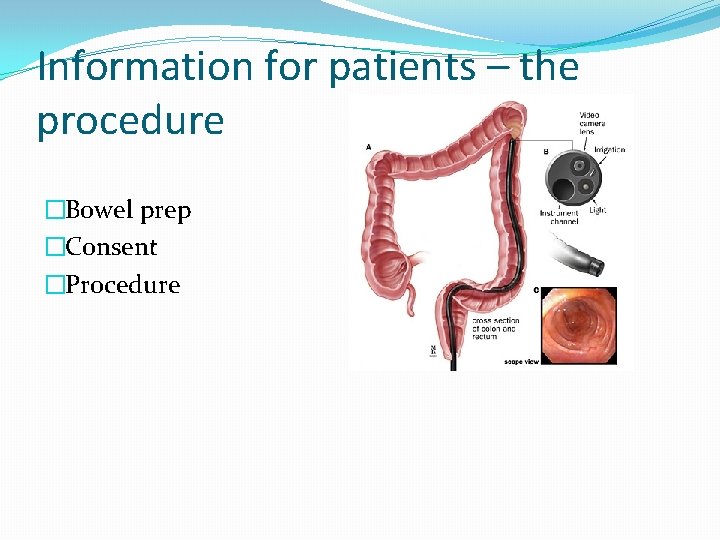
Information for patients – the procedure �Bowel prep �Consent �Procedure
Unsuitable Patients �Acute anal pain suggestive of anal fissure (procedure unlikely to be tolerated) �Recent MI or CVA within 6 w �Obesity (overall weight >135 kg) �Dementia �Poor mobility (need to be able to transfer from chair to bed)
Follow-up �All patients will be discharged back to primary care following this procedure unless diagnosis of serious pathology found: �malignancy �IBD �adenomatous polyps �The report will include detailed advice on management
Anal Fissure �A tear of the squamous lining of the distal anal canal. Clinical Features: �Sharp searing perianal pain, worse after defaecation. �Bleeding is common, usually bright red on tissue paper. �Pruritus and irritation. �Examination (gently part buttocks) may reveal linear split, usually in midline posteriorly (90%), or anterior midline 10%. Fissure may not be seen, but may be palpated or be tender on palpation of the anal margin.
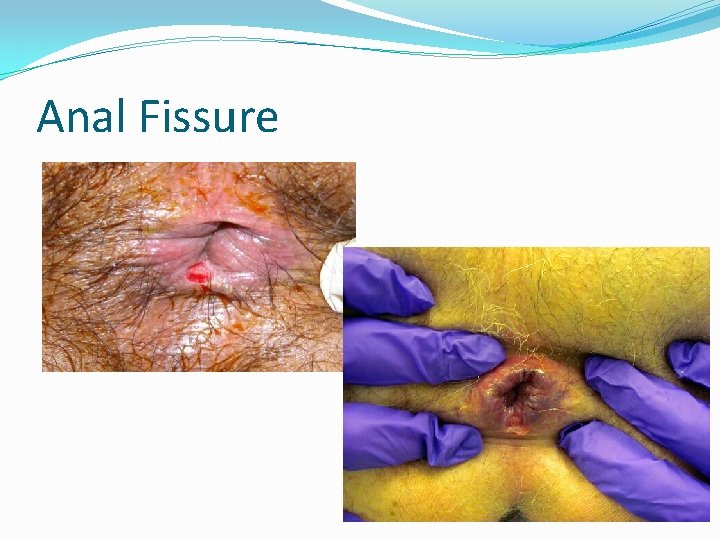
Anal Fissure
Anal Fissure - Management Acute: <6 weeks - conservative management: �Increase fluid intake �High fibre diet stools �? Bulk forming laxatives (fybogel) to achieve soft �Topical creams – 1 w course of lignocaine gel �Sitz baths relief �Oral Analgesia pain
Anal Fissure - Management Chronic: >6 weeks � Continue conservative measures � Combination of bulk forming laxative (Fybogel BD) and softening laxative (Lactulose BD) for the full 8 weeks � Prescribe topical 0. 4% Glyceryl Trinitrate (GTN) BD for 8 weeks course � N. B. 40% develop headaches as side effect � 2 tubes of 30 g should be sufficient to cover the 8 week course. � Cost £ 34. 80 for 30 g tube � If fissure fails to heal (after 8 weeks of GTN) or if side-effects on GTN ointment switch to diltiazem 2% ointment (Anoheal®) � Applied topically BD for 8 weeks. � Cost of Anoheal® is approx £ 45 per tube � If not settling – refer to secondary care
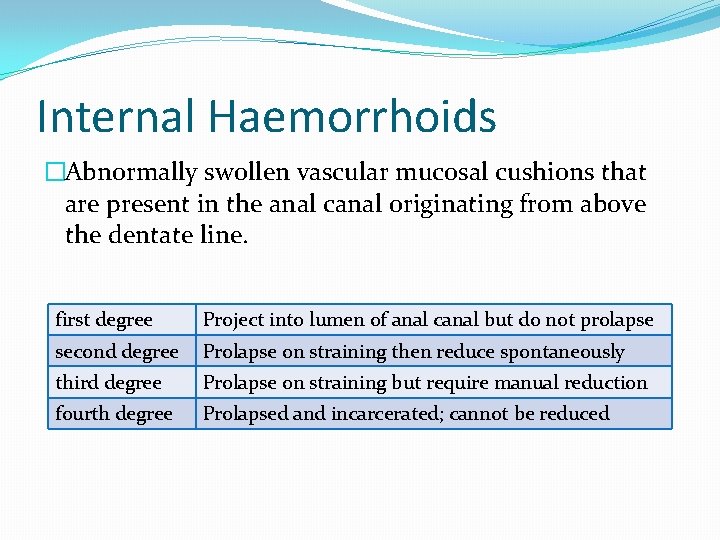
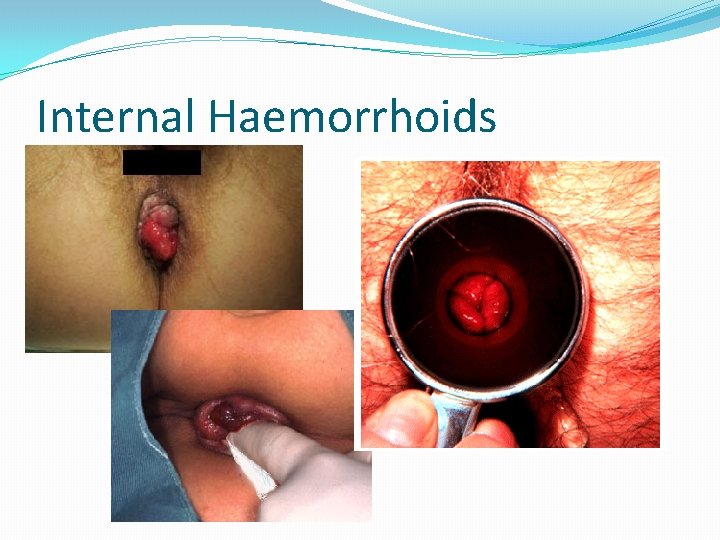
Internal Haemorrhoids �Abnormally swollen vascular mucosal cushions that are present in the anal canal originating from above the dentate line. first degree Project into lumen of anal canal but do not prolapse second degree Prolapse on straining then reduce spontaneously third degree Prolapse on straining but require manual reduction fourth degree Prolapsed and incarcerated; cannot be reduced
Internal Haemorrhoids
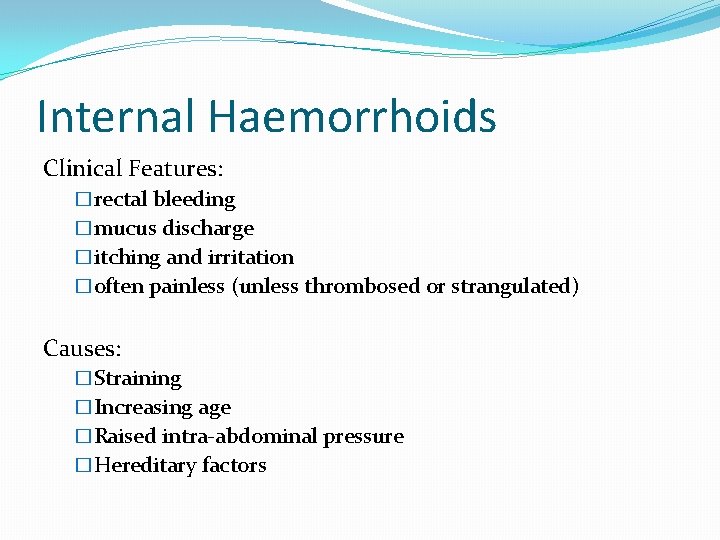
Internal Haemorrhoids Clinical Features: �rectal bleeding �mucus discharge �itching and irritation �often painless (unless thrombosed or strangulated) Causes: �Straining �Increasing age �Raised intra-abdominal pressure �Hereditary factors
Internal Haemorrhoids- Management �Increase oral fluid intake �Dietary advice �Consider laxatives � Bulk forming (ispaghula husk) � Lactulose (osmotic) or docusate (stimulant laxative with stool softening properties, avoid in pregnancy) �Topical anaesthetics with corticosteroids - use for up to 7 days �Oral analgesics �Referral if: � fail to respond to conservative management � persistent bleeding, severe prolapse, affecting daily living � fourth degree haemorrhoids �Urgent referral if: � thrombosis with severe pain, incarceration, gangrene or sepsis
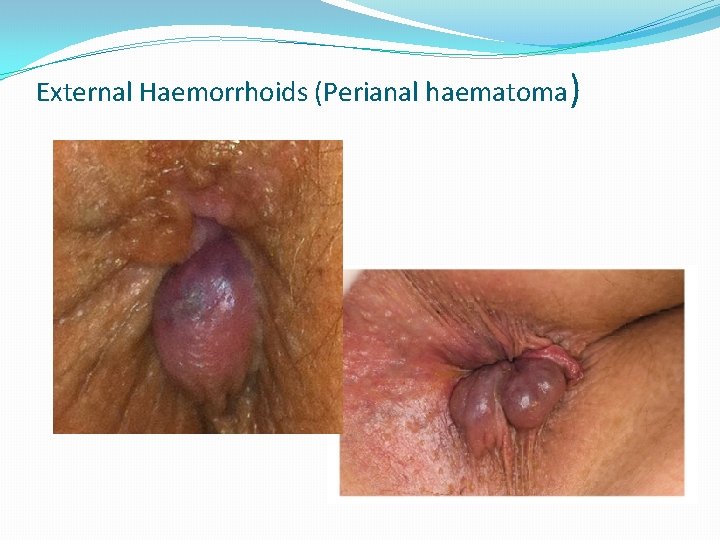
External Haemorrhoids (Perianal haematoma) �A thrombosis of the external haemorrhoid plexus, arising from below the dentate line Clinical Features: �acute severe pain, peaks 48 -72 hrs after onset �usually self-limiting to 7 -10 days �bleeding �discomfort �itch
External Haemorrhoids (Perianal haematoma)
Internal piles: Management � Analgesia � Topical anaesthetics and corticosteroids � Cold compresses � (If pt not tolerating pain in first 72 hrs, consider referral for I&D)
Skin tags �Growths of excess skin in the anal region, which are often a remnant following the resolution of a thrombosed external haemorrhoid or other perianal trauma or inflammation, though they can be an isolated finding. �Clinical features: �pruritus usually the biggest problem �usually skin-coloured lesions arising from the rim of the anal canal, which don’t contain dilated blood vessels
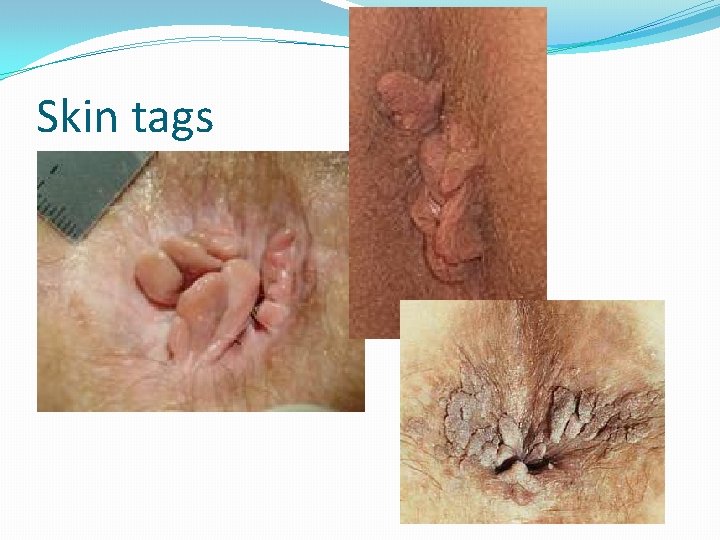
Skin tags
Skin tags - Management �Anal hygiene �Wash after defaecation �Thorough attention to anal washing in bath or shower �Avoid perfumed soaps, biological washing powders, fabric conditioners �Use cotton underwear, avoid tight fitting trousers �Management of constipation �Refer for removal if large and troublesome

Thank you!
- Slides: 31