
Recruiting and Retaining Volunteers How to get them


- Slides: 25
Recruiting and Retaining Volunteers: How to get them and keep them Emily Shaw, Volunteer Centre Co-ordinator, OCVA e t o n t i t s o p r u o r On y u o y e b i r c s e d r o draw – r e e t n u l o v m a e dr , s c i t s i r e t c a r a h c what d n a s l l i k s , s e i t i l a u qu o y d l u o w e c n e i exper ? e v a h to m e h t t wan
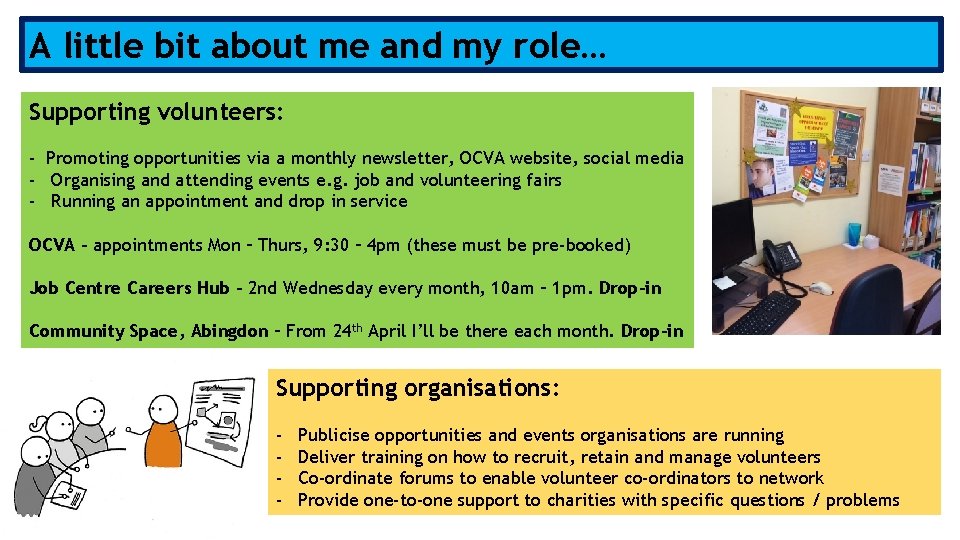
A little bit about me and my role… Supporting volunteers: - Promoting opportunities via a monthly newsletter, OCVA website, social media - Organising and attending events e. g. job and volunteering fairs - Running an appointment and drop in service OCVA – appointments Mon – Thurs, 9: 30 – 4 pm (these must be pre-booked) Job Centre Careers Hub – 2 nd Wednesday every month, 10 am – 1 pm. Drop-in Community Space, Abingdon – From 24 th April I’ll be there each month. Drop-in Supporting organisations: - Publicise opportunities and events organisations are running Deliver training on how to recruit, retain and manage volunteers Co-ordinate forums to enable volunteer co-ordinators to network Provide one-to-one support to charities with specific questions / problems
Outcomes forofthis Outcomes this session: training session: By the end of this training session you will: • Be able to identify what motivates people to start volunteering • Be able to describe what makes an effective volunteering advert • Be able to list a range of methods for effectively recruiting volunteers • Be able to identify strategies and approaches to effectively manage volunteers, in order to aid volunteer retention • Have had time to reflect on the approaches currently used by your organisation and how you may work differently in the future
Start off by thinking on your own for 30 seconds about what motivates people to volunteer. Write down your ideas on a piece of paper. Now compare your list to your partners: - What do you think are the top 3 reasons people are motivated to volunteer? As a table: - Compare the lists you have come up with - What do you think are the top 2 motivations to volunteer?
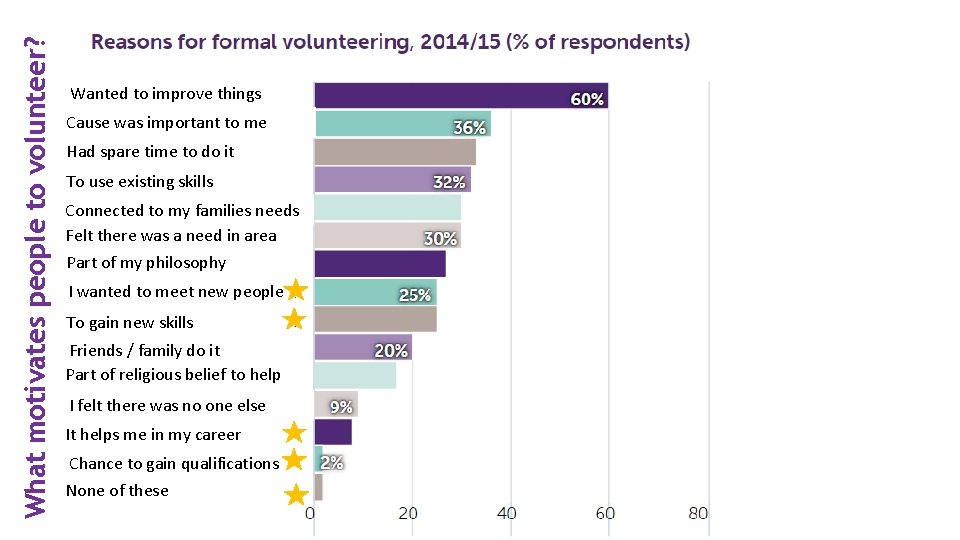
What motivates people to volunteer? Wanted to improve things Cause was important to me Had spare time to do it To use existing skills Connected to my families needs Felt there was a need in area Part of my philosophy I wanted to meet new people To gain new skills Friends / family do it Part of religious belief to help I felt there was no one else It helps me in my career Chance to gain qualifications None of these
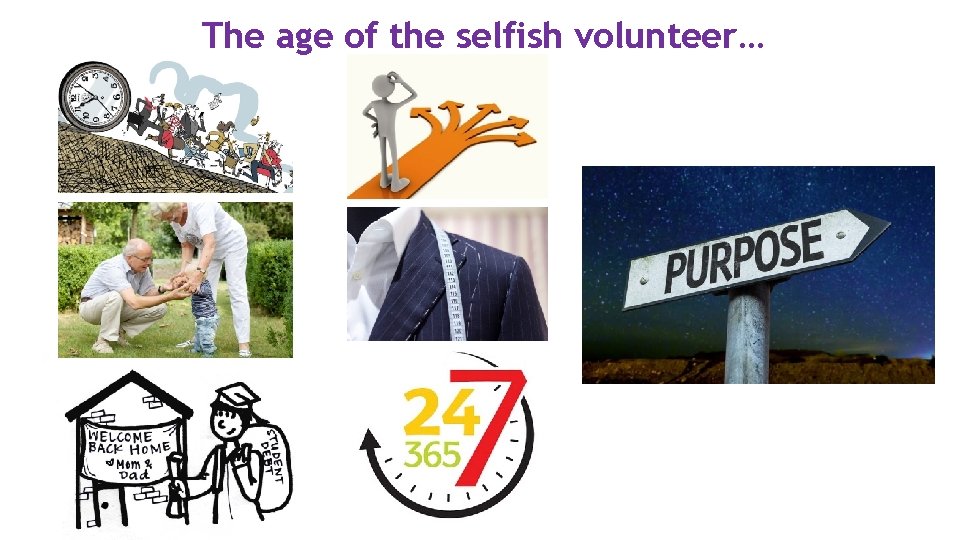
The age of the selfish volunteer…
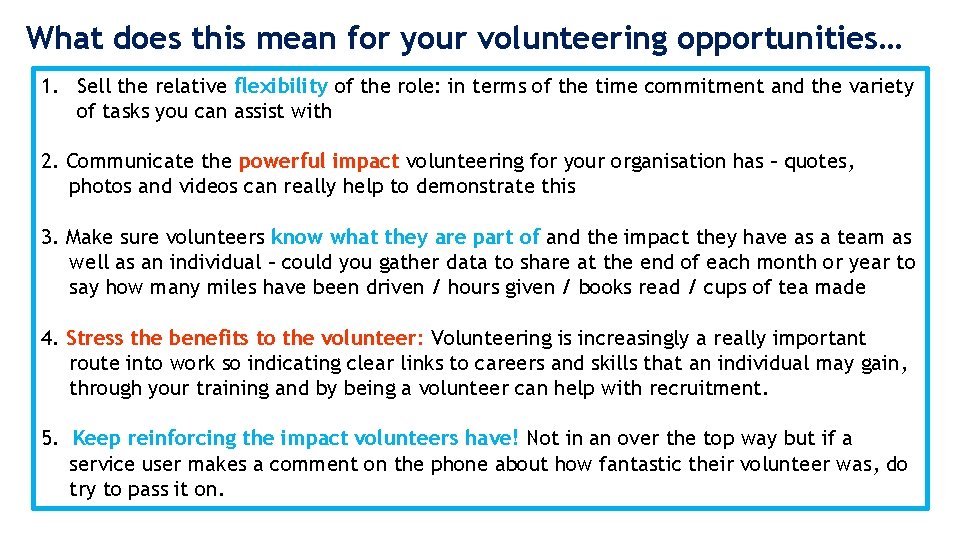
What does this mean for your volunteering opportunities… 1. Sell the relative flexibility of the role: in terms of the time commitment and the variety of tasks you can assist with 2. Communicate the powerful impact volunteering for your organisation has – quotes, photos and videos can really help to demonstrate this 3. Make sure volunteers know what they are part of and the impact they have as a team as well as an individual – could you gather data to share at the end of each month or year to say how many miles have been driven / hours given / books read / cups of tea made 4. Stress the benefits to the volunteer: Volunteering is increasingly a really important route into work so indicating clear links to careers and skills that an individual may gain, through your training and by being a volunteer can help with recruitment. 5. Keep reinforcing the impact volunteers have! Not in an over the top way but if a service user makes a comment on the phone about how fantastic their volunteer was, do try to pass it on.
Outcomes forofthis Outcomes this session: training session: By the end of this training session you will: • Be able to identify what motivates people to start volunteering • Be able to describe what makes an effective volunteering advert • Be able to list a range of methods for effectively recruiting volunteers • Be able to identify strategies and approaches to effectively manage volunteers, in order to aid volunteer retention • Have had time to reflect on the approaches currently used by your organisation and how you may work differently in the future
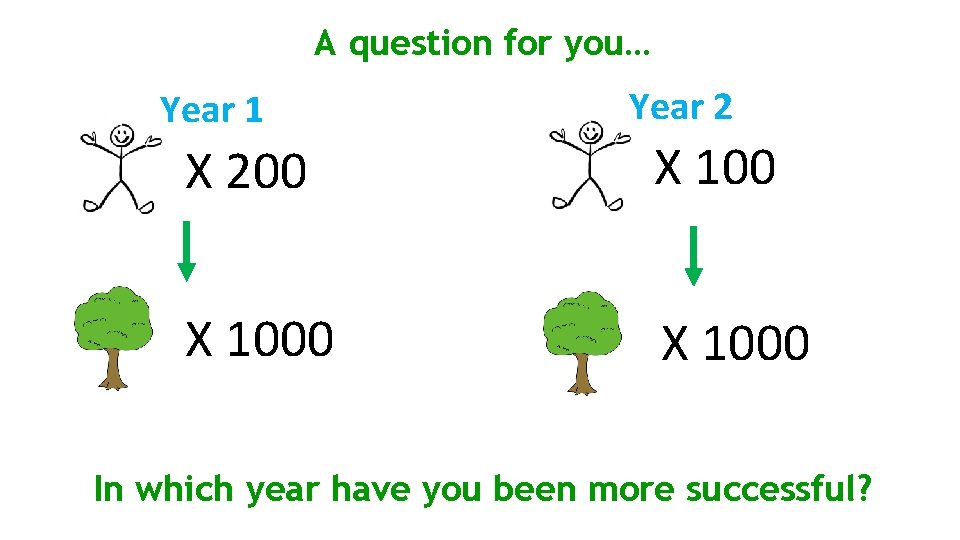
A question for you… Year 1 Year 2 X 200 X 1000 In which year have you been more successful?
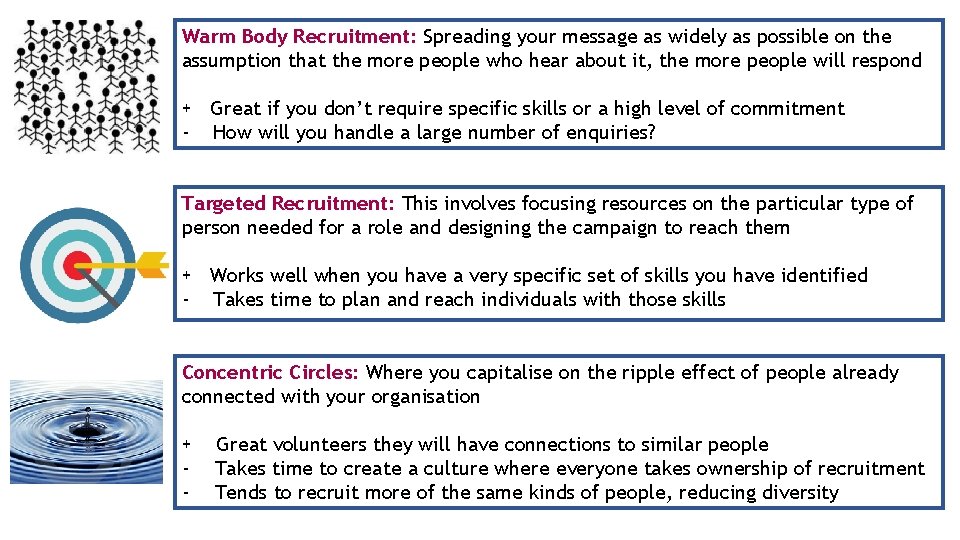
Warm Body Recruitment: Spreading your message as widely as possible on the assumption that the more people who hear about it, the more people will respond + Great if you don’t require specific skills or a high level of commitment - How will you handle a large number of enquiries? Targeted Recruitment: This involves focusing resources on the particular type of person needed for a role and designing the campaign to reach them + Works well when you have a very specific set of skills you have identified - Takes time to plan and reach individuals with those skills Concentric Circles: Where you capitalise on the ripple effect of people already connected with your organisation + - Great volunteers they will have connections to similar people Takes time to create a culture where everyone takes ownership of recruitment Tends to recruit more of the same kinds of people, reducing diversity
u o y o d w o H e h t t i u r c e r y l t n e r r cur u o y f o y t i r o j a m ? s r e e t n u l vo
On the spot challenge! Devise a concise, engaging, persuasive pitch to call people to action and join your organisation as a volunteer. This is a skill you can teach to current volunteers to help spread the word!
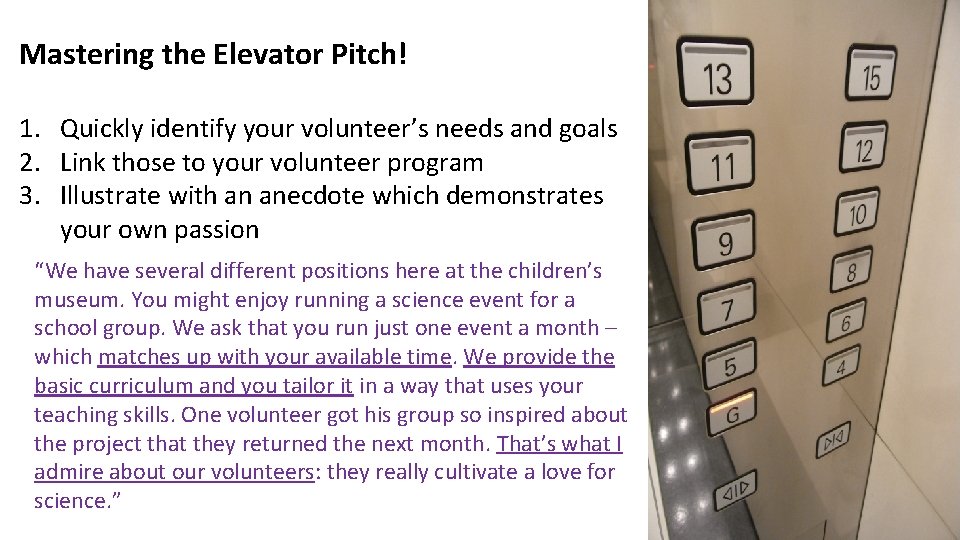
Mastering the Elevator Pitch! 1. Quickly identify your volunteer’s needs and goals 2. Link those to your volunteer program 3. Illustrate with an anecdote which demonstrates your own passion “We have several different positions here at the children’s museum. You might enjoy running a science event for a school group. We ask that you run just one event a month – which matches up with your available time. We provide the basic curriculum and you tailor it in a way that uses your teaching skills. One volunteer got his group so inspired about the project that they returned the next month. That’s what I admire about our volunteers: they really cultivate a love for science. ”
a s e k a m t r a e h e t W n u l o v d goo vert? ad As a group annotate the advert on your table: - What do you like about it? - What don’t you like – why? - How would you change it? - Who do you think this advert would appeal to? Get ready to rotate!
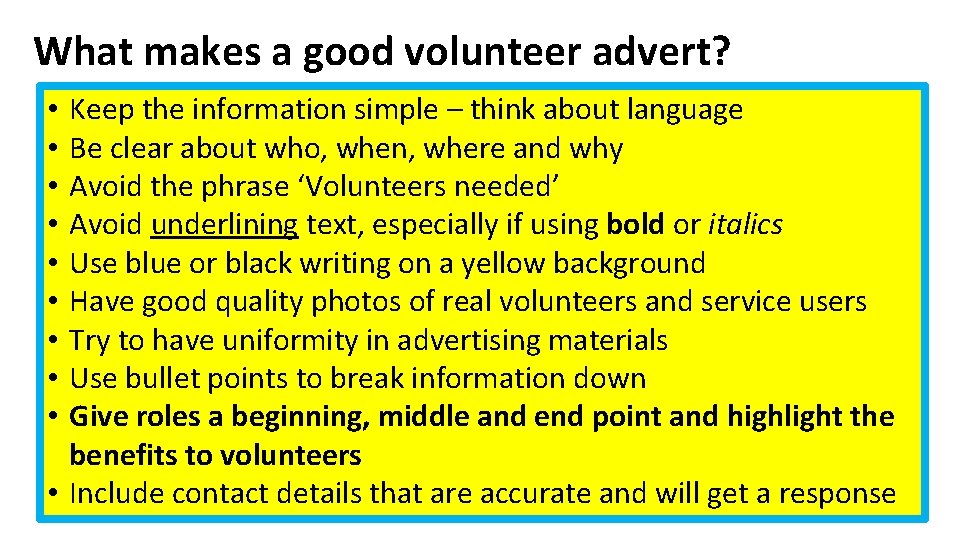
What makes a good volunteer advert? Keep the information simple – think about language Be clear about who, when, where and why Avoid the phrase ‘Volunteers needed’ Avoid underlining text, especially if using bold or italics Use blue or black writing on a yellow background Have good quality photos of real volunteers and service users Try to have uniformity in advertising materials Use bullet points to break information down Give roles a beginning, middle and end point and highlight the benefits to volunteers • Include contact details that are accurate and will get a response • • •
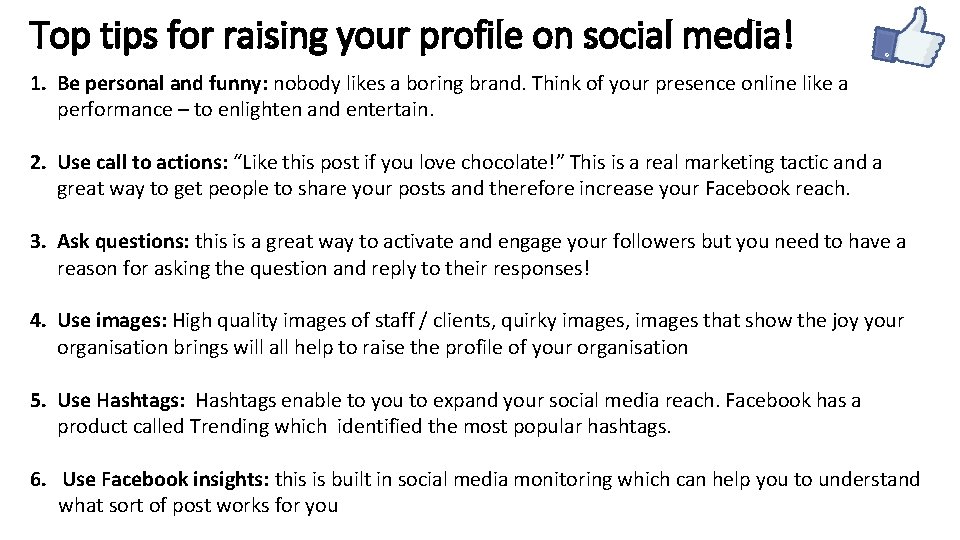
Top tips for raising your profile on social media! 1. Be personal and funny: nobody likes a boring brand. Think of your presence online like a performance – to enlighten and entertain. 2. Use call to actions: “Like this post if you love chocolate!” This is a real marketing tactic and a great way to get people to share your posts and therefore increase your Facebook reach. 3. Ask questions: this is a great way to activate and engage your followers but you need to have a reason for asking the question and reply to their responses! 4. Use images: High quality images of staff / clients, quirky images, images that show the joy your organisation brings will all help to raise the profile of your organisation 5. Use Hashtags: Hashtags enable to you to expand your social media reach. Facebook has a product called Trending which identified the most popular hashtags. 6. Use Facebook insights: this is built in social media monitoring which can help you to understand what sort of post works for you
Outcomes forofthis Outcomes this session: training session: By the end of this training session you will: • Be able to identify what motivates people to start volunteering • Be able to describe what makes an effective volunteering advert • Be able to list a range of methods for effectively recruiting volunteers • Be able to identify strategies and approaches to effectively manage volunteers, in order to aid volunteer retention • Have had time to reflect on the approaches currently used by your organisation and how you may work differently in the future
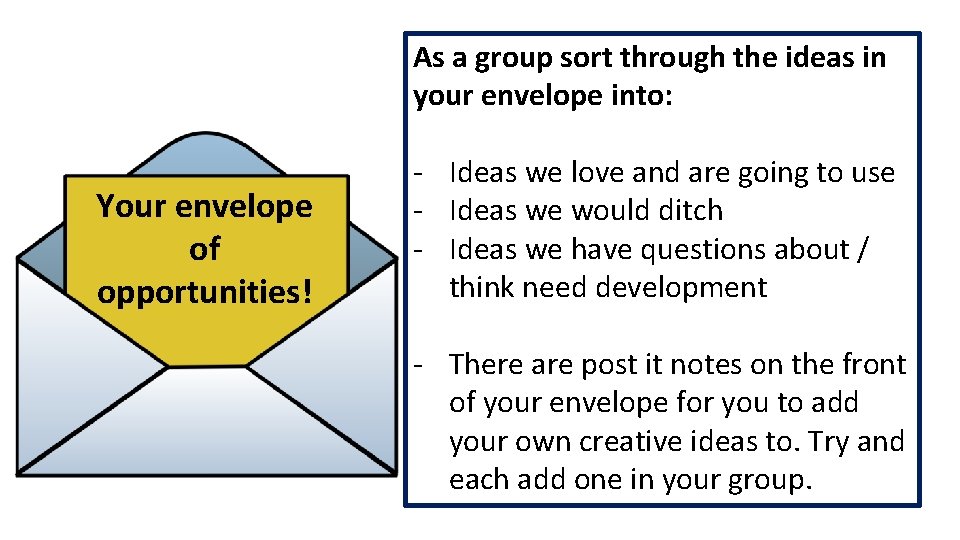
As a group sort through the ideas in your envelope into: Your envelope of opportunities! - Ideas we love and are going to use - Ideas we would ditch - Ideas we have questions about / think need development - There are post it notes on the front of your envelope for you to add your own creative ideas to. Try and each add one in your group.
Outcomes forofthis Outcomes this session: training session: By the end of this training session you will: • Be able to identify what motivates people to start volunteering • Be able to describe what makes an effective volunteering advert • Be able to list a range of methods for effectively recruiting volunteers • Be able to identify strategies and approaches to effectively manage volunteers, in order to aid volunteer retention • Have had time to reflect on the approaches currently used by your organisation and how you may work differently in the future
s e k a m t a Wh ood a g ce? a l p k r o w Wha t mak e a bad s work place ? As a pair write down your thoughts under the headings of work conditions, the work, management procedures and relationships with colleagues
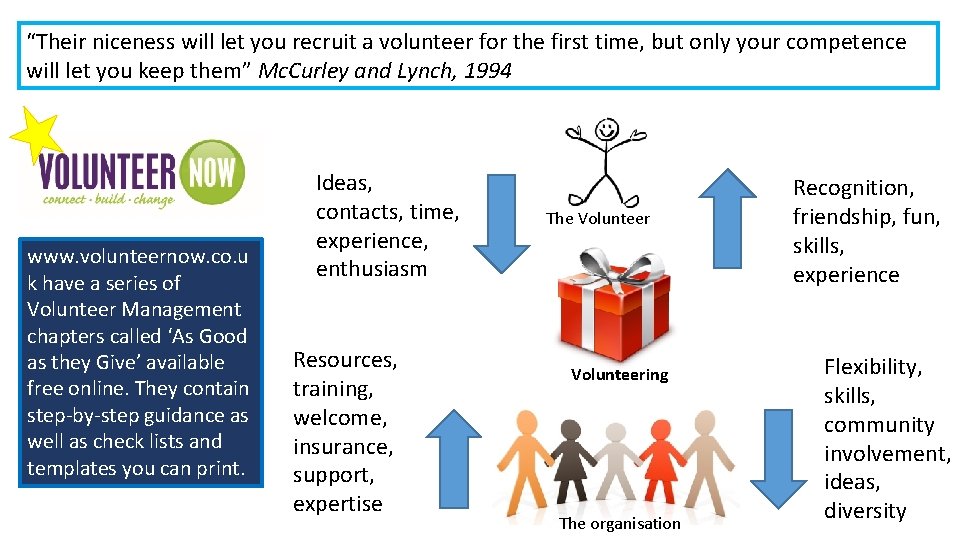
“Their niceness will let you recruit a volunteer for the first time, but only your competence will let you keep them” Mc. Curley and Lynch, 1994 www. volunteernow. co. u k have a series of Volunteer Management chapters called ‘As Good as they Give’ available free online. They contain step-by-step guidance as well as check lists and templates you can print. Ideas, contacts, time, experience, enthusiasm Resources, training, welcome, insurance, support, expertise The Volunteering The organisation Recognition, friendship, fun, skills, experience Flexibility, skills, community involvement, ideas, diversity
What every organisation should offer Induction covering: - Organisational information (aims, background) - Procedural information (health and safety) - Role related information (tasks, equipment) - Personal (toilets, expenses, kitchen, parking) - Team related (who will support them, meetings) • Think about who will deliver this info and when – you don’t want to overwhelm a volunteer • Could some be delivered to a new group of volunteers, and is some better individually? Settling in period and a catch up • Allows you both to decide if this is a good match • Greater supervision during settling in period • Should be a defined period with a clear outcome Training (must be linked to role) • For many this is a motivation to volunteer • Demonstrates the value you place on volunteers Volunteer agreement and good practice code • Set of guidelines outlining what volunteers can expect and what you hope of them. Not a rule book Support and supervise volunteers • Foster a climate where people feel able to ask • Support and supervision needs to be accessible • P 15 – 19 are really useful with practical advice on this • P 8 of the Managing and Motivating volunteers workbook has a handy checklist for induction
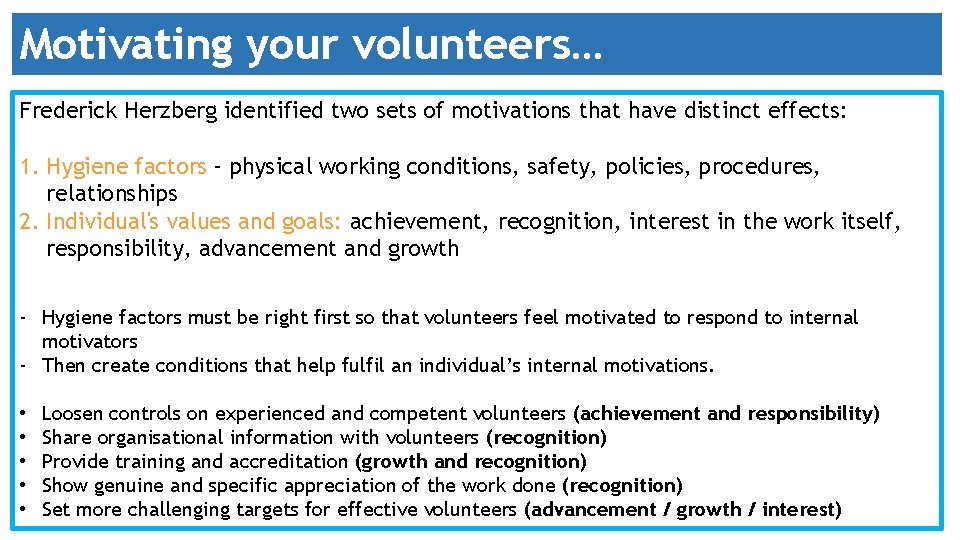
Motivating your volunteers… Frederick Herzberg identified two sets of motivations that have distinct effects: 1. Hygiene factors – physical working conditions, safety, policies, procedures, relationships 2. Individual's values and goals: achievement, recognition, interest in the work itself, responsibility, advancement and growth - Hygiene factors must be right first so that volunteers feel motivated to respond to internal motivators - Then create conditions that help fulfil an individual’s internal motivations. • • • Loosen controls on experienced and competent volunteers (achievement and responsibility) Share organisational information with volunteers (recognition) Provide training and accreditation (growth and recognition) Show genuine and specific appreciation of the work done (recognition) Set more challenging targets for effective volunteers (advancement / growth / interest)
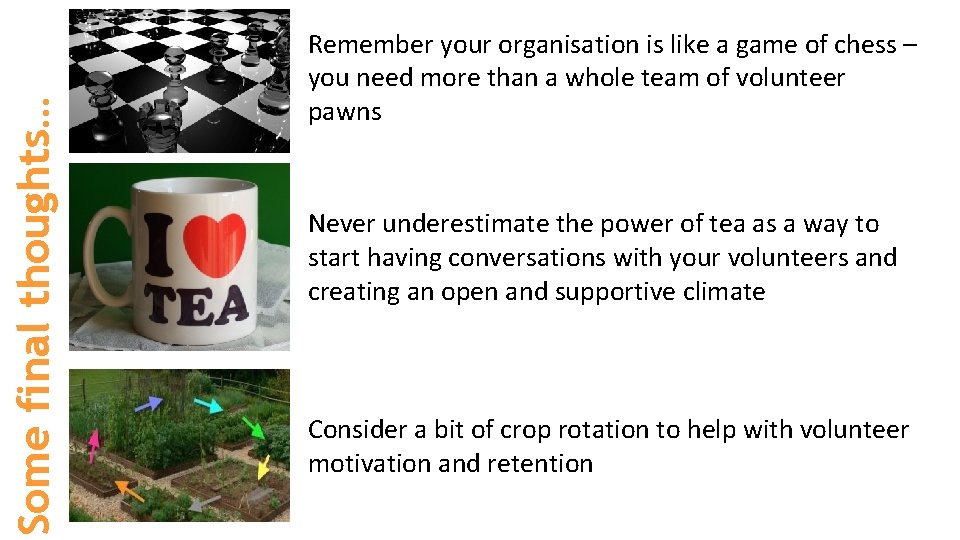
Some final thoughts… Remember your organisation is like a game of chess – you need more than a whole team of volunteer pawns Never underestimate the power of tea as a way to start having conversations with your volunteers and creating an open and supportive climate Consider a bit of crop rotation to help with volunteer motivation and retention
Please email Emily. shaw@ocva. org. uk or call 01865 25146 if you have any further questions