
RECREATING THE PAM 250 MATRIX MIRIAM BERN THE
RECREATING THE PAM 250 MATRIX MIRIAM BERN

THE PROBLEM • PAM 250 Matrix used to score sequence alignments • Provides more accurate understanding of which amino acids will be conserved and which mutations will occur • Is it easy to replicate? • Anna’s DNA example: Why was it not symmetric?
HOW DID I SOLVE IT? • Turned steps of Dayhoff paper into Python code • Wrote functions to compute the PAM 250 Matrix from the Accepted Point Mutations Matrix • Used the steps to replicate Anna’s DNA example to see what went wrong
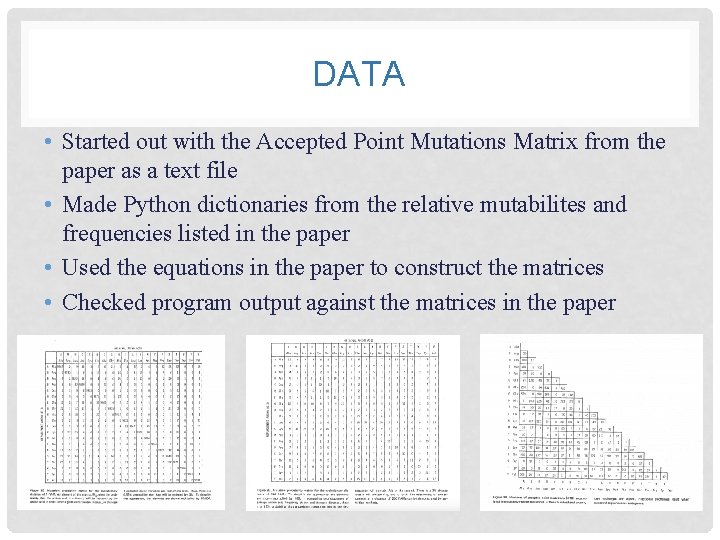
DATA • Started out with the Accepted Point Mutations Matrix from the paper as a text file • Made Python dictionaries from the relative mutabilites and frequencies listed in the paper • Used the equations in the paper to construct the matrices • Checked program output against the matrices in the paper

HIGH LEVEL STEPS • Step 1: Calculate proportionality constant (lambda) • Step 2: Using the Accepted Point Mutations Matrix, relative mutabilities, and lambda, create Mutation Probability Matrix for 1 PAM • Step 3: Using Python package Num. Py, multiply the matrix by itself 250 times to get the Mutation Probability Matrix for 250 PAMs • Step 4: Divide by the frequency to get the Relatedness Odds Matrix • Step 5: Take the log of these values to get the Log Odds Matrix • Step 6: Reorder the Log Odds Matrix to match the amino acid order in the paper and cut it in half
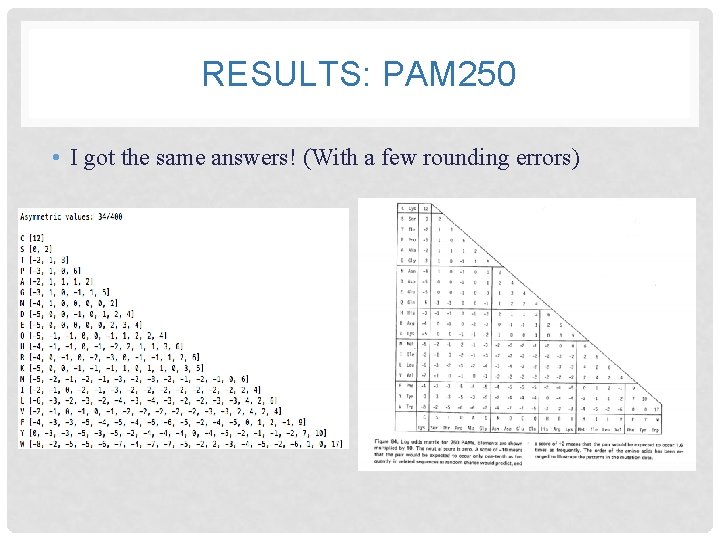
RESULTS: PAM 250 • I got the same answers! (With a few rounding errors)
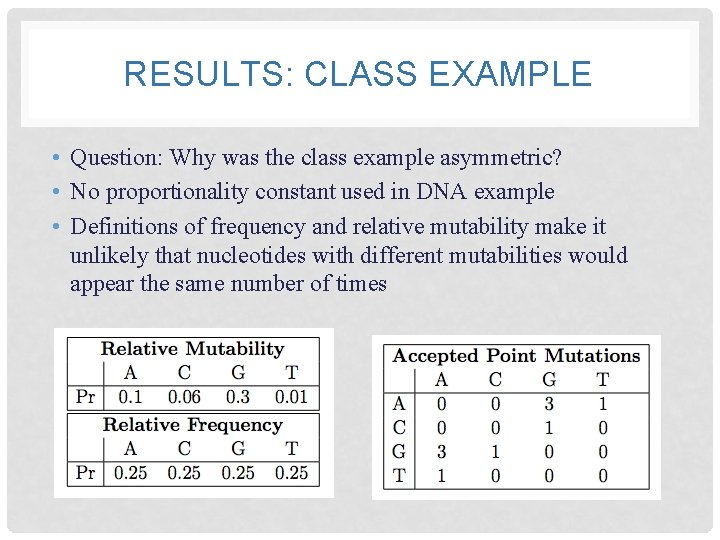
RESULTS: CLASS EXAMPLE • Question: Why was the class example asymmetric? • No proportionality constant used in DNA example • Definitions of frequency and relative mutability make it unlikely that nucleotides with different mutabilities would appear the same number of times
- Slides: 7