
Recreating the Big Bang Experiments at the Large
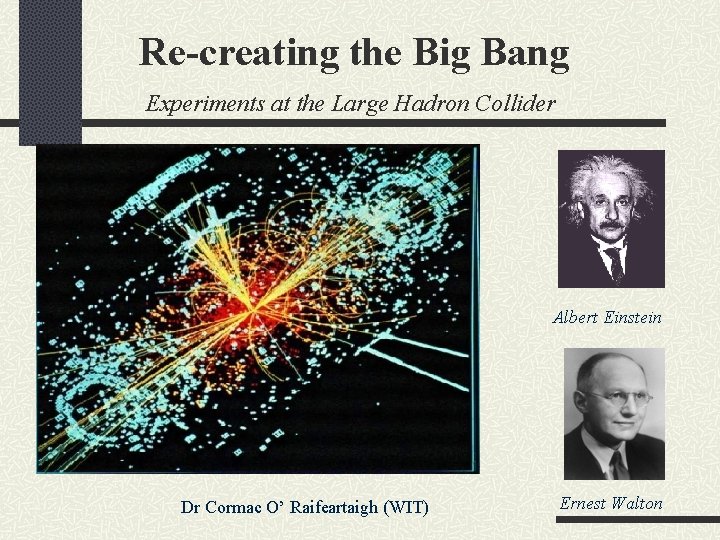
Re-creating the Big Bang Experiments at the Large Hadron Collider Albert Einstein Dr Cormac O’ Raifeartaigh (WIT) Ernest Walton
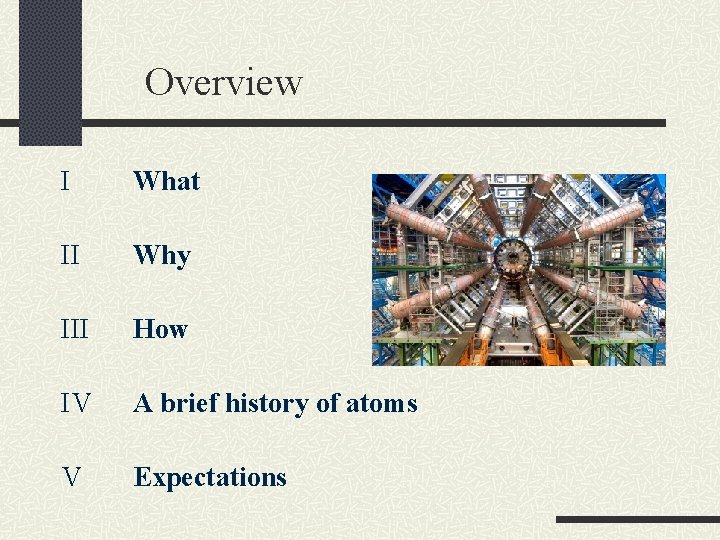
Overview I What II Why III How IV A brief history of atoms V Expectations
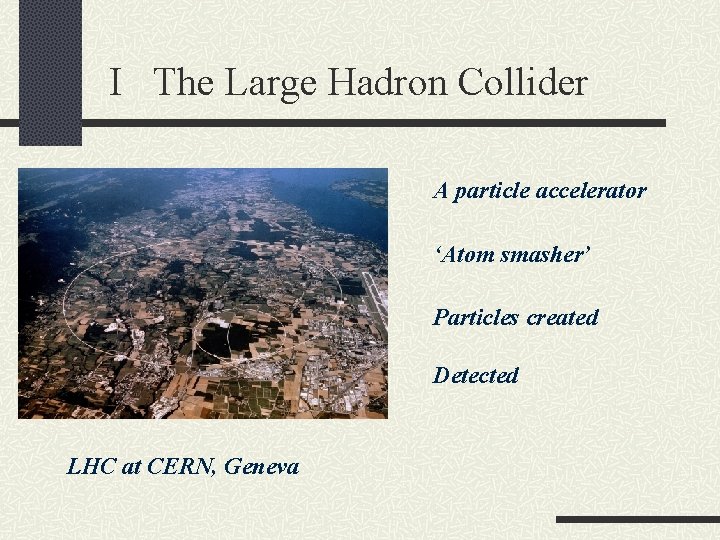
I The Large Hadron Collider A particle accelerator ‘Atom smasher’ Particles created Detected LHC at CERN, Geneva
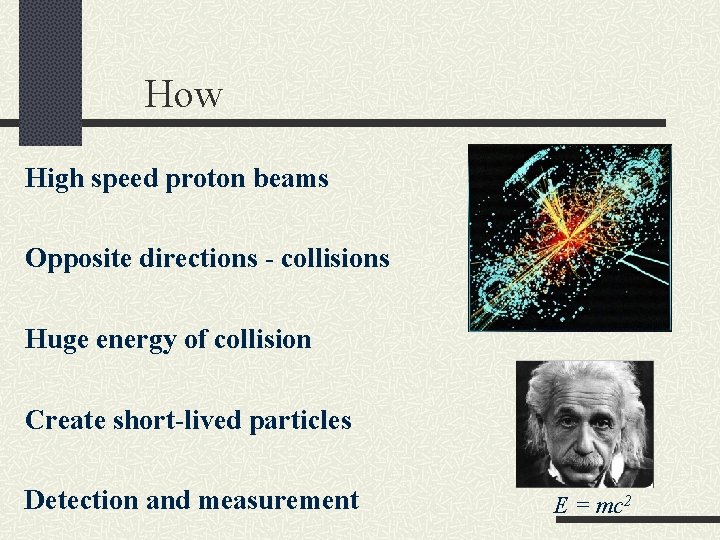
How High speed proton beams Opposite directions - collisions Huge energy of collision Create short-lived particles Detection and measurement E = mc 2
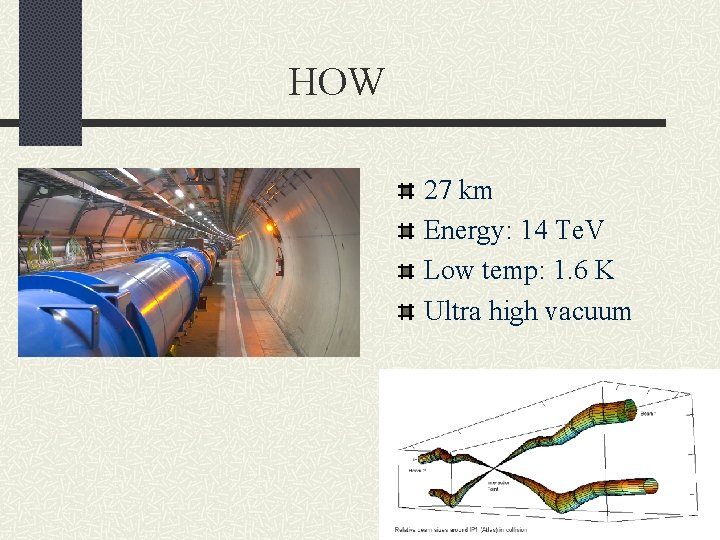
HOW 27 km Energy: 14 Te. V Low temp: 1. 6 K Ultra high vacuum
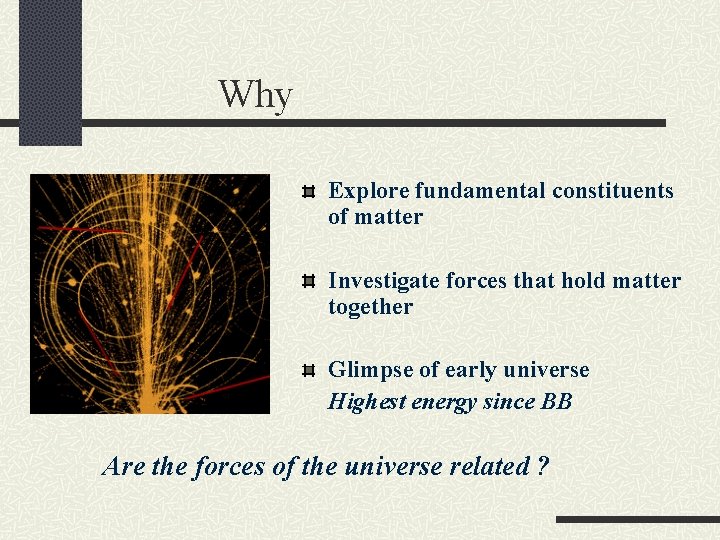
Why Explore fundamental constituents of matter Investigate forces that hold matter together Glimpse of early universe Highest energy since BB Are the forces of the universe related ?
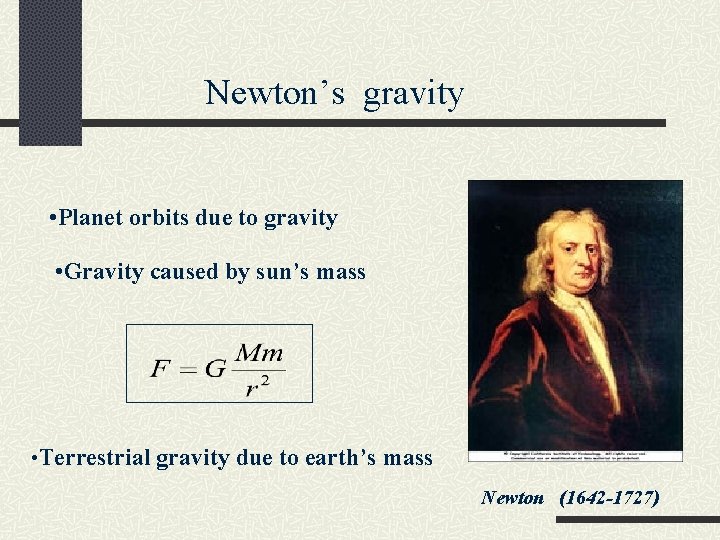
Newton’s gravity • Planet orbits due to gravity • Gravity caused by sun’s mass • Terrestrial gravity due to earth’s mass Newton (1642 -1727)
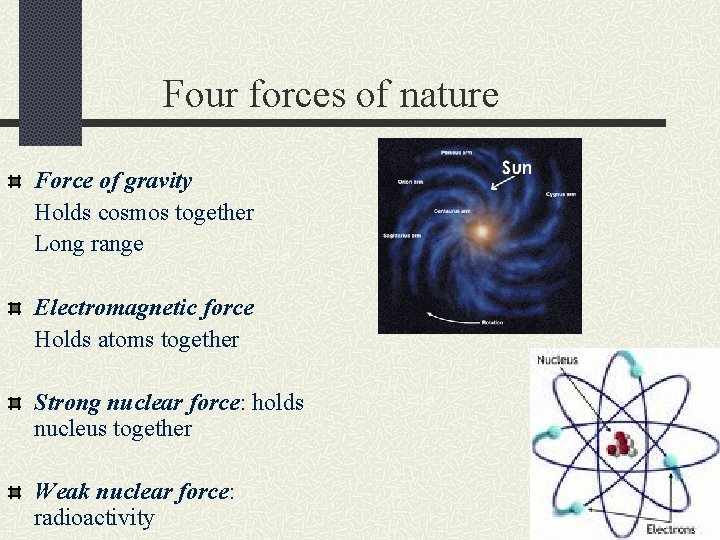
Four forces of nature Force of gravity Holds cosmos together Long range Electromagnetic force Holds atoms together Strong nuclear force: holds nucleus together The atom Weak nuclear force: radioactivity
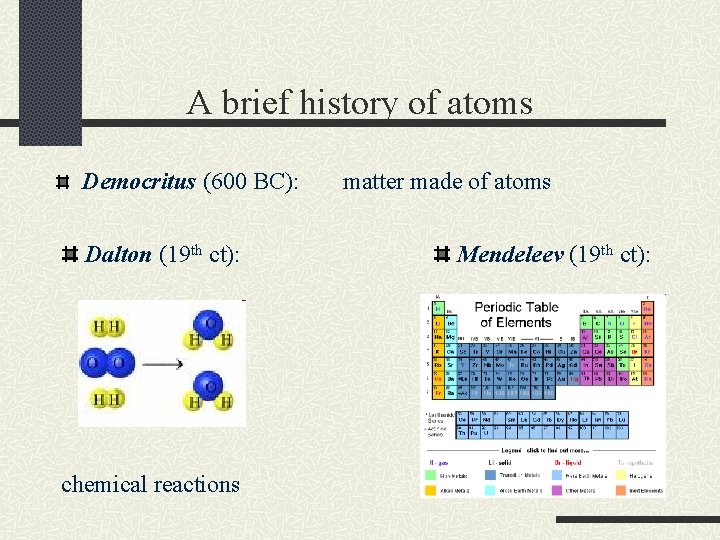
A brief history of atoms Democritus (600 BC): Dalton (19 th ct): chemical reactions matter made of atoms Mendeleev (19 th ct):
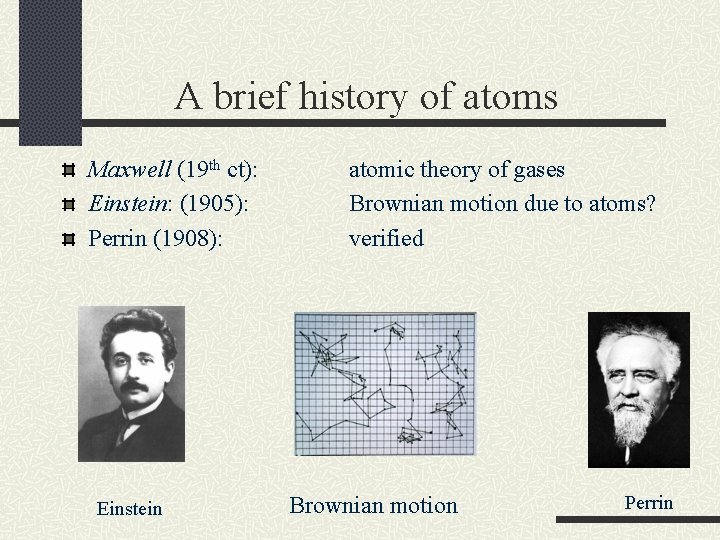
A brief history of atoms Maxwell (19 th ct): Einstein: (1905): Perrin (1908): Einstein atomic theory of gases Brownian motion due to atoms? verified Brownian motion Perrin
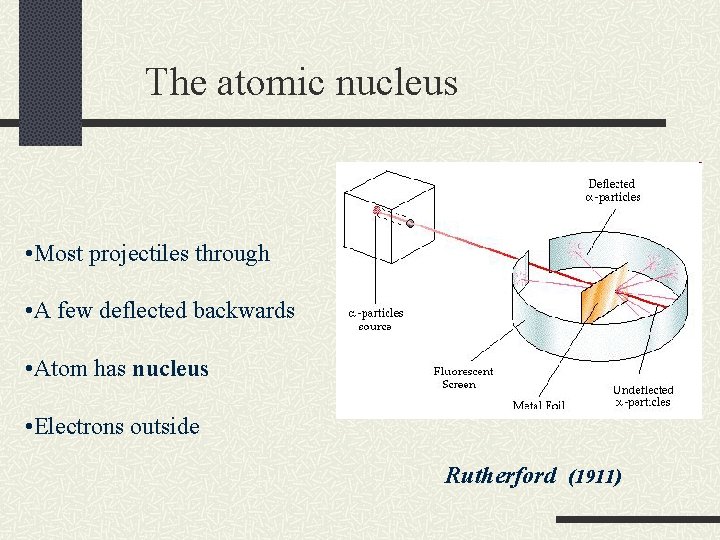
The atomic nucleus • Most projectiles through • A few deflected backwards • Atom has nucleus • Electrons outside Rutherford (1911)
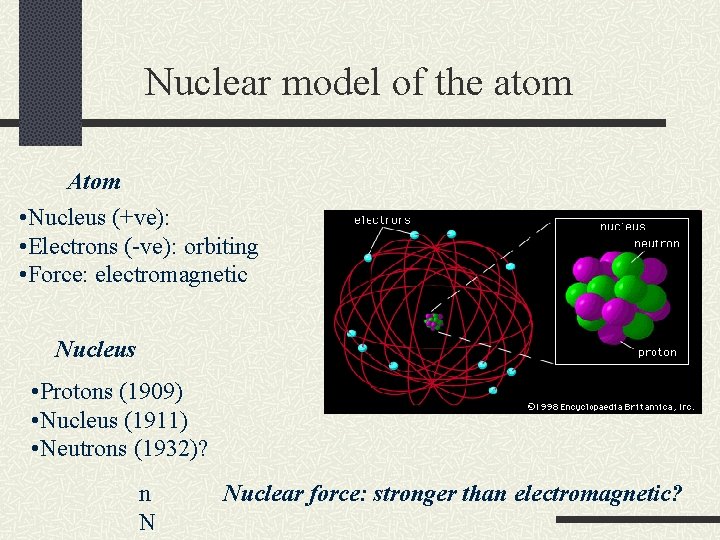
Nuclear model of the atom Atom • Nucleus (+ve): • Electrons (-ve): orbiting • Force: electromagnetic Nucleus • Protons (1909) • Nucleus (1911) • Neutrons (1932)? n N Nuclear force: stronger than electromagnetic?

Splitting the nucleus Cockcroft and Walton: particle accelerator Particles used to split the nucleus (1932) H + Li = He + He Verified mass-energy (E= mc 2) Verified quantum tunnelling Nobel prize (1956)
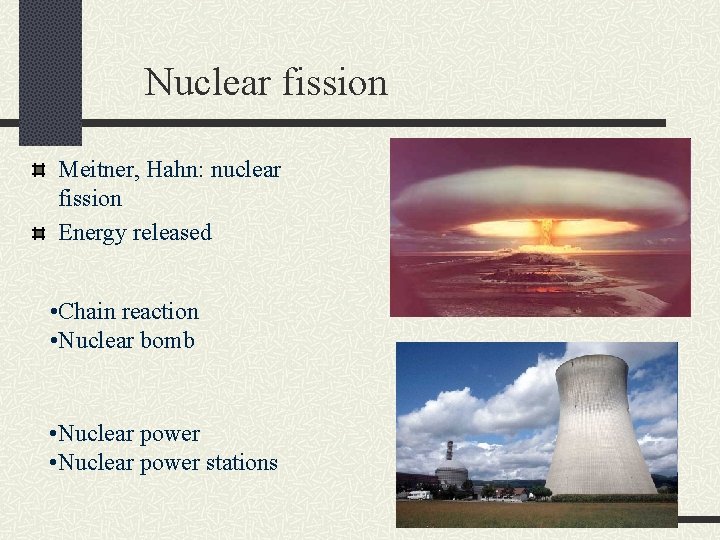
Nuclear fission Meitner, Hahn: nuclear fission Energy released • Chain reaction • Nuclear bomb • Nuclear power stations
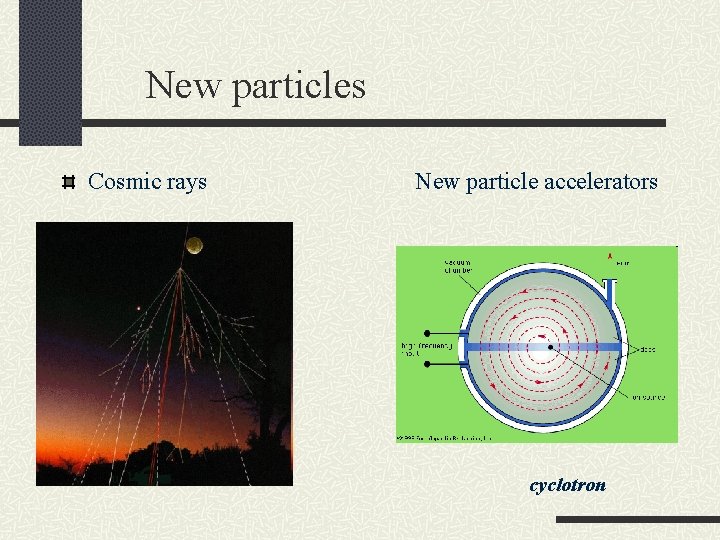
New particles Cosmic rays New particle accelerators cyclotron

Particle Zoo Over 100 particles
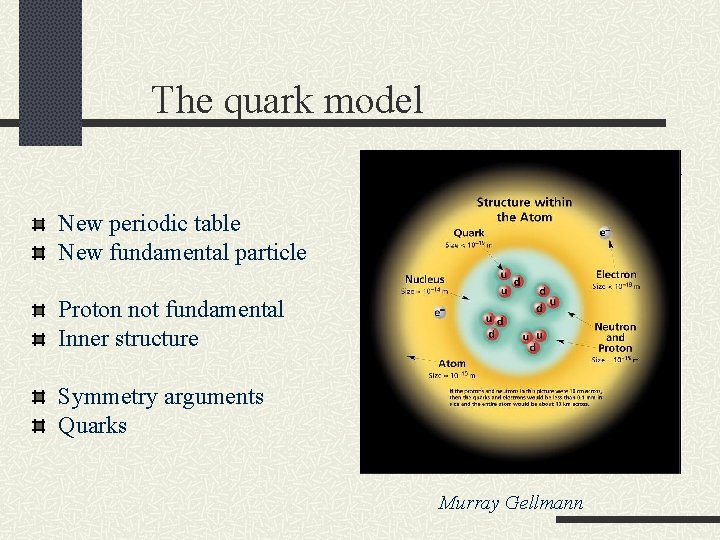
The quark model New periodic table New fundamental particle Proton not fundamental Inner structure Symmetry arguments Quarks Murray Gellmann
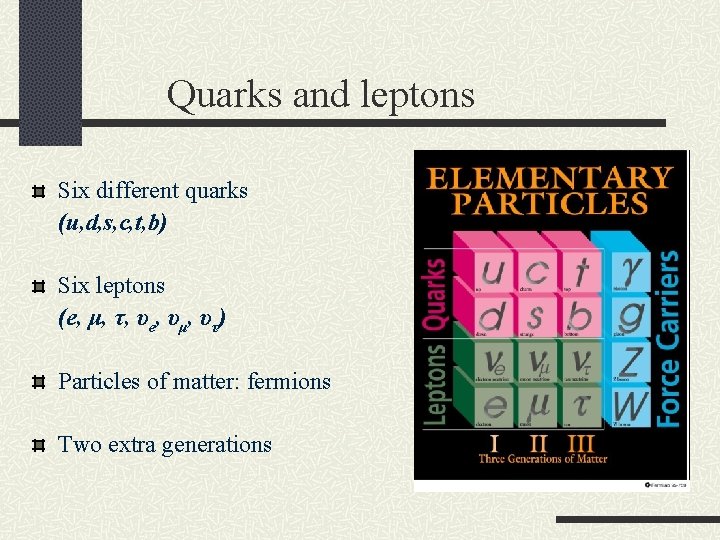
Quarks and leptons Six different quarks (u, d, s, c, t, b) Six leptons (e, μ, τ, υe, υμ, υτ) Particles of matter: fermions Two extra generations
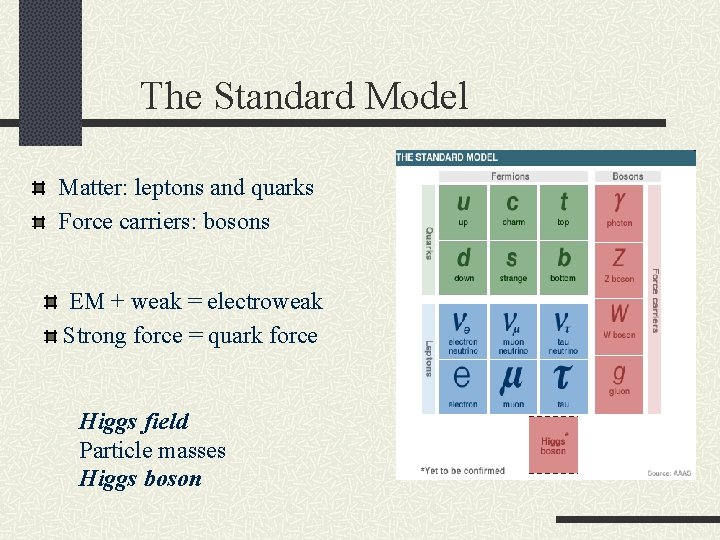
The Standard Model Matter: leptons and quarks Force carriers: bosons EM + weak = electroweak Strong force = quark force Higgs field Particle masses Higgs boson
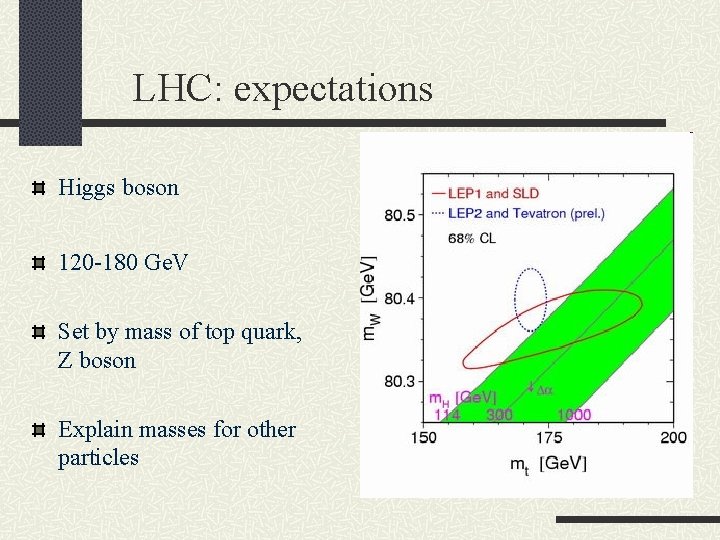
LHC: expectations Higgs boson 120 -180 Ge. V Set by mass of top quark, Z boson Explain masses for other particles
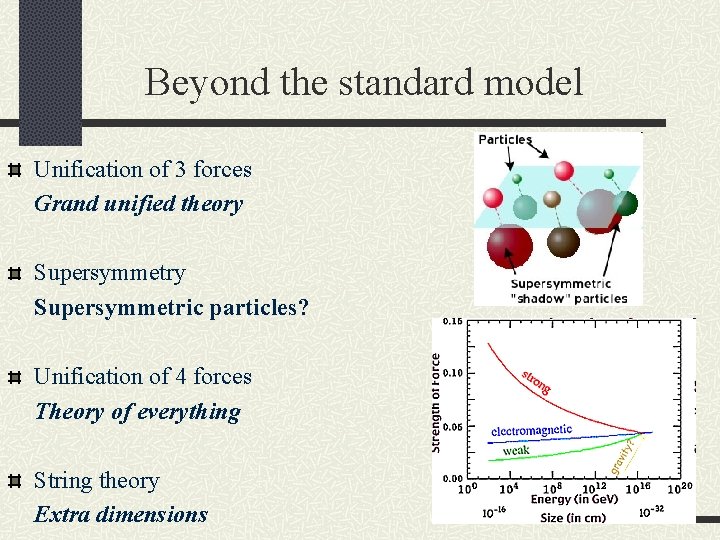
Beyond the standard model Unification of 3 forces Grand unified theory Supersymmetric particles? Unification of 4 forces Theory of everything String theory Extra dimensions
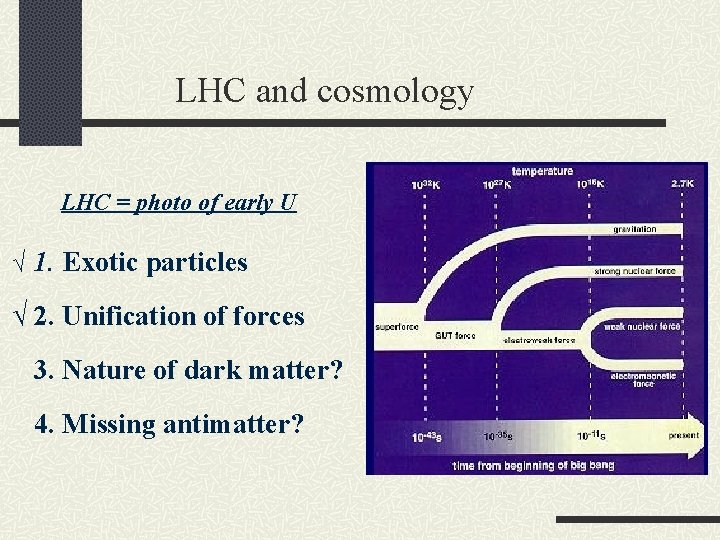
LHC and cosmology LHC = photo of early U √ 1. Exotic particles √ 2. Unification of forces 3. Nature of dark matter? 4. Missing antimatter?
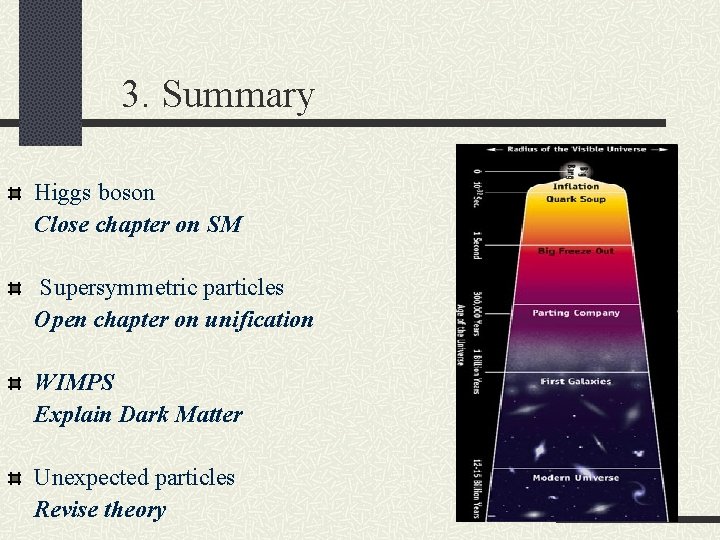
3. Summary Higgs boson Close chapter on SM Supersymmetric particles Open chapter on unification WIMPS Explain Dark Matter Unexpected particles Revise theory
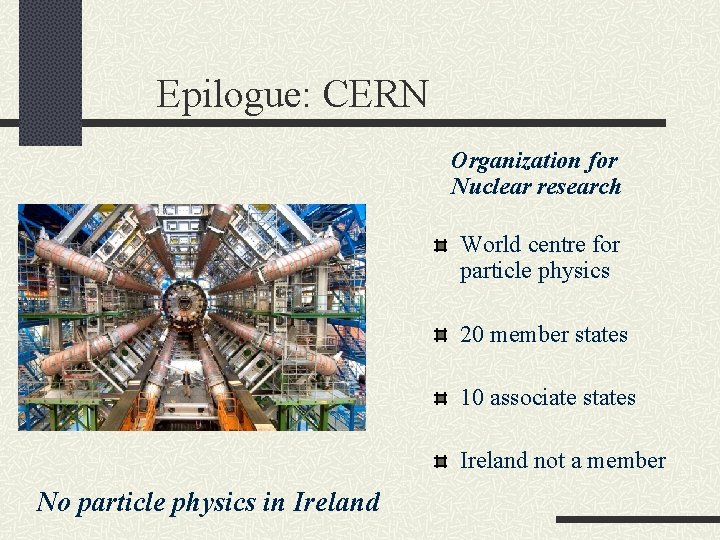
Epilogue: CERN Organization for Nuclear research World centre for particle physics 20 member states 10 associate states Ireland not a member No particle physics in Ireland
- Slides: 24