
Recovery While Incarcerated Transforming the Delivery of Addiction
- Slides: 26
“Recovery While Incarcerated” Transforming the Delivery of Addiction Recovery Services in IDOC Facilities Stephanie L. Anderson, LCSW Executive Director of Addiction Recovery Services Indiana Department of Correction
Addiction Recovery Division Julie Lanham, IDOC Deputy Commissioner Stephanie Spoolstra, IDOC Executive Director of Addiction Recovery J. David Reid, IDOC Assistant Director of Addiction Recovery Christopher Hufford, Wexford Regional Director of Addiction Recovery Mari Lane, Wexford Corporate Director of Operations (assigned to Indiana ARS Project) • Jayson Harvey, Wexford Regional Addiction Recovery Re-Entry Coordinator • In collaboration with the full IDOC/Wexford Medical Services Team • • • Monica Gipson, IDOC Director of Health Care Services Dr. Bill Van. Ness, IDOC Chief Medical Officer Mark Levenhagen, IDOC Executive Director of Mental Health & Special Populations John Dallas, VPO for Indiana Wexford Rebecca Hess, Melinda Titus, & Lisa Burgeson, Wexford Regional Operations Directors
“Recovery While Incarcerated” - RWI • The RWI Project seeks to transform the way addiction recovery services (ARS) are delivered in IDOC facilities • Responds to Governor Holcomb’s call for action by naming the Addiction Epidemic as one of the key pillars during his administration • Work collaboratively with Case Management Policy and Operations Policy • Shift the culture of corrections towards a Recovery Oriented System
Genesis of RWI • Prioritize education & literacy • Provide a full continuum of care • Remove time restrictions for entrance to addiction recovery services • Expand access to MAT and effective re-entry strategies • Address the unintended negative impact of Purposeful Incarceration • Integrate with medical and mental health services • Improve and update the curriculum • Increased training in evidencebased practice for AR staff
Goals of RWI • Provide the right treatment, right place, right time so that offenders can begin the journey into recovery from the beginning of their incarceration • Develop a continuum of care that spans the duration of incarceration for offenders, allowing offenders to engage in substance use disorder treatment at all stages of their incarceration • Provide a recovery-based environment that promotes structure, accountability, development of coping skills, and emotional support for offenders seeking change and recovery • Individualize treatment curriculums to address an offender’s unique needs, to prepare them for successful re-entry into the community
Key Features of RWI Treatment • Orientation and Mentoring • Individualized Treatment Planning • Process Group • Spirituality Group • Instructional Group • AA, NA, Celebrate Recovery selfhelp support groups • DBT Skills Training • Anger Management • Grief and Loss • Life Skills • Helping Women Recover • Relapse Prevention • Recovery Coaching • MAT (as clinically appropriate)
Screening for SUD
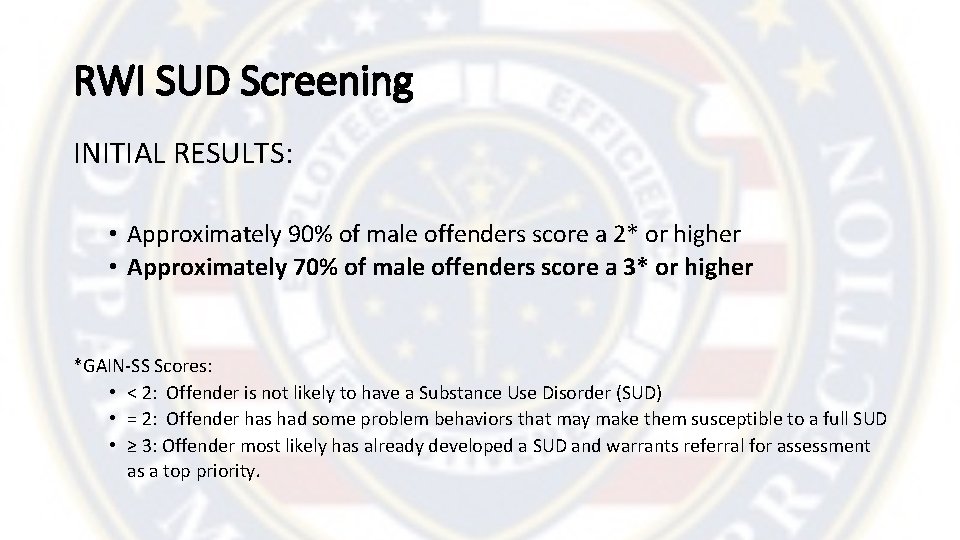
RWI SUD Screening • Beginning in July 2017, every offender newly committed to IDOC is screened at their intake facility for the presence of substance use and mental health disorders • Screening instrument is the Global Appraisal of Individual Needs. Short Screener (GAIN-SS; Chestnut Health Systems, 2007) • GAIN-SS scores indicate whether an offender needs to be referred to ARS and/or Mental Health for additional assessment
RWI SUD Screening INITIAL RESULTS: • Approximately 90% of male offenders score a 2* or higher • Approximately 70% of male offenders score a 3* or higher *GAIN-SS Scores: • < 2: Offender is not likely to have a Substance Use Disorder (SUD) • = 2: Offender has had some problem behaviors that may make them susceptible to a full SUD • ≥ 3: Offender most likely has already developed a SUD and warrants referral for assessment as a top priority.
Assessing for SUD
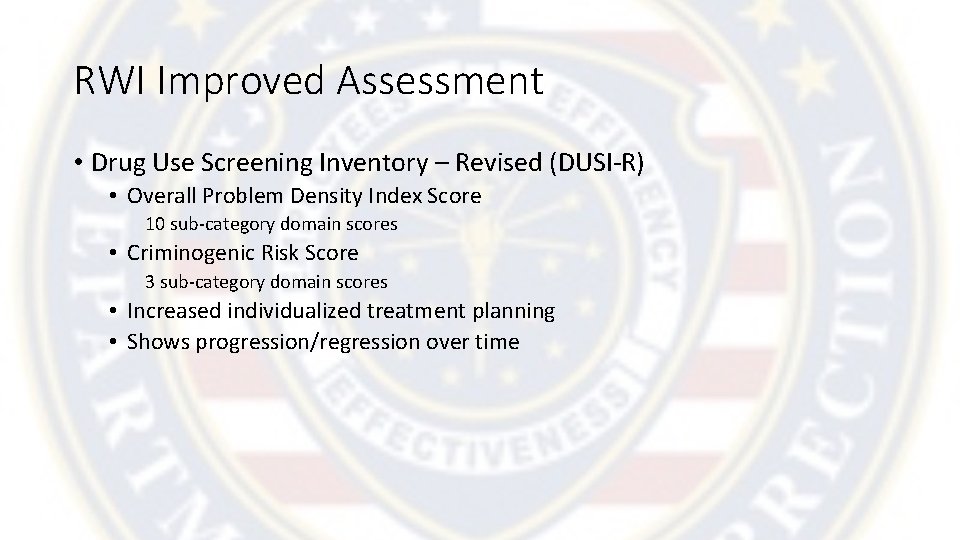
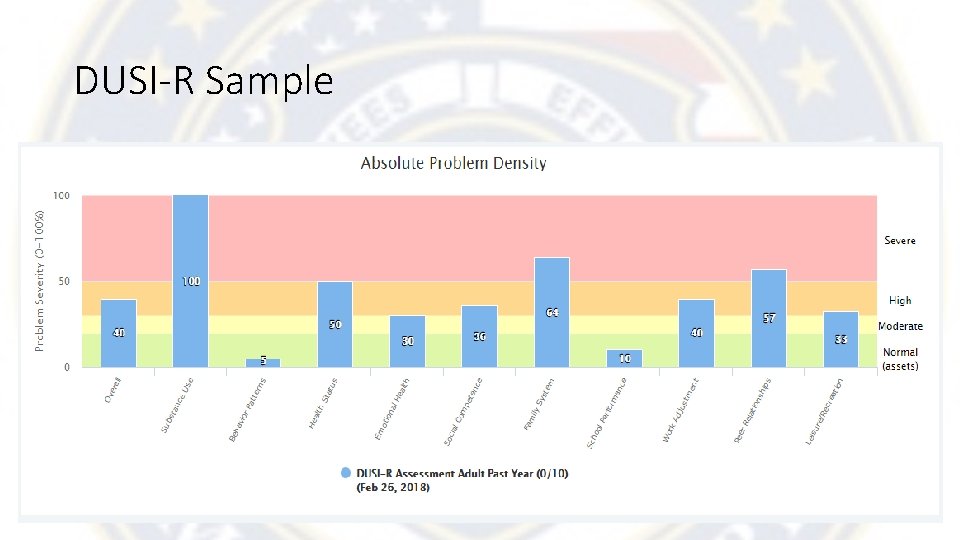
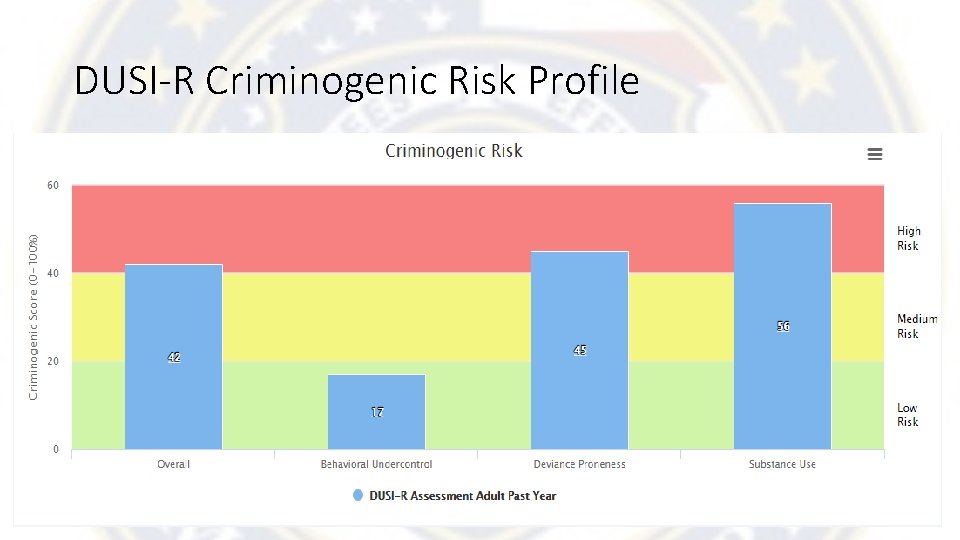
RWI Improved Assessment • Drug Use Screening Inventory – Revised (DUSI-R) • Overall Problem Density Index Score 10 sub-category domain scores • Criminogenic Risk Score 3 sub-category domain scores • Increased individualized treatment planning • Shows progression/regression over time
DUSI-R Sample
DUSI-R Criminogenic Risk Profile
RWI Program Operations
The Core of RWI – Sober Living Environment (SLE) • SLE is a designated pod or housing unit exclusively for offenders enrolled in the RWI program • SLE will allow offenders in all levels of treatment and phases of recovery to congregate together, to provide support in a controlled recovery environment • Depending on facility design, SLE may also incorporate offenders from other character programs such as PLUS and ICAN, similar to an “honor dorm” concept
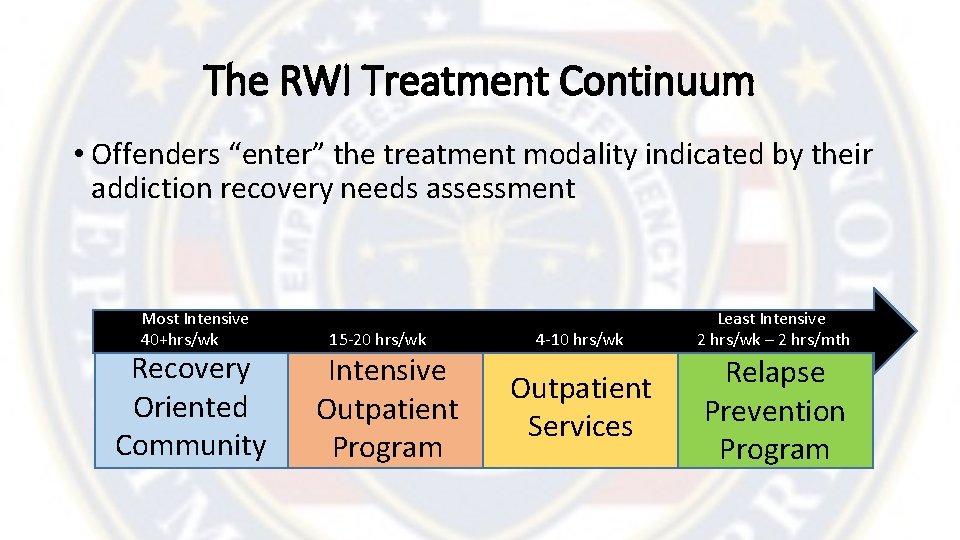
RWI Framework Continuum/Modality • Intensity/frequency of service • 4 distinct modalities • Placement determined by assessment scores Progression • Stage of Change • Level of competency in recovery skills • Six total progressions • Every enrolled offender will demonstrate mastery of each progression
The RWI Treatment Continuum • Offenders “enter” the treatment modality indicated by their addiction recovery needs assessment Most Intensive 40+hrs/wk Recovery Oriented Community 15 -20 hrs/wk Intensive Outpatient Program 4 -10 hrs/wk Outpatient Services Least Intensive 2 hrs/wk – 2 hrs/mth Relapse Prevention Program
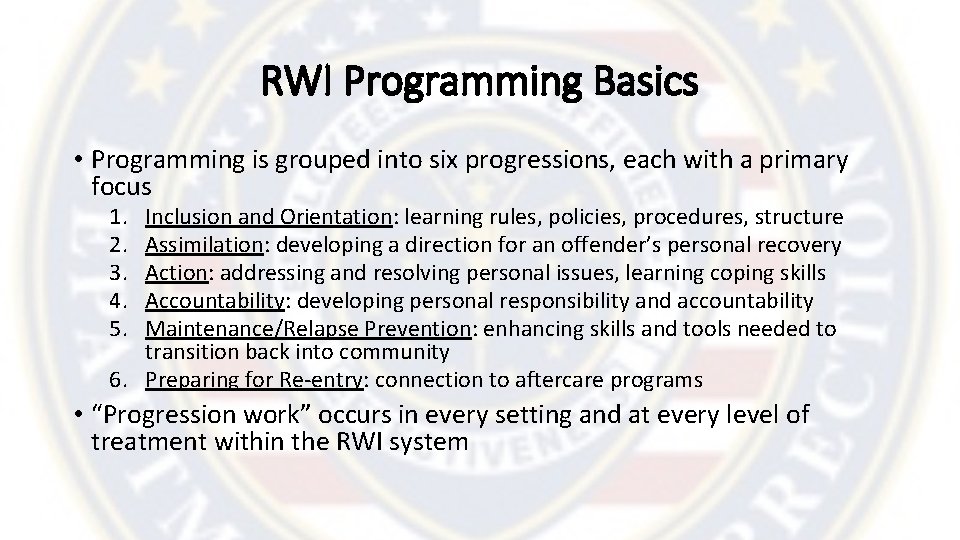
RWI Programming Basics • Programming is grouped into six progressions, each with a primary focus 1. 2. 3. 4. 5. Inclusion and Orientation: learning rules, policies, procedures, structure Assimilation: developing a direction for an offender’s personal recovery Action: addressing and resolving personal issues, learning coping skills Accountability: developing personal responsibility and accountability Maintenance/Relapse Prevention: enhancing skills and tools needed to transition back into community 6. Preparing for Re-entry: connection to aftercare programs • “Progression work” occurs in every setting and at every level of treatment within the RWI system
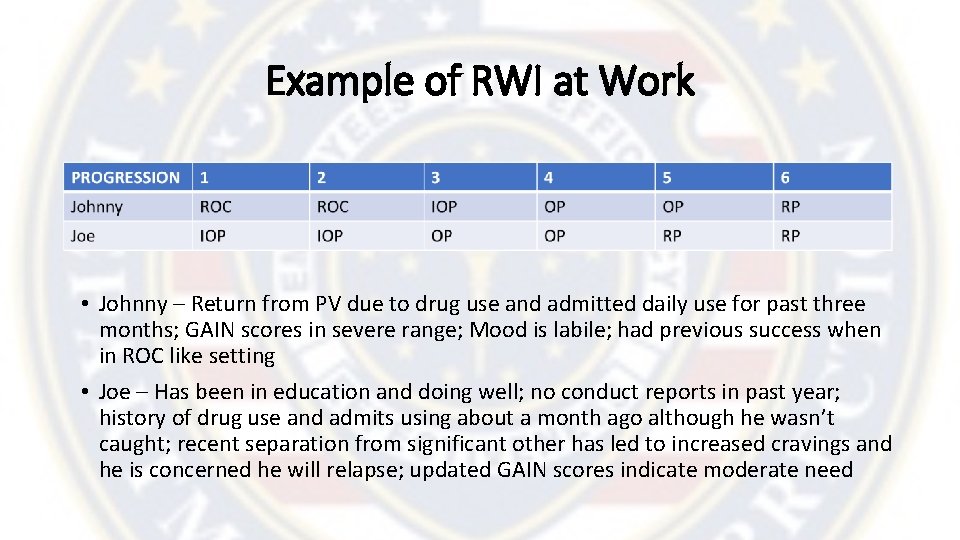
Example of RWI at Work • Johnny – Return from PV due to drug use and admitted daily use for past three months; GAIN scores in severe range; Mood is labile; had previous success when in ROC like setting • Joe – Has been in education and doing well; no conduct reports in past year; history of drug use and admits using about a month ago although he wasn’t caught; recent separation from significant other has led to increased cravings and he is concerned he will relapse; updated GAIN scores indicate moderate need
Medication Assisted Treatment
Medication Assisted Treatment (MAT) Basics • Three FDA approved medications for addiction MAT • Methadone • DEA Special License and Indiana DMHA Special Certification • Buprenorphine (Subutex) • DEA DATA 2000 Waiver (Drug Addiction Treatment Act of 2000) • Buprenorphine/Naloxone Combination (Suboxone, Bunavail, Zubsolv) • DEA DATA 2000 Waiver • Naltrexone (Revia, Vivitrol) • Not opioid based = no special license/certification • Emergency Overdose Medication • Naloxone (Narcan, Evzio)
MAT at the IDOC • Historically ØSmall re-entry pilot utilizing Naltrexone IM (Vivitrol) Ø Received one injection 5 -7 days prior to release with referral for continued treatment post-release • RWI Project ØNaltrexone PO (Revia) whenever clinically indicated Ø 60 days of Naltrexone PO pre-release Naltrexone IM (Vivitrol) 1 week prior to release Referral for continued MAT upon release
Engagement, Training & Planning
RWI – Staff Engagement • Leadership/Administrative Staff ØFacility requirements ØCustomization of service delivery ØOverall strategic planning • Custody/Operations Staff Ø Recognition of acute intoxication/overdose Ø Urine drug screening Ø General recovery principles • Unit Team/Case Management staff training Ø Offender referral/access to ARS Ø General recovery principles • Parole staff training ØRecognition of acute intoxication/overdose ØIdentifying highest risk populations ØRed flag conversations ØMAT
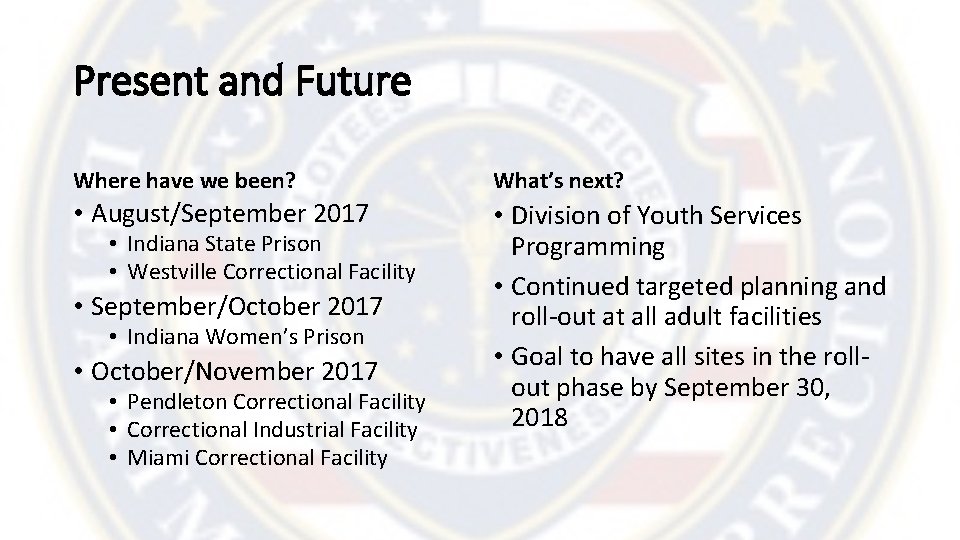
Present and Future Where have we been? What’s next? • August/September 2017 • Division of Youth Services Programming • Continued targeted planning and roll-out at all adult facilities • Goal to have all sites in the rollout phase by September 30, 2018 • Indiana State Prison • Westville Correctional Facility • September/October 2017 • Indiana Women’s Prison • October/November 2017 • Pendleton Correctional Facility • Correctional Industrial Facility • Miami Correctional Facility
Questions? Stephanie L. Anderson, LCSW 317 -232 -9588 SLAnderson@idoc. in. gov J. David Reid, LMHC 317 -234 -9751 jreid 1@idoc. in. gov