
RECOVERY Melissa Brymer National Center for Child Traumatic
RECOVERY Melissa Brymer National Center for Child Traumatic Stress Kelly Ryan-Biskup Windham (ME) School Department U. S. Department of Education Office of Safe and Drug-Free Schools 400 Maryland Avenue, SW Washington, DC 20202 DRAFT
Overview of Session w Identify Key Messages w Define the Recovery Phase w Identify Key Components of Recovery: § § w w 2 Physical aspects Business/fiscal elements Academic structure Emotional/mental health Discuss How to Prepare for Recovery in Advance Review Key "Issues/Debates" in Recovery Discuss Recovery Scenario Questions? DRAFT
Key Messages w The Recovery phase is designed to assist students, staff, and their families in the healing process and to restore educational operations in schools w Plan for common events; plan for uncommon events w Recovery is an ongoing process that is directly linked to the other three phases of crisis planning w Strong community partnerships are key to supporting Recovery efforts for schools 3 DRAFT
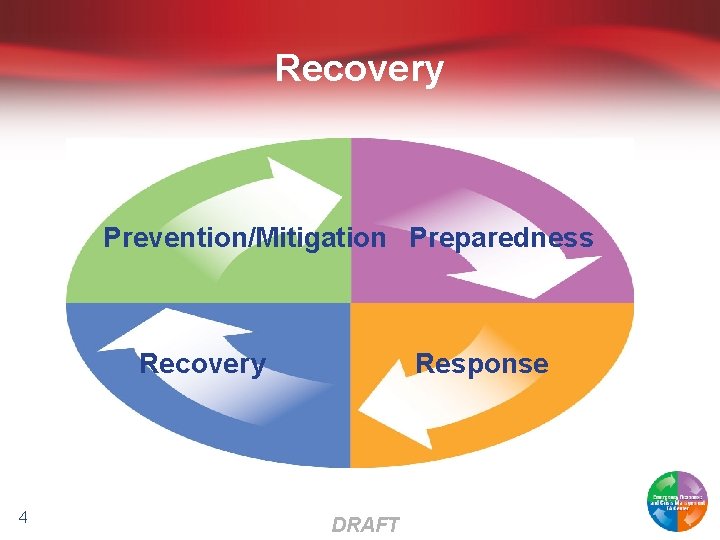
Recovery Prevention/Mitigation Preparedness Recovery 4 Response DRAFT
What is the Recovery Phase? 5 w The Recovery phase is designed to assist students and staff in the healing process and to restore educational operations in schools § Recovery can be a long-term process § Planning for Recovery begins in the Prevention/Mitigation phase § Providing for Recovery efforts requires leadership and buy-in from the top § There is a direct link between emotional stress and academic achievement w GOAL: Restore a safe and healthy learning environment DRAFT
Probability of Event Types of Events in Schools/Districts 6 w Student deaths w Staff deaths w Accidents (students hit by cars, bus accidents, car accidents, swimming, etc. ) w Violence in schools or community (assaults, murders, drive-by shooting in community, etc. ) w Suicides w Natural disasters (tornado, earthquake, wildfire, hurricane, etc. ) w School shootings. DRAFT
Preparing in Advance for Recovery: Introduction w Planning and Policies w Partners and Resources w Training 7 DRAFT
Preparing in Advance for Recovery: Policies and Planning w Planning in advance of an event § Outline service delivery systems § Develop template letters for emergencies § Pre-determine strategies for accepting contributions/donations following a death/incident § Outline strategies for dealing with "empty chairs" § Determine a policy for memorials (be consistent across events) § Ensure a process is in place for parental consent § Compile resource kits 8 DRAFT
Preparing in Advance for Recovery: Policies and Planning w Consider the structures and departments w Coordinate with district departments § Safety and security, facility management, risk management, budget office, transportation, food services, technology services, etc. w Develop and practice a continuity of operations plan (COOP) at district and school levels w Create Damage Assessment Response Teams (DART) § Assemble Crisis Recovery teams: • District teams • School-based teams • Define procedures for crisis recovery 9 § Coordinate with outside community partners and agencies DRAFT
Preparing in Advance for Recovery: Partners and Resources w Before an event occurs, schools should § Consider expertise available for mental health service provision at the: • School level • District level • Community level 10 § Outline partnership agreements with relevant local partners detailing support available § Identify a school/district employee to coordinate partnerships with community - a liaison officer § Identify and train crisis Recovery team members § Develop a process for screening and registering volunteers § Develop a process for inventorying district and donated DRAFT

Preparing in Advance for Recovery: Training w To ensure that appropriate training is conducted for Recovery, schools should proactively: § Identify and train appropriate staff in developmentally and culturally appropriate service provision 11 • Train mental health staff on specific interventions • Provide basic training on available resources and common reactions to trauma for all staff (including administrators) • Provide specific information to all staff regarding the school's referral system (e. g. , inform teachers on who students can go to for support - referral systems available) • Train teachers/staff on early warning signs DRAFT
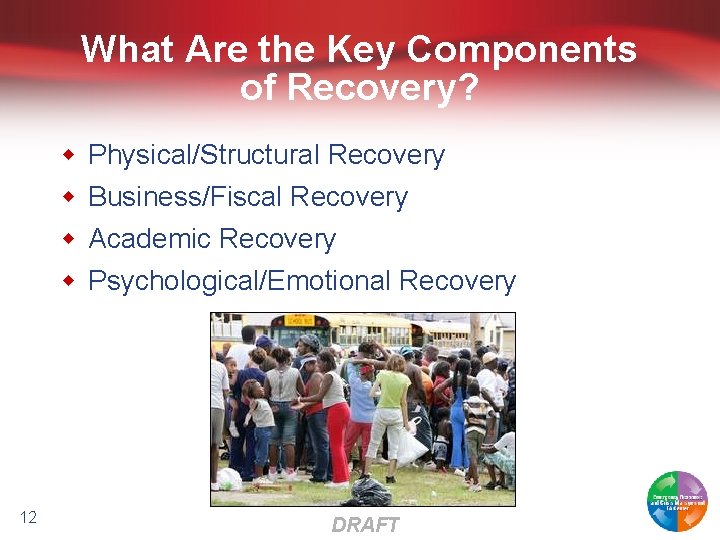
What Are the Key Components of Recovery? w w 12 Physical/Structural Recovery Business/Fiscal Recovery Academic Recovery Psychological/Emotional Recovery DRAFT
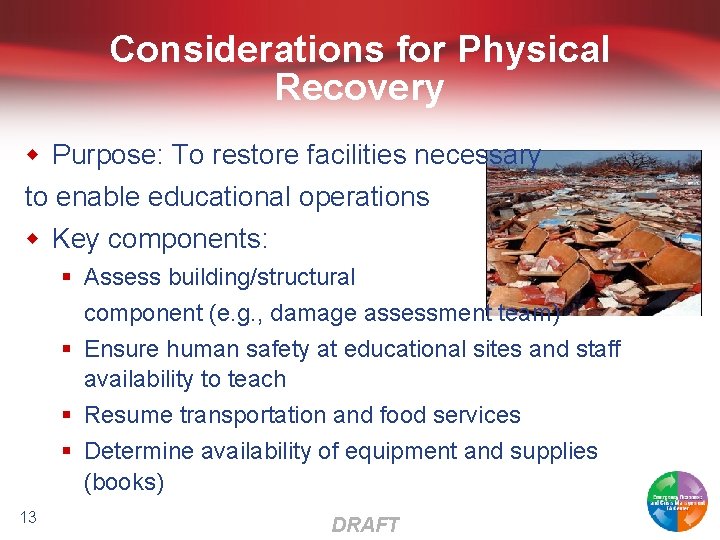
Considerations for Physical Recovery w Purpose: To restore facilities necessary to enable educational operations w Key components: § Assess building/structural component (e. g. , damage assessment team) § Ensure human safety at educational sites and staff availability to teach § Resume transportation and food services § Determine availability of equipment and supplies (books) 13 DRAFT
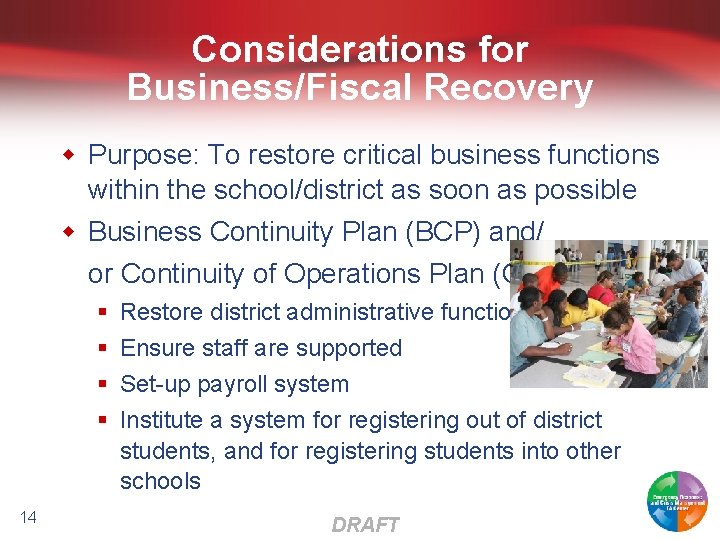
Considerations for Business/Fiscal Recovery w Purpose: To restore critical business functions within the school/district as soon as possible w Business Continuity Plan (BCP) and/ or Continuity of Operations Plan (COOP): § § 14 Restore district administrative functions Ensure staff are supported Set-up payroll system Institute a system for registering out of district students, and for registering students into other schools DRAFT
Considerations for Business Recovery w Functional Responsibilities § Identify, in advance, who has responsibility for closing schools, or sending students/staff to alternate locations § Identify who is responsible for restoring which business functions for schools/districts § Identify succession plans § Ensure systems are in place for rapid contract execution in the event of an emergency 15 DRAFT
Considerations for Academic Recovery w Purpose: To facilitate students' return to learning; restore structure and routine w Short-term considerations § Quick decision making regarding school/academic routines § Brief administrators and staff § Communicate with parents/guardians on events and the plan w In general, maintaining the school routine is helpful 16 § Can the school remain open? § Can the school routine be maintained? Modified? DRAFT
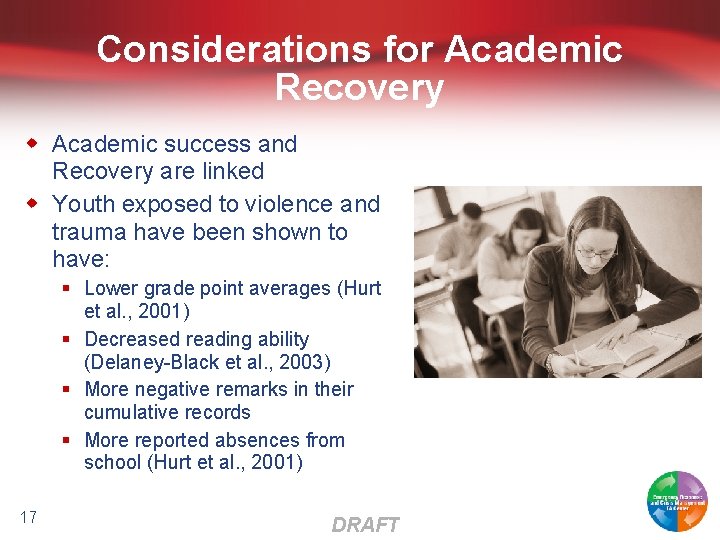
Considerations for Academic Recovery w Academic success and Recovery are linked w Youth exposed to violence and trauma have been shown to have: § Lower grade point averages (Hurt et al. , 2001) § Decreased reading ability (Delaney-Black et al. , 2003) § More negative remarks in their cumulative records § More reported absences from school (Hurt et al. , 2001) 17 DRAFT
Considerations for Academic Recovery w Youth exposed to violence and trauma have been shown to have: § Decreased rates of high school graduation (Grogger, 1997) § Increased expulsions and suspensions (LAUSD Survey) w Traumatized students may: § Engage in uncharacteristically aggressive behavior § Have difficulty concentrating and learning 18 DRAFT
Considerations for Emotional Recovery w Purpose: To promote coping and resiliency for students, staff, and their families following an emergency or crisis w Key components § Recovery/mental health services that are available and acceptable in your district § Internal and external resources • Short-term considerations • Overview of mental health interventions • Psychoeducation • Psychological first aid • Intervention strategies & models • Long-term considerations 19 DRAFT
Considerations for Emotional Recovery: w Crisis recovery/mental health services available and acceptable in the district § Support from leadership is critical • All planning involves the school Principal or their designee • Some schools may be hesitant to bring in "outside" mental health support - think this through in advance • Long-term services need support from the school board § Familiarity with funding sources after disasters 20 DRAFT
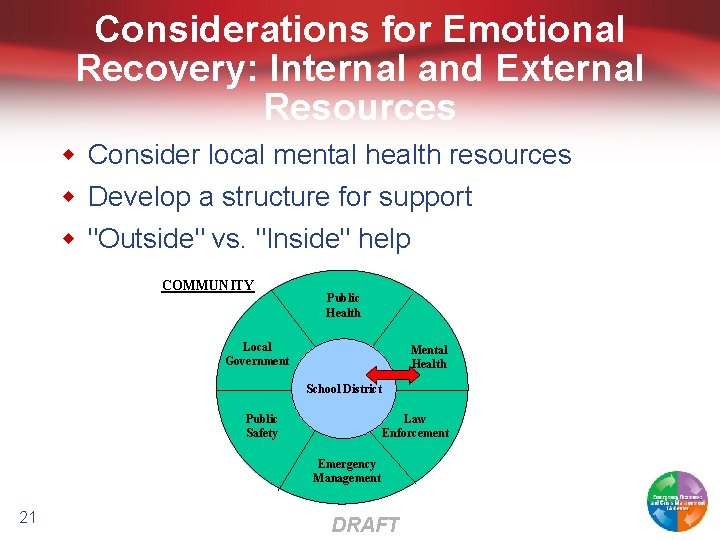
Considerations for Emotional Recovery: Internal and External Resources w Consider local mental health resources w Develop a structure for support w "Outside" vs. "Inside" help COMMUNITY Public Health Local Government Mental Health School District Public Safety Law Enforcement Emergency Management 21 DRAFT
Considerations for Emotional Recovery: Short-Term w Short-term Recovery § Identify circles of impact and provide triage • Triage is the process of identifying the immediate needs of students and staff, and ensuring referral to appropriate services • Provide psychoeducation for families, students, and staff § Consider psychological first aid § Consider utilization of services for staff through district Employee Assistance Programs (EAPs) § Leverage union resources available for teacher support § Be aware of impacts of possible trauma history 22 DRAFT
Considerations for Emotional Recovery: Short-Term w Traumatic Stress § Traumatic stress is an acute distress response that is experienced after exposure to a catastrophic event § Traumatic stress occurs because the event poses a serious threat to: • The individual's life or physical integrity • The life of a family member or close friend • One's surrounding environment § Individuals who have witnessed injury or death are also at risk to develop a trauma stress response 23 DRAFT
Key Components for Emotional Recovery: Mental Health Interventions w Purpose of mental health interventions § Promote coping and resiliency for students and staff and to assist with the healing process § Increase students' (ability to stay in school) academic performance § Provide a range of immediate and long-term interventions • Triage and assess immediate recovery needs of students and staff • Make individual and group crisis counseling available during the first week after a crisis event • Be aware of secondary adversities and make services available as needed 24 DRAFT
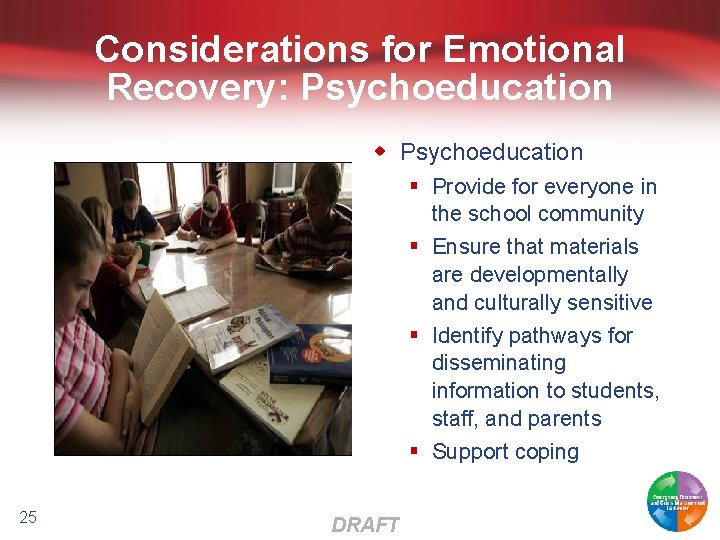
Considerations for Emotional Recovery: Psychoeducation w Psychoeducation § Provide for everyone in the school community § Ensure that materials are developmentally and culturally sensitive § Identify pathways for disseminating information to students, staff, and parents § Support coping 25 DRAFT
Considerations for Emotional Recovery: Psychological First Aid w Psychological First Aid (PFA) is an evidence-informed modular approach for assisting children, adolescents, adults, and families in the immediate aftermath of disaster and terrorism § Designed to • reduce the initial distress • foster short- and long-term adaptive functioning § PFA meets four basic standards • Consistent with research evidence on risk and resilience following trauma • Applicable & practical in field/school settings • Developmentally appropriate across the lifespan Source: National Child Traumatic Stress Network and National Center for PTSD, Psychological First Aid: Field Operations 2005 • Culturally informed. Guide, and. September, adaptable 26 DRAFT
Considerations for Emotional Recovery: Psychological First Aid w PFA Core Actions § § § § Initiate contact and engagement Ensure safety and comfort Stabilize Gather information on current needs and concerns Provide practical assistance Connect with social supports Provide information on coping Link with collaborative services Source: National Child Traumatic Stress Network and National Center for PTSD, Psychological First Aid: Field Operations Guide, September, 2005 27 DRAFT
Considerations for Emotional Recovery: Long-Term w Long-term Recovery strategies for mental health 28 § Conduct ongoing assessment/monitoring of mental health of students and staff § Monitor attendance, grades, and counselor's visits § Provide care for caregivers (compassion fatigue) § Incorporate lessons learned from each event into future planning efforts § Remember to reinforce ongoing prevention programs § Be aware of 'key dates, ' such as trials, DRAFT anniversaries, and holidays
Key Components for Emotional Recovery: Mental Health Interventions w Intervention strategies and models § Trauma and grief focused school-based mental health programs • Cognitive Behavioral Intervention for Trauma in Schools (CBITS) § Short-term individual, group, and family interventions § Depression and suicide prevention 29 DRAFT
Key Issues for the Recovery Phase w Issue #1: Opening or closing schools after an event occurs § Policy should be in place in advance § Considerations • How long should the school be closed? • How can parents/guardians weigh in on decisions about school closures? • Who has the ultimate decision-making power regarding school closure? • How will the community be notified? • Ultimate question -- Will the children be better off in school, or out of school? 30 DRAFT
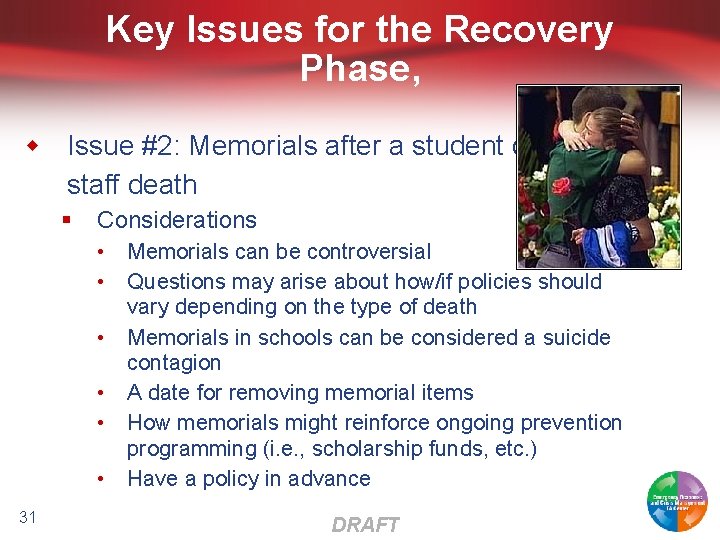
Key Issues for the Recovery Phase, w Issue #2: Memorials after a student or staff death § Considerations • Memorials can be controversial • Questions may arise about how/if policies should vary depending on the type of death • Memorials in schools can be considered a suicide contagion • A date for removing memorial items • How memorials might reinforce ongoing prevention programming (i. e. , scholarship funds, etc. ) • Have a policy in advance 31 DRAFT
Key Issues for the Recovery Phase, w Issue #3: How to handle key dates w Considerations § Be cognizant of anniversary dates but do not dramatize them § Watch for reactions around holidays and/or anniversaries § Prepare a constructive message for anniversaries § Make sure educators watch for risk behaviors 32 DRAFT
Discussion of Recovery Scenario
Discussion of Recovery Scenario w You're a member of the crisis recovery team at YOUR school. w Scenario § It's early morning. § School has just begun for the day. § One school bus is late arriving due to ice on the roads. 34 DRAFT
Discussion of Recovery Scenario w Details of the Incident § The bus has 26 students from the middle and high schools on board (ages 10 - 17) § As the bus arrives, the driver is unable to stop the bus. The bus skids and then crashes through the wall of the music room. There are 25 students in the music room w Additional Information § Two students are killed and 19 students are injured - four of them severely § The bus driver was found to be intoxicated 35 DRAFT
Discussion Questions 1) What are the first five steps you would take to activate your crisis recovery plan? 36 DRAFT
Discussion Questions 2) Which students and staff are most at risk? 37 DRAFT
Discussion Questions 3) What types of services would facilitate the recovery process? How would they be unfolded? 38 DRAFT
Summary w Recovery planning is a continual process w Schools need to plan for emotional/mental health needs of students and staff, as well as for the physical, business, and academic Recovery of their campuses following an emergency or crisis event w Planning for Recovery involves establishing key community partnerships, developing policies, providing training, and developing memoranda of understanding (MOU) 39 DRAFT

QUESTIONS? ?
THANK YOU!!! For More Information Contact: Melissa Brymer: (310) 235 -2633 ext. 227 Kelly Ryan-Biskup: (208) 284 -1173 or: Info@ercm. org
- Slides: 41