
Recovery Focused Practice Agnes Higgins Ph D School

- Slides: 22
Recovery Focused Practice Agnes Higgins Ph. D School of Nursing and Midwifery Trinity College Dublin Individual Care Planning: Enabling the Paradigm Shift to Recovery Focused Care - Lessons from the National Mental Health Services Collaborative Burlington Hotel 7 th February 2012
Recovery 2006 Recovery 1 of the 16 guiding principles 2005 Recovery discussion paper 2007 Recoveryfocussed approach is a standard 2008 Recovery Framework
Recovery Perennials Active process Individual and unique process Gradual process Non- linear process Trial and error process Life changing Stages or phases Can occur without professional help Aided by supportive healing environment • Journey of discovery • • • Leamy , M et al (2011) Conceptual framework for personal recovery in mental health: systematic review and narrative synthesis BJPsych 199: 445 -452
Journey of discovery • Discovery – – – – Identity Voice Hope Belief Meaning Belonging Strengths Personal control/agency – Life long journey
Recovery • Process/journey that person experiences • Philosophy/Approach to care and service provision
Recovery: approach to care • ‘Recovery offers a transformational ideology for services and suggests reform in how ‘mental illness’ is understood and managed, as well as in how people living with mental illness are understood and helped. This guiding philosophy challenges ideas and beliefs about the etiology and treatment of ‘mental illness’, including the way in which mental health practice is organised and implemented to ensure that people living with ‘mental illness’ lead meaningful and productive lives. ’ – Boutillier et al (2011) What does recovery mean in practice? A qualitative analysis of International recoveryoriented practice guidance psychiatric services 62(11): 1470 -1476
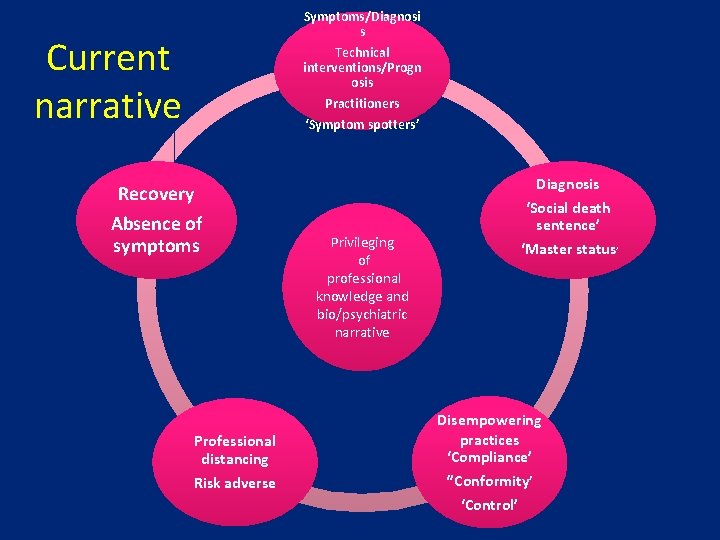
Symptoms/Diagnosi s Current narrative Technical interventions/Progn osis Practitioners ‘Symptom spotters’ Recovery Absence of symptoms Professional distancing Risk adverse Privileging of professional knowledge and bio/psychiatric narrative Diagnosis ‘Social death sentence’ ‘Master status’ Disempowering practices ‘Compliance’ ‘’Conformity’ ‘Control’
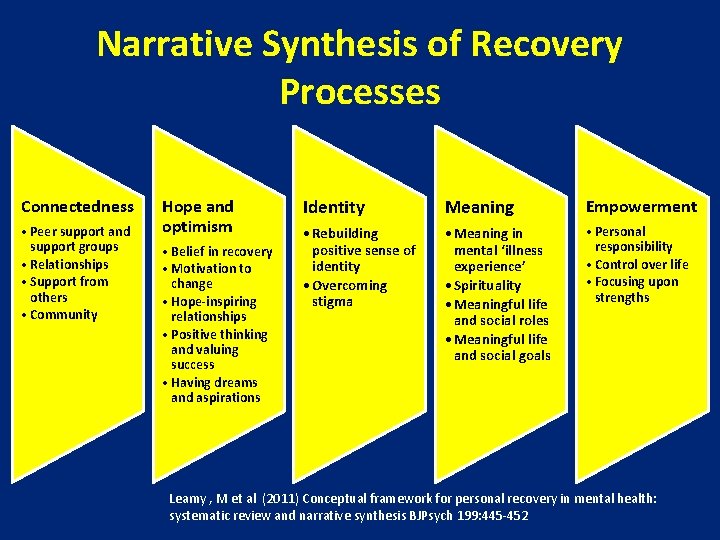
Narrative Synthesis of Recovery Processes Connectedness • Peer support and support groups • Relationships • Support from others • Community Hope and optimism • Belief in recovery • Motivation to change • Hope-inspiring relationships • Positive thinking and valuing success • Having dreams and aspirations Identity Meaning Empowerment • Rebuilding positive sense of identity • Overcoming stigma • Meaning in mental ‘illness experience’ • Spirituality • Meaningful life and social roles • Meaningful life and social goals • Personal responsibility • Control over life • Focusing upon strengths Leamy , M et al (2011) Conceptual framework for personal recovery in mental health: systematic review and narrative synthesis BJPsych 199: 445 -452
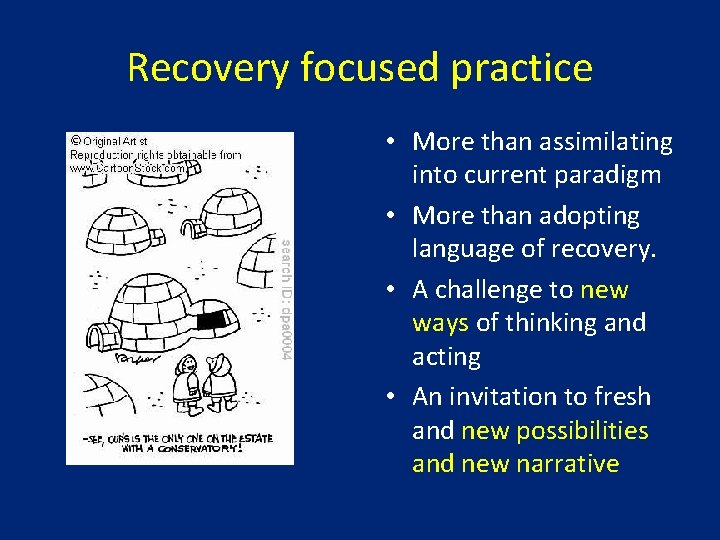
Recovery focused practice • More than assimilating into current paradigm • More than adopting language of recovery. • A challenge to new ways of thinking and acting • An invitation to fresh and new possibilities and new narrative
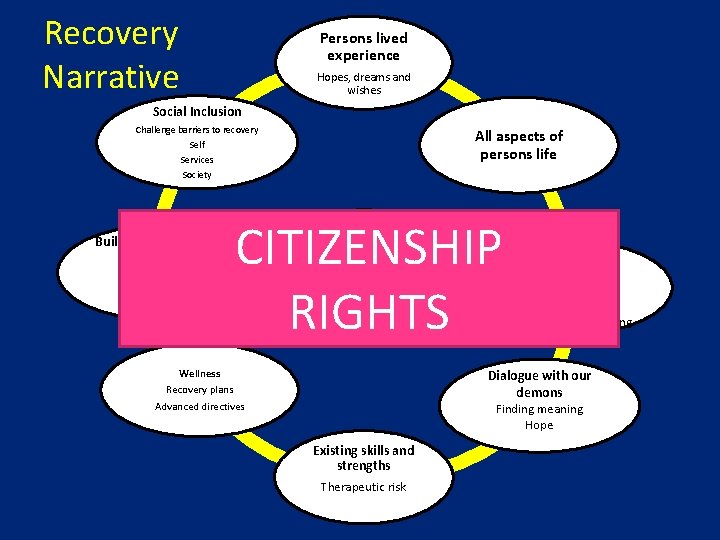
Recovery Narrative Persons lived experience Hopes, dreams and wishes Social Inclusion Challenge barriers to recovery Self Services Society Build connectedness ‘ME’ Family Peers Community All aspects of persons life CITIZENSHIP RIGHTS Values Meaning Power Relationships Wellness Recovery plans Advanced directives Collaborative relationships Giving back power, control, choices shared decision making Dialogue with our demons Finding meaning Hope Existing skills and strengths Therapeutic risk
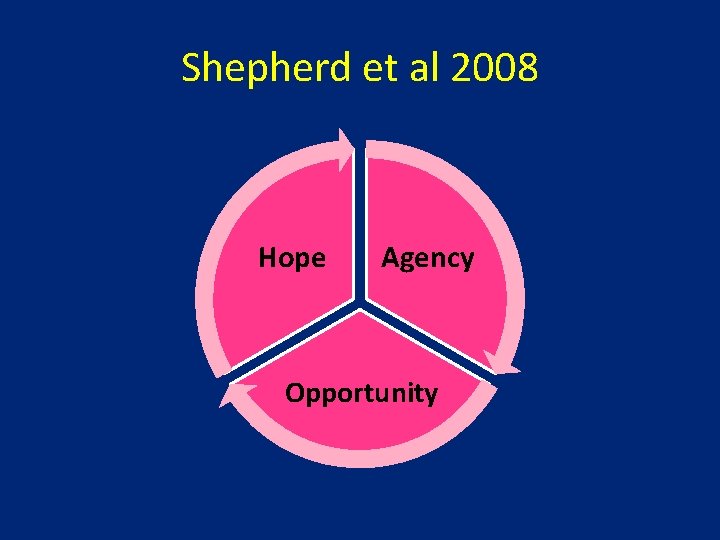
Shepherd et al 2008 Hope Agency Opportunity
Insight and Internalised stigma • People who accept that they have mental illness may feel driven to conform to an image of incapacity and worthlessness, becoming more socially withdrawn and adopting a disabled role. As a result, their symptoms may persist and they may become dependent on treatment providers and others. Thus, insight into one’s illness may be rewarded with poor outcome. • Empowerment of people and helping them reduce their internalised sense of stigma are as important as helping them find insight into their ‘illness’. Until now, however, more effort has been expended on the last than on the former. – Warner R. (2004). Recovery from Schizophrenia: Psychiatry and Political Economy (3 rd edn). Brunner-Routledge,
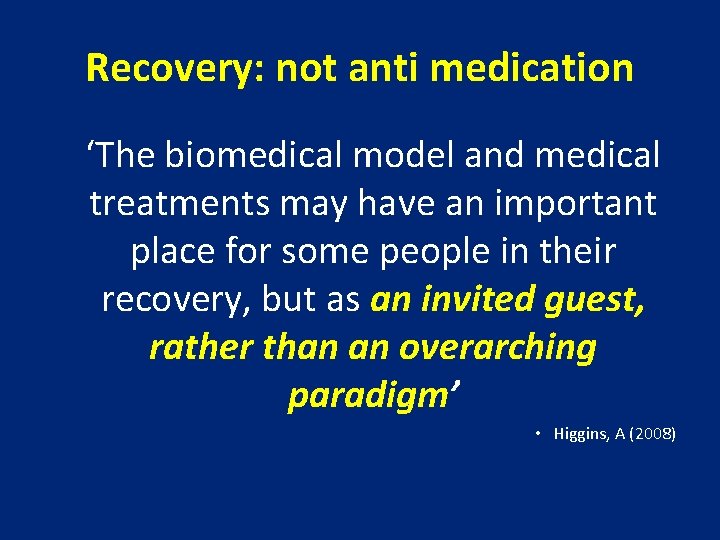
Recovery: not anti medication ‘The biomedical model and medical treatments may have an important place for some people in their recovery, but as an invited guest, rather than an overarching paradigm’ • Higgins, A (2008)
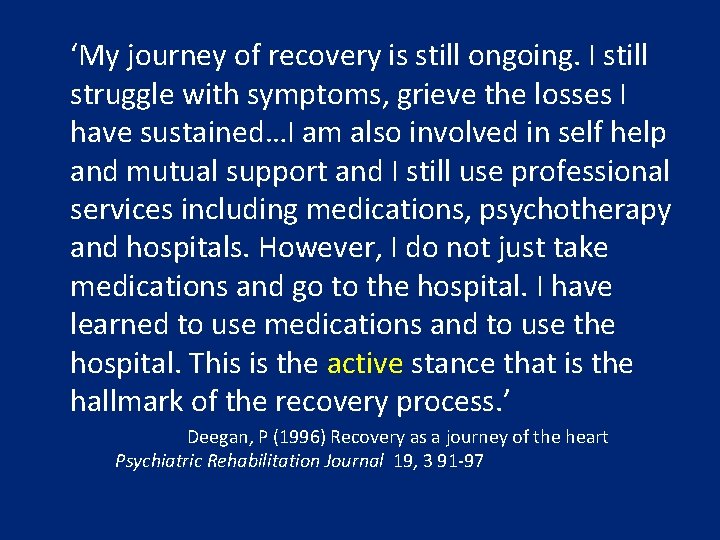
‘My journey of recovery is still ongoing. I still struggle with symptoms, grieve the losses I have sustained…I am also involved in self help and mutual support and I still use professional services including medications, psychotherapy and hospitals. However, I do not just take medications and go to the hospital. I have learned to use medications and to use the hospital. This is the active stance that is the hallmark of the recovery process. ’ Deegan, P (1996) Recovery as a journey of the heart Psychiatric Rehabilitation Journal 19, 3 91 -97
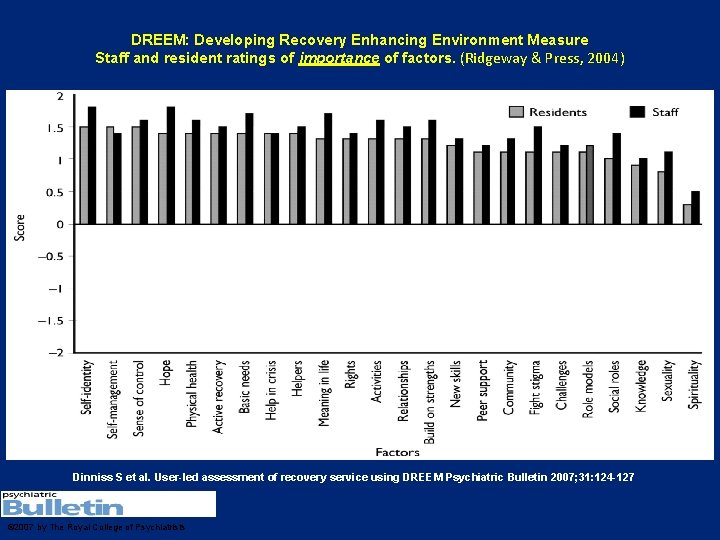
DREEM: Developing Recovery Enhancing Environment Measure Staff and resident ratings of importance of factors. (Ridgeway & Press, 2004) Dinniss S et al. User-led assessment of recovery service using DREEM Psychiatric Bulletin 2007; 31: 124 -127 © 2007 by The Royal College of Psychiatrists
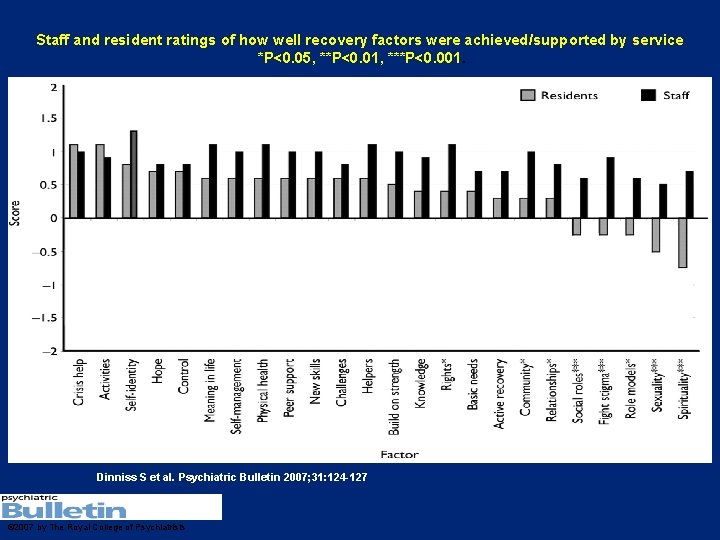
Staff and resident ratings of how well recovery factors were achieved/supported by service *P<0. 05, **P<0. 01, ***P<0. 001. Dinniss S et al. Psychiatric Bulletin 2007; 31: 124 -127 © 2007 by The Royal College of Psychiatrists
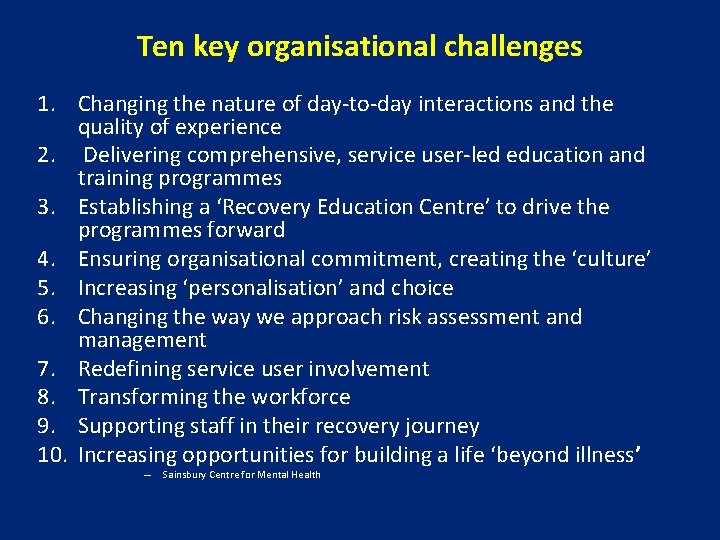
Ten key organisational challenges 1. Changing the nature of day-to-day interactions and the quality of experience 2. Delivering comprehensive, service user-led education and training programmes 3. Establishing a ‘Recovery Education Centre’ to drive the programmes forward 4. Ensuring organisational commitment, creating the ‘culture’ 5. Increasing ‘personalisation’ and choice 6. Changing the way we approach risk assessment and management 7. Redefining service user involvement 8. Transforming the workforce 9. Supporting staff in their recovery journey 10. Increasing opportunities for building a life ‘beyond illness’ – Sainsbury Centre for Mental Health
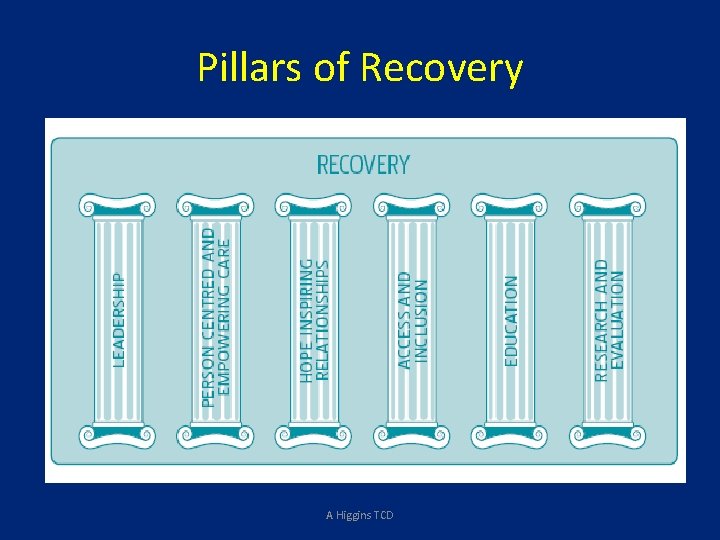
Pillars of Recovery A Higgins TCD
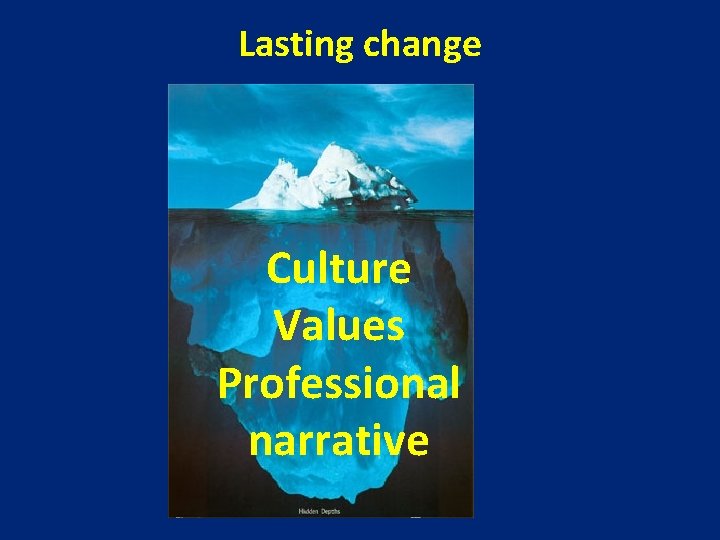
Lasting change Culture Values Professional narrative
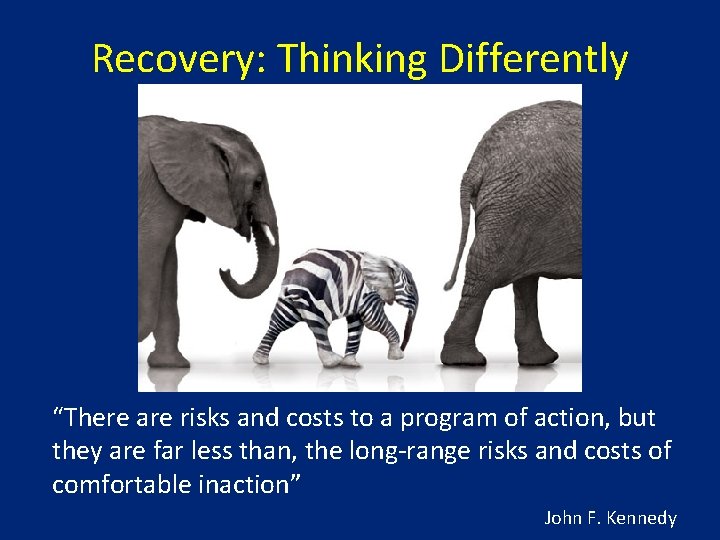
Recovery: Thinking Differently “There are risks and costs to a program of action, but they are far less than, the long-range risks and costs of comfortable inaction” John F. Kennedy