
Recovery and Return to Learning Approaches for Early




- Slides: 17
Recovery and Return to Learning Approaches for Early years professionals With thanks to COVENTRY special educational needs and disability (SEND) Support SERVICE www. coventry. gov. uk/recoverycurriculum
Overview 1 2 3 The impact of COVID 19 on the lived experience of children. People’s experience of Trauma. How to support children with their transition back to nursery school.
Helping ourselves to help others…
1 The impact of COVID 19 on the lived experience of children.
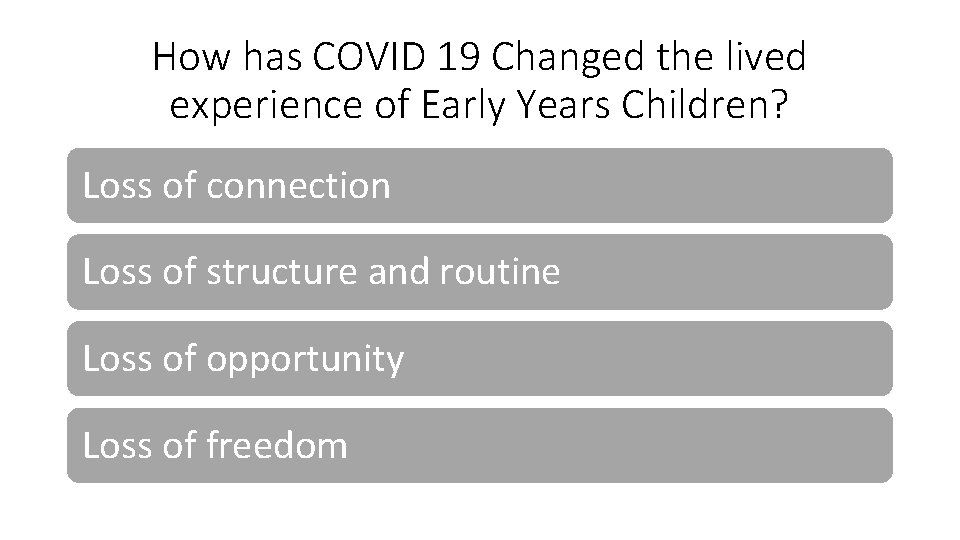
How has COVID 19 Changed the lived experience of Early Years Children? Loss of connection Loss of structure and routine Loss of opportunity Loss of freedom
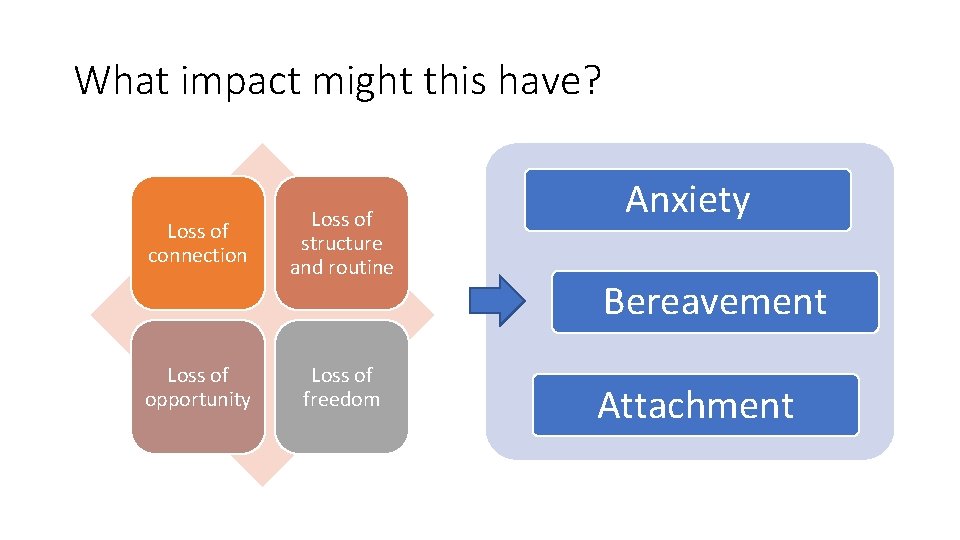
What impact might this have? Loss of connection Loss of opportunity Loss of structure and routine Loss of freedom Anxiety Bereavement Attachment
2 People’s experience of Trauma.
What are crisis and trauma? • A crisis is an event that is going to lead to an unstable or dangerous situation affecting an individual, group, organisation or society. • The term trauma can be used to describe a person’s response to a crisis, when their usual coping mechanisms are overwhelmed. • Different people are likely to respond to the same crisis differently. • When trying to understand a person’s behaviour, it can be helpful to ‘stand in their shoes’.
How do People Respond to Trauma? During a crisis, people may experience: • Flashbacks and intrusive memories • Vivid dreams • Headaches • Difficulty concentrating • Feeling guilty typically ‘it was my fault’ • Feeling detached from others • These things are “a normal reaction of normal people to events which, for them, are unusual or abnormal” (Parkinson, 1993) • If these symptoms emerge later, persist or intensify long after the event, then more specialist support may be needed.
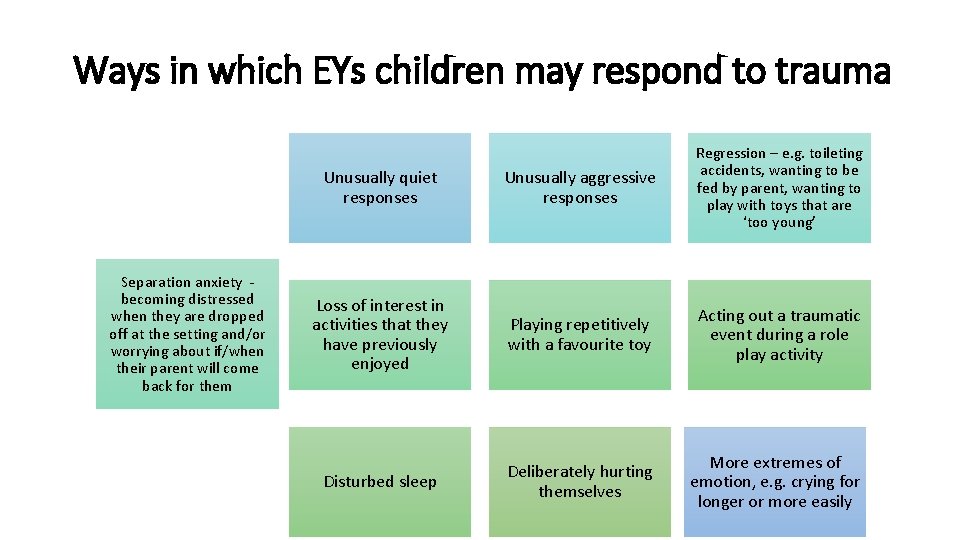
Ways in which EYs children may respond to trauma Separation anxiety becoming distressed when they are dropped off at the setting and/or worrying about if/when their parent will come back for them Unusually quiet responses Unusually aggressive responses Regression – e. g. toileting accidents, wanting to be fed by parent, wanting to play with toys that are ‘too young’ Loss of interest in activities that they have previously enjoyed Playing repetitively with a favourite toy Acting out a traumatic event during a role play activity Disturbed sleep Deliberately hurting themselves More extremes of emotion, e. g. crying for longer or more easily
3 How to support children with their transition back to NURSERY/ELC
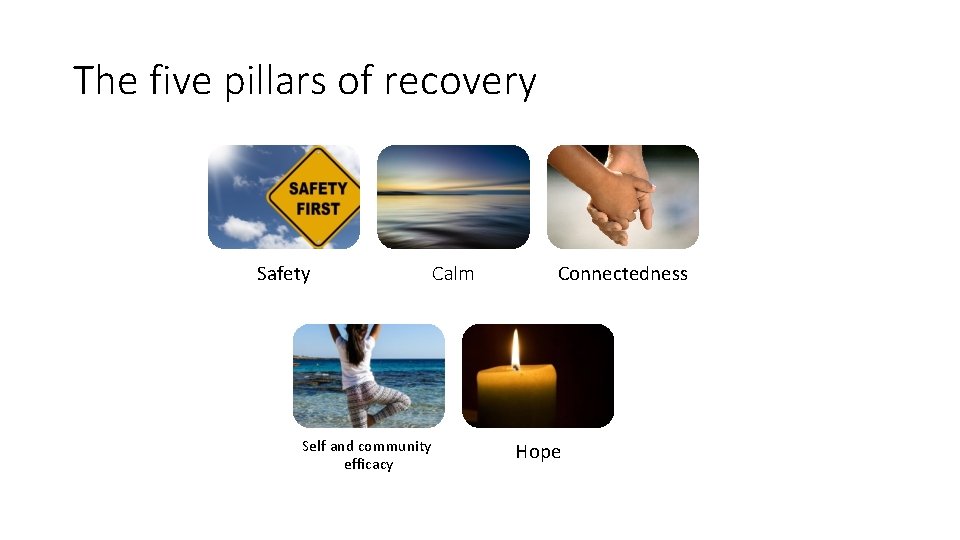
The five pillars of recovery Safety Self and community efficacy Calm Connectedness Hope
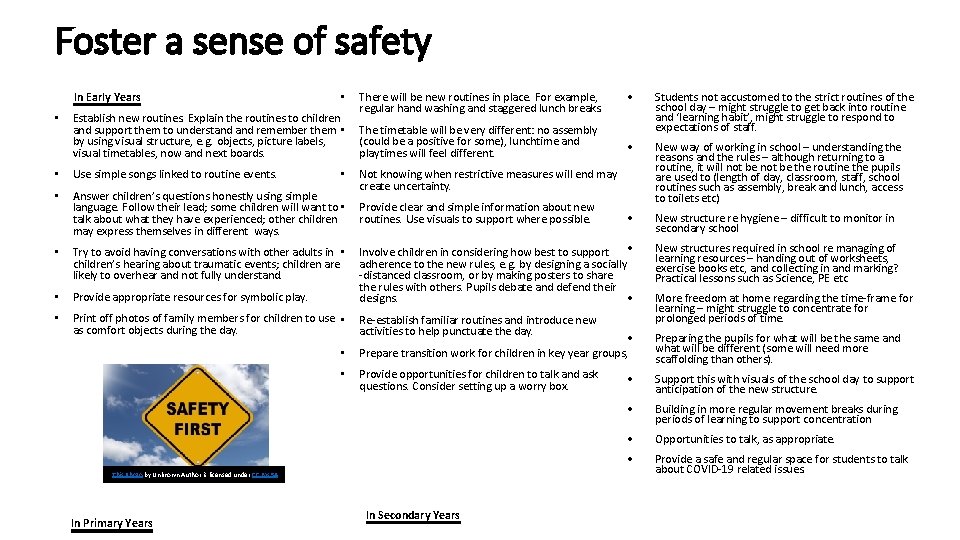
Foster a sense of safety In Early Years • • Establish new routines. Explain the routines to children and support them to understand remember them • by using visual structure, e. g. objects, picture labels, visual timetables, now and next boards. • Use simple songs linked to routine events. • Answer children’s questions honestly using simple language. Follow their lead; some children will want to • talk about what they have experienced; other children may express themselves in different ways. • There will be new routines in place. For example, regular hand washing and staggered lunch breaks. The timetable will be very different: no assembly (could be a positive for some), lunchtime and playtimes will feel different. Students not accustomed to the strict routines of the school day – might struggle to get back into routine and ‘learning habit’, might struggle to respond to expectations of staff. New way of working in school – understanding the reasons and the rules – although returning to a routine, it will not be the routine the pupils are used to (length of day, classroom, staff, school routines such as assembly, break and lunch, access to toilets etc) New structure re hygiene – difficult to monitor in secondary school Not knowing when restrictive measures will end may create uncertainty. Provide clear and simple information about new routines. Use visuals to support where possible. • Try to avoid having conversations with other adults in • children’s hearing about traumatic events; children are likely to overhear and not fully understand. • Provide appropriate resources for symbolic play. Involve children in considering how best to support adherence to the new rules, e. g. by designing a socially -distanced classroom, or by making posters to share the rules with others. Pupils debate and defend their designs. • Print off photos of family members for children to use • as comfort objects during the day. Re-establish familiar routines and introduce new activities to help punctuate the day. • • More freedom at home regarding the time-frame for learning – might struggle to concentrate for prolonged periods of time. Prepare transition work for children in key year groups, Preparing the pupils for what will be the same and what will be different (some will need more scaffolding than others). Provide opportunities for children to talk and ask questions. Consider setting up a worry box. Support this with visuals of the school day to support anticipation of the new structure. Building in more regular movement breaks during periods of learning to support concentration Opportunities to talk, as appropriate. Provide a safe and regular space for students to talk about COVID-19 related issues. This Photo by Unknown Author is licensed under CC BY-SA In Primary Years New structures required in school re managing of learning resources – handing out of worksheets, exercise books etc, and collecting in and marking? Practical lessons such as Science, PE etc In Secondary Years
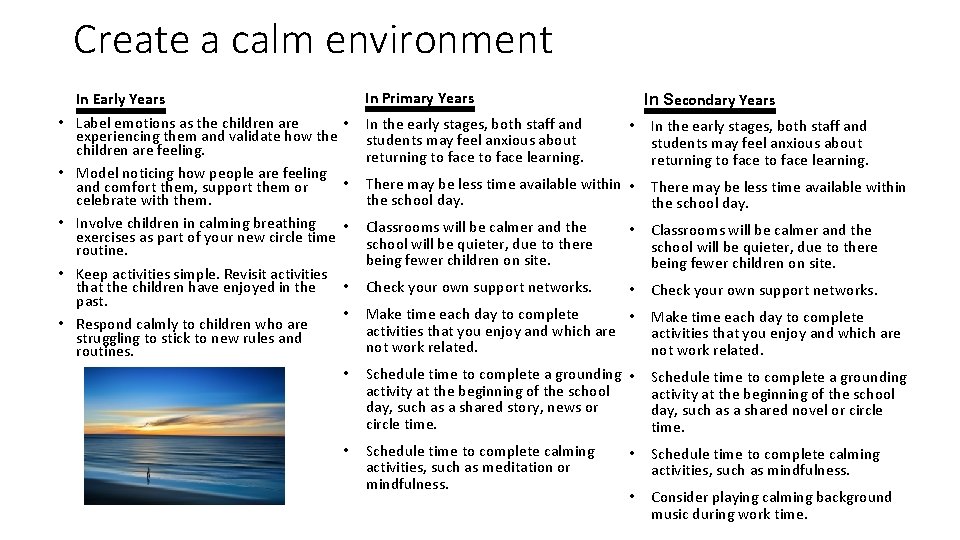
Create a calm environment • • • In Early Years Label emotions as the children are experiencing them and validate how the children are feeling. Model noticing how people are feeling and comfort them, support them or celebrate with them. Involve children in calming breathing exercises as part of your new circle time routine. Keep activities simple. Revisit activities that the children have enjoyed in the past. Respond calmly to children who are struggling to stick to new rules and routines. In Primary Years In Secondary Years • In the early stages, both staff and students may feel anxious about returning to face learning. • There may be less time available within • the school day. There may be less time available within the school day. • Classrooms will be calmer and the school will be quieter, due to there being fewer children on site. • Check your own support networks. • Make time each day to complete • activities that you enjoy and which are not work related. Make time each day to complete activities that you enjoy and which are not work related. • Schedule time to complete a grounding • activity at the beginning of the school day, such as a shared story, news or circle time. Schedule time to complete a grounding activity at the beginning of the school day, such as a shared novel or circle time. • Schedule time to complete calming activities, such as meditation or mindfulness. • Schedule time to complete calming activities, such as mindfulness. • Consider playing calming background music during work time. • In the early stages, both staff and students may feel anxious about returning to face learning.
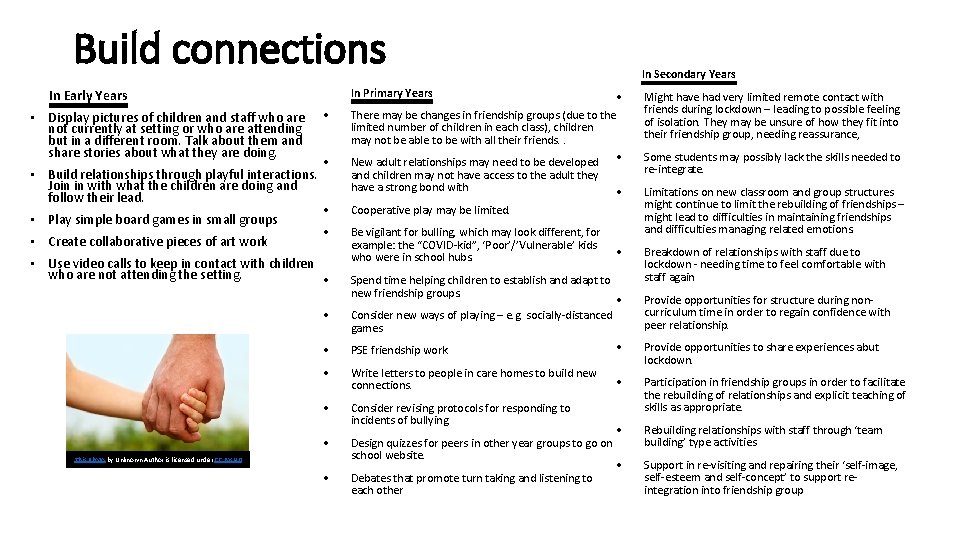
Build connections In Primary Years In Early Years • Display pictures of children and staff who are not currently at setting or who are attending but in a different room. Talk about them and share stories about what they are doing. • Build relationships through playful interactions. Join in with what the children are doing and follow their lead. • Play simple board games in small groups • Create collaborative pieces of art work There may be changes in friendship groups (due to the limited number of children in each class), children may not be able to be with all their friends. . New adult relationships may need to be developed and children may not have access to the adult they have a strong bond with Cooperative play may be limited. Be vigilant for bulling, which may look different, for example: the “COVID-kid”, ‘Poor’/’Vulnerable’ kids who were in school hubs. • Use video calls to keep in contact with children who are not attending the setting. Spend time helping children to establish and adapt to new friendship groups. In Secondary Years Might have had very limited remote contact with friends during lockdown – leading to possible feeling of isolation. They may be unsure of how they fit into their friendship group, needing reassurance, Some students may possibly lack the skills needed to re-integrate. Limitations on new classroom and group structures might continue to limit the rebuilding of friendships – might lead to difficulties in maintaining friendships and difficulties managing related emotions. Breakdown of relationships with staff due to lockdown - needing time to feel comfortable with staff again Provide opportunities for structure during noncurriculum time in order to regain confidence with peer relationship. Consider new ways of playing – e. g. socially-distanced games PSE friendship work Write letters to people in care homes to build new connections. Provide opportunities to share experiences abut lockdown. Consider revising protocols for responding to incidents of bullying. Participation in friendship groups in order to facilitate the rebuilding of relationships and explicit teaching of skills as appropriate. Design quizzes for peers in other year groups to go on school website. Rebuilding relationships with staff through ‘team building’ type activities Debates that promote turn taking and listening to each other Support in re-visiting and repairing their ‘self-image, self-esteem and self-concept’ to support reintegration into friendship group This Photo by Unknown Author is licensed under CC BY-ND
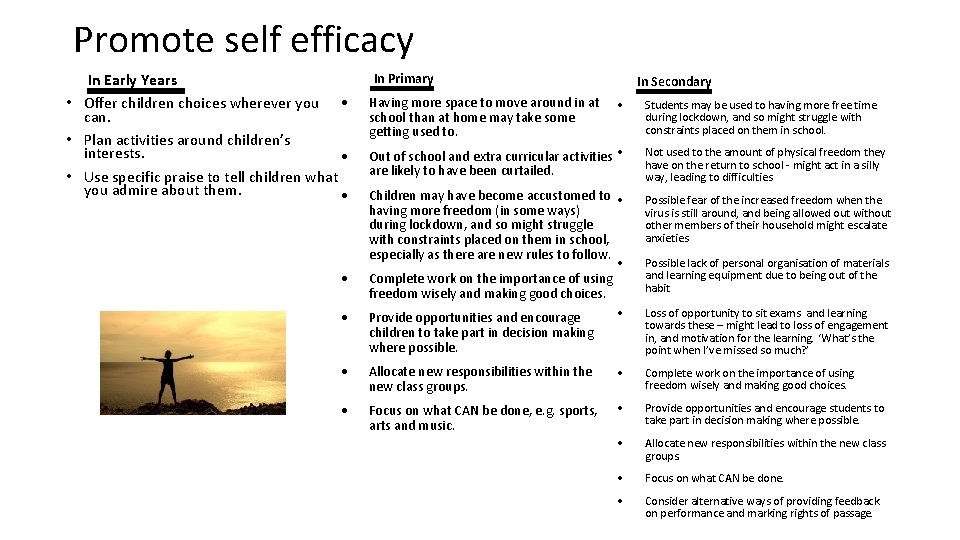
Promote self efficacy Promote Self Efficacy • In Early Years Offer children choices wherever you can. • Plan activities around children’s interests. • Use specific praise to tell children what you admire about them. In Primary Having more space to move around in at school than at home may take some getting used to. In Secondary Students may be used to having more free time during lockdown, and so might struggle with constraints placed on them in school. Out of school and extra curricular activities are likely to have been curtailed. Not used to the amount of physical freedom they have on the return to school - might act in a silly way, leading to difficulties Children may have become accustomed to having more freedom (in some ways) during lockdown, and so might struggle with constraints placed on them in school, especially as there are new rules to follow. Possible fear of the increased freedom when the virus is still around, and being allowed out without other members of their household might escalate anxieties Possible lack of personal organisation of materials and learning equipment due to being out of the habit Complete work on the importance of using freedom wisely and making good choices. Provide opportunities and encourage children to take part in decision making where possible. Loss of opportunity to sit exams and learning towards these – might lead to loss of engagement in, and motivation for the learning. ‘What’s the point when I’ve missed so much? ’ Allocate new responsibilities within the new class groups. Complete work on the importance of using freedom wisely and making good choices. Focus on what CAN be done, e. g. sports, arts and music. Provide opportunities and encourage students to take part in decision making where possible. Allocate new responsibilities within the new class groups. Focus on what CAN be done. Consider alternative ways of providing feedback on performance and marking rights of passage.
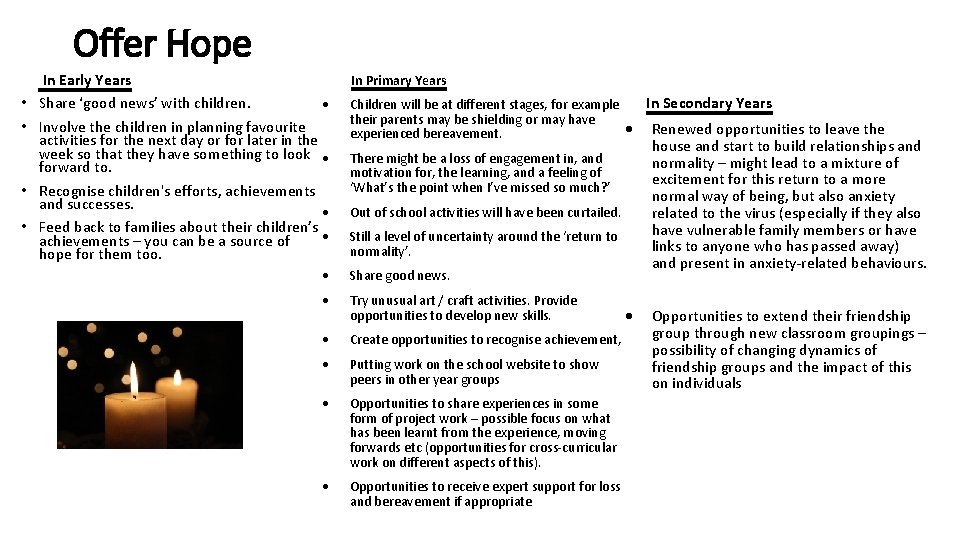
Offer Hope • • In Early Years Share ‘good news’ with children. Involve the children in planning favourite activities for the next day or for later in the week so that they have something to look forward to. Recognise children's efforts, achievements and successes. Feed back to families about their children’s achievements – you can be a source of hope for them too. In Primary Years Children will be at different stages, for example their parents may be shielding or may have experienced bereavement. There might be a loss of engagement in, and motivation for, the learning, and a feeling of ‘What’s the point when I’ve missed so much? ’ Out of school activities will have been curtailed. Still a level of uncertainty around the ‘return to normality’. Share good news. Try unusual art / craft activities. Provide opportunities to develop new skills. Create opportunities to recognise achievement, Putting work on the school website to show peers in other year groups Opportunities to share experiences in some form of project work – possible focus on what has been learnt from the experience, moving forwards etc (opportunities for cross-curricular work on different aspects of this). Opportunities to receive expert support for loss and bereavement if appropriate In Secondary Years Renewed opportunities to leave the house and start to build relationships and normality – might lead to a mixture of excitement for this return to a more normal way of being, but also anxiety related to the virus (especially if they also have vulnerable family members or have links to anyone who has passed away) and present in anxiety-related behaviours. Opportunities to extend their friendship group through new classroom groupings – possibility of changing dynamics of friendship groups and the impact of this on individuals Share good news. Try unusual art / craft activities. Provide opportunities to develop new and different skills. Create opportunities to recognise achievement (badges / credits). Opportunities to share experiences in some form of project work – possible focus on what has been learnt from the experience, moving forwards etc (opportunities for cross-curricular work on different aspects of this). Opportunities to receive expert support for loss and bereavement if appropriate.