
Recovery and resolution BRRD The Bank and Its
Recovery and resolution (BRRD) The Bank and Its Insolvency LUISS University, 25 -28 October 2016 1
Recovery and resolution (BRRD) 2 Rationale for the EU framework • A number of features makes bank failures difficult to handle: • Maturity mismatches: banks prone to short-term refinancing issues • Assets illiquidity and lack of transparency: liquidation more problematic and risk of fire-sales • Liquidity issues may easily turn into insolvency • Risk of contagion among banks: bank runs may involve sound entities as well • Systemic effects
Recovery and resolution (BRRD) 3 Rationale for the EU framework • Many EU governments had to inject public money to rescue banks in the wake of the 2008 financial crisis • BRRD aims, in future cases of bank failure, to avoid so- called ‘bailouts’ • It establishes a common European framework for the recovery and restructuring of ailing banks • Injection of public money remains as a last-resort device after write-off of investors and intervention of resolution financial arrangements
Recovery and resolution (BRRD) 4 BRRD • The Bank Recovery and Resolution Directive (Dir. 2014/59/UE –BRRD) entered into force on 2 July 2014. • The Directive establishes a common approach within the EU to the recovery and resolution of banks and investment firms • National measures on liquidation remain applicable as a back-up default (some MSs have special rules in place for bank liquidation, some others do not)
Recovery and resolution (BRRD) 5 Addressed issues • Managing the «too big to fail» problem • Enhance financial stability, reduce moral hazard, protect depositors • Ensure continuity of critical functions post resolution • Allocate losses to firm owners (shareholders) and unsecured creditors • Avoid exposing taxpayer funds to risk • Promote home-host cooperation (to avoid ring-fencing) • Enhance market discipline • Avoid contagion within the banking system
Recovery and resolution (BRRD) 6 Getting started: private intrernational law • Reg. (EU) 2015/848 (European Insolvency Regulation) • X-border insolvency of non-bank entities • Enables secondary (as opposed to main) proceedings for «establishments» in countries other than the COMI’s • Directive 2001/24/EC prevents this «ring fencing» by MSs as it concentrates insolvency proceeding in the home MS: • • • Mutual recognition of bank insolvency proceedings in the country where the bank is registered Secondary proceedings allowed neither for «establisments» nor for branches Autonomous proceeding remain in place for subsidiaries
Recovery and resolution (BRRD) 7 BRRD • Whereas no. 1: “The financial crisis has shown that there is a significant lack of adequate tools at Union level to deal effectively with unsound or failing credit institutions and investment firms. Such tools are needed, in particular, to prevent insolvency or, when insolvency occurs, to minimise negative repercussions by preserving the systemically important functions of the institution concerned. During the crisis, those challenges were a major factor that forced Member States to save institutions using taxpayers’ money. The objective of a credible recovery and resolution framework is to obviate the need for such action to the greatest extent possible”.
Recovery and resolution (BRRD) 8 The Resolution Authority • Each MS designates a resolution authorithy • Central banks can take this function, but there must be clear operational independence between the resolution and supervisory activities of the authority • For the Eurozone, the Single Resolution Board (SRB) is established as the single authority competent for the resolution of banks supervised by the SSM • Limitations under the Meroni doctrine and political compromises explain remaining powers to the Commission and the Council respectively • Commission: may object resolution programs and bail-outs • Council: may object the lack of public interest in resolution and use of Single Resoultion Fund
Recovery and resolution (BRRD) 9 The Directive includes: • Recovery plans • A requirement for all deposit-takers and significant investment firms to have in place recovery plans for the institution or the group it is part of, designed to ensure that firms have credible plans in place to recover their financial position following a stress; and that the authorities could manage their failure in an orderly way. • Establishment of resolution authorities • with responsibility for planning for and managing the failure of banks and investment firms, and with the necessary tools to manage the failure of banks. This includes a bail-in tool, which allows the resolution authority to write down or cancel debt in a failing firm, and convert it in to equity.
Recovery and resolution (BRRD) 10 The Directive includes: • A requirement to ensure that 8% of a bank’s liabilities are used to absorb losses and recapitalise a failing bank before public funds can be used to absorb losses. • Co-operation between the authorities in different Member States in order to effectively plan for and manage the failure of firms which operate across borders. • Protection for depositors – deposits covered by Deposit Guarantee Schemes are excluded from bail-in and will also be preferred liabilities. • The introduction of depositor preference will ensure that these deposits, and the deposits of natural persons and SMEs, will be senior to other unsecured liabilities of the bank
Recovery and resolution (BRRD) 11 Scope of the Directive • The BRRD is based on three pillars, reflecting the different stages of the recovery and resolution planning and execution: • Preparation & prevention • banks must draw up recovery plans while resolution authorities must prepare resolution plans that ensure the continuity of critical functions. • Early intervention • the supervisor may activate the early intervention process if a bank does not meet regulatory capital requirements or is likely to breach them. The institution must restore its financial situation by implementing recovery measures, and/or adopting key reforms or restructuring its debt with creditors, among others. • Resolution powers and tools • the resolution phase is activated only if the two previous stages fail. Authorities would take control of the institution and activate any of the following resolution tools: i) sale of business, ii) bridge bank, iii) asset separation and iv) debt conversion or write down (bail-in, the main novelty).
Recovery and resolution (BRRD) 12 Scope of the Directive • The Directive states that all credit institutions and investment firms established in the European Union should come within the scope of the regime.
Recovery and resolution (BRRD) 13 Recovery planning • The BRRD requires that all institutions (unless subject to consolidated supervision) draw up and maintain recovery plans which set out actions that the firm could take to restore its financial position following a significant deterioration of its financial situation • The plan set out measures to be taken by those institutions for the restoration of their financial position following a significant deterioration
Recovery and resolution (BRRD) 14 Recovery planning • The Directive also requires that for groups subject to consolidated supervision, the Union parent undertaking draw up and submit a recovery plan for the group as a whole • This group recovery plan must be assessed and approved by the management body of the parent undertaking and submitted to the consolidating supervisor
Recovery and resolution (BRRD) 15 Recovery plans • Recovery plans should be detailed and based on realistic assumptions applicable in a range of robust and severe scenarios. • The requirement to prepare a recovery plan should, however, be applied proportionately, reflecting the systemic importance of the institution or the group and its interconnectedness, including through mutual guarantee schemes • Institutions are required to submit their plans to competent authorities for an assessment • (including whether the plans are comprehensive and could feasibly restore an institution’s viability, in a timely manner, even in periods of severe financial stress)
Recovery and resolution (BRRD) 16 Recovery Plans • The BRRD sets out measures to be taken by those institutions for the restoration of their financial position following a significant deterioration. • The recovery plan is each firm’s complete “menu of options” for addressing extreme financial stress caused by internal or system failures, and is aimed to restore the long term viability • Additionally, the recovery plan should include a description of the governance procedure – roles, duties, decision-making process, etc. – for critical situations
Recovery and resolution (BRRD) 17 Recovery Plans • Recovery plans are developed both at group level and for the individual institutions within the group. • Supervisors will assess and approve recovery plans annually. • Where an institution does not present an adequate recovery plan, supervisors are empowered to require that institution to take all measures necessary to redress the deficiencies of the plan.
Recovery and resolution (BRRD) 18 Resolution Plans • The resolution plan is prepared ex-ante by the resolution authorities in cooperation with supervisors and the institutions themselves. • For groups, plan for resolution of the group headed by the EU parent undertaking as a whole, either through resolution at the level of the EU parent undertaking or through break up and resolution of the subsidiaries. • Content: • The plan set out options for resolving the institution (or its groups) in a range of scenarios, including systemic crisis triggering conditions for resolution • Such plans should include details on the application of resolution tools and ways to ensure the continuity of critical functions, in order to minimise the cost of resolution to public funds.
Recovery and resolution (BRRD) 19 Resolution Plans • Resolution plan must assess resolvability of institution without extraordinary public support (other than permitted resolution financing) or central bank liquidity assistance on emergency or non- standard terms • Institution must provide all required information and assistance needed to prepare resolution plan • Resolution authority must also identify material impediments to resolvability, including actions to address the impediments
Recovery and resolution (BRRD) 20 Early intervention • BRRD expands the powers of the resolution authority to intervene at an early stage in cases where an institution is in breach of CRR and CRD IV provisions, due inter alia to: • deteriorating liquidity, • increasing levels of leverage, • non-performing loans or concentration of exposures
Recovery and resolution (BRRD) 21 Early Intervention • Measures include: • requiring management to implement measures contained in the recovery plan • requirement for management and/or shareholder meeting to approve/implement an action plan for recovery • removing management if found unfit to perform duties • requiring management to draw up debt restructuring plan to negotiate with creditors • requiring changes to business strategy and/or to legal or operational structures
Recovery and resolution (BRRD) 22 Early intervention • In case the early intervention measures are considered insufficient to address an institution’s deteriorating financial position, the resolution authority can appoint a temporary administrator by replacing the institution’s management with a “special manager” for a maximum period of one year (renewable under exceptional circumstances). • Purpose: restoring institution’s financial stability and prudent management within the shortest possible time • The special manager may also increase the firm’s capital or reorganise its governance
Recovery and resolution (BRRD) 23 Resolution • Where the recovery plan and other early intervention measures are insufficient to stop deterioration, resolution authorities must consider whether conditions for resolution are met • Resolution authority must consider that all of following conditions are met, before taking resolution action: • competent authority or resolution authority has determined, after consulting the other authority, that the institution is failing or likely to fail • having regard to timing and other relevant circumstances, there is no reasonable prospect that alternative private sector measures or supervisory action (including early intervention measures and write down or conversion of capital instruments) would prevent failure • resolution action is necessary in public interest
Recovery and resolution (BRRD) 24 Resolution • Institution shall be deemed to be failing or likely to fail in any of the following circumstances: • the institution infringes or will, in the near future, infringe the requirements for continuing authorisation, so as to justify a competent authority from withdrawing authorisation – including but not limited to losses that will deplete all or a significant amount of its own funds • the institution’s assets are or will in the near future be less than its liabilities • the institution is or will in the near future be unable to pay its debts or other liabilities as they fall due • extraordinary public financial support is required, with the exceptions: • a state guarantee to back central bank liquidity facilities in accordance with the central bank’s conditions • a state guarantee of newly issued liabilities • an injection of own funds or purchase of capital instruments on terms that do not confer an advantage upon the institution
Recovery and resolution (BRRD) 25 Resolution • When applying resolution tools and powers, resolution authorities must have regard to following resolution objectives and choose tools/powers that best achieve the objectives relevant to the particular circumstances: • to ensure continuance of critical functions • to maintain financial system stability • to protect public funds by minimising reliance on public sector support, e. g. bailouts • to protect guaranteed deposits • to protect client funds/ assets
Recovery and resolution (BRRD) 26 Resolution • Resolution authorities must ensure resolution action taken in accordance with following principles: • the shareholders of the institution must bear first losses • creditors of the institution bear losses after the shareholders in • • accordance with the priority of their claims under normal insolvency proceedings, except as expressly provided otherwise the management body and senior management of the institution are replaced except where their retention is considered necessary to achieve the resolution objectives except where otherwise provided, creditors of the same class are treated in an equitable manner no creditor shall incur greater losses than they would have incurred under normal insolvency proceedings (NCWO) covered deposits are fully protected
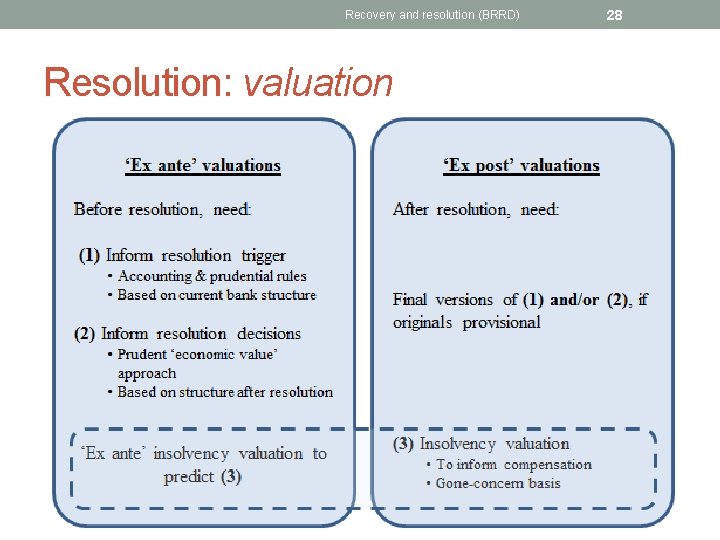
Recovery and resolution (BRRD) 27 Resolution: valuation • Before any resolution action can be taken, assets and liabilities of the institution must be valued by a valuer independent from the institution, as well as from the resolution authority • This valuation is used: • To determine the extent to which capital instruments and liabilites need to be written down or converted • To determine the value of assets/liabilites to be transferred to good banks and banks • It is based on prudent assumptions, including as to rates of default and severity of losses, but must assume no future provision of extraordinary public support or central bank assistance on emergency/non-standard terms
Recovery and resolution (BRRD) Resolution: valuation 28
Recovery and resolution (BRRD) 29 Resolution: valuation • Must indicate sub-division of different creditors, based on priority levels under applicable insolvency law, and an estimate of recovery for each class under a standard winding-up action
Recovery and resolution (BRRD) BRRD: Resolution tools 1. Sale of business tool 2. Bridge institution tool 3. Asset separation tool 4. Bail-in tool Tools can be applied individually or in combination 30
Recovery and resolution (BRRD) 31 Sale of business tool • This tool gives the power to the resolution authorities to sell the institution under resolution, without the consent of the shareholders or other procedural requirements • Authorities may sell any of its shares or other instruments representing ownership, all or any of its assets, rights and liabilities
Recovery and resolution (BRRD) 32 Bridge institution tool (good bank) • This tool gives resolution authorities the power to • transfer, without the consent of the shareholders or third party, shares, the assets, rights and liabilities of the institution to a bridge institution (more than once in the course of the resolution process), and • if certain conditions are met, to transfer these instruments from the bridge institution back to the institution under resolution; or alternatively transfer them from the bridge institution to a third party.
Recovery and resolution (BRRD) 33 Bridge institution tool (good bank) • In applying the bridge bank option: • The bridge institution must be a legal entity controlled by one or more public authorities (which may include the resolution authority) • The resolution authorities have power to decide on: the content of its constitutional documents, the appointment of the institution’s management and the risk profile of the bridge institution • Goal: selling assets, rights and liabilities of the institution to private parties, based on open and transparent marketing and on commercial terms • The bridge institution may only operate for two years, extendable for one or more additional one-year periods • After the expiry of this period, the operation of the bridge institution shall be terminated by liquidation
Recovery and resolution (BRRD) 34 Asset separation tool (bad bank) • This tool should be used when the resolution authority determines that: • liquidation of “bad assets” under insolvency proceeding could have an adverse effect on financial markets • it is necessary for the proper functioning of the institution under resolution or a bridge institution; or • it maximises the liquidation proceeds.
Recovery and resolution (BRRD) 35 Asset separation tool (bad bank) • The asset separation tool’s goal is to separate the distressed, problematic assets of the institution from the others, and to manage them in such a way as to maximise their value • Shall only be used in conjunction with another tool • Transfer the assets, rights or liabilities of an institution to an asset management vehicle at the market value • Legal entity owned by public authorities, including the resolution authorities • As with the bridge institution tool, the resolution authority will appoint the asset managers who shall maximise the value of the instruments through sale or wind down the business in an orderly manner
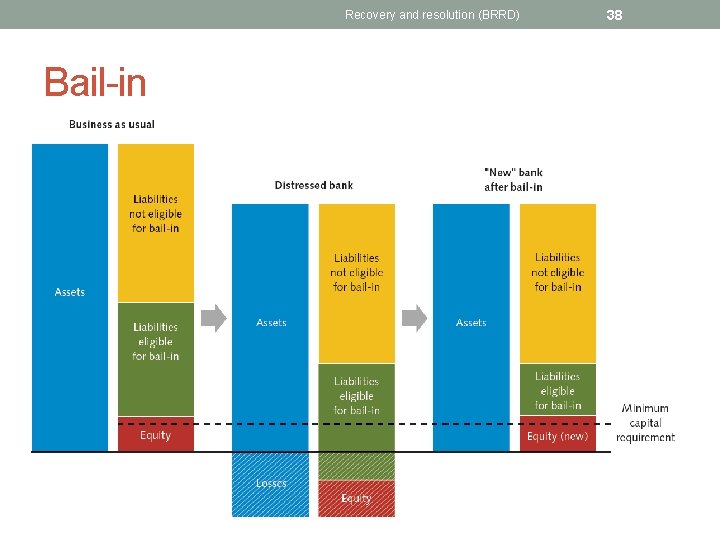
Recovery and resolution (BRRD) 36 Bail-in • Loss absorption by: • conversion of the liability into a common equity instrument – the most loss-absorbent instrument • writing down/off the principal amount of the liability
Recovery and resolution (BRRD) 37 Bail-in • Bail-in tool can be used either to: • recapitalise the institution under resolution to the extent necessary to restore its ability to comply with the conditions for its authorisation and so as to continue performing its authorised activities; or • convert to equity, or reduce the principal amount of, claims or debt instruments that are transferred to a bridge institution or under the sale of business tool or asset separation tool
Recovery and resolution (BRRD) Bail-in 38
Recovery and resolution (BRRD) 39 What is bail-inable? • All liabilities not expressly excluded from the scope of bail-in • Legal certainty v. effectiveness • Exclusions ex lege • covered deposits – deposits up to the amount covered by a deposit • • • guarantee scheme liabilities in respect to holding client assets or client money, where the client is protected under applicable insolvency law liabilities resulting from a fiduciary relationship, where the beneficiary is protected under applicable law liabilities to other financial institutions (outside its group) with an original maturity of less than seven days liabilities with a remaining maturity of less than seven days, owed to payment or securities settlement systems or their participants employee remuneration or benefits (other than variable remuneration) liabilities to commercial/trade creditors relating to provision of critical goods/services
Recovery and resolution (BRRD) 40 What is bail-inable? • Additional exclusions (discretional) • Resolution authority can wholly or partially exclude liabilities from the scope of bail-in in the following circumstances: • where it is not possible to bail-in the liability in a reasonable timeframe • where the exclusion is necessary and proportionate to achieve continuity of critical • functions/core business lines • where the exclusion is necessary and proportionate to avoid widespread contagion that would disrupt functioning of financial markets – particularly as regards deposits of individuals and SMEs • where bailing-in the liability would cause higher losses to other creditors than not bailing it in
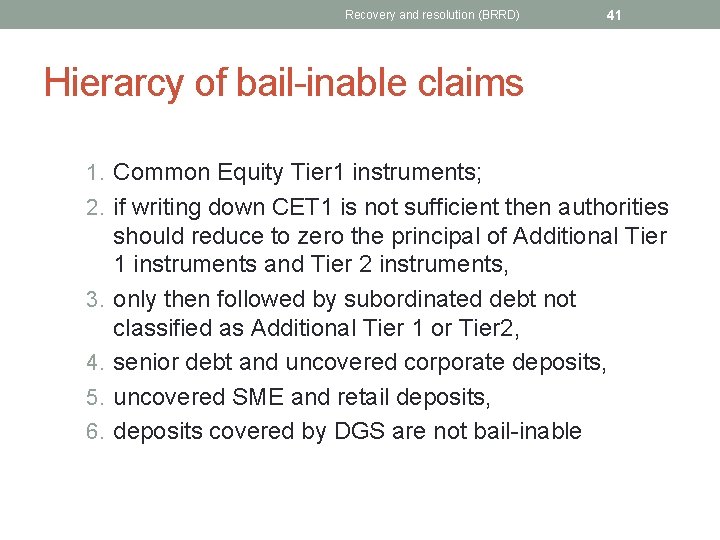
Recovery and resolution (BRRD) 41 Hierarcy of bail-inable claims 1. Common Equity Tier 1 instruments; 2. if writing down CET 1 is not sufficient then authorities 3. 4. 5. 6. should reduce to zero the principal of Additional Tier 1 instruments and Tier 2 instruments, only then followed by subordinated debt not classified as Additional Tier 1 or Tier 2, senior debt and uncovered corporate deposits, uncovered SME and retail deposits, deposits covered by DGS are not bail-inable
Recovery and resolution (BRRD) 42 Minimum bail-inable liabilities • Each Member State must set a minimum required level of loss- absorbing liabilities (“MREL”) consisting of • own funds (regulatory capital) and • bail-inable liabilities • expressed as percentage of the aggregate of an institution’s own funds and total liabilities – N. B. not risk-weighted assets • Minimum own funds are already established by CRR by reference to risk-weighted assets • Where liability is governed by law of a non-EU country, it will only count towards minimum bail-inable liabilities where resolution authority is satisfied that the non-EU country would give effect to a decision to bail-in that liability, whether by virtue of the terms of the contract creating the liability, or by international agreements on the recognition of resolution actions/proceedings
Recovery and resolution (BRRD) 43 Minimum bail-inable liabilities • Resolution authorities may require that part of the minimum eligible liabilities be in the form of contractual bail-in instruments • Contractual bail-in instruments are those which: • Contain a contractual term providing that where a resolution authority decides to apply the bail-in tool the instrument shall be written down/converted before other eligible liabilities; and • Are subject to a binding subordination agreement, undertaking or other provision under which, in the event of normal insolvency proceedings, it ranks below other eligible liabilities
Recovery and resolution (BRRD) 44 Bail-in treatment of shareholders • Existing shares to be cancelled or transferred to bailed-in creditors • Where, under the resolution valuation, the institution has a positive net asset value, existing shareholders to be diluted by conversion of existing capital instruments or conversion of eligible liabilities • In such a case, conversions must “severely dilute” the existing shareholdings • This applies also to shareholders who had already been converted pursuant to going concern conversion of capital instruments or of other debt instruments
Recovery and resolution (BRRD) 45 Effects of bail-in • Different equity conversion ratios may be applied to different classes of capital instruments and liabilities, to reflect: • appropriate levels of compensation for loss incurred due to exercise of write down and conversion powers • the seniority of the liability that was bailed-in – higher conversion rates for more senior liabilities
Recovery and resolution (BRRD) 46 Effects of bail-in on deposits • Covered deposits (i. e. the amount of a deposit that is covered by a deposit guarantee scheme) are excluded from bail-in • BRRD also requires that national insolvency regimes give deposits priority status • Therefore, the amount of an eligible deposit that is not covered by a deposit guarantee scheme ranks senior to other unsecured liabilities • In turn, covered deposits and claims for covered deposits subrogated to a deposit guarantee scheme will rank senior to the deposits in the previous bullet point
Recovery and resolution (BRRD) 47 Resolution funding • Resolution financing arrangement to be established by each Member State, to be funded by: • ex ante contributions from institutions authorised in that Member State, including EU branches of non-EU banks (to reach at least 1% of the amount of covered deposits of all institutions authorised in that Member State, by 31 December 2024) • ex post extraordinary contributions (where ex ante contributions insufficient) limited to 300% of the annual ex ante contributions • contract borrowings and other forms of financial support where the ex ante and ex post contributions are insufficient
Recovery and resolution (BRRD) 48 Resolution funding • Resolution financing arrangement may only contribute to loss absorption for an institution under resolution where: • own funds, capital instruments and eligible liabilities have already absorbed losses of at least 8% of institution’s total liabilities (including own funds) measured pursuant to the resolution valuation; and • the contribution from the resolution financing arrangement does not exceed 5% of total liabilities (including own funds) measured pursuant to the resolution valuation
Recovery and resolution (BRRD) 49 Resolution funding • Such contribution can be funded from ex ante contributions, amounts that can be raised from ex post contributions within 3 years, and from alternative financing arrangements • In extraordinary circumstances, resolution authority can seek additional funding from alternative sources where 5% contribution has been used up and all unsecured nonpreferred liabilities (other than eligible deposits) have been fully bailed-in
Recovery and resolution (BRRD) 50 Deposit Guarantee Schemes • A trade off: • An «induced» Nash equlibrium • Together withdrawal prevention • But moral hazard • Mandatory accession to a DGS • 100, 000 € maximum harmonization • Calculated per account and per bank (group? ) • Not to be confused with Investor Protrection Schemes (dir. 97/9/EC) (20, 000 €)
- Slides: 50