
RECORDS REVISION WHAT DO WE KNOW ABOUT RECORDS

RECORDS REVISION
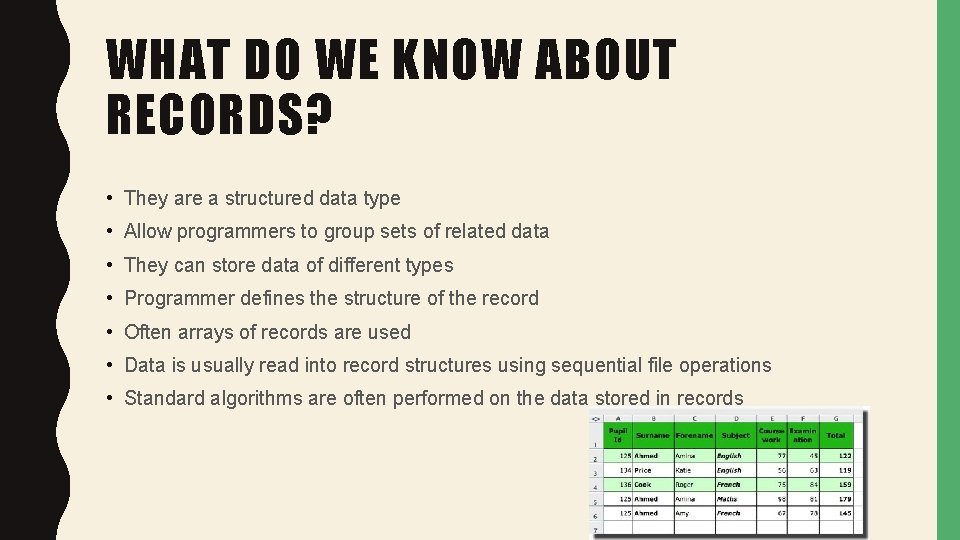
WHAT DO WE KNOW ABOUT RECORDS? • They are a structured data type • Allow programmers to group sets of related data • They can store data of different types • Programmer defines the structure of the record • Often arrays of records are used • Data is usually read into record structures using sequential file operations • Standard algorithms are often performed on the data stored in records
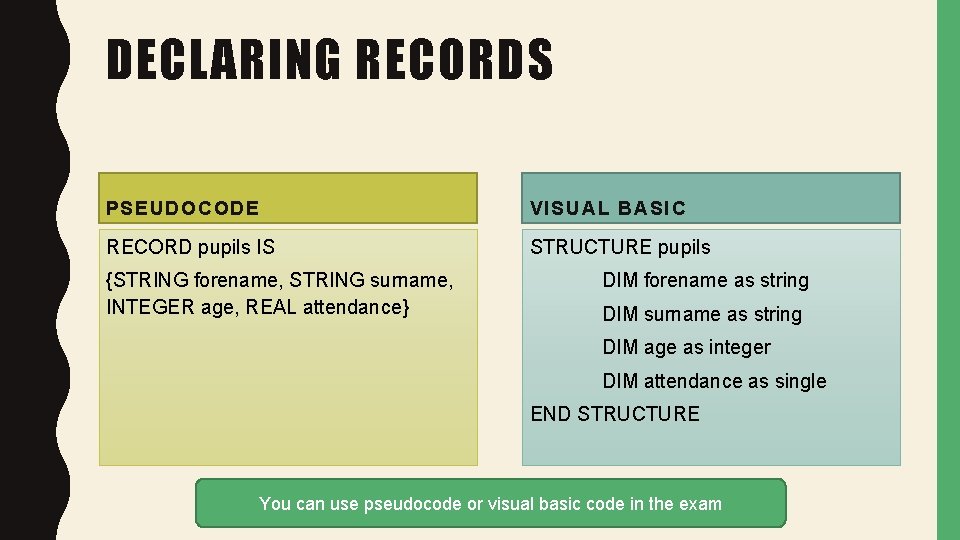
DECLARING RECORDS PSEUDOCODE VISUAL BASIC RECORD pupils IS STRUCTURE pupils {STRING forename, STRING surname, INTEGER age, REAL attendance} DIM forename as string DIM surname as string DIM age as integer DIM attendance as single END STRUCTURE You can use pseudocode or visual basic code in the exam
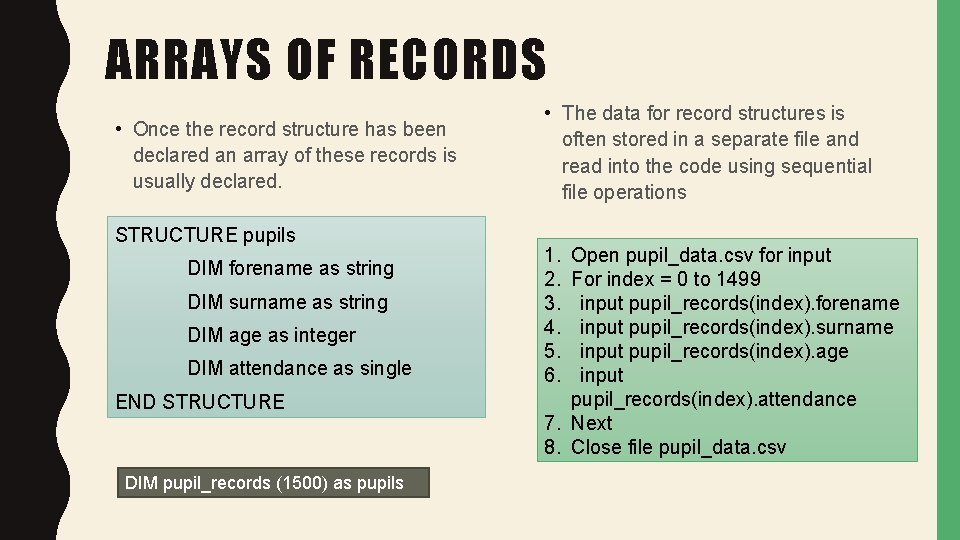
ARRAYS OF RECORDS • Once the record structure has been declared an array of these records is usually declared. STRUCTURE pupils DIM forename as string DIM surname as string DIM age as integer DIM attendance as single END STRUCTURE DIM pupil_records (1500) as pupils • The data for record structures is often stored in a separate file and read into the code using sequential file operations 1. 2. 3. 4. 5. 6. Open pupil_data. csv for input For index = 0 to 1499 input pupil_records(index). forename input pupil_records(index). surname input pupil_records(index). age input pupil_records(index). attendance 7. Next 8. Close file pupil_data. csv
SQA – WHAT ARE THEY ASKING? • Can you identify a record structure from pseudocode? • Can you write code to set up a record structure? • Can you write code to set up an array of records? • Can you write code to populate an array of records – By reading data in from a sequential file – By asking users to enter data manually • Can you write code using record structures applying your knowledge of standard algorithms AND functions?
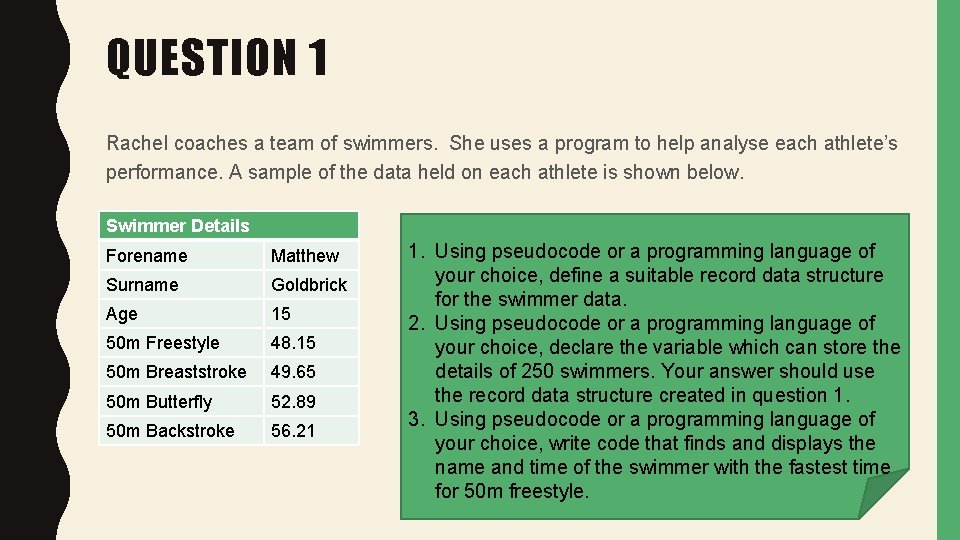
QUESTION 1 Rachel coaches a team of swimmers. She uses a program to help analyse each athlete’s performance. A sample of the data held on each athlete is shown below. Swimmer Details Forename Matthew Surname Goldbrick Age 15 50 m Freestyle 48. 15 50 m Breaststroke 49. 65 50 m Butterfly 52. 89 50 m Backstroke 56. 21 1. Using pseudocode or a programming language of your choice, define a suitable record data structure for the swimmer data. 2. Using pseudocode or a programming language of your choice, declare the variable which can store the details of 250 swimmers. Your answer should use the record data structure created in question 1. 3. Using pseudocode or a programming language of your choice, write code that finds and displays the name and time of the swimmer with the fastest time for 50 m freestyle.
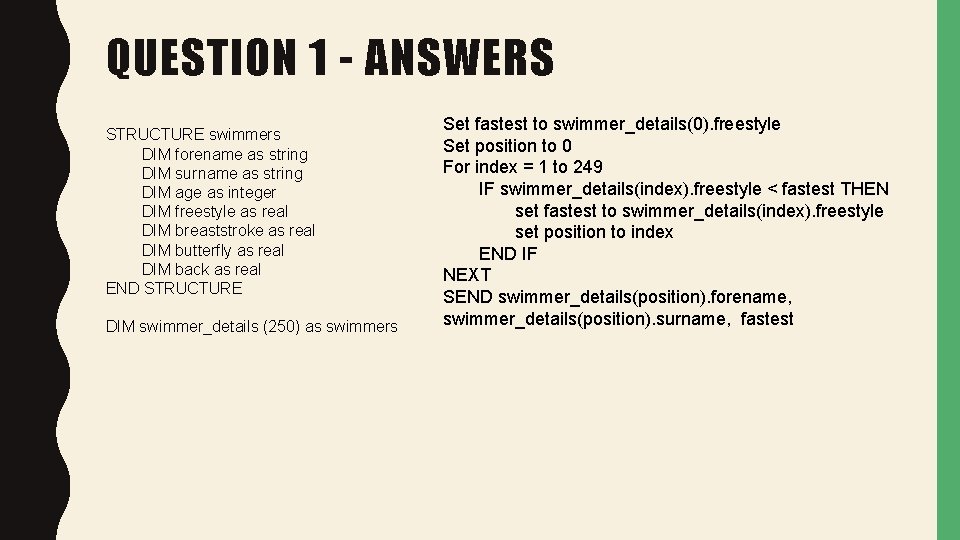
QUESTION 1 - ANSWERS STRUCTURE swimmers DIM forename as string DIM surname as string DIM age as integer DIM freestyle as real DIM breaststroke as real DIM butterfly as real DIM back as real END STRUCTURE DIM swimmer_details (250) as swimmers Set fastest to swimmer_details(0). freestyle Set position to 0 For index = 1 to 249 IF swimmer_details(index). freestyle < fastest THEN set fastest to swimmer_details(index). freestyle set position to index END IF NEXT SEND swimmer_details(position). forename, swimmer_details(position). surname, fastest
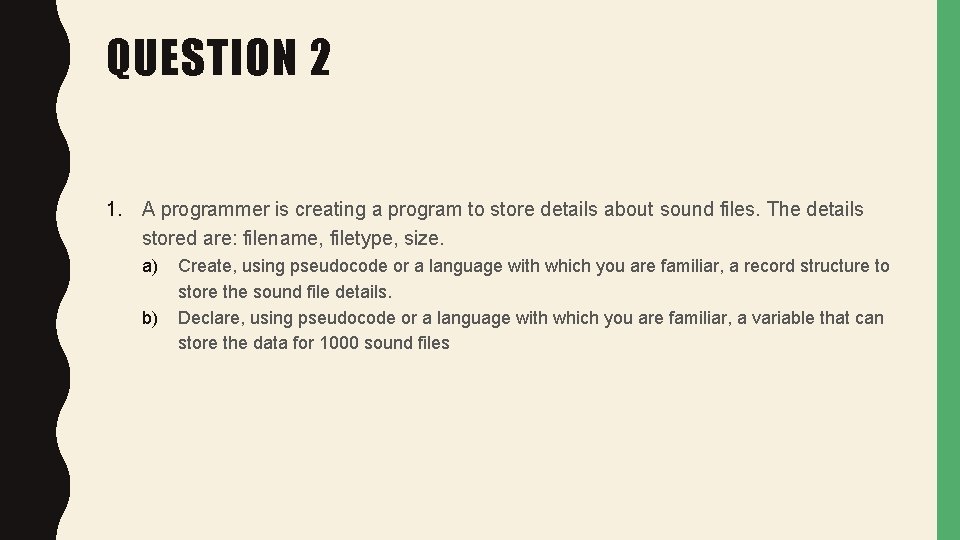
QUESTION 2 1. A programmer is creating a program to store details about sound files. The details stored are: filename, filetype, size. a) b) Create, using pseudocode or a language with which you are familiar, a record structure to store the sound file details. Declare, using pseudocode or a language with which you are familiar, a variable that can store the data for 1000 sound files
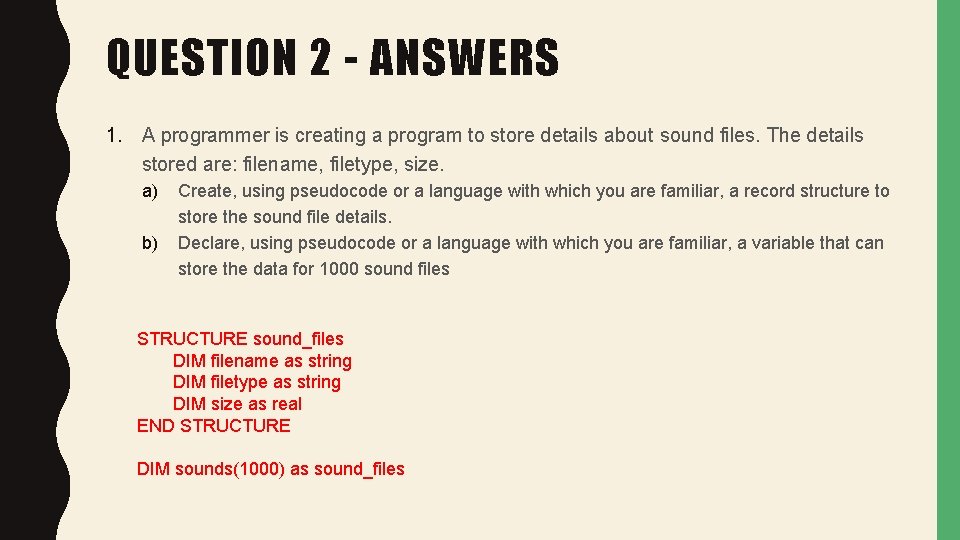
QUESTION 2 - ANSWERS 1. A programmer is creating a program to store details about sound files. The details stored are: filename, filetype, size. a) b) Create, using pseudocode or a language with which you are familiar, a record structure to store the sound file details. Declare, using pseudocode or a language with which you are familiar, a variable that can store the data for 1000 sound files STRUCTURE sound_files DIM filename as string DIM filetype as string DIM size as real END STRUCTURE DIM sounds(1000) as sound_files
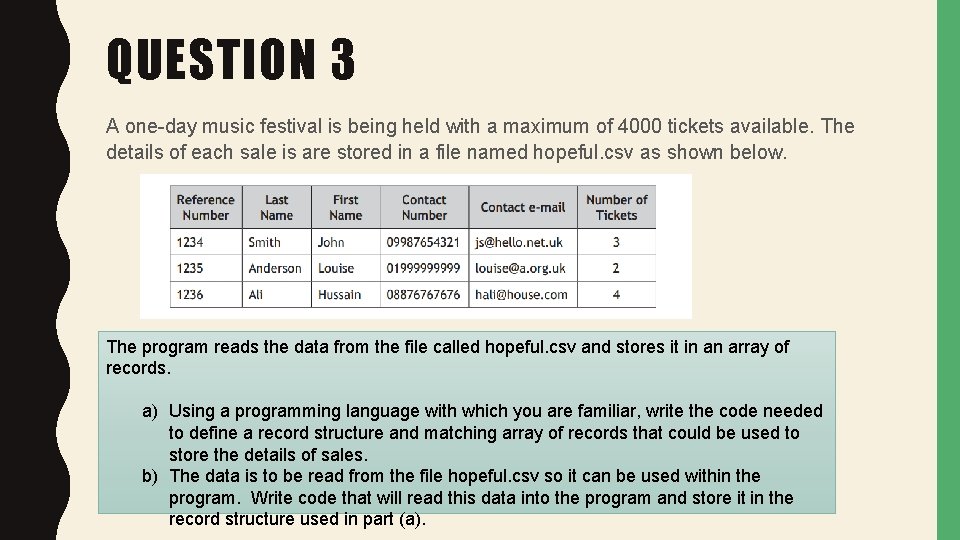
QUESTION 3 A one-day music festival is being held with a maximum of 4000 tickets available. The details of each sale is are stored in a file named hopeful. csv as shown below. The program reads the data from the file called hopeful. csv and stores it in an array of records. a) Using a programming language with which you are familiar, write the code needed to define a record structure and matching array of records that could be used to store the details of sales. b) The data is to be read from the file hopeful. csv so it can be used within the program. Write code that will read this data into the program and store it in the record structure used in part (a).
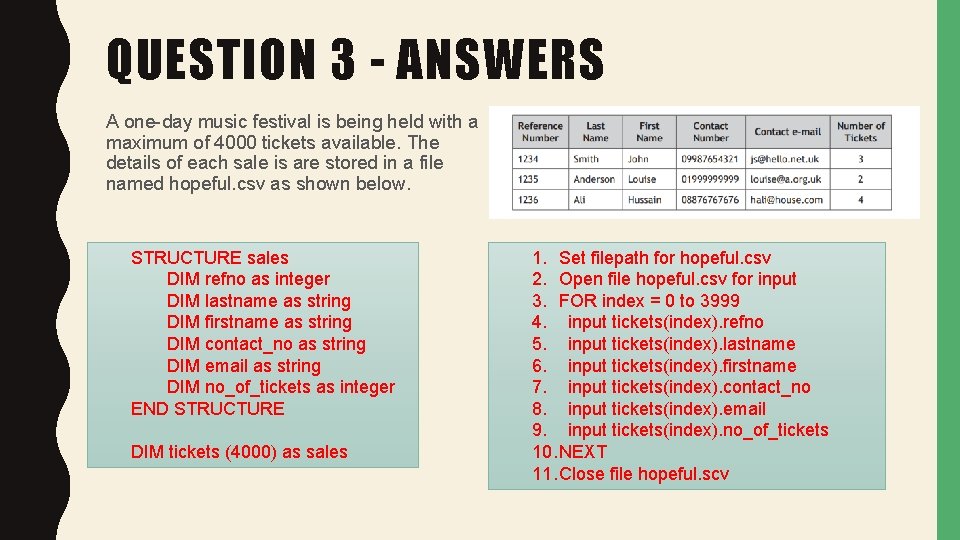
QUESTION 3 - ANSWERS A one-day music festival is being held with a maximum of 4000 tickets available. The details of each sale is are stored in a file named hopeful. csv as shown below. STRUCTURE sales DIM refno as integer DIM lastname as string DIM firstname as string DIM contact_no as string DIM email as string DIM no_of_tickets as integer END STRUCTURE DIM tickets (4000) as sales 1. Set filepath for hopeful. csv 2. Open file hopeful. csv for input 3. FOR index = 0 to 3999 4. input tickets(index). refno 5. input tickets(index). lastname 6. input tickets(index). firstname 7. input tickets(index). contact_no 8. input tickets(index). email 9. input tickets(index). no_of_tickets 10. NEXT 11. Close file hopeful. scv
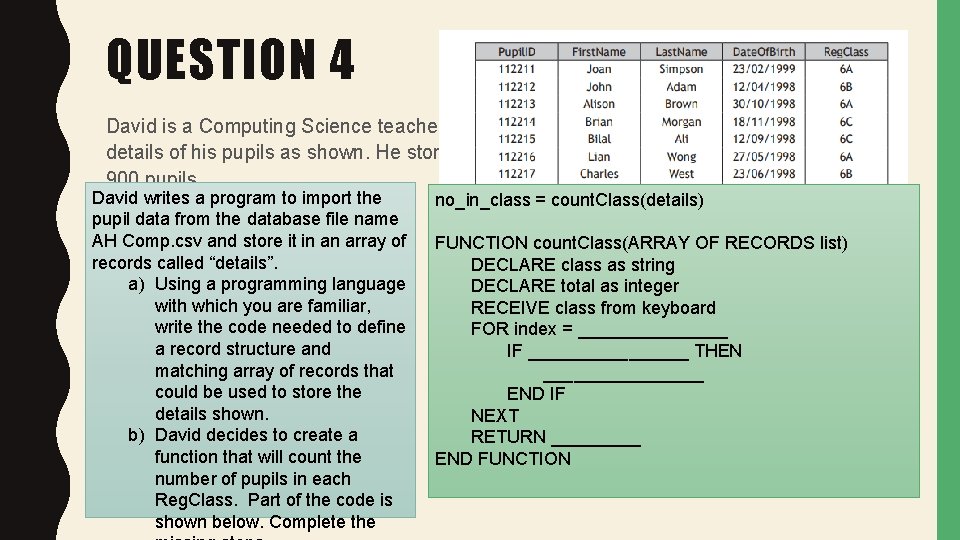
QUESTION 4 David is a Computing Science teacher, he stores details of his pupils as shown. He stores details for 900 pupils. David writes a program to import the pupil data from the database file name AH Comp. csv and store it in an array of records called “details”. a) Using a programming language with which you are familiar, write the code needed to define a record structure and matching array of records that could be used to store the details shown. b) David decides to create a function that will count the number of pupils in each Reg. Class. Part of the code is shown below. Complete the no_in_class = count. Class(details) FUNCTION count. Class(ARRAY OF RECORDS list) DECLARE class as string DECLARE total as integer RECEIVE class from keyboard FOR index = ________ IF ________ THEN ________ END IF NEXT RETURN _____ END FUNCTION
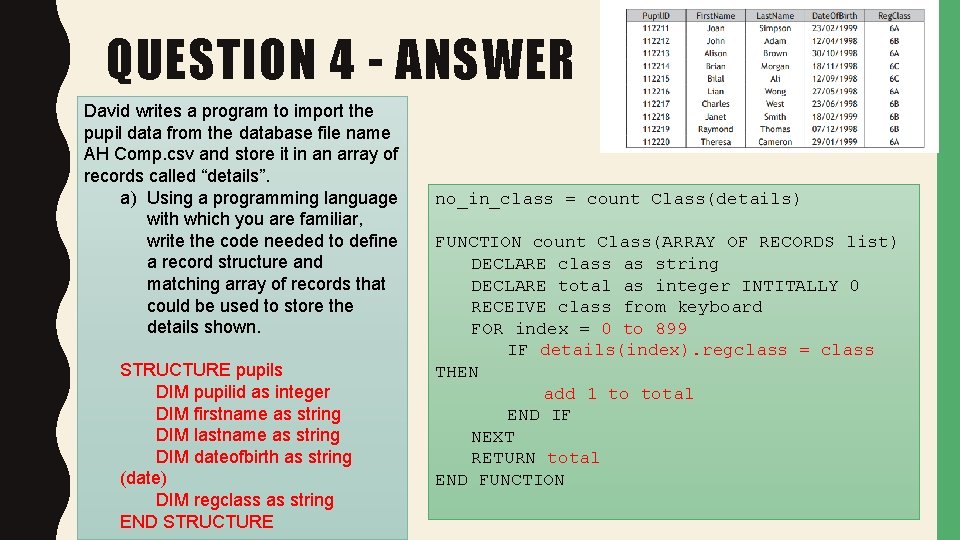
QUESTION 4 - ANSWER David writes a program to import the pupil data from the database file name AH Comp. csv and store it in an array of records called “details”. a) Using a programming language with which you are familiar, write the code needed to define a record structure and matching array of records that could be used to store the details shown. STRUCTURE pupils DIM pupilid as integer DIM firstname as string DIM lastname as string DIM dateofbirth as string (date) DIM regclass as string END STRUCTURE no_in_class = count Class(details) FUNCTION count Class(ARRAY OF RECORDS list) DECLARE class as string DECLARE total as integer INTITALLY 0 RECEIVE class from keyboard FOR index = 0 to 899 IF details(index). regclass = class THEN add 1 to total END IF NEXT RETURN total END FUNCTION
- Slides: 13