
Records management practices of Qalakabusha and Westville prison

Records management practices of Qalakabusha and Westville prison: Evaluating systems for records management in prisons Literature review University of Zululand, South Africa Department of information studies S. Mbatha Supervisor: L. P Luthuli

Outline Introduction & background Objectives Problem statement Methodology Current status of records management in prisons Types of management systems for records management in prisons • Challenges associated with the lack of systems for records management in prisons • Contribution of records management systems in prisons • Conclusion • • •

Introduction & background • Prisons serve as institutions of incarceration that are responsible for detaining individuals that have been found guilty of a criminal offense. • Prisons are facilities that do more than just detain prisoners; they provide medical care, separation of categories, food, sanitation, administration and independent monitoring (Stephens, 2018). • As facilities that house a large number of prisoners and provide other programs, they rely on a management system to keep track of records from different departments.
Introduction & background • Records keep track of prisoner information and provide evidence of other activities, such as administration, medical care and rehabilitation. • Creating and maintaining prisoner files is also essential for effective prison management and improves the transparency and accountability of prison administrations. • The careful collection of information about those being held in custody is critical to informing both day to day prison administration and long-term prison planning (handbook on prisoner file management, 2008)
Objectives • To evaluate the types of records management systems used in prisons • To determine challenges associated with the lack of records management systems in prisons. • To determine the contribution of records management systems in prisons
Problem statement • Most prisons in Africa still rely primarily on the traditional system of record keeping for managing their records. • This can be validated by Ahishayike, Taremwa and Omulo (2017) who state that a majority of correctional centres in developing countries still depend on the manual system (pen and paper) to create, store and retrieve their records. • The traditional paper-driven, system is unreliable, unsecure, requires a lot of space and puts records at the risk of being damaged or lost. • The study aims to create awareness of records management systems implemented in some prisons.
Methodology Research method- Qualitative Paradigm- interpretative research paradigm Research design- case study Data collection tools- interviews, observations and document analysis • Sampling- purposive sampling • Data analysis- thematic analysis • •
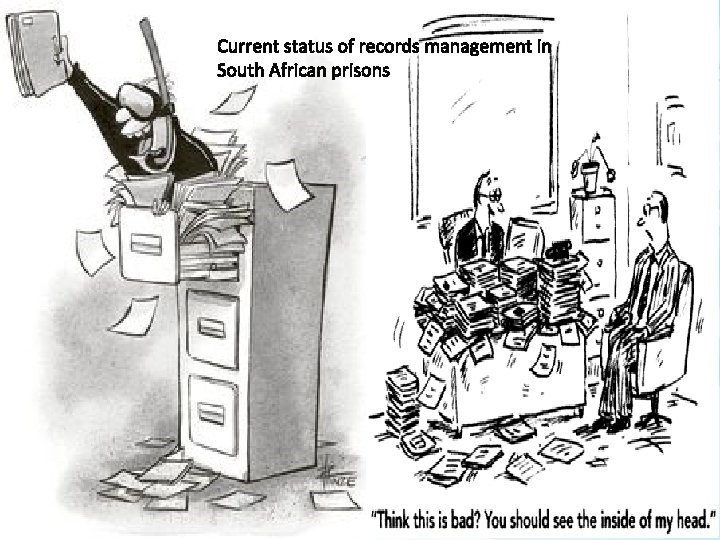
Current status of records management in South African prisons
Current status of records management in South African prisons • Prison records are still kept in manual systems (Tapscott, 2009). • Lack of accurate data still a major issue in south African prisons • There are issues regarding corruption and the credibility of records (Stephens, 2018).
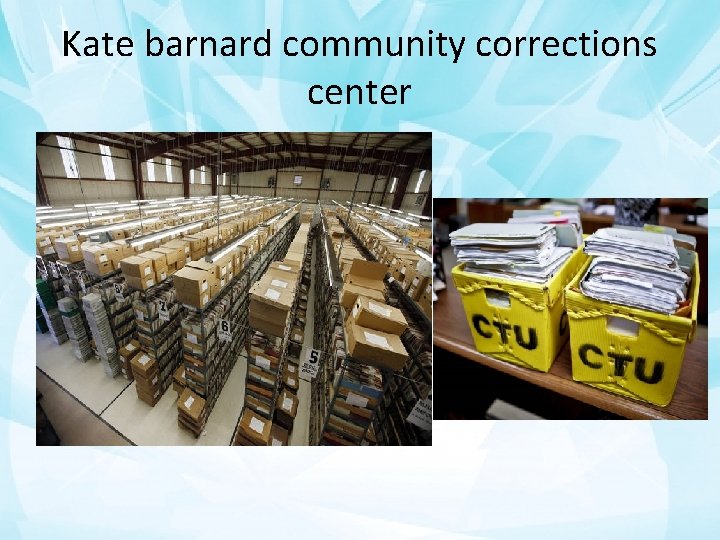
Kate barnard community corrections center

Systems for records management in prisons • A records management system refers to flow-processing procedures based on computer data, and integrated with other procedures in order store retrieve and provide information in a timely and effective manner • Ensuring effective records management systems is essential for the effective management of any prison. • To ensure adequacy and efficiency in records management • To make it less difficult to monitor individual records of prisoners (Hand book for prison leaders, 2010).
Integrated prison management system (IPMS) • The integrated prison management system is used to enhance the administrative capabilities of jails in terms of monitoring and security of a majority prisons in India (Jharkhand). • The IPMS has the following advantages, it is a secure system to modernize inmate record maintenance and searching operations. • It also facilitates electronic processing of inmates records and the management of such activities to provide higher level of compliance and faster service with lower costs and higher efficiency. • Supports the jail staff working in the prisons with efficient recordkeeping and makes the work profile of the staff much easier in day by day administrative work
Prison management systems (PRISMS) • The Prisons Management Systems (PRISMS), is an egovernance initiative of Goa government that been has influential as far as automation and efficiency of Prisons management is concerned. • Provides effectiveness and efficiency of record keeping and stores records in a centralized database. • Provides real-time information on all aspects of jail management including “inmate personal property, visitor activity, mental and medical health information, inmate movement in and out the facility, case and crime information, remission, parole, and furlough (Manzar, 2014).
Prison management and visitor management system • Captures registration, movement in the jail and outside and release of the inmate. • Stores prison records in a central database such that duplicate entry of the prisoner can be identified in a global manner • It helps to generate more reports of administrative performance and statistical nature. • It facilitates, regulates and simplifies the processes of meeting between the visitors who are coming to visit their prisoners. • Helps in dealing with over populous prison that is housing inmates, which are more than three times of the sanctioned capacity (Ahishayike, Taremwa & Omulo, 2017).
Offender management information system (OMIS) • It is a web based electronic data management system that stores and retrieves important prisoner records from the day they are admitted to the day they finish their sentence. • The system provides these modules: Admission, Reception and Assessment, Health Management , Case Management, Rehabilitation Activities, Institutional Incidents , Visits, Transfers, Pre-Release, Sentence Changes; and Release. • It stores, retrieves and analyses more complex data elements that can then generate other summary information.
Challenges associated with the lack of records management systems in prisons • There are thousands of paper records and no storage space. Average of 700 -800 paper records per month (The Oklahoman, 2016). • Abundance of paper records that get lost and damaged (Wahome, 2011). • The manual system for administrative records functions causes delays and reduces the output of staff significantly (Ahishayike, Taremwa and Omulo , 2017) • Manual system results in redundancy, inconsistency, data insecurity, lack of proper backup measures (Joshua legacy enterprise, 2019). • In other prisons reports disappear and tracing them becomes a problem since their system is not automated. Some files get worn out (Wahome, 2011).
The contribution of records management systems in prisons • The prison management systems have transformed the working environment and brought forth a significant change in terms of electronic records management. • Manzar (2011) asserts that records management became easier after the prison management system (PRISMS) initiative was implemented • The integrated prison management system (IPMS) has modernized inmate records maintenance and searching operations. • The offender management information system (OMIS) provides digital storage of records concerning admission, health management, rehabilitation and jail visits.
Conclusion • Literature revealed that the systems that have been implemented in some prisons are effective and efficient in terms of records management. • Furthermore a majority of the prisons that are plagued with challenges and inadequacy of recordkeeping still rely on the traditional system of record keeping which requires them to use paper records. • Ensuring a simplified and efficient records management approach in prisons calls for the adoption of records management systems, therefore it is recommended that prisons migrate from the manual system to minimize the challenges and to improve accountability, transparency and security of records.
- Slides: 18