
Record Keeping for Cost Analysis Prepared by L
Record Keeping for Cost Analysis Prepared by: L. Robert Barber, Roland Quitugua & Ilene Iriarte For: Guam Cooperative Extension Service & Guam Department of Agriculture Funding provided by: United States Department of Agriculture Natural Resources Conservation Service, Western Region Sustainable Agriculture Research and Education, Administration for Native Americans, , & Sanctuary Incorporated
Record Management • Financial records: to determine whether you are making or loosing money (develop enterprise budgets) and how much. – Needed for pricing (cost analysis), government program participation, and taxes. • Production records: to prove compliance (organic), maximize disaster benefits, plan activities and rotations, ensure practices being implemented anticipate problems. • Observation information: spot problems early, note trends or capture ideas • Most basic method: Start with a daily log of what you do, use, observe, time involved (labor).

Accurate Record Keeping • Requires a paper trail, very difficult to do after the fact. • Need a system to generate and store information. • If you have the information recorded and stored you can later: – Determine how to cut costs – Claim maximum disaster benefits – Maximize tax benefits • “Make it a habit”

Record Collection Organization • 1 st Step is to generate & organize your records • UOG-CES developed the FROG system – (Friendly Record Organization for Guam) – Convenient portable filling system – Contains DAILY LOG • Notes on what you do, what you used – Generate & collect production cost and sales information – Keeps records in one place • Date all entries
FROG System • Based on a divided plastic portfolio organized into several main categories: – Contains all materials necessary for record generation. – Sales Receipts (Income) – Crop/Enterprise Expenses (Reciepts, log: materials use, log: time used) – Whole farm costs – Daily log & recording material
Determining Profitability • INCOME: Income – Expenses = Profit – Production Quantity – Market Price (Selling Price) • EXPENSE: – Fixed Costs (Whole Farm & Long Term) – Variable Costs (Out of Pocket Costs & Labor)
Budget; Planning • Good planning is essential for increasing profits & insuring success • Key planning tool is a summary of expected costs (having a Budget) • Most important input to use in planning is past records of actual costs & returns – First time may have guess – Use past experiences and other “applicable” resources
Costs (Handled Differently) • Variable Costs: (Direct into Budget) – Costs that change during the production cycle – Frequently called out of pocket expenses – Ex: are labor, feed, water, marketing • Fixed Costs: (depends on life & number of enterprises) – Costs that remain the same during the production cycle – Ex: are chicken tractor canopy & tarp, vehicle, property tax
Costs (Handled Differently) • Variable Costs: (Direct into Budget) – Costs that change during the production cycle – Frequently called out of pocket expenses – Ex: are labor, feed, water, marketing • Fixed Costs: (depends on life & number of enterprises) – Costs that remain the same during the production cycle – Ex: are chicken tractor canopy & tarp, vehicle, property tax
Fixed Costs • Depreciating costs – Estimating multi-year/crop cycle costs that occur in one year but benefit the producer for many years • Ex: Truck, irrigation equipment, vehicle – If these costs are charged to one year it would look like the business is unprofitable • You can deal with this by: – Divide these costs by the number of years the item would be useful, & this value is charged for each year.
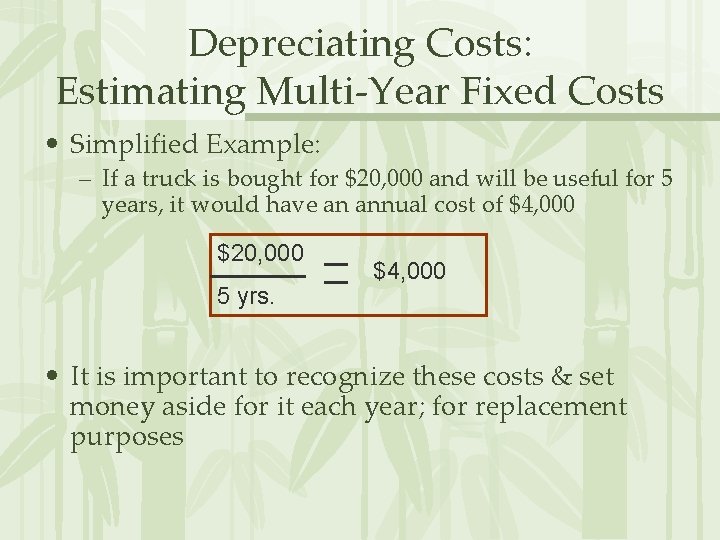
Depreciating Costs: Estimating Multi-Year Fixed Costs • Simplified Example: – If a truck is bought for $20, 000 and will be useful for 5 years, it would have an annual cost of $4, 000 $20, 000 5 yrs. $4, 000 • It is important to recognize these costs & set money aside for it each year; for replacement purposes
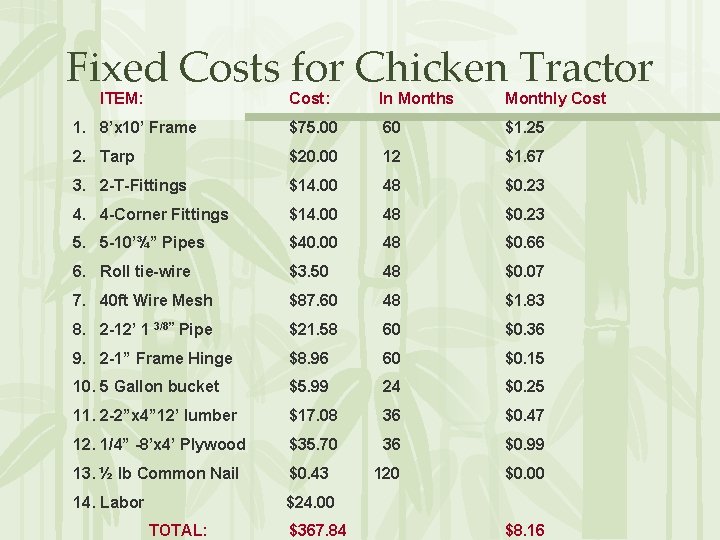
Fixed Costs for Chicken Tractor ITEM: Cost: In Months Monthly Cost 1. 8’x 10’ Frame $75. 00 60 $1. 25 2. Tarp $20. 00 12 $1. 67 3. 2 -T-Fittings $14. 00 48 $0. 23 4. 4 -Corner Fittings $14. 00 48 $0. 23 5. 5 -10’¾” Pipes $40. 00 48 $0. 66 6. Roll tie-wire $3. 50 48 $0. 07 7. 40 ft Wire Mesh $87. 60 48 $1. 83 8. 2 -12’ 1 3/8” Pipe $21. 58 60 $0. 36 9. 2 -1” Frame Hinge $8. 96 60 $0. 15 10. 5 Gallon bucket $5. 99 24 $0. 25 11. 2 -2”x 4” 12’ lumber $17. 08 36 $0. 47 12. 1/4” -8’x 4’ Plywood $35. 70 36 $0. 99 13. ½ lb Common Nail $0. 43 120 $0. 00 14. Labor $24. 00 TOTAL: $367. 84 $8. 16
Fixed Costs to Consider Initial Investment VS. Allocated Investment Cost per Cycle
Production Costs • Explore costs and their alternatives weighing their pros and cons
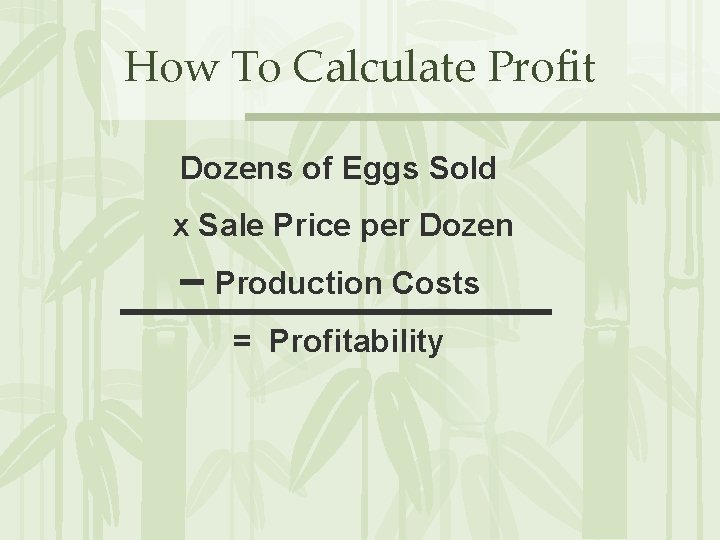
How To Calculate Profit Dozens of Eggs Sold x Sale Price per Dozen Production Costs = Profitability
Breakeven Price • Breakeven price is the unit price that one must obtain in the market in order to cover cost of production • To calculate breakeven price you: – Divide the cost of production by the total number of units produced
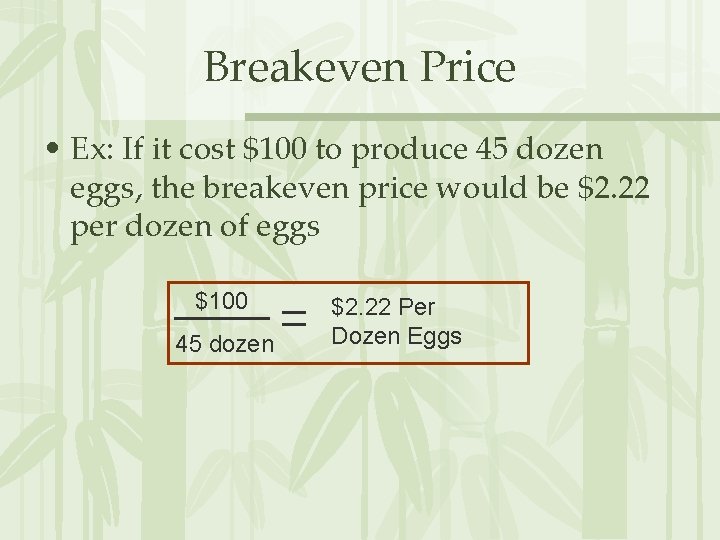
Breakeven Price • Ex: If it cost $100 to produce 45 dozen eggs, the breakeven price would be $2. 22 per dozen of eggs $100 45 dozen $2. 22 Per Dozen Eggs
Home Work: Cost Analysis • Due Friday before class starts • Build a chicken tractor with the intention to sell eggs produced for a profit. • Compare two systems starting with baby chicks or purchasing layers • List: fixed costs, variable costs and break even point and when can you expect to see a profit? • Be prepared to recommend and defend one system.
- Slides: 18