
Record Authenticity as a Measure of Trust A
- Slides: 22
Record Authenticity as a Measure of Trust: A View Across Records Professions, Sectors, and Legal Systems Corinne Rogers University of British Columbia In. Future 2015 Zagreb, Croatia November 11 -13, 2015
What are authentic digital records? • The concept of authenticity of records has ancient roots • Authenticity of records is fundamental to archival theory and practice, reified in laws, standards, codes of practice, research recommendations • Despite clear guidance from archival science, research, and law, known recommendations are not consistently applied in practice
Authenticity – the “ideal” • Establish identity • Demonstrate integrity – Of the record(s) – Of the system(s)
Authenticity – the “real” Research questions • How do records professionals approach the concept of authenticity in the digital environment? – What indicators do they apply to ensure authenticity? – What indicators do they rely on when required to make an assessment of authenticity? – What indicators would they rely on if required to make an assessment of authenticity?
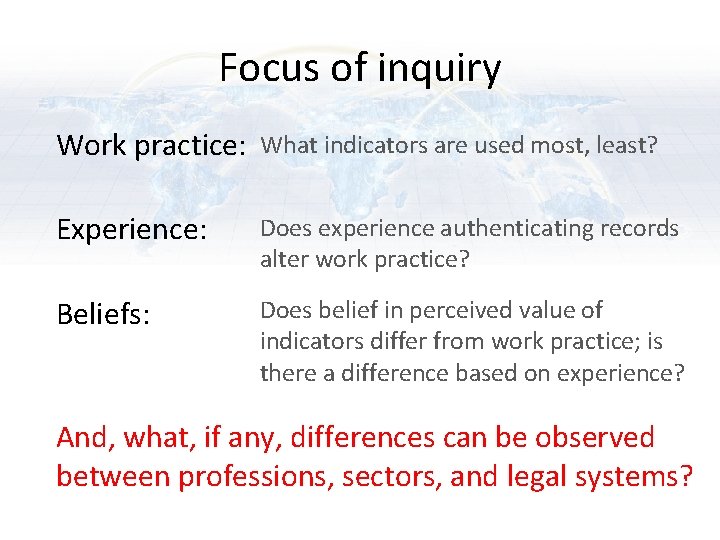
Focus of inquiry Work practice: What indicators are used most, least? Experience: Does experience authenticating records alter work practice? Beliefs: Does belief in perceived value of indicators differ from work practice; is there a difference based on experience? And, what, if any, differences can be observed between professions, sectors, and legal systems?
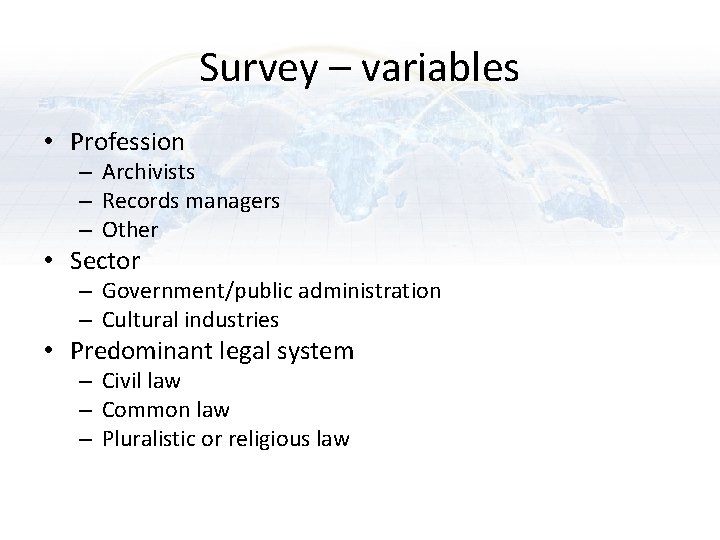
Survey – variables • Profession – Archivists – Records managers – Other • Sector – Government/public administration – Cultural industries • Predominant legal system – Civil law – Common law – Pluralistic or religious law
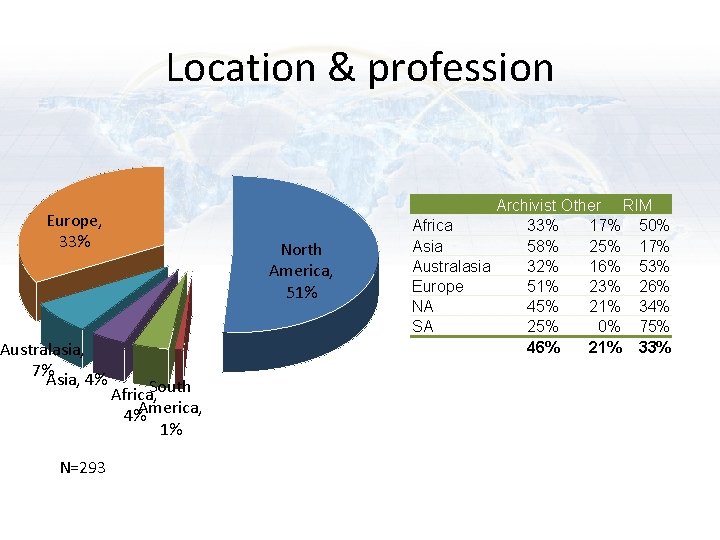
Location & profession Europe, 33% Australasia, 7%Asia, 4% N=293 North America, 51% Africa, South 4%America, 1% Archivist Other RIM Africa 33% 17% 50% Asia 58% 25% 17% Australasia 32% 16% 53% Europe 51% 23% 26% NA 45% 21% 34% SA 25% 0% 75% 46% 21% 33%
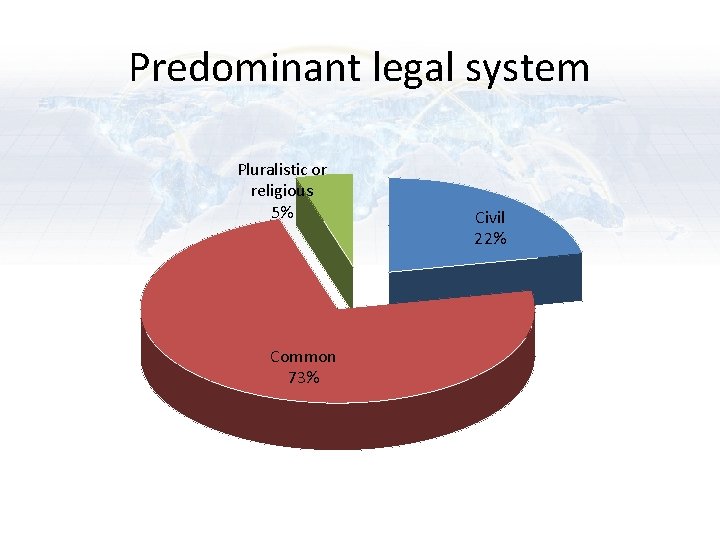
Predominant legal system Pluralistic or religious 5% Common 73% Civil 22%
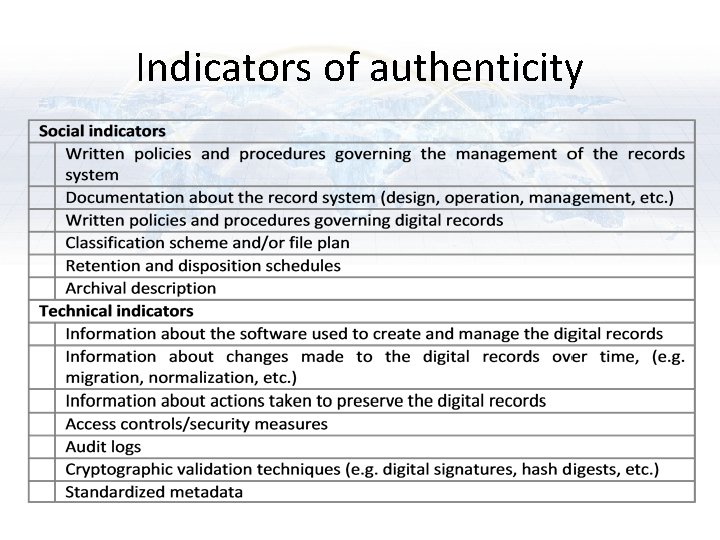
Indicators of authenticity
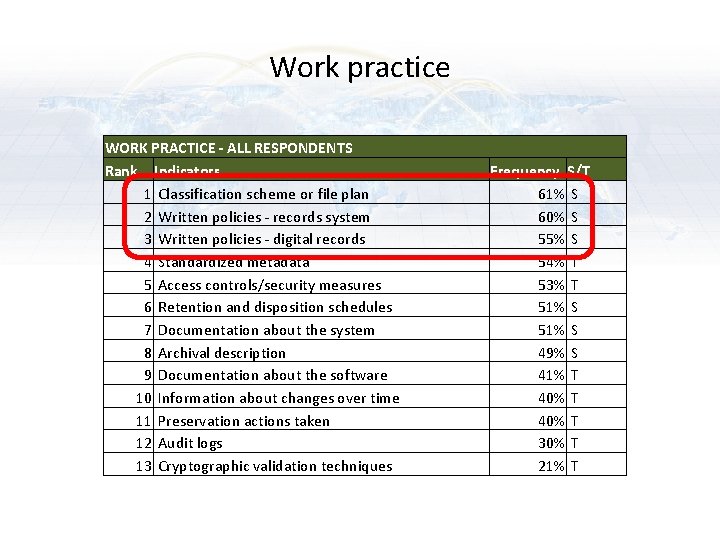
Work practice WORK PRACTICE - ALL RESPONDENTS Rank Indicators 1 Classification scheme or file plan 2 Written policies - records system 3 Written policies - digital records 4 Standardized metadata 5 Access controls/security measures 6 Retention and disposition schedules 7 Documentation about the system 8 Archival description 9 Documentation about the software 10 Information about changes over time 11 Preservation actions taken 12 Audit logs 13 Cryptographic validation techniques Frequency S/T 61% S 60% S 55% S 54% T 53% T 51% S 49% S 41% T 40% T 30% T 21% T
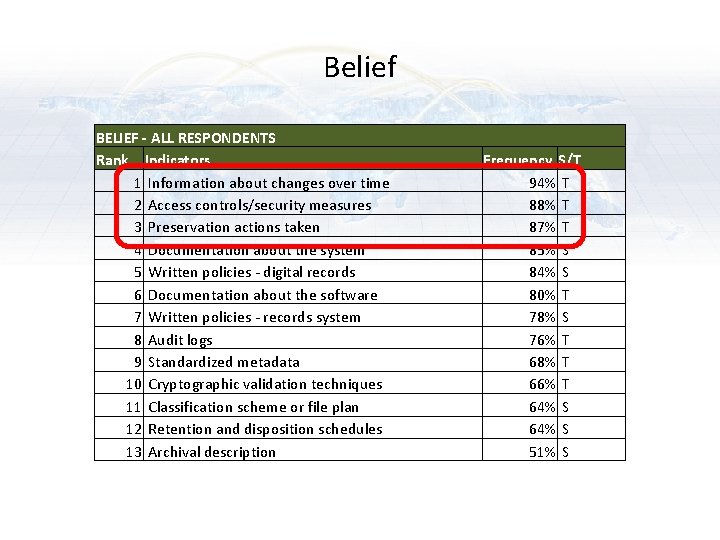
Belief BELIEF - ALL RESPONDENTS Rank Indicators 1 Information about changes over time 2 Access controls/security measures 3 Preservation actions taken 4 Documentation about the system 5 Written policies - digital records 6 Documentation about the software 7 Written policies - records system 8 Audit logs 9 Standardized metadata 10 Cryptographic validation techniques 11 Classification scheme or file plan 12 Retention and disposition schedules 13 Archival description Frequency S/T 94% T 88% T 87% T 85% S 84% S 80% T 78% S 76% T 68% T 66% T 64% S 51% S
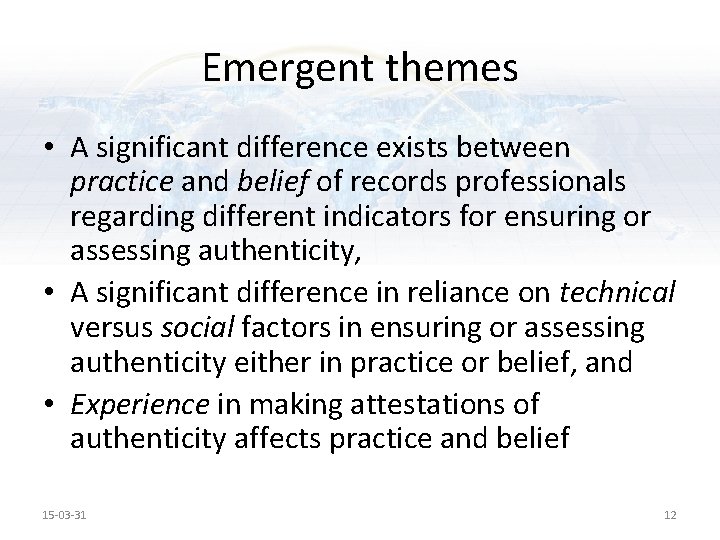
Emergent themes • A significant difference exists between practice and belief of records professionals regarding different indicators for ensuring or assessing authenticity, • A significant difference in reliance on technical versus social factors in ensuring or assessing authenticity either in practice or belief, and • Experience in making attestations of authenticity affects practice and belief 15 -03 -31 12
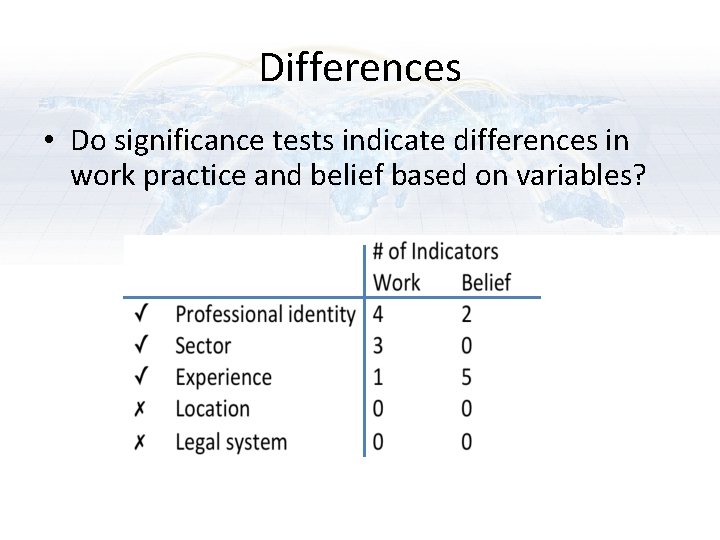
Differences • Do significance tests indicate differences in work practice and belief based on variables?
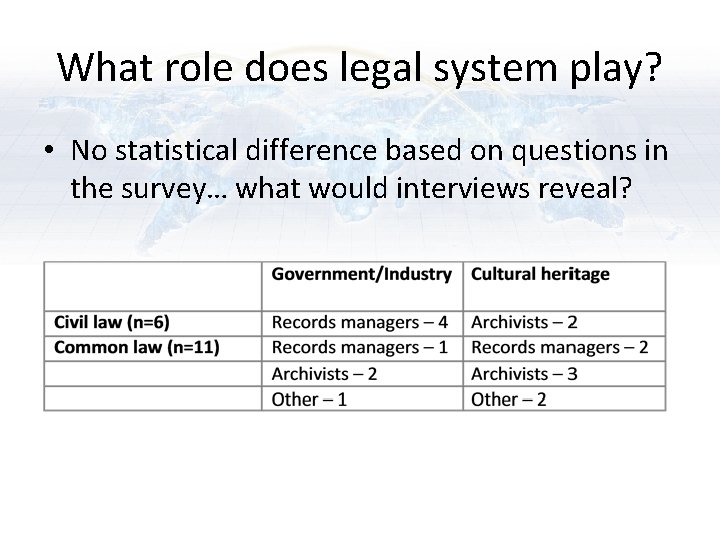
What role does legal system play? • No statistical difference based on questions in the survey… what would interviews reveal?
Common law • Authenticity part of the foundation of admissibility of documentary and real evidence • Proven through authentication of documents when introduced into evidence – Through testimony – Expert analysis – Non-expert opinion – In certain cases, circumstances of creation or preservation
Admissibility in court: identity and integrity • Authentication establishes the record’s identity • “Best evidence” traditionally satisfied by production of an original • Hearsay rule and its exceptions for documentary evidence
Civil law • Greater procedural formalism through brightline rules: – Clearly defined rules – Based on objective factors – Little room for interpretation
Conclusions • What mechanisms do records professionals use and rely on in order to determine and manage authenticity? 1. records professionals are strategic, realistic, pragmatic given resources, expectations, and requirements 2. social mechanisms ensure authenticity, while technical mechanisms prove authenticity at a moment in time 18
Conclusions • Is the traditional model of authenticity of records used in the digital environment and if so, to what degree? And, Is the traditional model of authenticity sufficient? 1. It still forms the foundation, but requires development 2. In practice, the concept of authenticity is tied to purpose (focus of creator) or use (focus of user); getting the job done 3. Theoretical models may be accepted in principle, but ignored in practice
Conclusions • Work practice and belief (perceived value) in indicators of authenticity are qualitatively different • The focus is on integrity: Security has become the “new authenticity” • Complexity and ambiguity are driving pragmatic responses to a latent problem situation
Questions remain… • The role of the legal system: – Patchwork of legislation – Underlying assumptions and values – Unintended consequences • An area ripe for further investigation
Thank you Corinne Rogers corinne. rogers@ubc. ca “Some problems are so complex that you have to be highly intelligent and well informed just to be undecided about them. ” --Laurence J. Peter 22