
Reconstruction The South After the Civil War Freedmen
- Slides: 13
Reconstruction The South After the Civil War
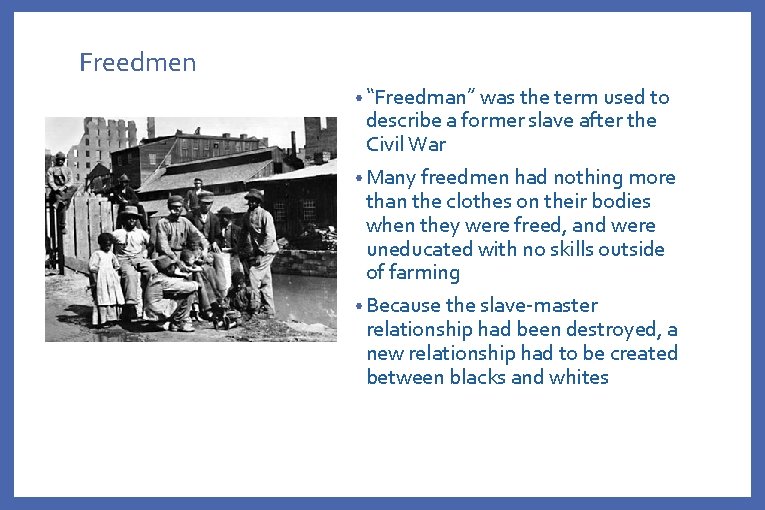
Freedmen • “Freedman” was the term used to describe a former slave after the Civil War • Many freedmen had nothing more than the clothes on their bodies when they were freed, and were uneducated with no skills outside of farming • Because the slave-master relationship had been destroyed, a new relationship had to be created between blacks and whites
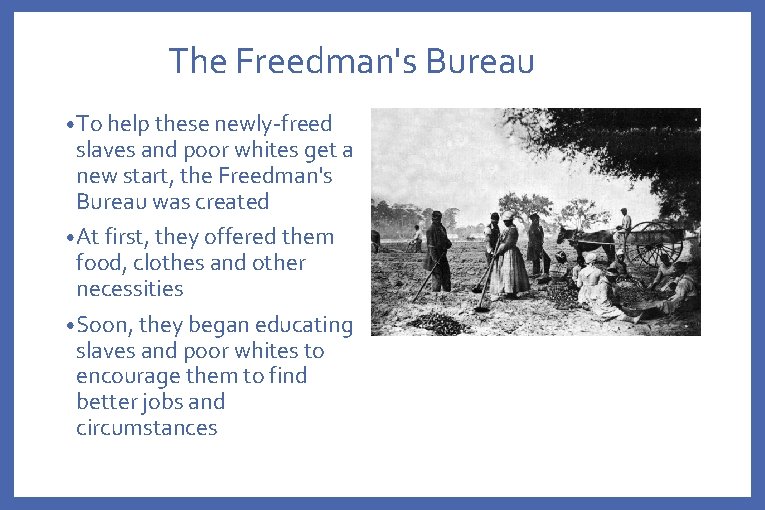
The Freedman's Bureau • To help these newly-freed slaves and poor whites get a new start, the Freedman's Bureau was created • At first, they offered them food, clothes and other necessities • Soon, they began educating slaves and poor whites to encourage them to find better jobs and circumstances
Sharecropping • Sharecropping was a system where landowners provided land, housing and supplies to farmers who would in turn give part of their harvest to the landowner • Landowners would sell medicine, food and clothes to farmers on credit until their crops came in • Farmers would then have to pay landowners back at a highly increased price • This kept farmers from ever leaving the sharecropping system
Tenant Farming • Similar to sharecropping, except that tenant farmers owned some farming supplies and animals, as well as seeds for planting • They only borrowed land from landowners, and paid them a set amount (cash or crops) at the end of a harvest • This was better for farmers than sharecropping, but it was still a difficult life
Lincoln's Reconstruction • Lincoln said that the South could rejoin the union after two things happened: (1) All southerners, except high-ranking Confederate leaders, had to take an oath of allegiance to the USA, and (2) when 10% of voters in each state had taken the oath, the state would be allowed to rejoin. • Many northerners thought the South should be punished, but Lincoln fought this idea, believing that the South had paid a big enough price
Andrew Johnson's Reconstruction • After Lincoln was assassinated, it was left up to Vice President Johnson to bring the country back together. • Johnson's plan for the South rejoining the union was more strict than Lincoln's, but it was still too lenient for many radical northerners • Johnson also required southern states to ratify the 13 th Amendment, outlawing slavery and nullify (invalidate) their laws and governments of secession
Constitutional Amendments of Reconstruction *Super-Important!!!! • 13 th Amendment- Made slavery illegal • 14 th Amendment- Granted citizenship to former slaves, and guaranteed “equal protection of the law” for all people • 15 th Amendment- Gave all male citizens the right to vote, regardless of race
Black Congressmen in Georgia • Only two years after the war ended (1867), the first African American votes were cast • 32 African Americans were elected to Georgia's Congress in 1867, but were expelled the next year • It was argued that although the Constitution gave blacks the right to vote, it did not give them the right to hold public office • Regardless, the Republican party held power thanks to the votes of many African Americans
Henry Mc. Neal Turner • Born in the South but never a slave, Henry Mc. Neal Turner actually received an education while working as a custodian at a law firm • He would become a highly influential preacher for the African Methodist Episcopal church, and eventually one of the first African Americans elected to Congress • He was removed from office due to pressure from the KKK and a fraudulant election, but remained a prominent leader in the community
Ku Klux Klan • The Klan was a group who used intimidation in order to keep freedmen from exercising their rights • They harassed, beat, whipped, and hanged many African Americans to keep them from voting and to return power to the Democratic party in the South • They dressed in hooded garments in order to hide their identity and to scare victims
The Georgia Act • The KKK actions became so severe that it impacted the presidential election of 1868 because so many blacks were afraid to vote • The Georgia Act was passed as a result • This act returned Georgia to military control, which made it easier to contain the KKK
Ending Reconstruction • Reconstruction in Georgia officially ended in July 1870, when Georgia was readmitted to the United States • Despite this, Georgia had much work left in the rebuilding process that the Civil War had required • Georgia's economy was still in grave trouble, and race relations between blacks and whites were as bad as they had ever been