
RECONSTRUCTION Reconstruction is a process of the companys
- Slides: 12
RECONSTRUCTION Reconstruction is a process of the company’s reorganization, concerning legal, operational, ownership and other structures, by revaluing assets and reassessing the liabilities.
There are two methods of reconstruction which are internal reconstruction and external reconstruction. The former is the method in which the reconstruction is undertaken without winding up the company and forming a new one, while the latter, is one whereby the existing company loses its existence, and a new company is set up to take over the business of the existing company
OBJECTIVES OF RECONSTRUCTION • To resolve the problem of over-capitalization/huge accumulated losses/over valuation of assets. • When the capital structure of a company is complex and is required to make it simple • When change is required in the face value of shares of the company • To generate surplus for writing off accumulated losses & writing down overstated assets. • Raising the fresh capital by issuing new shares. • Changing altogether the memorandum of association of the company.
TYPES OF RECONSTRUCTION EXTERNAL RECONSTRUCTION External reconstruction refers to the sale of the business of existing company to another company formed for the purposed. In external reconstruction, one company is liquidated another new company is formed. The liquidated company is called "Vendor Company" and the new company is called "Purchasing Company". Shareholders of vendor company become the shareholders of purchasing company
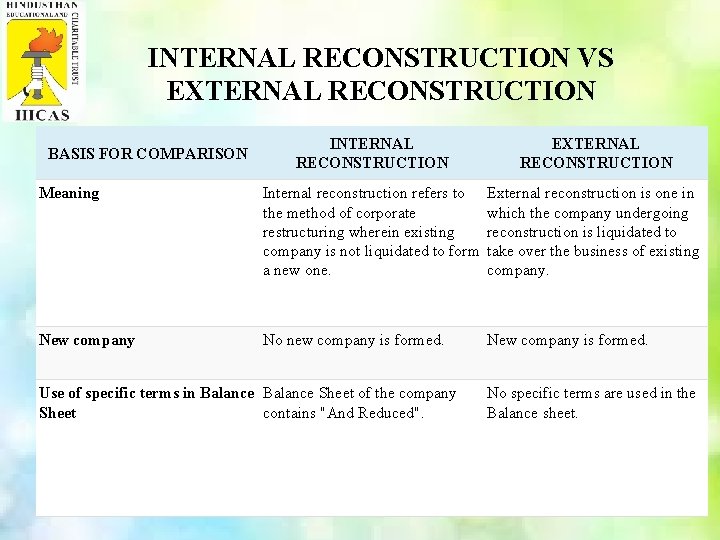
INTERNAL RECONSTRUCTION VS EXTERNAL RECONSTRUCTION INTERNAL RECONSTRUCTION EXTERNAL RECONSTRUCTION Meaning Internal reconstruction refers to the method of corporate restructuring wherein existing company is not liquidated to form a new one. External reconstruction is one in which the company undergoing reconstruction is liquidated to take over the business of existing company. New company No new company is formed. New company is formed. BASIS FOR COMPARISON Use of specific terms in Balance Sheet of the company Sheet contains "And Reduced". No specific terms are used in the Balance sheet.
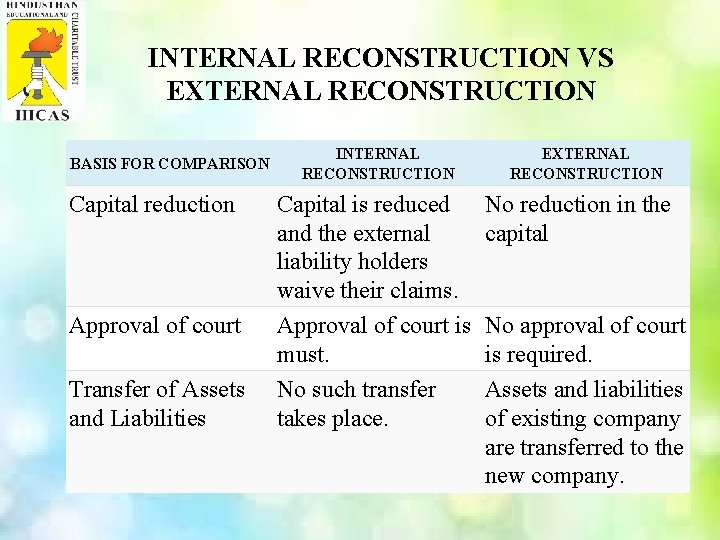
INTERNAL RECONSTRUCTION VS EXTERNAL RECONSTRUCTION BASIS FOR COMPARISON Capital reduction Approval of court Transfer of Assets and Liabilities INTERNAL RECONSTRUCTION Capital is reduced and the external liability holders waive their claims. Approval of court is must. No such transfer takes place. EXTERNAL RECONSTRUCTION No reduction in the capital No approval of court is required. Assets and liabilities of existing company are transferred to the new company.
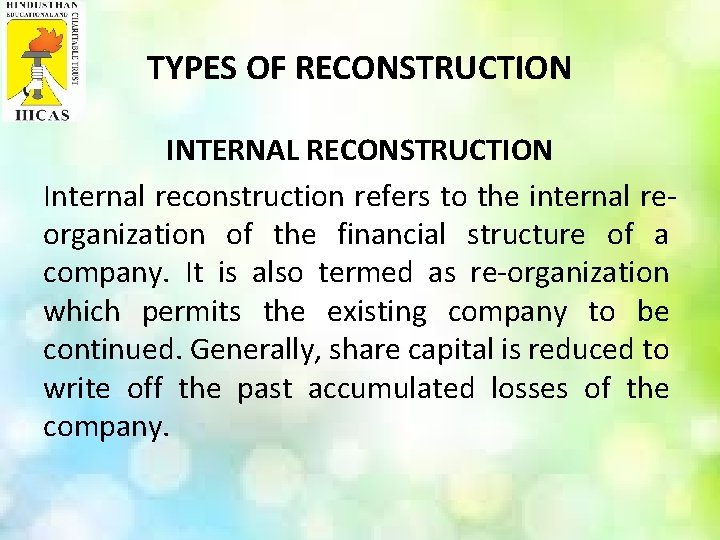
TYPES OF RECONSTRUCTION INTERNAL RECONSTRUCTION Internal reconstruction refers to the internal reorganization of the financial structure of a company. It is also termed as re-organization which permits the existing company to be continued. Generally, share capital is reduced to write off the past accumulated losses of the company.
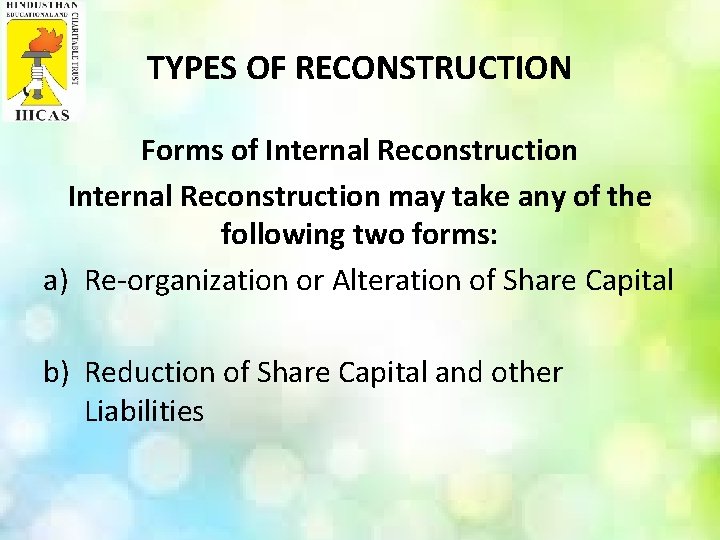
TYPES OF RECONSTRUCTION Forms of Internal Reconstruction may take any of the following two forms: a) Re-organization or Alteration of Share Capital b) Reduction of Share Capital and other Liabilities
RE-ORGANIZATION OR ALTERATION OF SHARE CAPITAL Re-organization or alteration of share capital refers to the arrangement of the capital of the company and include the following: • Increase the share capital by making fresh issue of shares • Decreasing the share capital by cancelling the unissued shares. • Conversion of shares into stock and vice versa
RE-ORGANIZATION OR ALTERATION OF SHARE CAPITAL • Consolidation of shares of smaller amounts into shares of larger amounts • Sub-division of shares of larger amounts into share of smaller amounts. A company can alter its share capital if it is authorized by its Articles of Association
REDUCTIONOF SHARE CAPITAL AND OTHER LIABILITIES • Reduction of Share Capital is an arrangement under which the capital of the shareholder and sometimes even the claims of debenture holders and the creditors are reduced. • The amount made available by capital reduction is utilized in writing off the accumulated losses, fictitious assets and the overvalued portion of the other assets.
REDUCTIONOF SHARE CAPITAL AND OTHER LIABILITIES(Cont) A company can reduce its paid-up capital if a. It is authorized by its articles b. A special resolution is passed and c. A sanction of the court is obtained