
Reconstruction of High Transverse Momentum Top Quarks at

- Slides: 16
Reconstruction of High Transverse Momentum Top Quarks at CMS Gavril Giurgiu (Johns Hopkins University) For the CMS Collaboration 2009 DPF Meeting Wayne State University, Detroit, Michigan July 26 -31, 2009 G. Giurgiu, DPF 2009
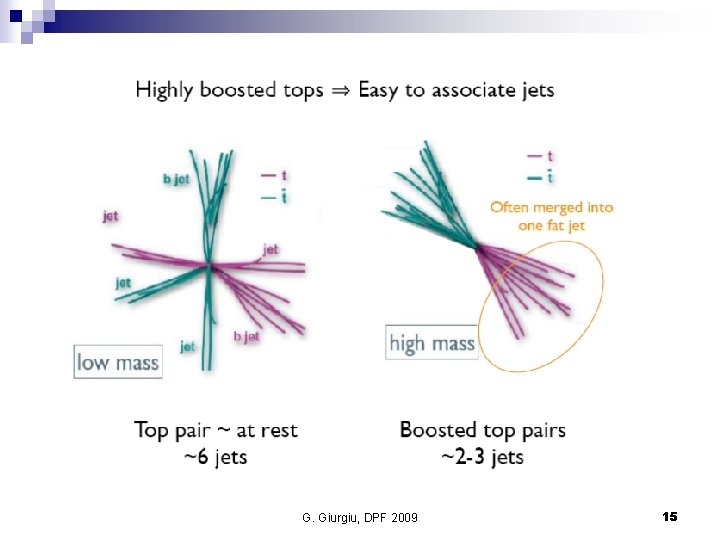
Introduction - Various New Physics particles decay into tt pairs with large branching fractions: - Randall-Sundrum KK gluon: g. KK → tt L. Randall, R. Sundrum, Phys. Rev. Lett 88: 3370 -3374 (1999) - excited neutral gauge boson: Z’ → tt - If Z’/g. KK is heavy enough (~Te. V), tt daughters are highly boosted → top quark daughters, b and W (→q+q’ or lepton+n) are collimated into single high momentum “top” jet - Top identification techniques based on b-tagging difficult in highly boosted jets - dense tracking environment CMS note BTV-09 -001 → affects displaced track or vertex b-tagging - lepton ID not trivial for leptons inside boosted jets → affects “soft lepton” tagging - Expect lower efficiency and higher mis-tag rates of most b-tagging methods - Easier to associate jets with top-quark since jet daughters follow top direction - New idea: Identify t → W(→qq’) b decays directly by studying the sub-structure of the collimated “top” jet G. Giurgiu, DPF 2009 2
Boosted Top Tagging ar. Xiv: 0806. 0848 v 2, Phys. Rev. Lett. 101: 142001, 2008, D. Kaplan et all - If boosted top decays to quarks only (hadronic mode): t → W(→qq’) b → take advantage of large BR in all hadronic mode (46%) → decompose top jet into sub-jets corresponding to top daughters (bqq’) → attempt to discriminate top jets from QCD jets using jet sub-structure information → challenge: large QCD jet background → expect 40% efficiency and 99% non-top background rejection - Implement boosted top tagging algorithm at CMS - attempt to reconstruct top and W mass using sub-jets - Is it possible to decompose boosted top jet into sub-jets ? G. Giurgiu, DPF 2009 3
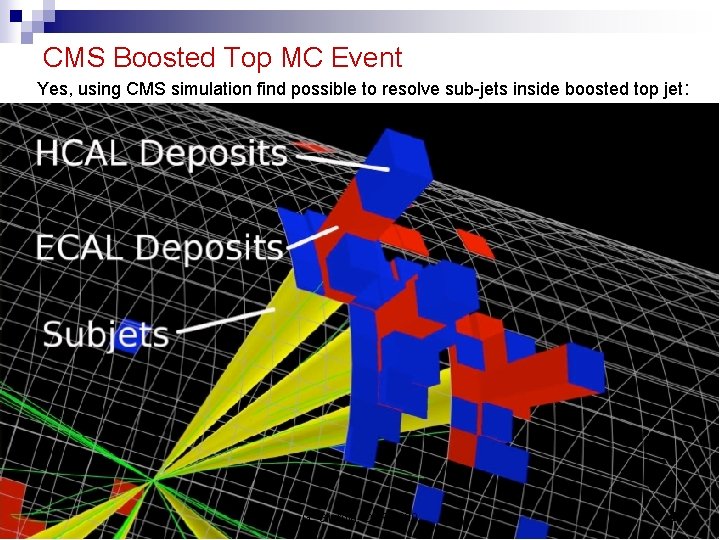
CMS Boosted Top MC Event Yes, using CMS simulation find possible to resolve sub-jets inside boosted top jet: G. Giurgiu, DPF 2009 4
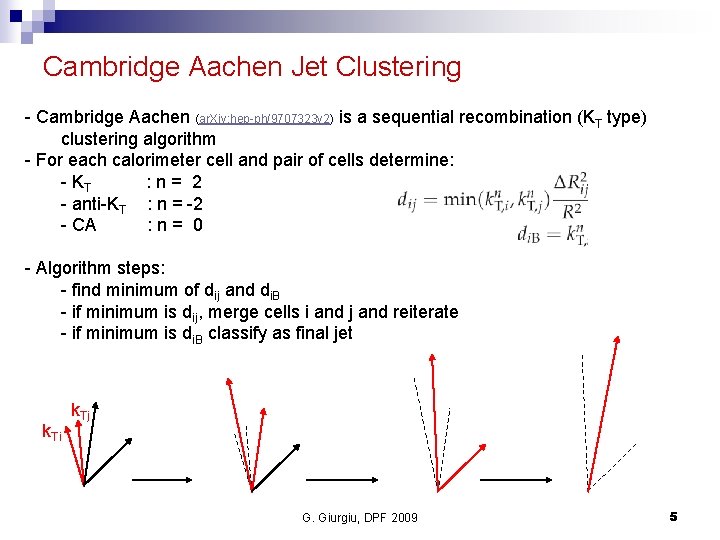
Cambridge Aachen Jet Clustering - Cambridge Aachen (ar. Xiv: hep-ph/9707323 v 2) is a sequential recombination (KT type) clustering algorithm - For each calorimeter cell and pair of cells determine: - KT : n= 2 - anti-KT : n = -2 - CA : n= 0 - Algorithm steps: - find minimum of dij and di. B - if minimum is dij, merge cells i and j and reiterate - if minimum is di. B classify as final jet k. Ti k. Tj G. Giurgiu, DPF 2009 5
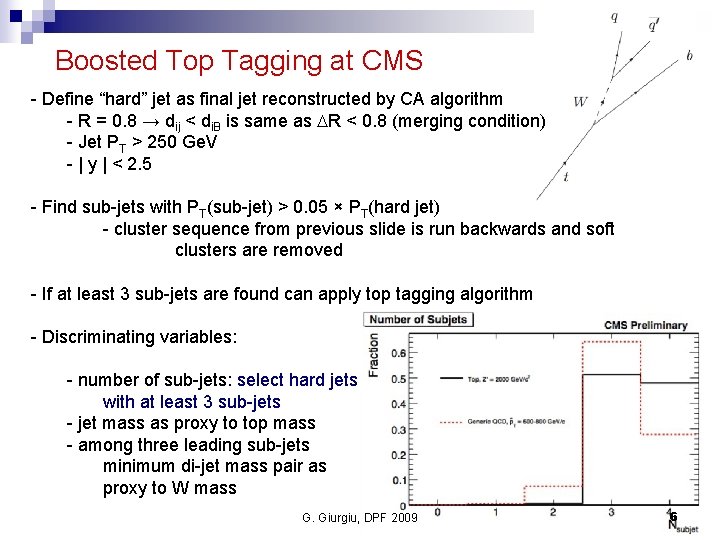
Boosted Top Tagging at CMS - Define “hard” jet as final jet reconstructed by CA algorithm - R = 0. 8 → dij < di. B is same as DR < 0. 8 (merging condition) - Jet PT > 250 Ge. V - | y | < 2. 5 - Find sub-jets with PT(sub-jet) > 0. 05 × PT(hard jet) - cluster sequence from previous slide is run backwards and soft clusters are removed - If at least 3 sub-jets are found can apply top tagging algorithm - Discriminating variables: - number of sub-jets: select hard jets with at least 3 sub-jets - jet mass as proxy to top mass - among three leading sub-jets minimum di-jet mass pair as proxy to W mass G. Giurgiu, DPF 2009 6
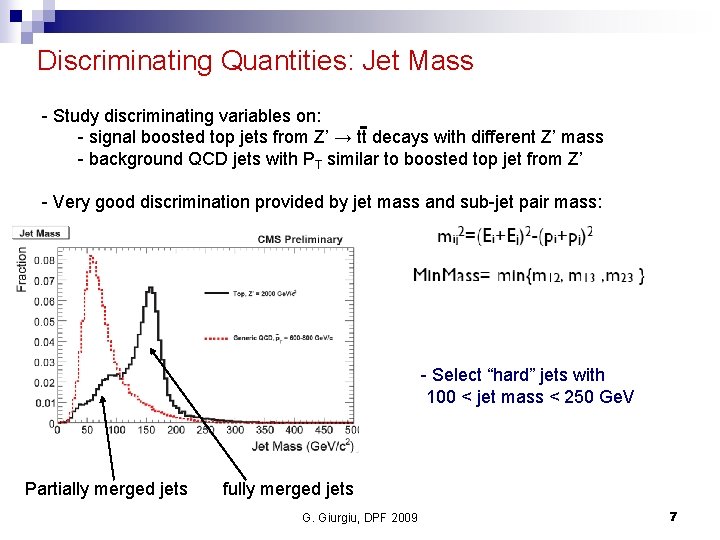
Discriminating Quantities: Jet Mass - Study discriminating variables on: - signal boosted top jets from Z’ → tt decays with different Z’ mass - background QCD jets with PT similar to boosted top jet from Z’ - Very good discrimination provided by jet mass and sub-jet pair mass: - Select “hard” jets with 100 < jet mass < 250 Ge. V Partially merged jets fully merged jets G. Giurgiu, DPF 2009 7
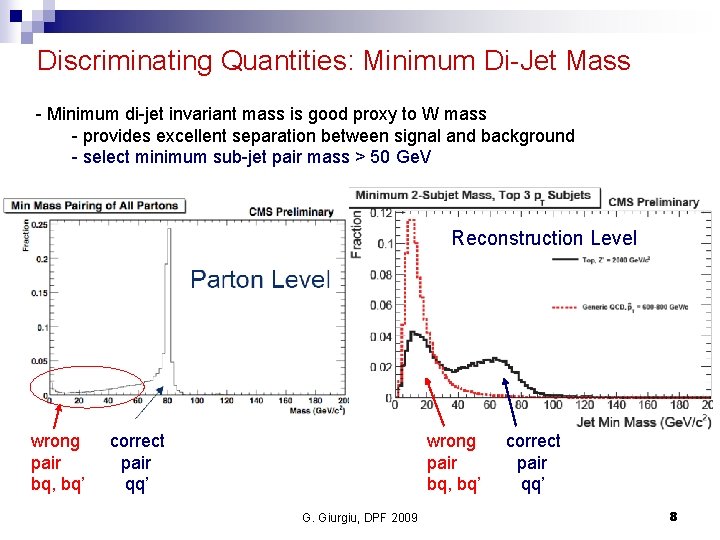
Discriminating Quantities: Minimum Di-Jet Mass - Minimum di-jet invariant mass is good proxy to W mass - provides excellent separation between signal and background - select minimum sub-jet pair mass > 50 Ge. V Reconstruction Level wrong pair bq, bq’ correct pair qq’ wrong pair bq, bq’ G. Giurgiu, DPF 2009 correct pair qq’ 8
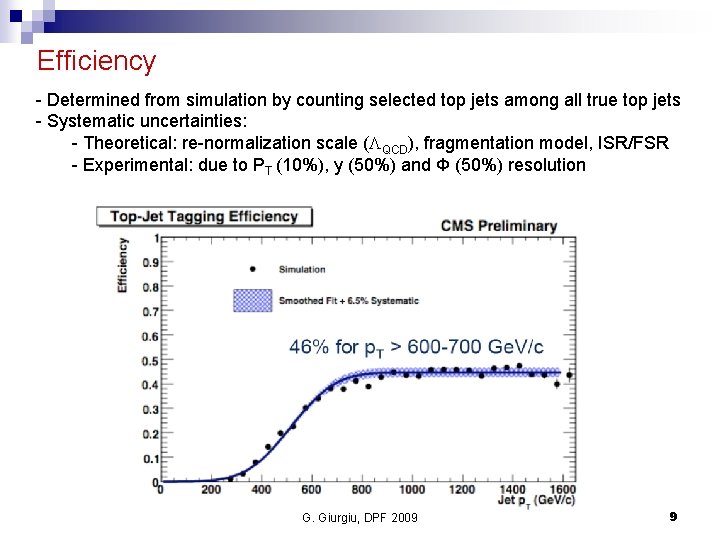
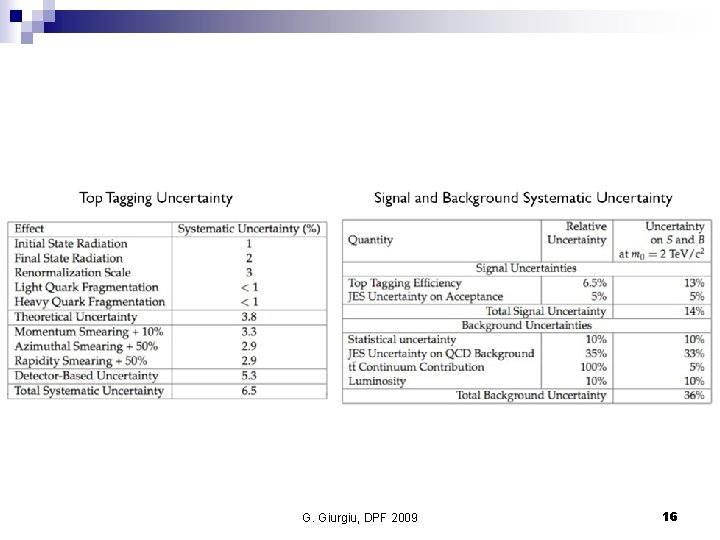
Efficiency - Determined from simulation by counting selected top jets among all true top jets - Systematic uncertainties: - Theoretical: re-normalization scale (LQCD), fragmentation model, ISR/FSR - Experimental: due to PT (10%), y (50%) and Φ (50%) resolution G. Giurgiu, DPF 2009 9
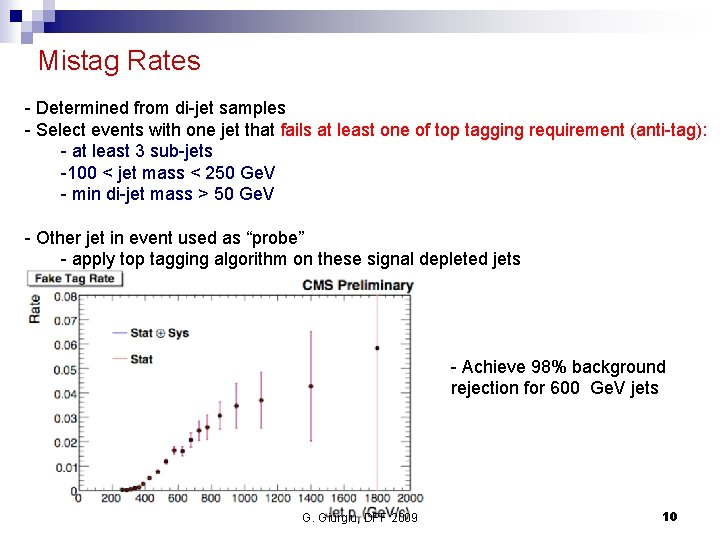
Mistag Rates - Determined from di-jet samples - Select events with one jet that fails at least one of top tagging requirement (anti-tag): - at least 3 sub-jets -100 < jet mass < 250 Ge. V - min di-jet mass > 50 Ge. V - Other jet in event used as “probe” - apply top tagging algorithm on these signal depleted jets - Achieve 98% background rejection for 600 Ge. V jets G. Giurgiu, DPF 2009 10
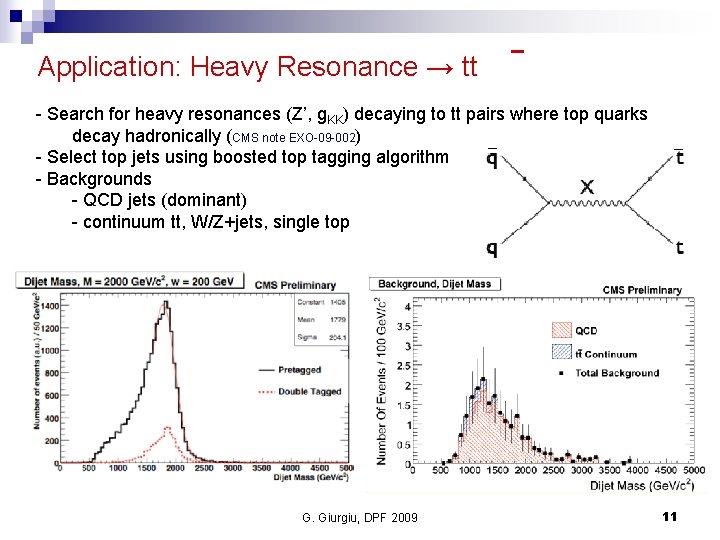
Application: Heavy Resonance → tt - Search for heavy resonances (Z’, g. KK) decaying to tt pairs where top quarks decay hadronically (CMS note EXO-09 -002) - Select top jets using boosted top tagging algorithm - Backgrounds - QCD jets (dominant) - continuum tt, W/Z+jets, single top G. Giurgiu, DPF 2009 11
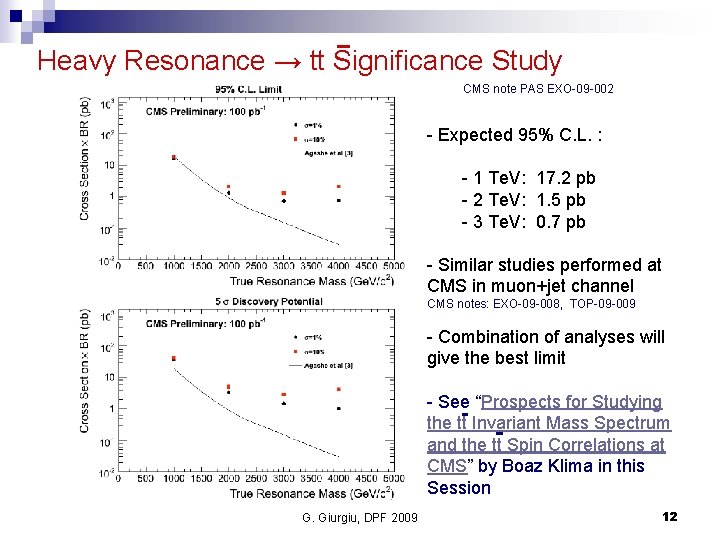
Heavy Resonance → tt Significance Study CMS note PAS EXO-09 -002 - Expected 95% C. L. : - 1 Te. V: 17. 2 pb - 2 Te. V: 1. 5 pb - 3 Te. V: 0. 7 pb - Similar studies performed at CMS in muon+jet channel CMS notes: EXO-09 -008, TOP-09 -009 - Combination of analyses will give the best limit - See “Prospects for Studying the tt Invariant Mass Spectrum and the tt Spin Correlations at CMS” by Boaz Klima in this Session G. Giurgiu, DPF 2009 12
Conclusions - Boosted top tagging algorithm implemented at CMS - identifies high PT hadronic top decays - based on sub-jet identification - Achieves ~46% efficiency and ~98% background rejection for ~600 Ge. V jets - Will be used in searches for high mass New Physics resonances G. Giurgiu, DPF 2009 13
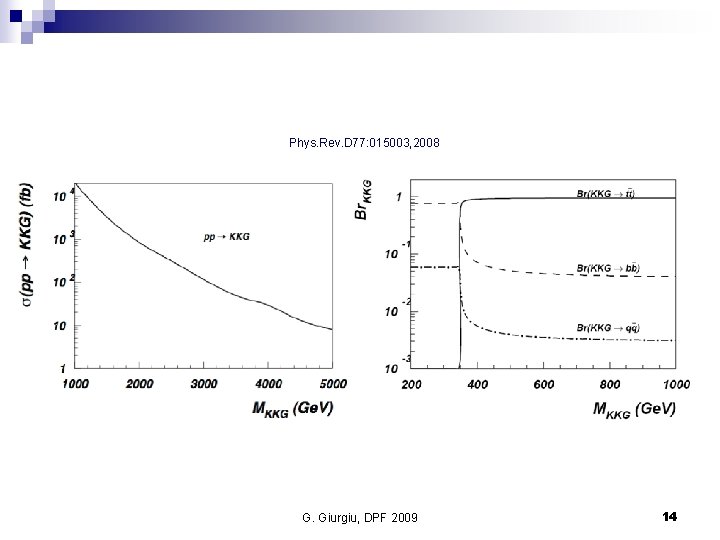
Phys. Rev. D 77: 015003, 2008 G. Giurgiu, DPF 2009 14
G. Giurgiu, DPF 2009 15
G. Giurgiu, DPF 2009 16