
Reconstruction of a Traumatic 1 st Ray with
- Slides: 1
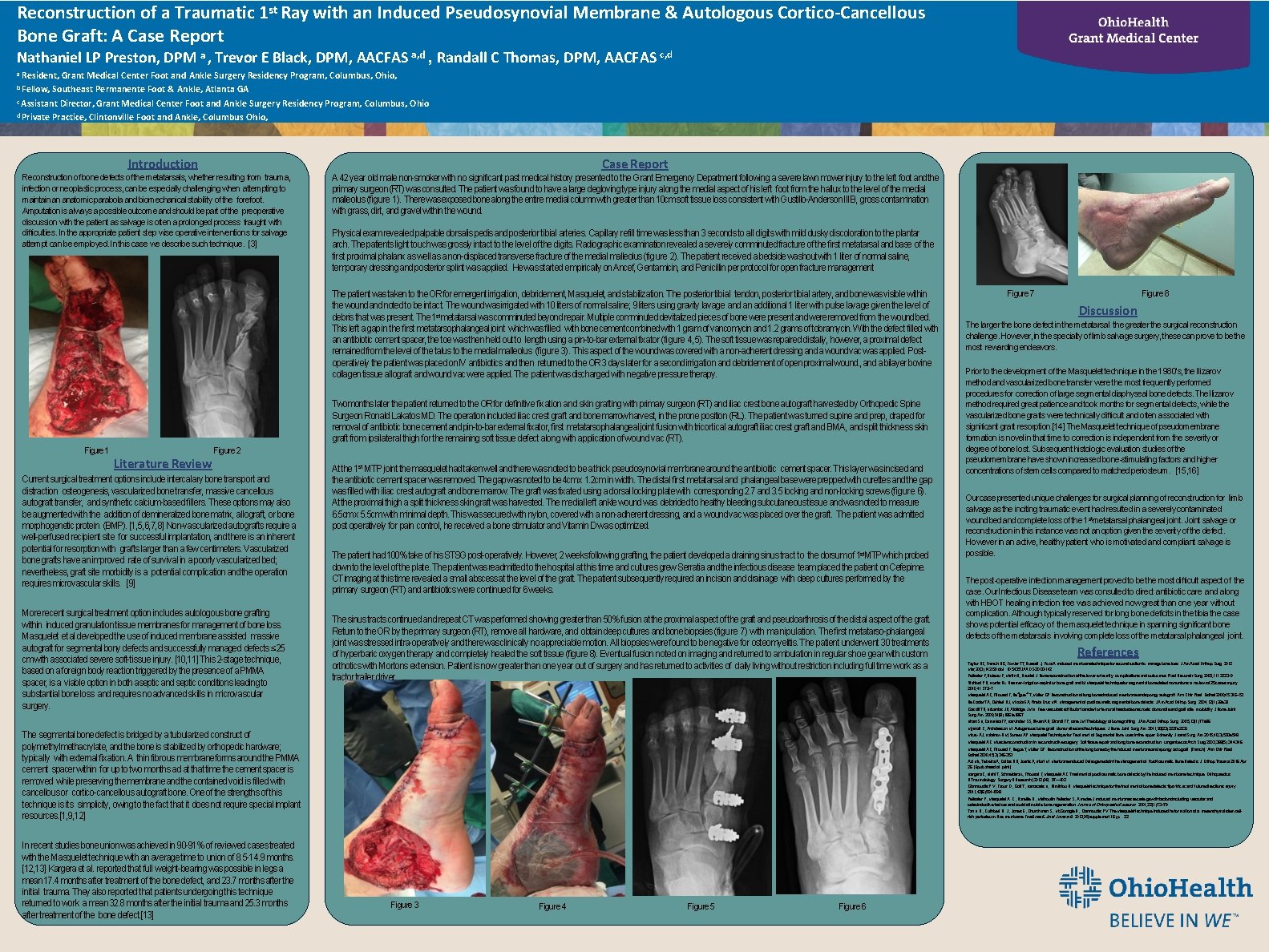
Reconstruction of a Traumatic 1 st Ray with an Induced Pseudosynovial Membrane & Autologous Cortico-Cancellous Bone Graft: A Case Report Nathaniel LP Preston, DPM a , Trevor E Black, DPM, AACFAS a, d , Randall C Thomas, DPM, AACFAS c, d a Resident, Grant Medical Center Foot and Ankle Surgery Residency Program, Columbus, Ohio, Southeast Permanente Foot & Ankle, Atlanta GA c Assistant Director, Grant Medical Center Foot and Ankle Surgery Residency Program, Columbus, Ohio d Private Practice, Clintonville Foot and Ankle, Columbus Ohio, b Fellow, Introduction Case Report Reconstruction of bone defects of the metatarsals, whether resulting from trauma, infection or neoplastic process, can be especially challenging when attempting to maintain an anatomic parabola and biomechanical stability of the forefoot. Amputation is always a possible outcome and should be part of the preoperative discussion with the patient as salvage is often a prolonged process fraught with difficulties. In the appropriate patient step wise operative interventions for salvage attempt can be employed. In this case we describe such technique. [3] A 42 year old male non-smoker with no significant past medical history presented to the Grant Emergency Department following a severe lawn mower injury to the left foot and the primary surgeon (RT) was consulted. The patient was found to have a large degloving type injury along the medial aspect of his left foot from the hallux to the level of the medial malleolus (figure 1). There was exposed bone along the entire medial column with greater than 10 cm soft tissue loss consistent with Gustillo-Anderson IIIB, gross contamination with grass, dirt, and gravel within the wound. Physical exam revealed palpable dorsalis pedis and posterior tibial arteries. Capillary refill time was less than 3 seconds to all digits with mild dusky discoloration to the plantar arch. The patients light touch was grossly intact to the level of the digits. Radiographic examination revealed a severely comminuted fracture of the first metatarsal and base of the first proximal phalanx as well as a non-displaced transverse fracture of the medial malleolus (figure 2). The patient received a bedside washout with 1 liter of normal saline, temporary dressing and posterior splint was applied. He was started empirically on Ancef, Gentamicin, and Penicillin per protocol for open fracture management. The patient was taken to the ORfor emergent irrigation, debridement, Masquelet, and stabilization. The posterior tibial tendon, posterior tibial artery, and bone was visible within the wound and noted to be intact. The wound was irrigated with 10 liters of normal saline; 9 liters using gravity lavage and an additional 1 liter with pulse lavage given the level of debris that was present. The 1 stmetatarsal was comminuted beyond repair. Multiple comminuted devitalized pieces of bone were present and were removed from the wound bed. This left a gap in the first metatarsophalangeal joint which was filled with bone cement combined with 1 gram of vancomycin and 1. 2 grams of tobramycin. With the defect filled with an antibiotic cement spacer, the toe was then held out to length using a pin-to-bar external fixator (figure 4, 5). The soft tissue was repaired distally, however, a proximal defect remained from the level of the talus to the medial malleolus (figure 3). This aspect of the wound was covered with a non-adherent dressing and a wound vac was applied. Postoperatively the patient was placed on IV antibiotics and then returned to the OR 3 days later for a second irrigation and debridement of open proximal wound. , and a bilayer bovine collagen tissue allograft and wound vac were applied. The patient was discharged with negative pressure therapy. Twomonths later the patient returned to the ORfor definitive fixation and skin grafting with primary surgeon (RT) and iliac crest bone autograft harvested by Orthopedic Spine Surgeon Ronald Lakatos MD. The operation included iliac crest graft and bone marrow harvest, in the prone position (RL). The patient was turned supine and prep, draped for removal of antibiotic bone cement and pin-to-bar external fixator, first metatarsophalangeal joint fusion with tricortical autograft iliac crest graft and BMA, and split thickness skin graft from ipsilateral thigh for the remaining soft tissue defect along with application of wound vac (RT). Figure 1 Literature Review Figure 2 Current surgical treatment options include intercalary bone transport and distraction osteogenesis, vascularized bone transfer, massive cancellous autograft transfer, and synthetic calcium-based fillers. These options may also be augmented with the addition of demineralized bone matrix, allograft, or bone morphogenetic protein (BMP). [1, 5, 6, 7, 8] Non-vascularized autografts require a well-perfused recipient site for successful implantation, and there is an inherent potential for resorption with grafts larger than a few centimeters. Vascularized bone grafts have an improved rate of survival in a poorly vascularized bed; nevertheless, graft site morbidity is a potential complication and the operation requires microvascular skills. [9] More recent surgical treatment option includes autologous bone grafting within induced granulation tissue membranes for management of bone loss. Masquelet et al developed the use of induced membrane assisted massive autograft for segmental bony defects and successfully managed defects ≤ 25 cm with associated severe soft-tissue injury. [10, 11] This 2 -stage technique, based on a foreign body reaction triggered by the presence of a PMMA spacer, is a viable option in both aseptic and septic conditions leading to substantial bone loss and requires no advanced skills in microvascular surgery. At the 1 st MTP joint the masquelet had taken well and there was noted to be a thick pseudosynovial membranearound the antibioitic cement spacer. This layer was incised and the antibiotic cement spacer was removed. The gap was noted to be 4 cm x 1. 2 cm in width. The distal first metatarsal and phalangeal base were prepped with curettes and the gap was filled with iliac crest autograft and bone marrow. The graft was fixated using a dorsal locking plate with corresponding 2. 7 and 3. 5 locking and non-locking screws (figure 6). At the proximal thigh a split thickness skin graft was harvested. The medial left ankle wound was debrided to healthy bleeding subcutaneous tissue and was noted to measure 6. 5 cm x 5. 5 cm with minimal depth. This was secured with nylon, covered with a non-adherent dressing, and a wound vac was placed over the graft. The patient was admitted post operatively for pain control, he received a bone stimulator and Vitamin D was optimized. The patient had 100%take of his STSG post-operatively. However, 2 weeks following grafting, the patient developed a draining sinus tract to the dorsum of 1 st. MTPwhich probed down to the level of the plate. The patient was readmitted to the hospital at this time and cultures grew Serratia and the infectious disease team placed the patient on Cefepime. CTimaging at this time revealed a small abscess at the level of the graft. The patient subsequently required an incision and drainage with deep cultures performed by the primary surgeon (RT) and antibiotics were continued for 6 weeks. The sinus tracts continued and repeat CT was performed showing greater than 50% fusion at the proximal aspect of the graft and pseudoarthrosis of the distal aspect of the graft. Return to the OR by the primary surgeon (RT), remove all hardware, and obtain deep cultures and bone biopsies (figure 7) with manipulation. The first metatarso-phalangeal joint was stressed intra-operatively and there was clinically no appreciable motion. All biopsies were found to be negative for osteomyelitis. The patient underwent 30 treatments of hyperbaric oxygen therapy and completely healed the soft tissue (figure 8). Eventual fusion noted on imaging and returned to ambulation in regular shoe gear with custom orthotics with Mortons extension. Patient is now greater than one year out of surgery and has returned to activities of daily living without restriction including full time work as a tractor trailer driver. Figure 7 Figure 8 Discussion The larger the bone defect in the metatarsal the greater the surgical reconstruction challenge. However, in the specialty of limb salvage surgery, these can prove to be the most rewarding endeavors. Prior to the development of the Masquelet technique in the 1980’s, the Ilizarov method and vascularized bone transfer were the most frequently performed procedures for correction of large segmental diaphyseal bone defects. The Ilizarov method required great patience and took months for segmental defects, while the vascularized bone grafts were technically difficult and often associated with significant graft resorption. [14] The Masquelet technique of pseudomembrane formation is novel in that time to correction is independent from the severity or degree of bone lost. Subsequent histologic evaluation studies of the pseudomembrane have shown increased bone-stimulating factors and higher concentrations of stem cells compared to matched periosteum. [15, 16] Our case presented unique challenges for surgical planning of reconstruction for limb salvage as the inciting traumatic event had resulted in a severely contaminated wound bed and complete loss of the 1 stmetatarsal phalangeal joint. Joint salvage or reconstruction in this instance was not an option given the severity of the defect. However in an active, healthy patient who is motivated and compliant salvage is possible. The post-operative infection management proved to be the most difficult aspect of the case. Our Infectious Disease team was consulted to direct antibiotic care and along with HBOT healing infection free was achieved now great than one year without complication. Although typically reserved for long bone deficits in the tibia the case shows potential efficacy of the masquelet technique in spanning significant bone defects of the metatarsals involving complete loss of the metatarsal phalangeal joint. References Taylor BC, French BG, Fowler TT, Russell J, Poka A. Induced membrane technique for reconstruction to manage bone loss. J Am. Acad Orthop Surg. 2012 Mar; 20(3): 142 -50. doi: 10. 5435/JAAOS-20 -03 -142. Pelissier P, Boireau P, Martin D, Baudet J. Bone reconstruction of the lower extremity: complications and outcomes. Plast Reconstr Surg 2003; 111: 2223– 9. Stafford PR, Norris BL. Reamer–irrigator–aspirator bone graft and bi Masquelet technique for segmental bone defect nonunions: a review of 25 cases. Injury 2010; 41: S 72– 7. Masquelet AC, Fitoussi F, Be´gue´ T, Muller GP. Reconstruction of long bones induced membrane and spongy autograft. Ann Chir Plast Esthet 2000; 45: 346– 53. De. Coster TA, Gehlert RJ, Mikola EA, Pirela-Cruz MA. Management of posttraumatic segmental bone defects. J Am. Acad Orthop Surg. 2004; 12(1): 28 e 38. Gaskill TR, Urbaniak JR, Aldridge JMIII. Free vascularized fibular transfer for femoral head osteonecrosis: donor site and graft site morbidity. J Bone Joint Surg Am. 2009; 91(8): 1861 e 1867. Khan SN, Cammisa FP, Harvinder SS, Diwan AD, Girardi FP, Lane JM. The biology of bone grafting. J Am. Acad Orthop Surg. 2005; 13(1): 77 e 86. Myeroff C, Archdeacon M. Autogenous bone graft: donor sites and techniques. J Bone Joint Surg Am. 2011; 93(23): 2227 e 2236. The segmental bone defect is bridged by a tubularized construct of polymethylmethacrylate, and the bone is stabilized by orthopedic hardware; typically with external fixation. A thin fibrous membrane forms around the PMMA cement spacer within for up to two months ad at that time the cement spacer is removed while preserving the membrane and the contained void is filled with cancellous or cortico-cancellous autograft bone. One of the strengths of this technique is its simplicity, owing to the fact that it does not require special implant resources. [1, 9, 12] In recent studies bone union was achieved in 90 -91% of reviewed cases treated with the Masquelet technique with an average time to union of 8. 5 -14. 9 months. [12, 13] Kargera et al. reported that full weight-bearing was possible in legs a mean 17. 4 months after treatment of the bone defect, and 23. 7 months after the initial trauma. They also reported that patients undergoing this technique returned to work a mean 32. 8 months after the initial trauma and 25. 3 months after treatment of the bone defect. [13] Micev AJ, Kalainov DM, Soneru AP. Masquelet Technique for Treatment of Segmental Bone Loss in the Upper Extremity. J Hand Surg Am. 2015; 40(3): 593 e 598 Masquelet AC: Muscle reconstruction in reconstructive surgery: Soft tissue repair and long bone reconstruction. Langenbecks Arch Surg 2003; 388(5): 344 -346. Masquelet AC, Fitoussi F, Begue T, Muller GP: Reconstruction of the long bones by the induced membrane and spongy autograft [French]. Ann Chir Plast Esthet 2000; 45(3): 346 -353. Azi ML, Teixeira A, Cotias RB, Joeris A, Kfuri M. Membrane Induced Osteogenesis in the Management of Post-traumatic Bone Defects. J Orthop Trauma. 2016 Apr 26. [Epub ahead of print] Kargera C, Kishi T, Schneidera L, Fitoussi F, Masquelet AC. Treatment of posttraumatic bone defects by the induced membrane technique. Orthopaedics &Traumatology: Surgery &Research (2012) 98, 97— 102 Giannoudis P. V. , Faour O. , Goff T. , Kanakaris N. , Dimitriou R. Masquelet technique for the treatment of bone defects: tips-tricks and future directions. Injury. 2011; 42(6): 591– 598. Pelissier P. , Masquelet A. C. , Bareille R. , Mathoulin Pelissier S. , Amedee J. Induced membranes secrete growth factors including vascular and osteoinductive factors and could stimulate bone regeneration. Journal of Orthopaedic Research. 2004; 22(1): 73– 79. Tan. H. B. , Cuthbert R. J. , Jones E. , Churchman S. , Mc. Gonagle D. , Giannoudis P. V. The Masquelet technique induces the formation of a mesenchymal stem cellrich periosteum -like membrane. The Bone & Joint Journal B. 2013; 95(supplement 16): p. 22. Figure 3 Figure 4 Figure 5 Figure 6