
Reconstruction IDs Sharecroppers Black CodesJim Crow Laws Reconstruction
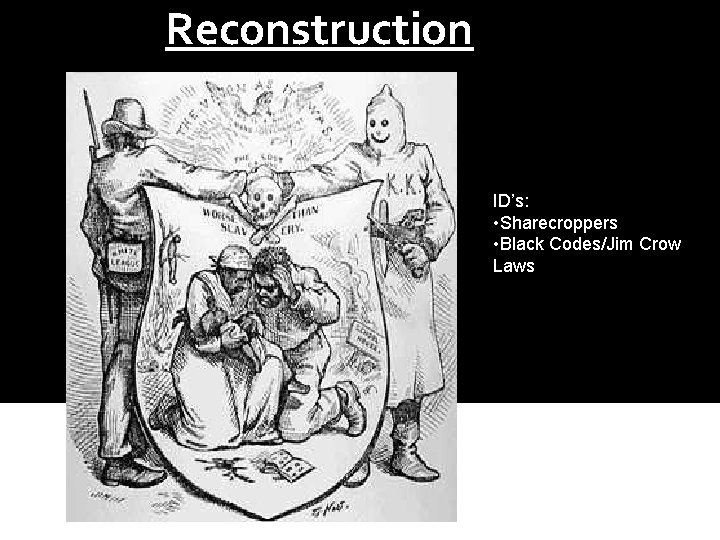
Reconstruction ID’s: • Sharecroppers • Black Codes/Jim Crow Laws
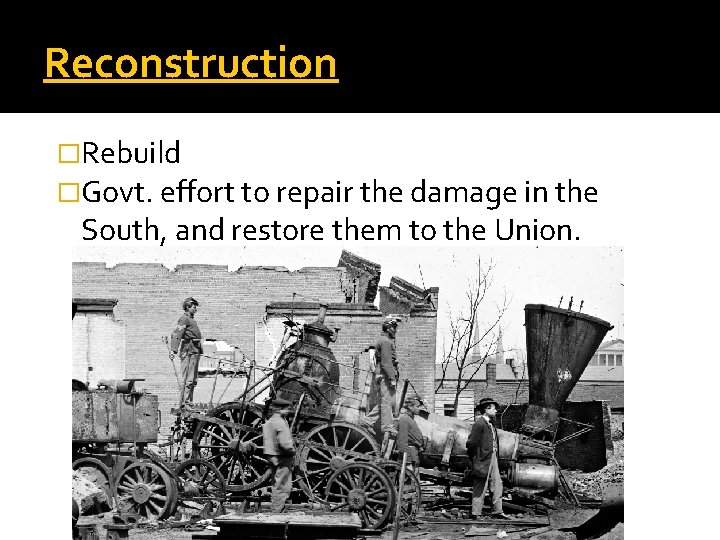
Reconstruction �Rebuild �Govt. effort to repair the damage in the South, and restore them to the Union.
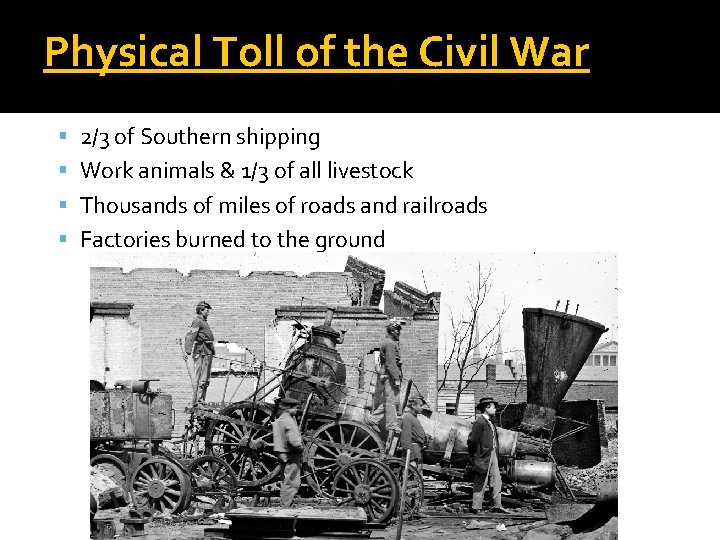
Physical Toll of the Civil War 2/3 of Southern shipping Work animals & 1/3 of all livestock Thousands of miles of roads and railroads Factories burned to the ground
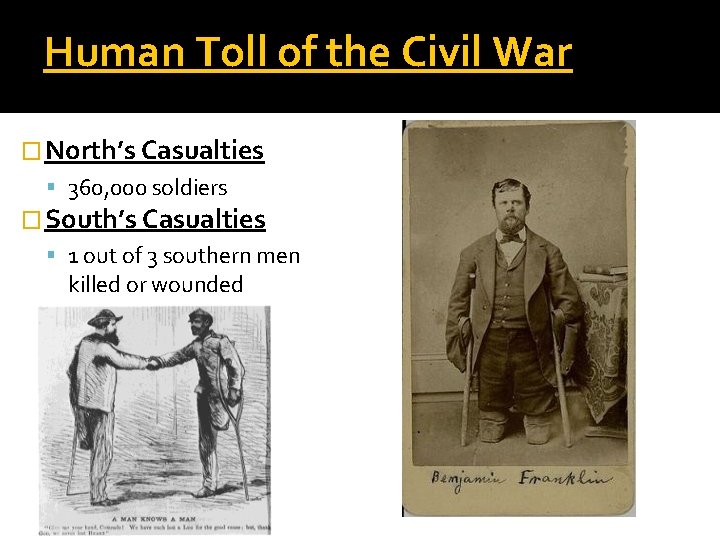
Human Toll of the Civil War � North’s Casualties 360, 000 soldiers � South’s Casualties 1 out of 3 southern men killed or wounded
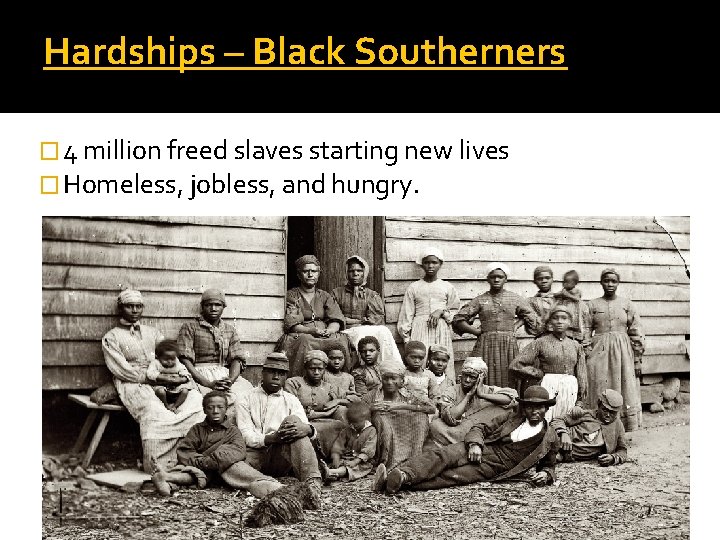
Hardships – Black Southerners � 4 million freed slaves starting new lives � Homeless, jobless, and hungry.
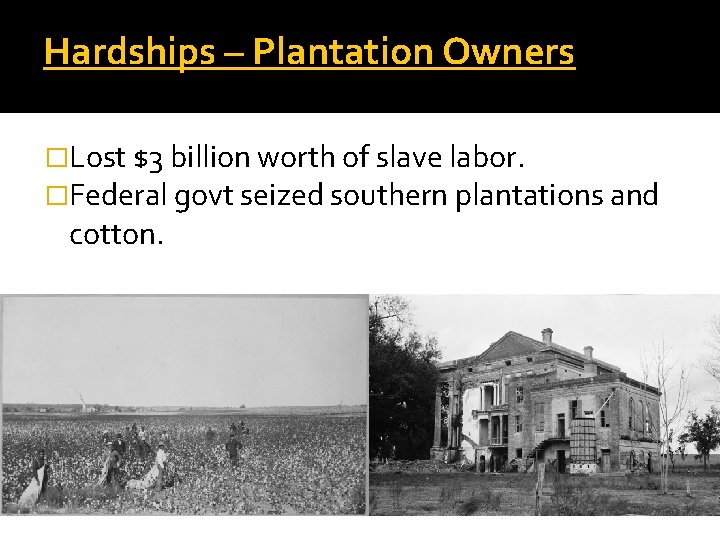
Hardships – Plantation Owners �Lost $3 billion worth of slave labor. �Federal govt seized southern plantations and cotton.
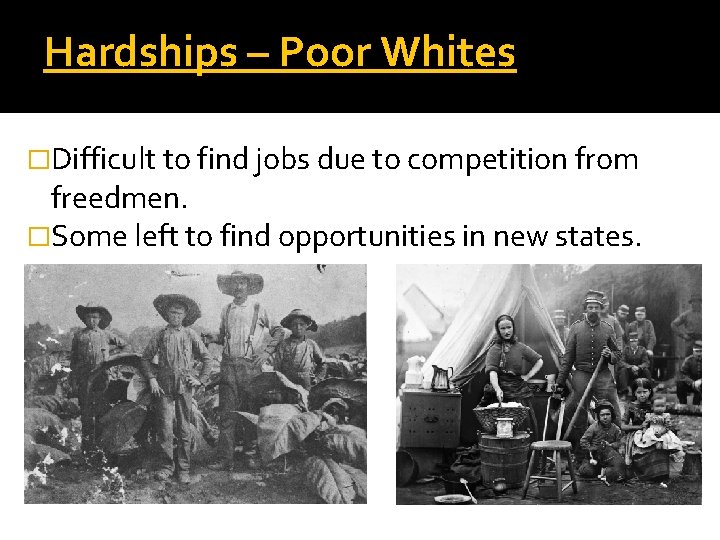
Hardships – Poor Whites �Difficult to find jobs due to competition from freedmen. �Some left to find opportunities in new states.
Quickwrite After inspecting southern states, how do you think the federal gov’t should respond to what it has seen? Explain.
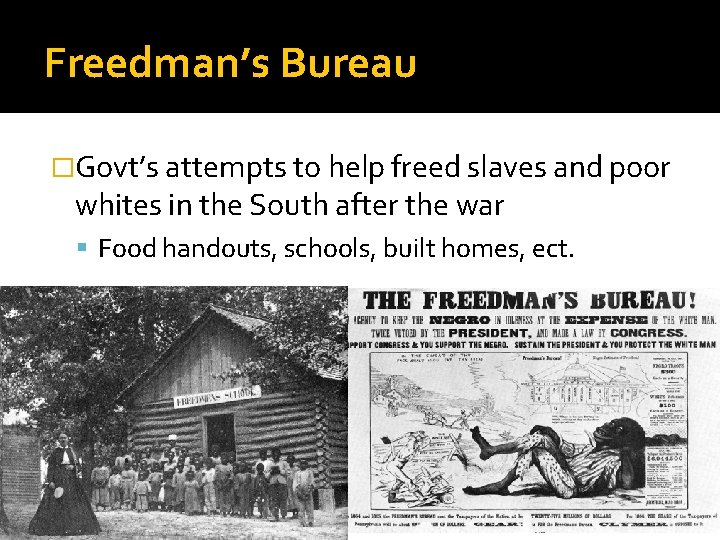
Freedman’s Bureau �Govt’s attempts to help freed slaves and poor whites in the South after the war Food handouts, schools, built homes, ect.
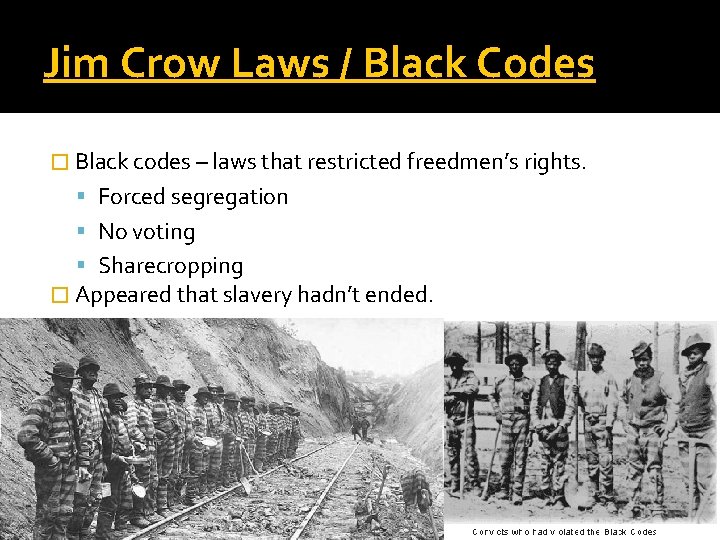
Jim Crow Laws / Black Codes � Black codes – laws that restricted freedmen’s rights. Forced segregation No voting Sharecropping � Appeared that slavery hadn’t ended.
Jim Crow Laws � Literacy Test – pass reading & comprehension (understanding) test to vote. Blacks did not know how to read. � Lynching – hanging blacks for whatever crimes whites think they committed. � Legal Segregation – Plessy v. Ferguson (1896); “separate but equal. ” � Grandfather Clause – blacks can vote if grandfather voted in last election. Nobody’s grandfather in the South voted. � Poll Tax – want to vote you have to pay money. � Ban from Juries – blacks not allowed to serve on juries.
Jim Crow Laws � Streetcar Law – authorized separate sections for Af-Am. and whites riding on the city’s streetcars. – passed in N. Carolina and Virginia, 1901 � Curfew Law – required Af-Am. to be off the streets by 10 p. m. – passed in Mobile, Alabama, 1909 � Telephone Booth Law – required telephone companies to “maintain separate booths for white and colored patrons. ” – passed in Oklahoma, 1915 � Textbook Law – required that textbooks used by one race be kept separate from those used by the other race, even while in storage. � Separate Bibles Law – started that two separate Bibles used to swear in witnesses were required to be kept in courtrooms. – passed in Atlanta, Georgia, 1915
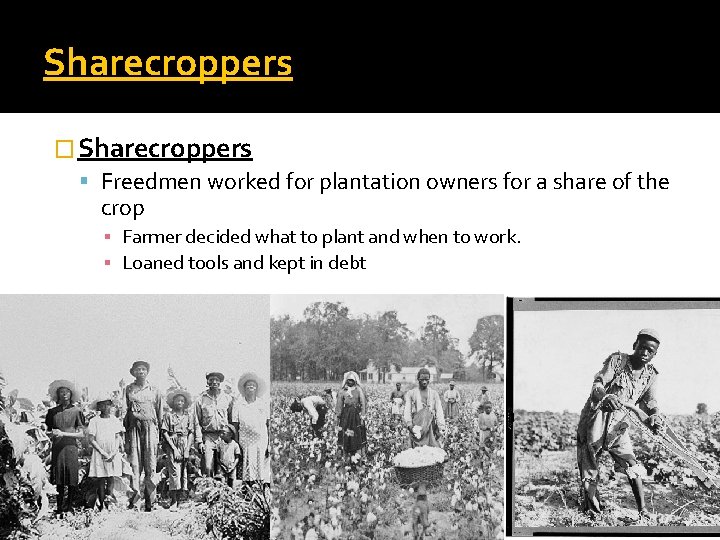
Sharecroppers � Sharecroppers Freedmen worked for plantation owners for a share of the crop ▪ Farmer decided what to plant and when to work. ▪ Loaned tools and kept in debt
Primary Source – W. E. B du Bois “The slave went free; stood a brief moment in the sun; then moved back again toward slavery. ” – W. E. B du Bois � Explain what this quote means.
Pro/Con �Choose Partner A and Partner B �Together you are going to argue the Pros and Cons of emancipation �Each time Partner A claps: Switch between Pro and Con
Pro/Con: Emancipation �Use the following terms to help switch between ideas: However Despite that fact On the other hand On the contrary

Activity: Before & After Reconstruction
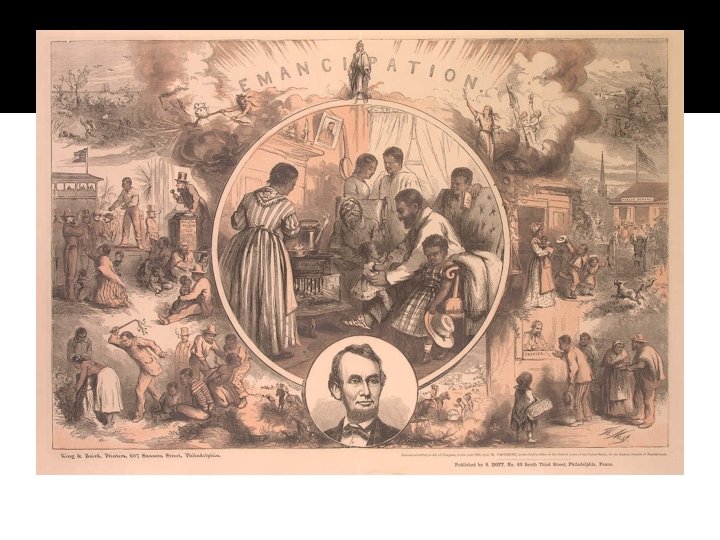
Activity: Before & After Reconstruction � Directions: What was life like for African. Americans before and after the Civil War? 1. Fold your paper in half (hamburger style). 2. On one side, title it “African-Am. Before the Civil War” and on the other side, title it “African-Am. After the Civil War. ” 3. Draw two pictures. One should depict what life was like for African-Am. before the war, and the other after. 4. On the back of the paper, answer the following question: “Did the Civil War change things for African-Am. ? Explain your reason.
Lincoln’s Reconstruction Plan � 10% Plan 1. Forgive any Confederate who took an oath of allegiance to the Union & accepted the end of slavery. 2. Constitutional Convention if 10% of voters swore allegiance to Union.
Johnson’s Reconstruction Plan � Presidential Reconstruction 1. Pardoned southerners who swore allegiance to the Union. 2. Constitutional convention without 10% allegiance. 3. States required to abolish slavery, and ratify (approve) the 13 th Amendment.
Radical Reconstruction Plan � Radical Republicans 1. Military rule. 2. All qualified male voters (i. e. Af-Am) to vote in elections. 3. Southerners who supported Confederacy couldn’t vote. 4. Guarantee equal rights to all citizens. 5. Required states to ratify (approve) the 14 th Amendment.
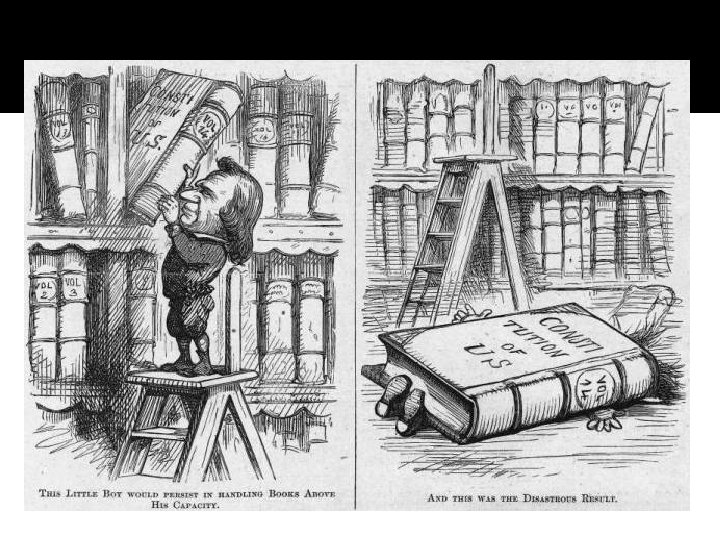
� Citizenship and Equal Protection Under the Law! “All persons born or naturalized in the United States…are citizens of the United States and of the State wherein they reside. No state shall make or enforce any law which shall abridge the privileges or immunities of citizens of the United States; nor shall any State deprive any person of life, liberty, or property, without due process of law; nor deny to any person within its jurisdiction the equal protection of the laws…” – 14 th Amendment -1868 th 14 Amendment
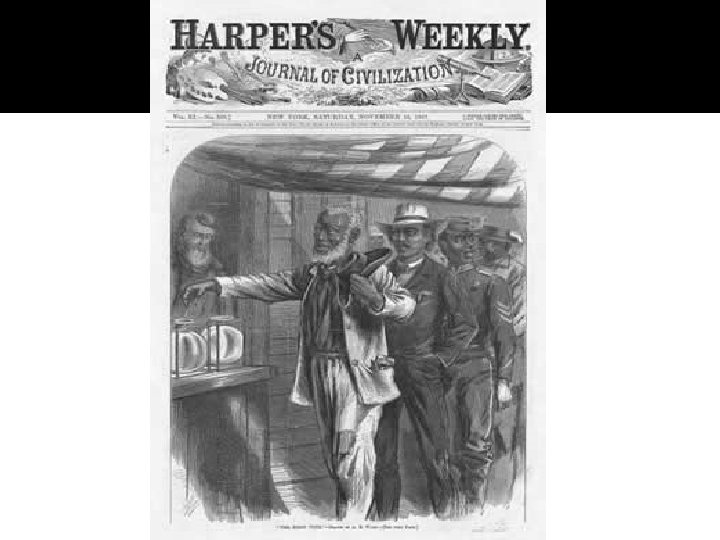
�The Right to Vote!! No citizen may be denied the right to vote by the United States or “by any State on account of race, color, or previous condition of servitude. ” ▪ 15 th Amendment -1870 15 th Amendment
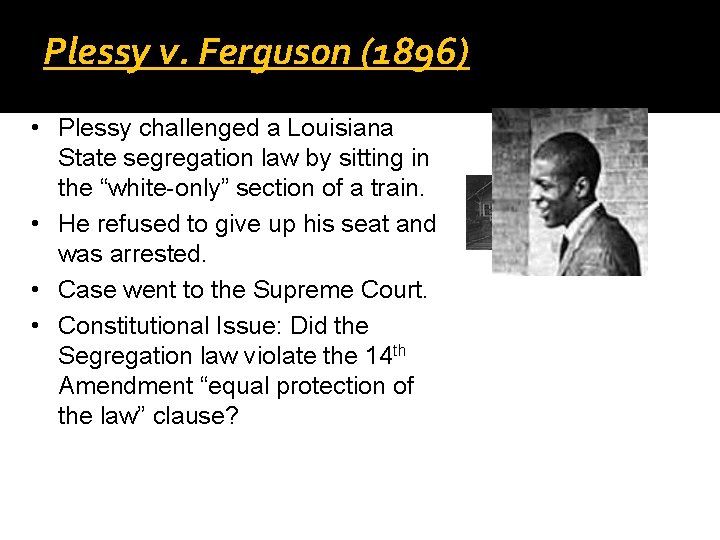
Plessy v. Ferguson (1896) • Plessy challenged a Louisiana State segregation law by sitting in the “white-only” section of a train. • He refused to give up his seat and was arrested. • Case went to the Supreme Court. • Constitutional Issue: Did the Segregation law violate the 14 th Amendment “equal protection of the law” clause?
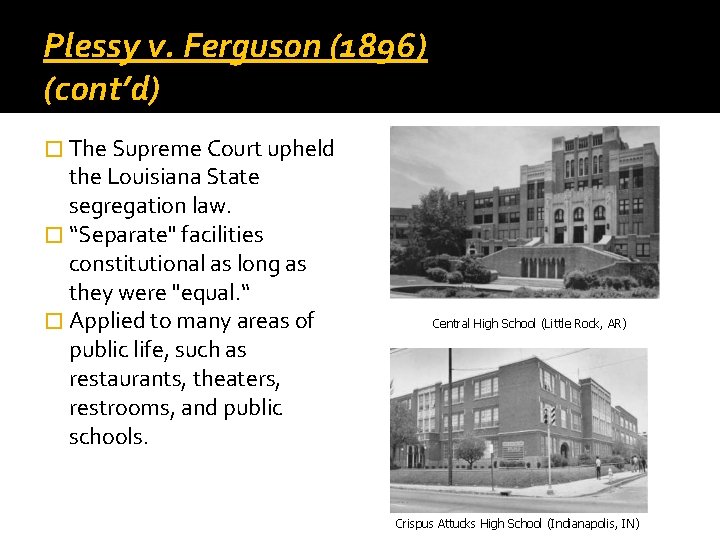
Plessy v. Ferguson (1896) (cont’d) � The Supreme Court upheld the Louisiana State segregation law. � “Separate" facilities constitutional as long as they were "equal. “ � Applied to many areas of public life, such as restaurants, theaters, restrooms, and public schools. Central High School (Little Rock, AR) Crispus Attucks High School (Indianapolis, IN)
Activity – 4 Squares Reconstruction Amendments & Plessy v. Ferguson (1896)
Activity – 4 Squares Reconstruction Amendments & Plessy v. Ferguson (1896) Directions: 1. Fold your paper so that it has four squares. 2. In the top left-hand corner, title it: “ 13 th Amendment (1865)” 3. In the top right-hand corner, title it: “ 14 th Amendment (1868)” 4. In the bottom left-hand corner, title it: “ 15 th Amendment (1870)” 5. In the bottom right-hand corner, title it: “Plessy v. Ferguson (1896)”
Activity – 4 Squares Reconstruction Amendments & Plessy v. Ferguson (1896) Directions: 6. In your own words, explain how each amendment or court case helped or hurt African-Americans. 7. Draw a symbol or picture to represent the amendment or court case.
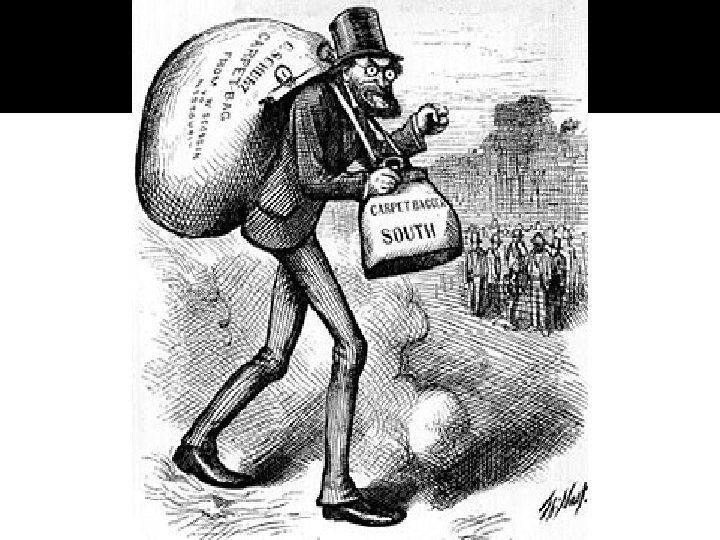
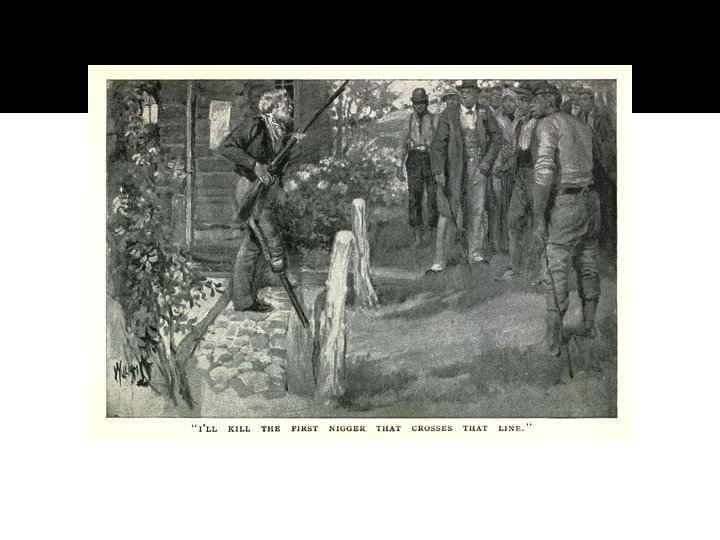
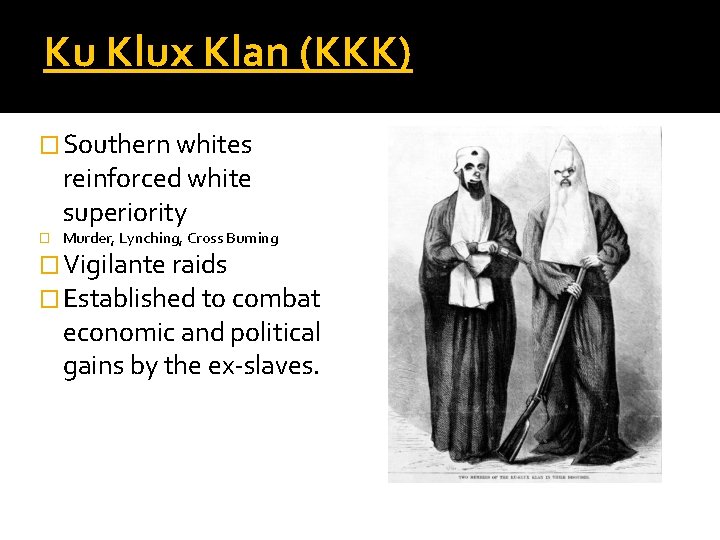
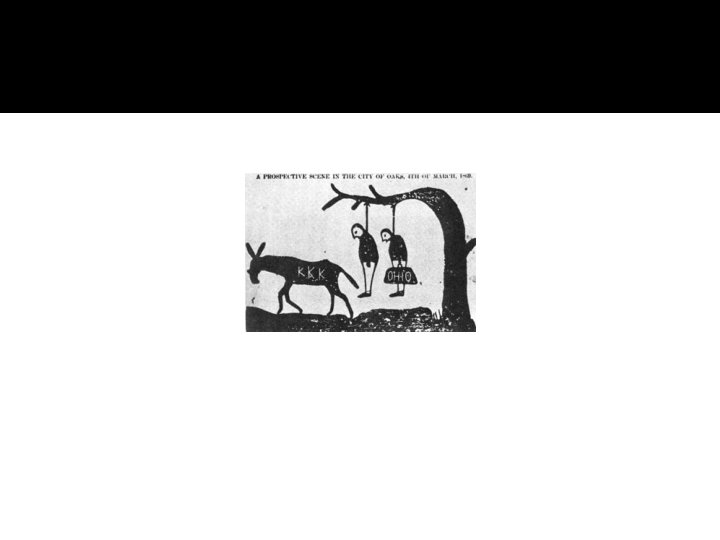
Ku Klux Klan (KKK) � Southern whites reinforced white superiority � Murder, Lynching, Cross Burning � Vigilante raids � Established to combat economic and political gains by the ex-slaves.
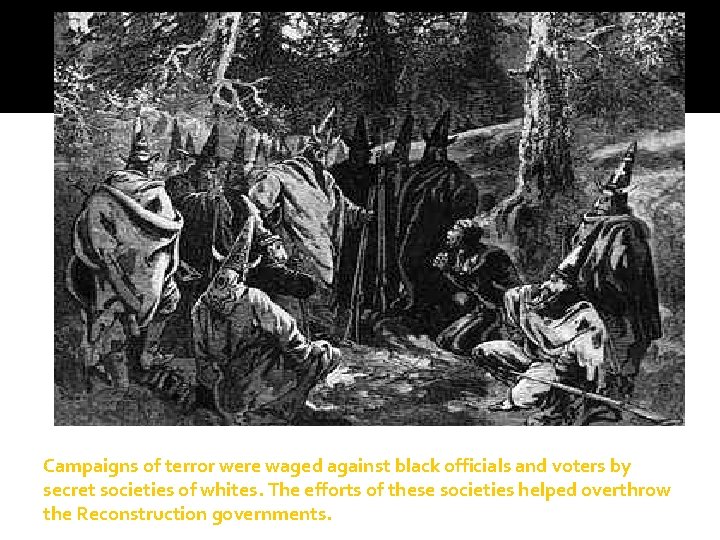
Campaigns of terror were waged against black officials and voters by secret societies of whites. The efforts of these societies helped overthrow the Reconstruction governments.
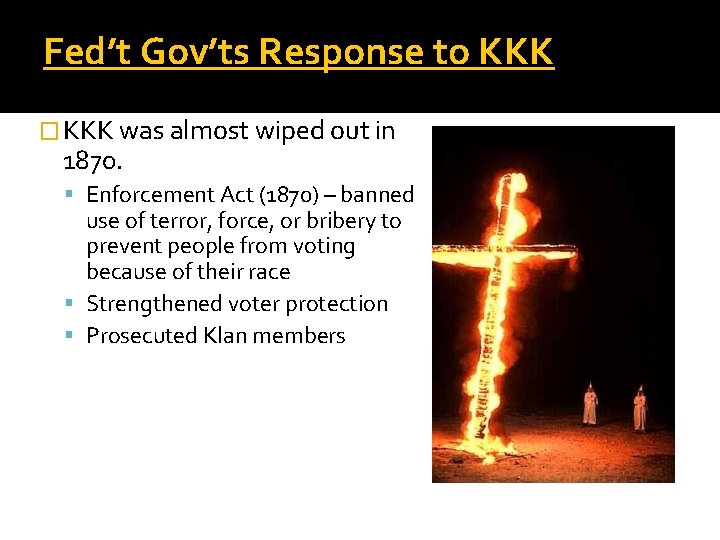
Fed’t Gov’ts Response to KKK � KKK was almost wiped out in 1870. Enforcement Act (1870) – banned use of terror, force, or bribery to prevent people from voting because of their race Strengthened voter protection Prosecuted Klan members
Primary Sources - The Ku Klux Klan
Primary Sources – The Ku Klux Klan � The Ku Klux Klan terrorized blacks in the postwar South. Here are some black people’s memories of the Klan: 1. “If you got so you made good money an’ had a good farm, the Ku Klux’d come an’ murder you. The gov’ment built the colored people schoolhouses, an’ the Ku Klux went to work an’ burn ‘em down. They’d go to the jails an’ take the colored men out, an’ knock their brains out, an’ break their necks, an’ throw ‘em in the river. Men you thought was your friends was Ku Kluxes. You deal with ‘em in the stores daytimes, an’ at night they come out to your house an’ kill you. ” – Pierce Harper
Primary Sources – The Ku Klux Klan � The Ku Klux Klan terrorized blacks in the postwar South. Here are some black people’s memories of the Klan: 2. Marster ju’ laugh. He told us that we weren’t goin’ to be hurt, if we were good. He said that it was only the bad blacks that were goin’ to be got after by the Ku Klux. – Nicey Pugh
Primary Sources – The Ku Klux Klan � The Ku Klux Klan terrorized blacks in the postwar South. Here are some black people’s memories of the Klan: 3. “No one knew when the Klux comin’. All a-sudden, up they gallop on horses, all covered with hoods, and burst right into the house…I’d hear them comin’ when they hit the lane, and I’d holler, “The Klux is comin’. It was my job, after dark, listenin’ for the Klux. Then, I got under the bed. ” – William Hamilton
Primary Sources – The Ku Klux Klan � The Ku Klux Klan terrorized blacks in the postwar South. Here are some black people’s memories of the Klan: 4. “The Klux would carry the blacks to Turk Creek bridge, and make them set up on the banisters of the bridge; then, they would shoot them off the banisters into the water. ” – Brawley Gilmore
Reconstruction Accomplishments Economic growth in South and new wealth in North. 2. 14 th and 15 th Amendments 3. Freedmen’s Bureau helped blacks obtain housing, jobs, and schooling. 1.
Reconstruction Failures 1. 2. 3. 4. 5. Most blacks remained in poverty. Blacks denied right to vote Racist attitudes continued. Southern whites bitter toward fed’l gov’t. South slow to industrialize.
- Slides: 45