
Reconstruction How the Union was rebuilt North and
Reconstruction How the Union was rebuilt
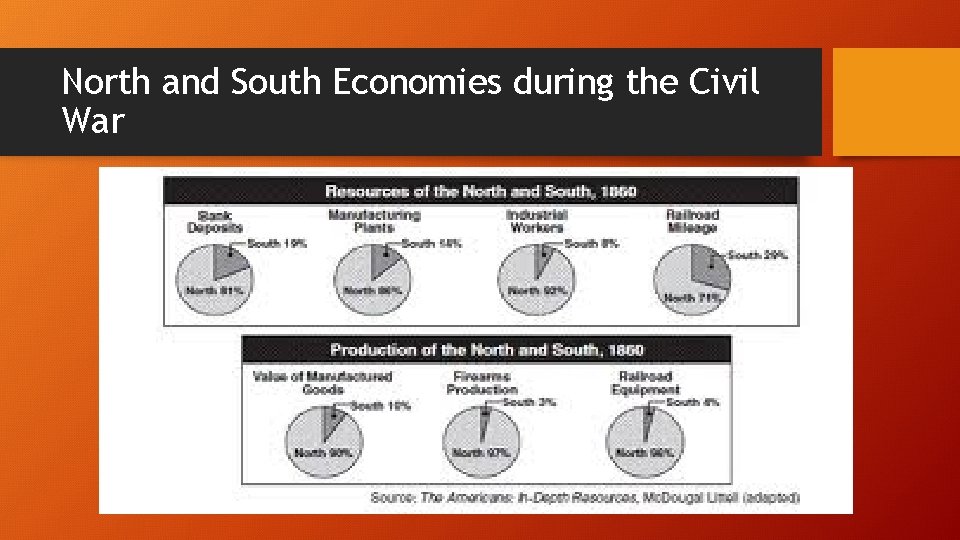
North and South Economies during the Civil War
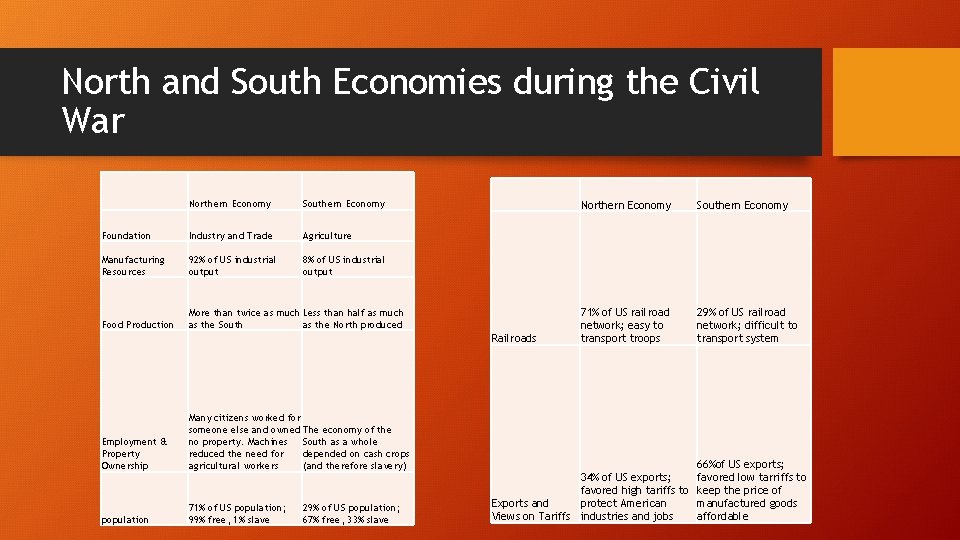
North and South Economies during the Civil War Northern Economy Southern Economy Foundation Industry and Trade Agriculture Manufacturing Resources 92% of US industrial output 8% of US industrial output Food Production More than twice as much Less than half as much as the South as the North produced Railroads Employment & Property Ownership Many citizens worked for someone else and owned The economy of the no property. Machines South as a whole reduced the need for depended on cash crops agricultural workers (and therefore slavery) population 71% of US population; 99% free, 1% slave 29% of US population; 67% free, 33% slave Northern Economy Southern Economy 71% of US railroad network; easy to transport troops 29% of US railroad network; difficult to transport system 66%of US exports; 34% of US exports; favored low tarriffs to favored high tariffs to keep the price of Exports and protect American manufactured goods Views on Tariffs industries and jobs affordable
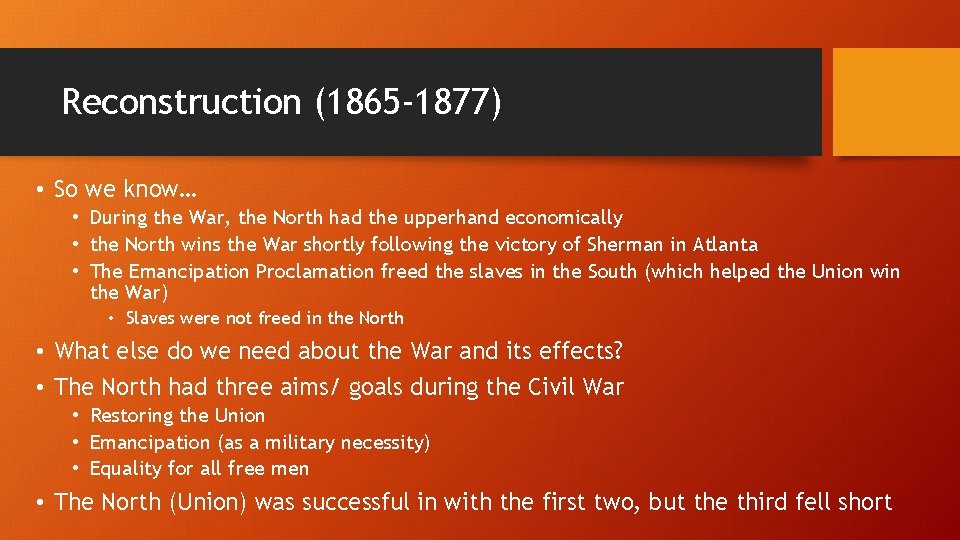
Reconstruction (1865 -1877) • So we know… • During the War, the North had the upperhand economically • the North wins the War shortly following the victory of Sherman in Atlanta • The Emancipation Proclamation freed the slaves in the South (which helped the Union win the War) • Slaves were not freed in the North • What else do we need about the War and its effects? • The North had three aims/ goals during the Civil War • Restoring the Union • Emancipation (as a military necessity) • Equality for all free men • The North (Union) was successful in with the first two, but the third fell short
Reconstruction (1865 -1877) • Two groups with two very different ideas about rebuilding the South after the Civil War • Presidents Lincoln and Johnson • Radical Republicans • Lincoln (and eventually Johnson) were proponents (supporters) of moderate Reconstruction Policies • They wanted to bring the South back into the Union immediately • The Ten Percent Plan required Southern states to complete three (3) tasks to re-enter the Union • Ratify the 13 th Amendment • Repudiate (denounce/ reject) secession • 10% of each state’s voters must take an oath of allegiance
Reconstruction (1865 -1877) • Radical Republicans were proponents of harsh actions against the South • • They wanted to protect the rights of and guarantee equality of newly freed slaves Proposed the Wade-Davis Bill ratification of the 13 th Amendment; 50% allegiance Vetoed by President Lincoln Also known as Congressional Reconstruction • Lincoln was assassinated before being able to implement his plan of moderate Reconstruction VP Andrew Johnson became president and continued the Plan for Lincoln • Johnson appointed Union governors in the South to ensure compliance • Issues between the majority Radical Republican Congress and Johnson arose as Congress pushed bills that favored their goals, Johnson continued to veto • President Johnson was impeached (charged with misconduct; not a conviction of wrongdoing) by Congress in 1867, but failed to remove from office
Reconstruction (1865 -1877) • Following Johnson, Congress was able to submit the First Reconstruction Act. It reversed progress by Lincoln and Johnson. It did the following: • Divided South into 5 military districts with military governors • Required voting rights and political power for blacks • Revision or creation of new state constitutions to include 13 th, 14 th, 15 th amendments • What was the intention of the 13 th, 14 th, and 15 th amendments • 13 th Amendment abolished slavery • 14 th Amendment equal protection of and application of the law • 15 th Amendment extended voting rights (“not to be abridged on the account of race, color, or previous condition of servitude”; what about women? ) • Election of 1876, President Hayes (R) wins by electoral votes (not popular) the Compromise of 1877 = Hayes agreed to terms of Dem. ; appoint Southern Cabinet, removal of federal troops in the South, and collapse of Republican govts led to the end of Reconstruction
- Slides: 7