
RECONSTRUCTION GUIDED NOTES IMPACT OF RECONSTRUCTION ON GA
- Slides: 12
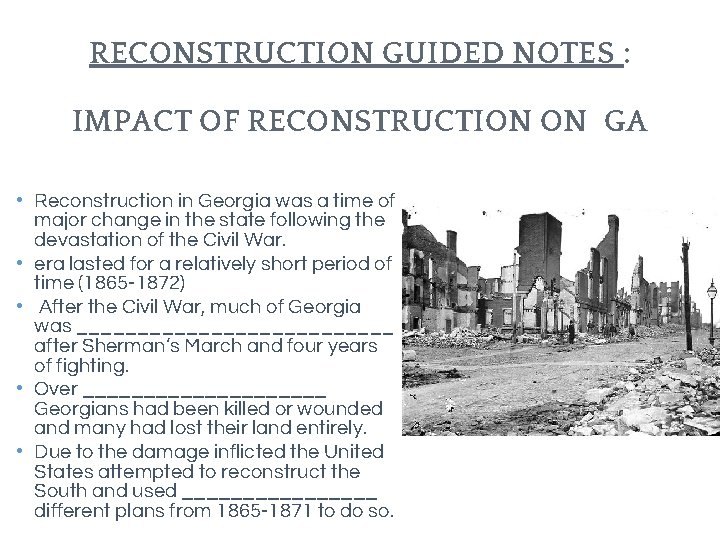
RECONSTRUCTION GUIDED NOTES : IMPACT OF RECONSTRUCTION ON GA • Reconstruction in Georgia was a time of major change in the state following the devastation of the Civil War. • era lasted for a relatively short period of time (1865 -1872) • After the Civil War, much of Georgia was _____________ after Sherman’s March and four years of fighting. • Over __________ Georgians had been killed or wounded and many had lost their land entirely. • Due to the damage inflicted the United States attempted to reconstruct the South and used ________ different plans from 1865 -1871 to do so.
PRESIDENTIAL RECONSTRUCTION LINCOLN’S PLAN (1865) • Lincoln’s plan sought to help the South re-enter the Union quickly to _________ the wounds of the war. • President Lincoln’s plan to allow Southern states back into the Union was simple: 1. All southerners, except for high-ranking Confederate civil and military leaders, would be pardoned after taking an ______ of allegiance to the United States 2. His plan allowed for a Southern state to be readmitted into the Union if 10% of the population swore an oath of allegiance to the United States. 3. required to ratify the _________________, which officially ended slavery in the United States.
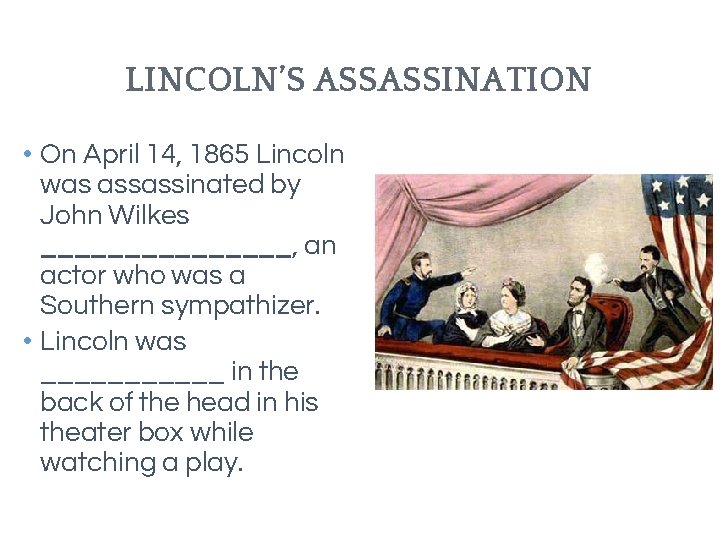
LINCOLN’S ASSASSINATION • On April 14, 1865 Lincoln was assassinated by John Wilkes ________, an actor who was a Southern sympathizer. • Lincoln was ______ in the back of the head in his theater box while watching a play.
PRESIDENTIAL RECONSTRUCTION JOHNSON’S PLAN (1865 -1866) • President Johnson, was from the South, therefore he was extremely lenient with the southern states. • His plan was very similar to Lincoln’s, except he extended the group not granted general pardons to those who owned property worth more than ____________. • Trouble began brewing again between the southern states and the Republican controlled Congress when several former confederate leaders were elected back into the fold. • In Georgia, former Confederate Vice President Alexander Stephens was elected as a Senator. • “________________________, ” (Northern Senators ) who favored harsher punishments for the South, refused to seat former Confederate leaders in the Senate • Radical Republicans were appalled at the South’s treatment of the freedmen under laws that were called _____________________.
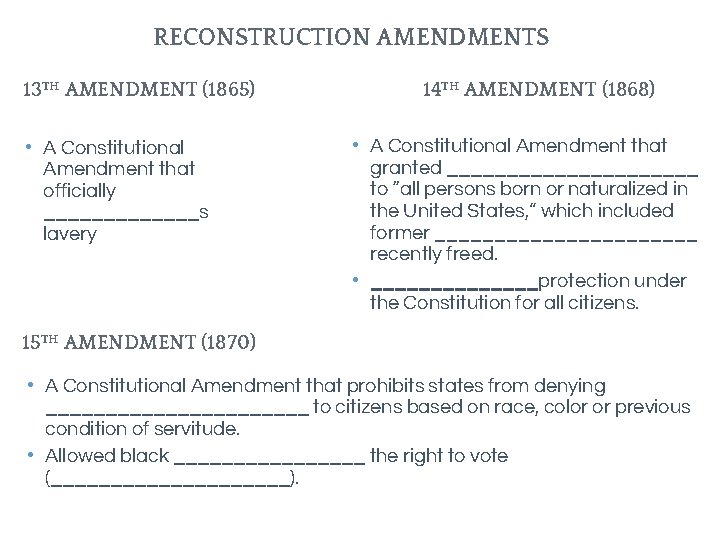
RECONSTRUCTION AMENDMENTS 13 TH AMENDMENT (1865) • A Constitutional Amendment that officially _______s lavery 14 TH AMENDMENT (1868) • A Constitutional Amendment that granted ___________ to “all persons born or naturalized in the United States, ” which included former ___________ recently freed. • _______protection under the Constitution for all citizens. 15 TH AMENDMENT (1870) • A Constitutional Amendment that prohibits states from denying ___________ to citizens based on race, color or previous condition of servitude. • Allowed black ________ the right to vote (__________).
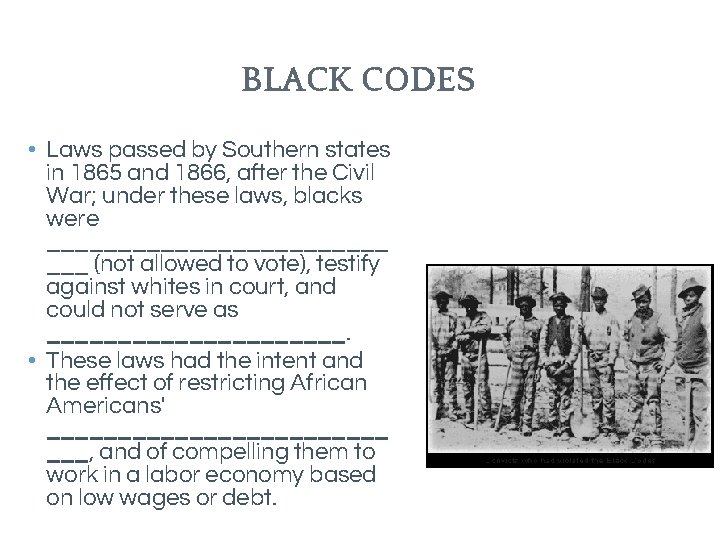
BLACK CODES • Laws passed by Southern states in 1865 and 1866, after the Civil War; under these laws, blacks were ____________ ___ (not allowed to vote), testify against whites in court, and could not serve as ___________. • These laws had the intent and the effect of restricting African Americans' ____________ ___, and of compelling them to work in a labor economy based on low wages or debt.
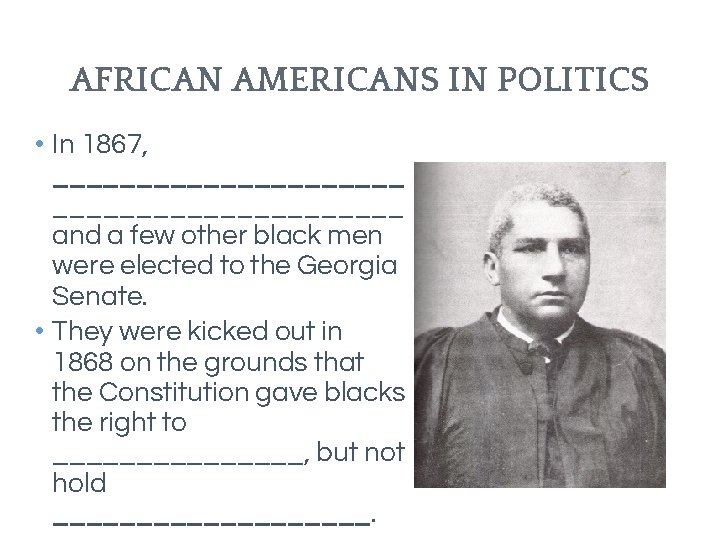
AFRICAN AMERICANS IN POLITICS • In 1867, _____________________ and a few other black men were elected to the Georgia Senate. • They were kicked out in 1868 on the grounds that the Constitution gave blacks the right to ________, but not hold __________.
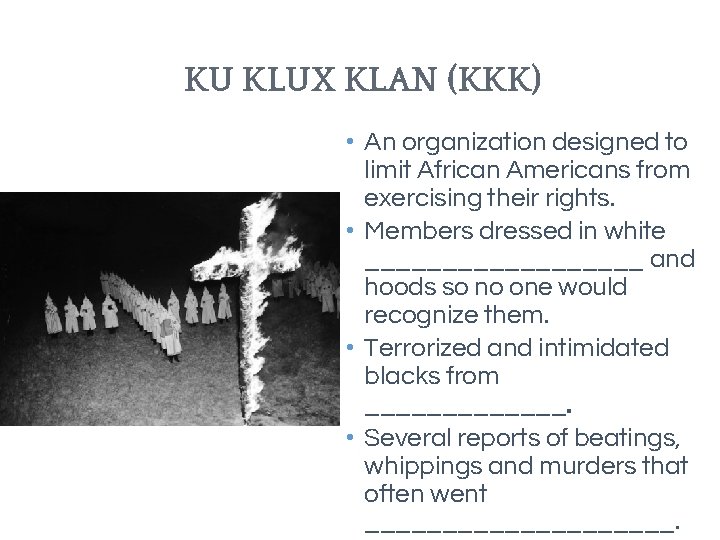
KU KLUX KLAN (KKK) • An organization designed to limit African Americans from exercising their rights. • Members dressed in white _________ and hoods so no one would recognize them. • Terrorized and intimidated blacks from _______. • Several reports of beatings, whippings and murders that often went __________.
CONGRESSIONAL RECONSTRUCTION (1866 -1867) • Congress passed the Reconstruction Act of _______. This act lumped the South into five military districts with Georgia, Alabama, and Florida making up the third district. Under ___________ Reconstruction General John Pope served as the third district’s 1 st military governor. • During this period, Georgia held another constitutional convention, this time in Atlanta. During this convention, Georgia created a new constitution that included a provision for black voting, public schools, and moving the capital to Atlanta. • After this convention, Republican Rufus Bullock was elected Governor and the Republican controlled General Assembly began its session. However, the military continued to be a presence in the state due to the continued actions of the KKK and Georgia’s refusal to pass the 15 th amendment which gave African. American men the right to vote. • Georgia was finally readmitted into the _______________ when reinstated Republican and black legislators voted for the passage of the 15 th amendment. However, by 1872 southern Democrats called the “redeemers” were voted back into office and took control of the Governorship and General Assembly.
SHARECROPPER VS TENANT FARMER • Most African Americans in the South were forced to work as sharecroppers or laborers, for jobs were not all open to them. • Tenant Farmer: Brought “something to the table” ie, ____________, plow, mules, seed, fertilizer and, of course, his labor • Sharecropper: Brought only his _________ to the “table” • Land-owners always had the upper hand. Perhaps for the first time since colonization, there was a lot of labor for the land as opposed to a shortage of labor
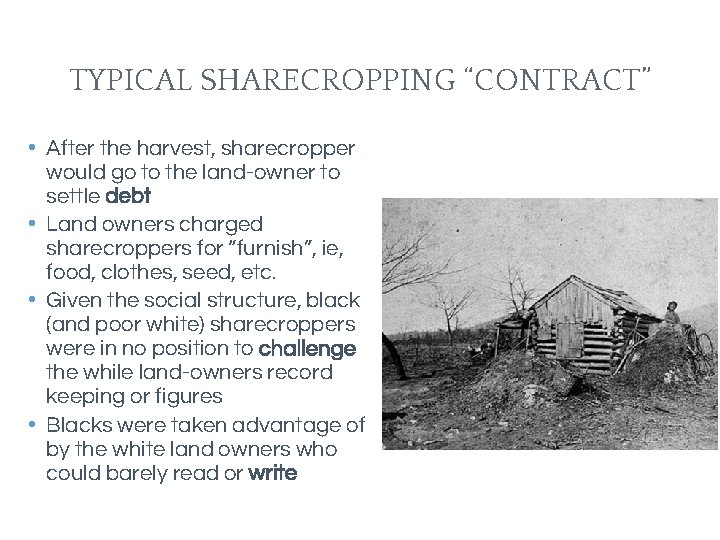
TYPICAL SHARECROPPING “CONTRACT” • After the harvest, sharecropper would go to the land-owner to settle debt • Land owners charged sharecroppers for “furnish”, ie, food, clothes, seed, etc. • Given the social structure, black (and poor white) sharecroppers were in no position to challenge the while land-owners record keeping or figures • Blacks were taken advantage of by the white land owners who could barely read or write
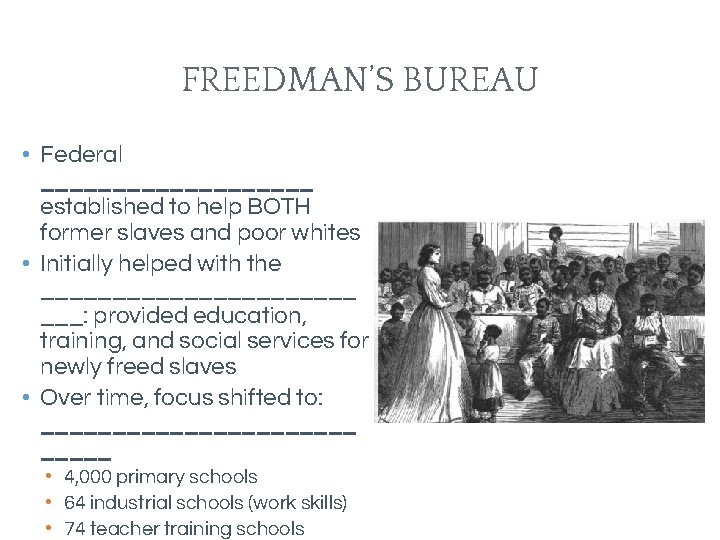
FREEDMAN’S BUREAU • Federal __________ established to help BOTH former slaves and poor whites • Initially helped with the ___________ ___: provided education, training, and social services for newly freed slaves • Over time, focus shifted to: ___________ • 4, 000 primary schools • 64 industrial schools (work skills) • 74 teacher training schools