
Reconstruction Fall 2018 A Why was the Civil
- Slides: 22
Reconstruction Fall 2018
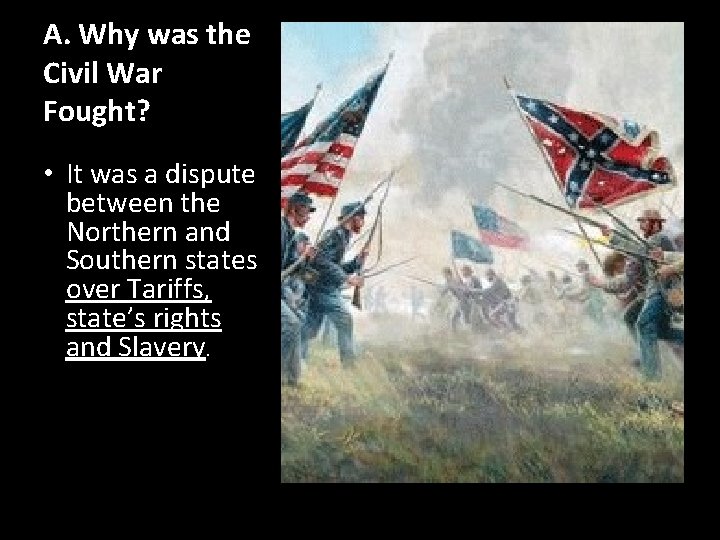
A. Why was the Civil War Fought? • It was a dispute between the Northern and Southern states over Tariffs, state’s rights and Slavery.
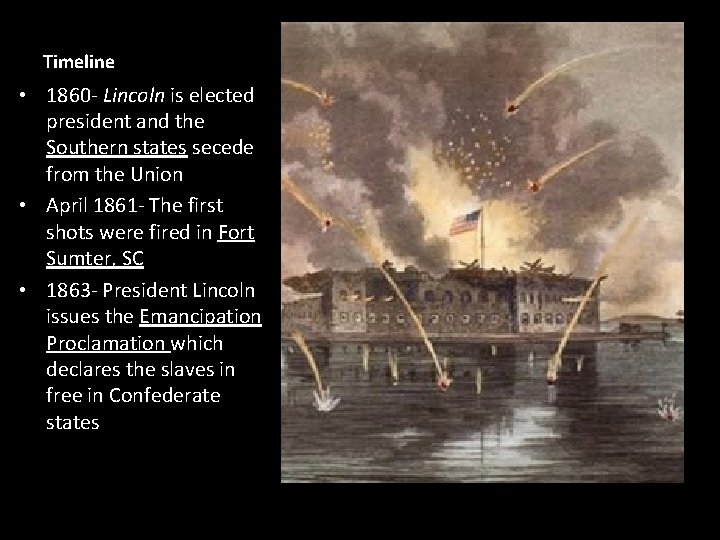
Timeline • 1860 - Lincoln is elected president and the Southern states secede from the Union • April 1861 - The first shots were fired in Fort Sumter, SC • 1863 - President Lincoln issues the Emancipation Proclamation which declares the slaves in free in Confederate states
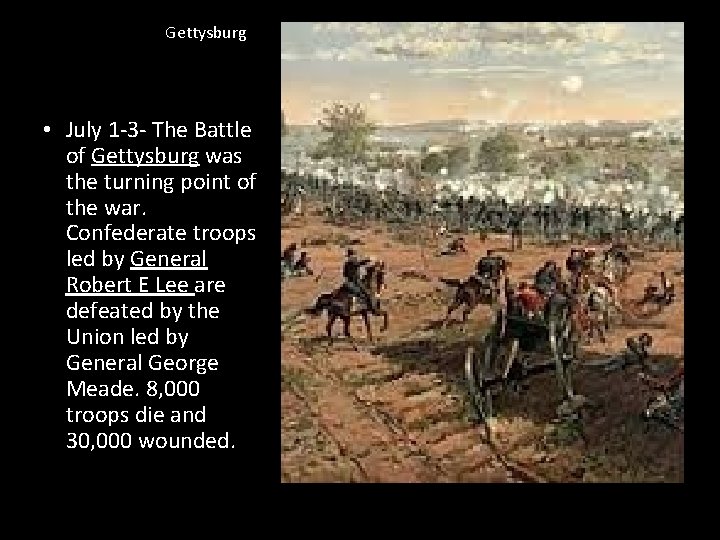
Gettysburg • July 1 -3 - The Battle of Gettysburg was the turning point of the war. Confederate troops led by General Robert E Lee are defeated by the Union led by General George Meade. 8, 000 troops die and 30, 000 wounded.
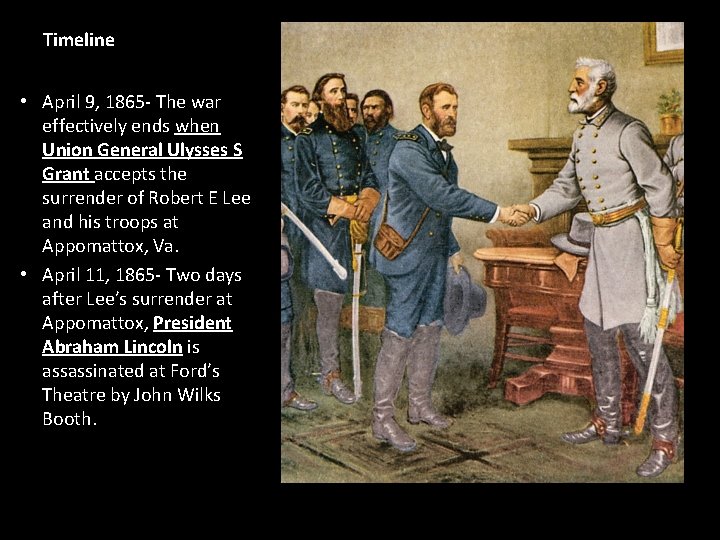
Timeline • April 9, 1865 - The war effectively ends when Union General Ulysses S Grant accepts the surrender of Robert E Lee and his troops at Appomattox, Va. • April 11, 1865 - Two days after Lee’s surrender at Appomattox, President Abraham Lincoln is assassinated at Ford’s Theatre by John Wilks Booth.
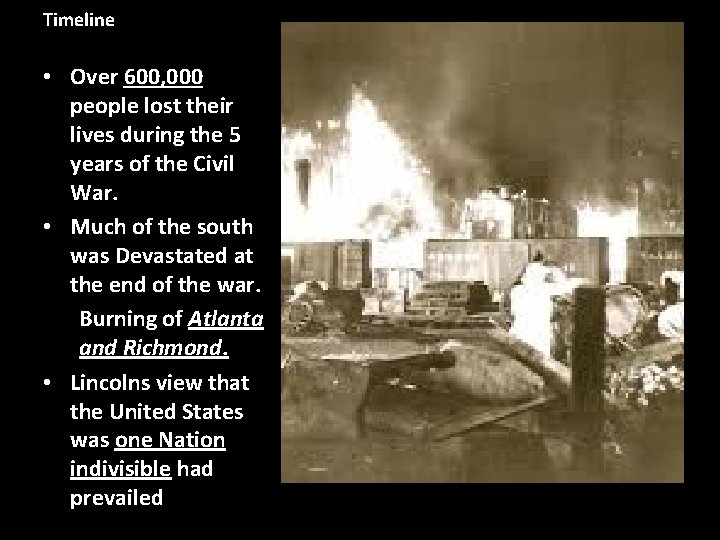
Timeline • Over 600, 000 people lost their lives during the 5 years of the Civil War. • Much of the south was Devastated at the end of the war. Burning of Atlanta and Richmond. • Lincolns view that the United States was one Nation indivisible had prevailed
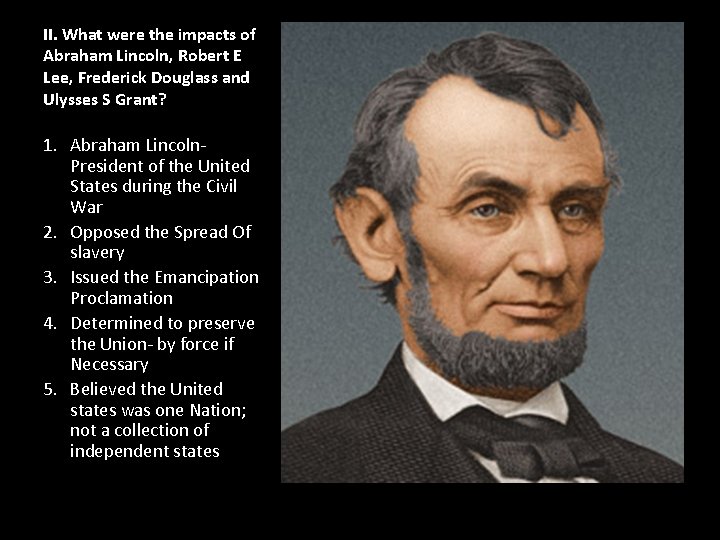
II. What were the impacts of Abraham Lincoln, Robert E Lee, Frederick Douglass and Ulysses S Grant? 1. Abraham Lincoln. President of the United States during the Civil War 2. Opposed the Spread Of slavery 3. Issued the Emancipation Proclamation 4. Determined to preserve the Union- by force if Necessary 5. Believed the United states was one Nation; not a collection of independent states
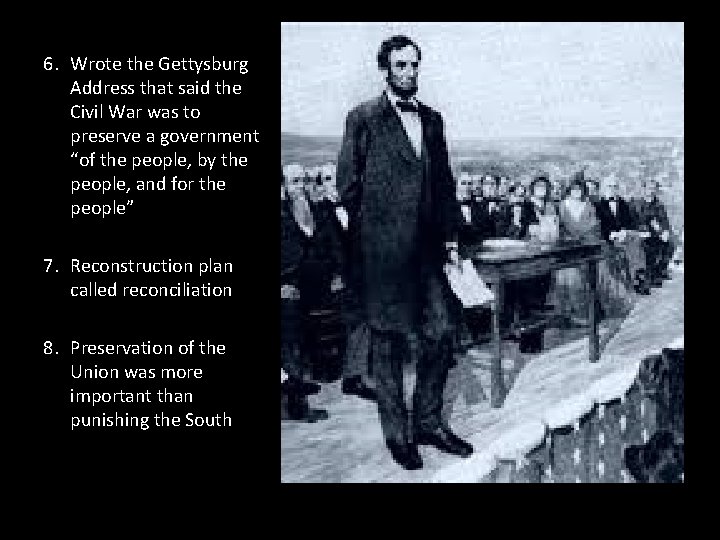
6. Wrote the Gettysburg Address that said the Civil War was to preserve a government “of the people, by the people, and for the people” 7. Reconstruction plan called reconciliation 8. Preservation of the Union was more important than punishing the South
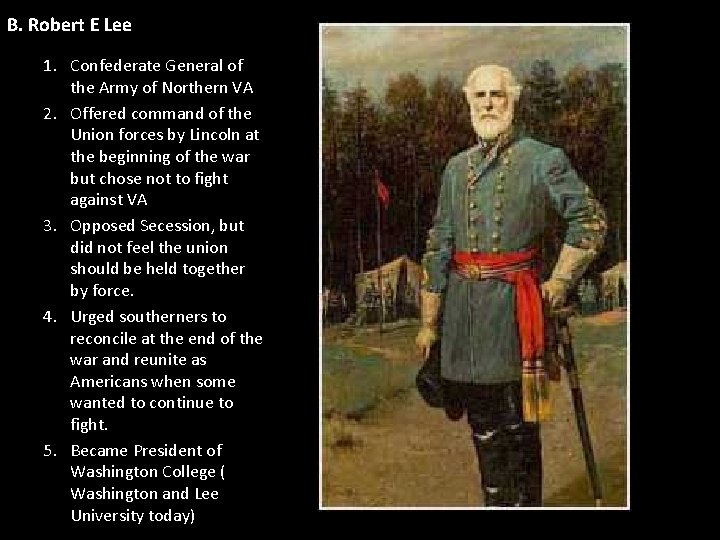
B. Robert E Lee 1. Confederate General of the Army of Northern VA 2. Offered command of the Union forces by Lincoln at the beginning of the war but chose not to fight against VA 3. Opposed Secession, but did not feel the union should be held together by force. 4. Urged southerners to reconcile at the end of the war and reunite as Americans when some wanted to continue to fight. 5. Became President of Washington College ( Washington and Lee University today)
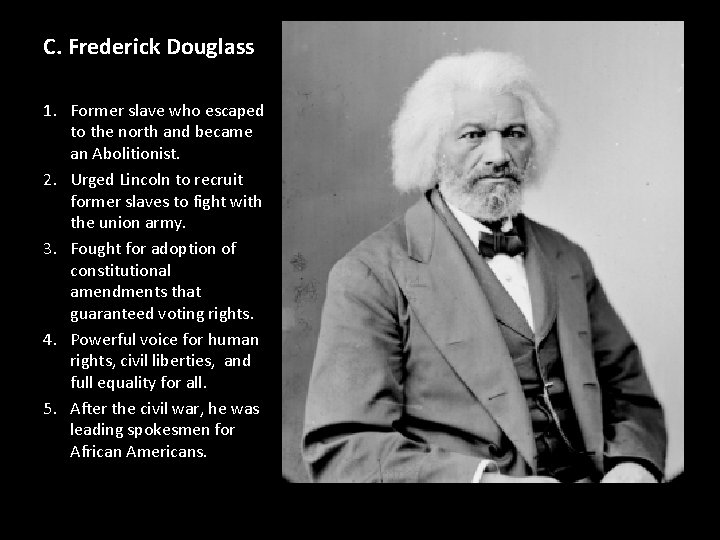
C. Frederick Douglass 1. Former slave who escaped to the north and became an Abolitionist. 2. Urged Lincoln to recruit former slaves to fight with the union army. 3. Fought for adoption of constitutional amendments that guaranteed voting rights. 4. Powerful voice for human rights, civil liberties, and full equality for all. 5. After the civil war, he was leading spokesmen for African Americans.
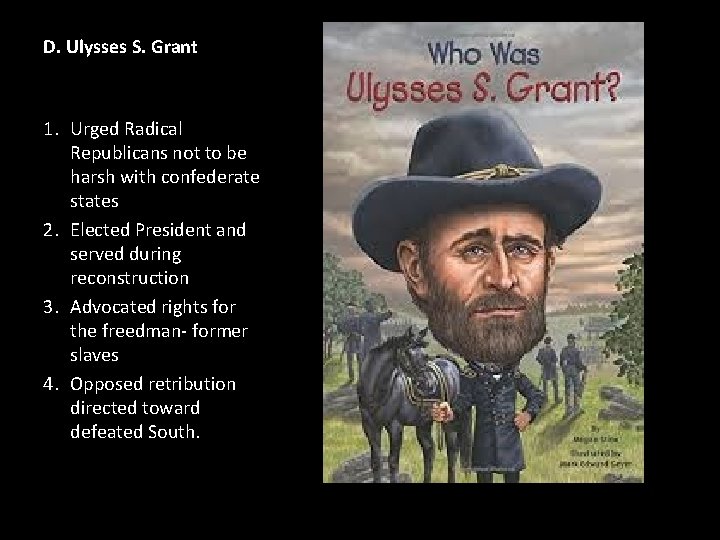
D. Ulysses S. Grant 1. Urged Radical Republicans not to be harsh with confederate states 2. Elected President and served during reconstruction 3. Advocated rights for the freedman- former slaves 4. Opposed retribution directed toward defeated South.
III. What were reconstruction policies for the South? A. Purpose- Reconstruction attempted to give meaning to the freedman that the former enslaved African Americans had Achieved B. Result- The reconstruction policies were harsh and created problems in the south.
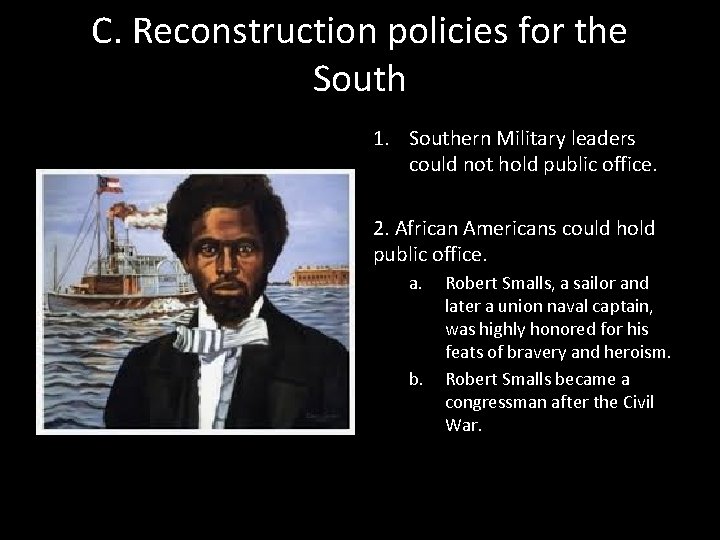
C. Reconstruction policies for the South 1. Southern Military leaders could not hold public office. 2. African Americans could hold public office. a. b. Robert Smalls, a sailor and later a union naval captain, was highly honored for his feats of bravery and heroism. Robert Smalls became a congressman after the Civil War.
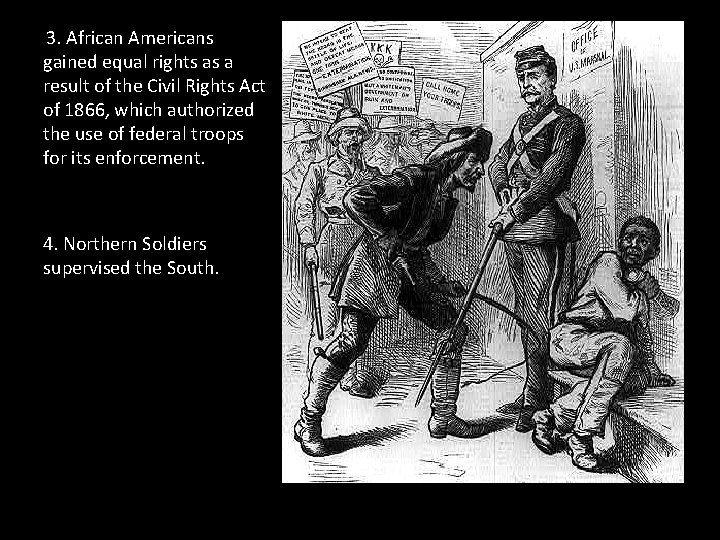
3. African Americans gained equal rights as a result of the Civil Rights Act of 1866, which authorized the use of federal troops for its enforcement. 4. Northern Soldiers supervised the South.
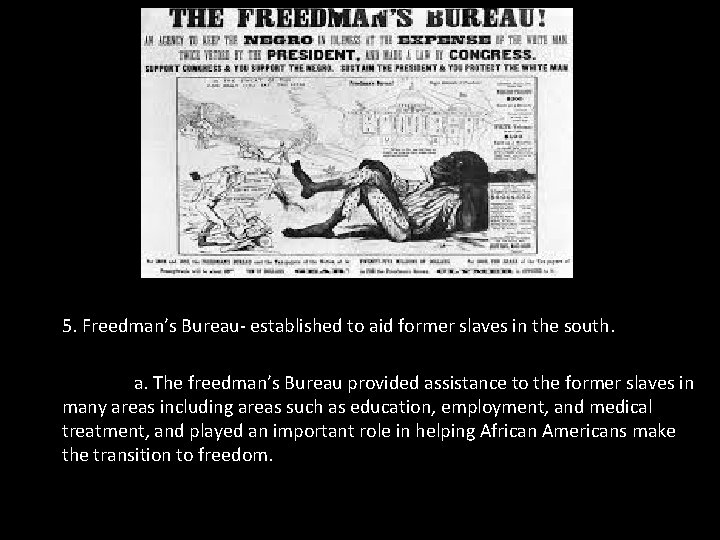
5. Freedman’s Bureau- established to aid former slaves in the south. a. The freedman’s Bureau provided assistance to the former slaves in many areas including areas such as education, employment, and medical treatment, and played an important role in helping African Americans make the transition to freedom.
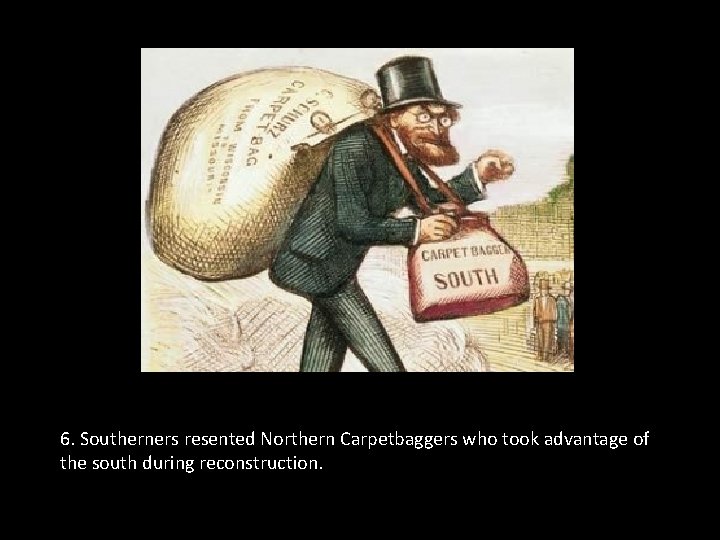
6. Southerners resented Northern Carpetbaggers who took advantage of the south during reconstruction.
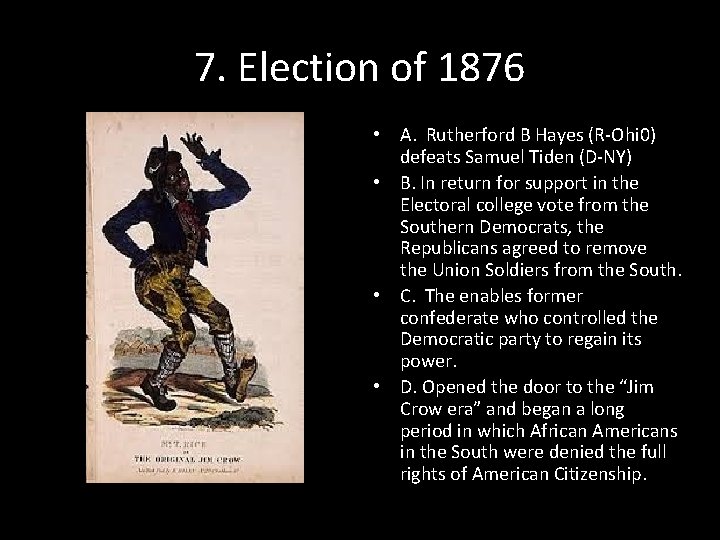
7. Election of 1876 • A. Rutherford B Hayes (R-Ohi 0) defeats Samuel Tiden (D-NY) • B. In return for support in the Electoral college vote from the Southern Democrats, the Republicans agreed to remove the Union Soldiers from the South. • C. The enables former confederate who controlled the Democratic party to regain its power. • D. Opened the door to the “Jim Crow era” and began a long period in which African Americans in the South were denied the full rights of American Citizenship.
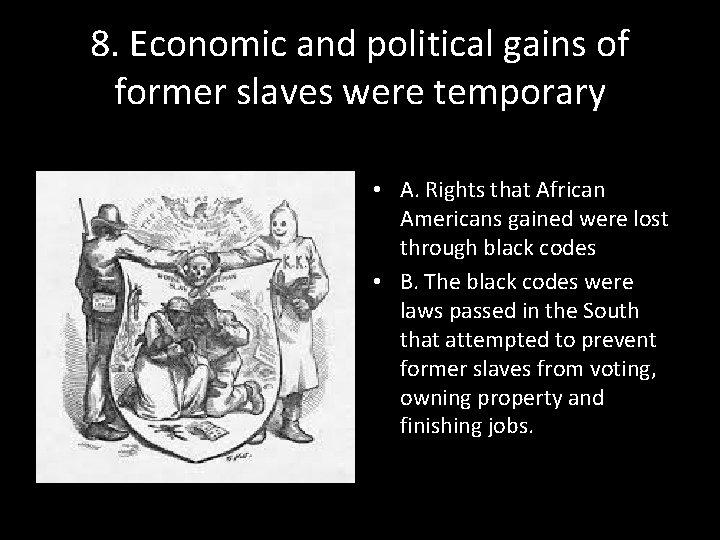
8. Economic and political gains of former slaves were temporary • A. Rights that African Americans gained were lost through black codes • B. The black codes were laws passed in the South that attempted to prevent former slaves from voting, owning property and finishing jobs.
Political impact 1. Lincoln believed that once the war was over, t reunify the nation the federal government should not punish the south but act “ with malice towards none, with charity for all. . to bind up the nations wounds 2. The assassination of Lincoln results in RADICAL REPUBLICANS trying to punish the former Confederate states. 3. RADICAL REBULBLICANS BELIEVED in aggressively guaranteeing voting and other civil rights to African Americans. THEY CLASHED REPEATEDLY WITH LINCOLNS successor as President Andrew Johnson over the issue of civil rights for freed slaves, eventually impeached but failing to remove him from office.
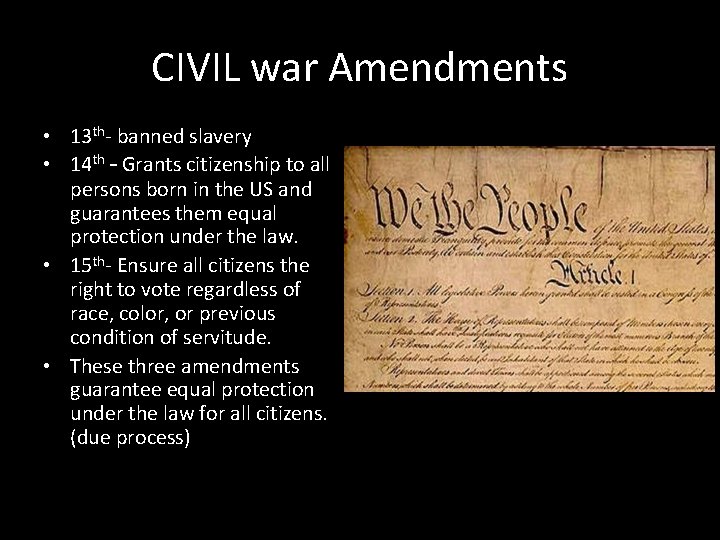
CIVIL war Amendments • 13 th- banned slavery • 14 th – Grants citizenship to all persons born in the US and guarantees them equal protection under the law. • 15 th- Ensure all citizens the right to vote regardless of race, color, or previous condition of servitude. • These three amendments guarantee equal protection under the law for all citizens. (due process)
Economic and Social Impact 1. The Southern States were left bitter and devastated by the war. • A. Farms, Railroads, and factories • • had been destroyed throughout the South. B. Confederate money was worthless. C. Many towns and cities such as Richmond and Atlanta laid in ruins D. The source of labor was greatly changed due to loss of life during the war and the end of slavery. E. The south would remain agricultural- based economy and the poorest section of the nation for many decades afterwards
Economic and Social Impact Continued 2. The North and Midwest emerged with strong and growing industrial economies. • A. Built the foundation for industrialization in the next half-century and the emergence of the United States as a Global Economic Power by the beginning of the 1900’s. • 3. The completion of the Transcontinental Railroad soon after the war ended increased the westward movement of settlers into the states west of the Mississippi River. 4. Although slavery ended, African Americans did not begin to achieve full equality during the 100 years.