
Reconstruction 1863 1877 Essential Question Explain the extent



- Slides: 19
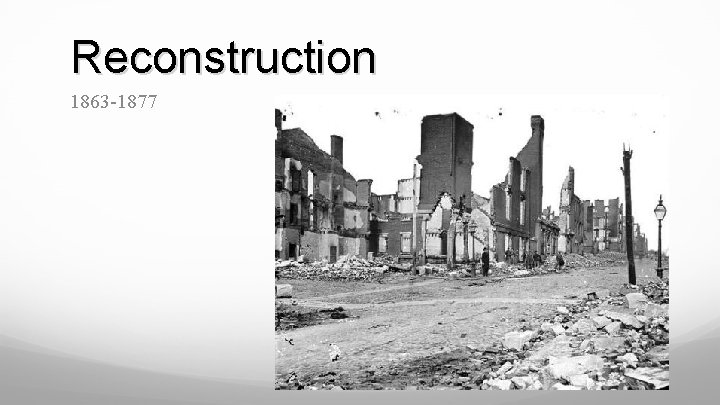
Reconstruction 1863 -1877
Essential Question Explain the extent to which constitutional and social developments contributed to maintaining continuity as well as fostering change during the Civil War to the end of Reconstruction.
A Series of Challenges How would the South rebuild its shattered economy and society? What would be the place in society of 4 million freedmen? To what extent was the federal government responsible for helping them? How should the former Confederate states be treated? Recognize secession, or not? How would they be brought back into the Union? Who has the authority to decide these questions? Congress or the President?
Plans for Reconstruction Lincoln’s Plan Proclamation of Amnesty and Reconstruction (1863) Full pardons for: Oath of allegiance Accepting emancipation of slaves States can draw constitution and be reestablished as soon as ten percent of voters took oath (10% Plan) Summation: Lenient, designed for expedited implementation and enforcement of Emancipation Proclamation. NOT “readmission” – did not recognize secession Wade-Davis Bill Congressional Plan (1864) Required 50% of 1860 population to take “iron-clad” oath Required state constitutional convention to be held before elections for office Only non-Confederates could vote Enacted specific safeguards of freedmen’s liberties Lincoln pocket vetoed Summation: Would be a laborious, if not impossible task, for the South to comply. Recognized secession. Harsh; Meant to punish the South.
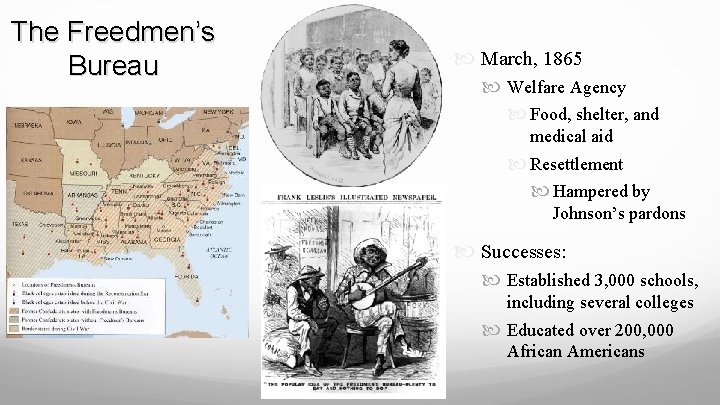
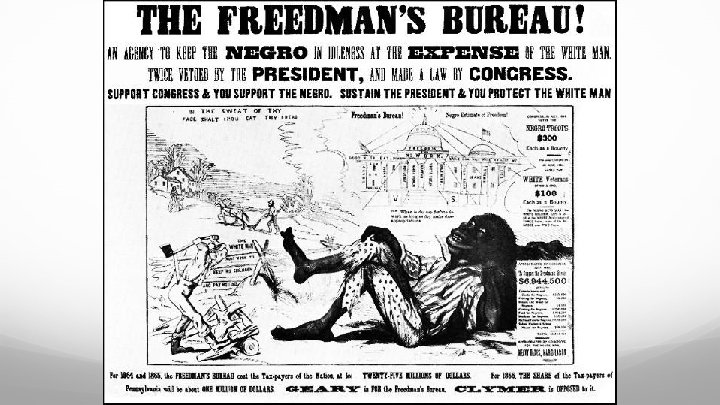
The Freedmen’s Bureau March, 1865 Welfare Agency Food, shelter, and medical aid Resettlement Hampered by Johnson’s pardons Successes: Established 3, 000 schools, including several colleges Educated over 200, 000 African Americans
Johnson and Reconstruction Andrew Johnson Democrat from Tennessee, only senator from the South to remain loyal Anti-aristocrat, White Supremacist Reconstruction Policy Continue Lincoln’s Plan Additional Provisions (Ten Percent Plus Plan): Disfranchisement (loss of the right to vote and hold office ) of: Former Confederate leaders and officeholders Confederates with more than $20, 000 in taxable property Gave president the power to pardon “disloyal” Southerners Johnson pardoned over 13, 000 Results: Expedited eligibility of states to become functioning members of the Union Pardons allowed for return of Confederate office holders and the planter aristocracy to power Battle between Johnson and the Republicans Use of the Veto (29)
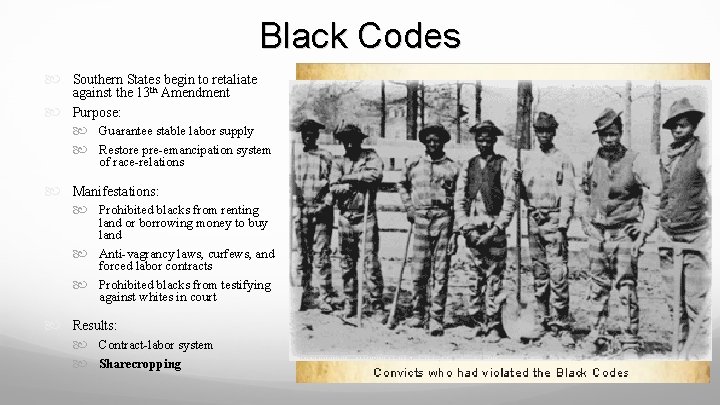
Black Codes Southern States begin to retaliate against the 13 th Amendment Purpose: Guarantee stable labor supply Restore pre-emancipation system of race-relations Manifestations: Prohibited blacks from renting land or borrowing money to buy land Anti-vagrancy laws, curfews, and forced labor contracts Prohibited blacks from testifying against whites in court Results: Contract-labor system Sharecropping
Congressional Reconstruction The Radical Republicans Retaliate Led by Charles Sumner & Thaddeus Stevens Provisions: Civil Rights Act of 1866 Sought to override Johnson vetoes Nullify Dred Scott Shield against Black Codes 14 th Amendment (ratified 1868) Citizenship for all persons born or naturalized in the United States Afford “due process” and “equal protection” Punished the South Disqualified former Confederate leaders, repudiated debt, and could reduce a state’s proportional representation
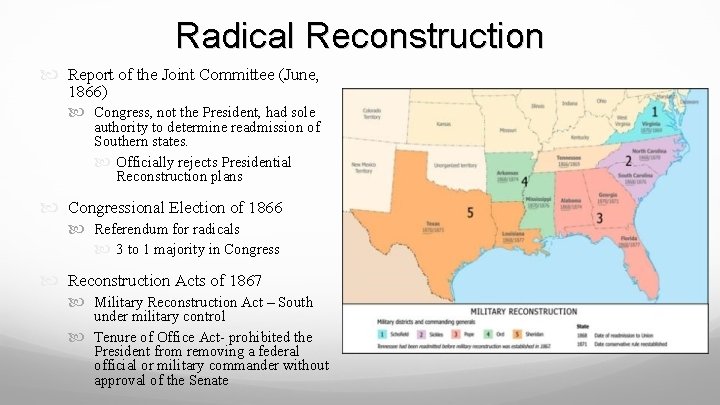
Radical Reconstruction Report of the Joint Committee (June, 1866) Congress, not the President, had sole authority to determine readmission of Southern states. Officially rejects Presidential Reconstruction plans Congressional Election of 1866 Referendum for radicals 3 to 1 majority in Congress Reconstruction Acts of 1867 Military Reconstruction Act – South under military control Tenure of Office Act- prohibited the President from removing a federal official or military commander without approval of the Senate
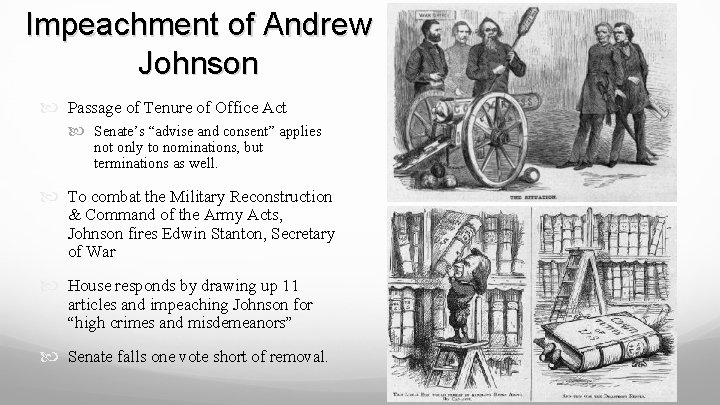
Impeachment of Andrew Johnson Passage of Tenure of Office Act Senate’s “advise and consent” applies not only to nominations, but terminations as well. To combat the Military Reconstruction & Command of the Army Acts, Johnson fires Edwin Stanton, Secretary of War House responds by drawing up 11 articles and impeaching Johnson for “high crimes and misdemeanors” Senate falls one vote short of removal.
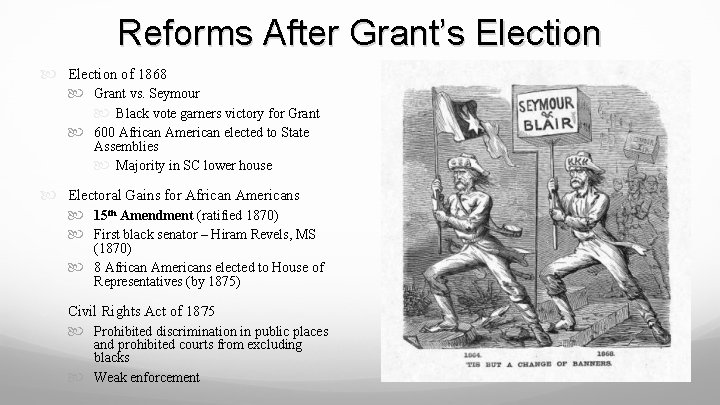
Reforms After Grant’s Election of 1868 Grant vs. Seymour Black vote garners victory for Grant 600 African American elected to State Assemblies Majority in SC lower house Electoral Gains for African Americans 15 th Amendment (ratified 1870) First black senator – Hiram Revels, MS (1870) 8 African Americans elected to House of Representatives (by 1875) Civil Rights Act of 1875 Prohibited discrimination in public places and prohibited courts from excluding blacks Weak enforcement
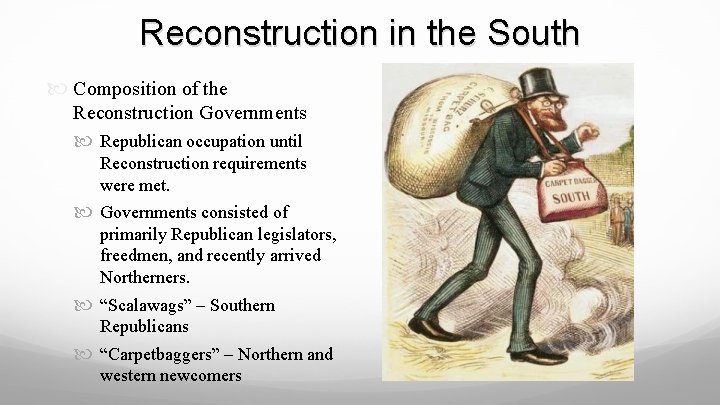
Reconstruction in the South Composition of the Reconstruction Governments Republican occupation until Reconstruction requirements were met. Governments consisted of primarily Republican legislators, freedmen, and recently arrived Northerners. “Scalawags” – Southern Republicans “Carpetbaggers” – Northern and western newcomers
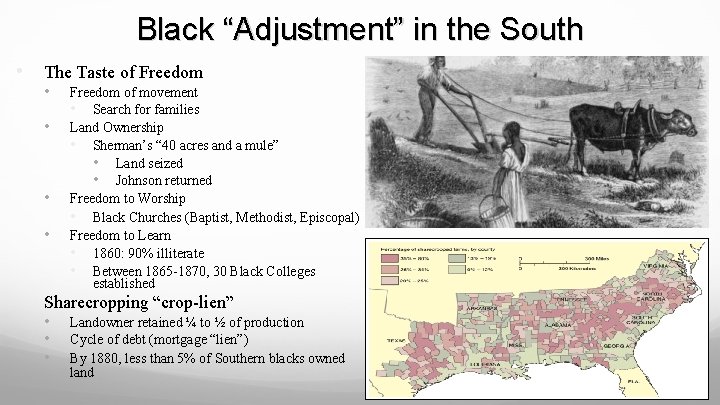
Black “Adjustment” in the South • The Taste of Freedom • • • Freedom of movement • Search for families Land Ownership • Sherman’s “ 40 acres and a mule” • Land seized • Johnson returned Freedom to Worship • Black Churches (Baptist, Methodist, Episcopal) Freedom to Learn • 1860: 90% illiterate • Between 1865 -1870, 30 Black Colleges established Sharecropping “crop-lien” • • • Landowner retained ¼ to ½ of production Cycle of debt (mortgage “lien”) By 1880, less than 5% of Southern blacks owned land
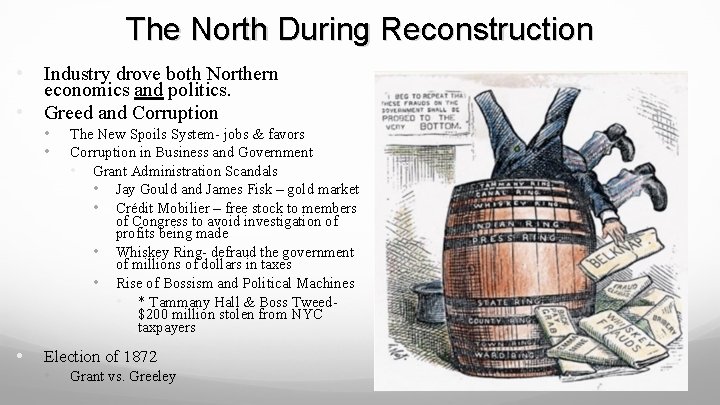
The North During Reconstruction • Industry drove both Northern economics and politics. • Greed and Corruption • • • The New Spoils System- jobs & favors Corruption in Business and Government • Grant Administration Scandals • Jay Gould and James Fisk – gold market • Crédit Mobilier – free stock to members of Congress to avoid investigation of profits being made • Whiskey Ring- defraud the government of millions of dollars in taxes • Rise of Bossism and Political Machines • * Tammany Hall & Boss Tweed$200 million stolen from NYC taxpayers Election of 1872 • Grant vs. Greeley
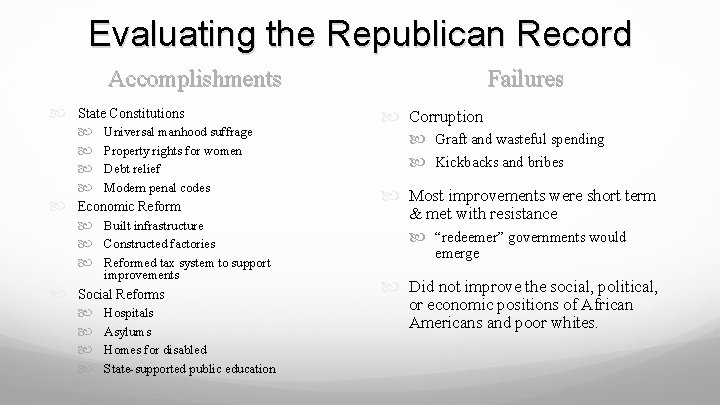
Evaluating the Republican Record Accomplishments State Constitutions Universal manhood suffrage Property rights for women Debt relief Modern penal codes Economic Reform Built infrastructure Constructed factories Reformed tax system to support improvements Social Reforms Hospitals Asylums Homes for disabled State-supported public education Failures Corruption Graft and wasteful spending Kickbacks and bribes Most improvements were short term & met with resistance “redeemer” governments would emerge Did not improve the social, political, or economic positions of African Americans and poor whites.
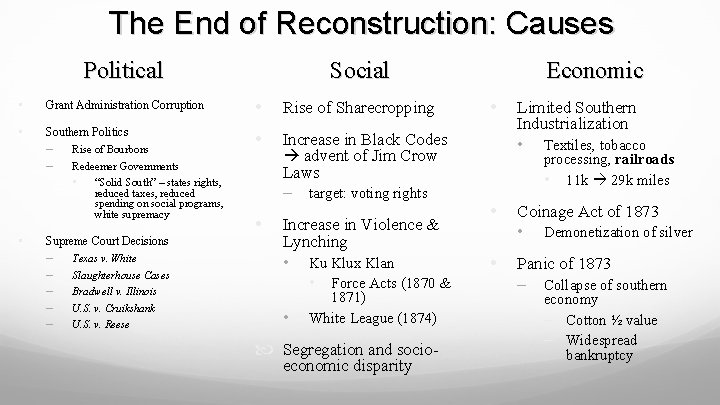
The End of Reconstruction: Causes Political Social • Grant Administration Corruption • Rise of Sharecropping • Southern Politics • Increase in Black Codes advent of Jim Crow Laws – target: voting rights – – Rise of Bourbons Redeemer Governments • • “Solid South” – states rights, reduced taxes, reduced spending on social programs, white supremacy Supreme Court Decisions – – – Texas v. White Slaughterhouse Cases Bradwell v. Illinois U. S. v. Cruikshank U. S. v. Reese • Increase in Violence & Lynching • Ku Klux Klan • Force Acts (1870 & • 1871) White League (1874) Segregation and socioeconomic disparity Economic • Limited Southern Industrialization • Textiles, tobacco processing, railroads • 11 k 29 k miles • Coinage Act of 1873 • Demonetization of silver • Panic of 1873 – Collapse of southern economy – Cotton ½ value – Widespread bankruptcy
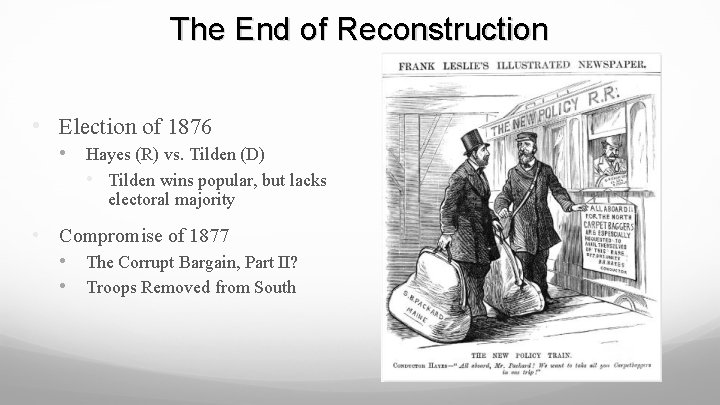
The End of Reconstruction • Election of 1876 • Hayes (R) vs. Tilden (D) • Tilden wins popular, but lacks electoral majority • Compromise of 1877 • The Corrupt Bargain, Part II? • Troops Removed from South
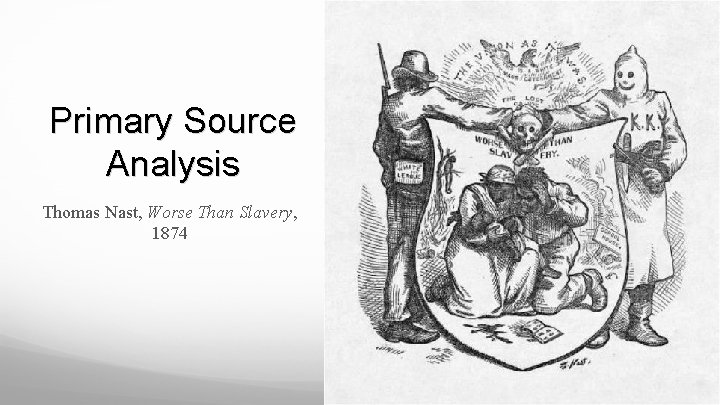
Primary Source Analysis Thomas Nast, Worse Than Slavery, 1874