
Reconstructing Sea Ice Extent from Early Nimbus Satellites
Reconstructing Sea Ice Extent from Early Nimbus Satellites David Gallaher(1), Garrett Campbell(1) 1) 1 National Snow and Ice Data Center, University of Colorado, Boulder, Colorado, 80303, USA Reconstructing Sea Ice Extent from Early Nimbus Satellites

The 1960 s NIMBUS Series HRIR Sensor Spacecraft Launch date End of Operation Sensors Nimbus-1 Aug. 28, 1964 Sep 22, 1964 AVCS, HRIR Nimbus-2 May 15, 1966 Nov 15, 1966 AVCS, HRIR, MRIR Nimbus-3 Apr. 14, 1969 Jan. 31, 1970 IDCS, HRIR, MRIR Advanced Vidicon Camera System (AVCS) to provides visible light images (4 -bit, 3 km nadir ) Image Dissector Camera System (IDCS) provides improved visible light images (8 -bit, 5 km nadir) Medium Resolution Infrared Radiometer (MRIR) to measure electromagnetic radiation emitted in five wavelength bands (Nimbus II & III) 50 km High Resolution Infrared Radiometer (HRIR) to map the Earth at night (7 km nadir) 2 Reconstructing Sea Ice Extent from Early Nimbus Satellites
Determining 1960 s Sea Ice Extent - Project Impetus • Could 50 -year old 1960 s satellite data can be used to create polar sea ice extent on a monthly basis? • Except for the original science team, much of the data has likely never been seen or been made available. • The original engineers and researchers are now mostly in their late 70 s and 80 s, and time was running out to contact them. The tapes were disintegrating and film scanners are becoming obsolete. • The objective was to get this data to earth science researchers in a modern format (Net. CDF). • This could extend the satellite sea ice 1979 -2014 records by as much as 16 years. Reconstructing Sea Ice Extent from Early Nimbus Satellites

Nimbus Sensors (Visible and Infrared) Devon and Baffin Islands, AVCS Image September 16, 1964 Ground Resolution as good as 1 km, 250, 000 + images NCDC had the only known copy Nimbus II HRIR Infrared False Color, Asia, September 23, 1966 Note Himalayan Plateau and Pacific typhoons National Archives had only tapes Reconstructing Sea Ice Extent from Early Nimbus Satellites

Extraction & Recovery of Nimbus data Processing of Visible Data: AVCS/IDCS: 0. 5 -7. 5 um Digitizing film 250, 000 images Scanning over 1, 000 frames Marking bad data Navigating Merge with NORAD ephemeris data Merging into time composite Metadata development Need to enter the time of every image Need to designate the center Not possible to automate because some of the information is not readable We were able to interpolate between good images to guess the times Improve image location to 20 km 5 Reconstructing Sea Ice Extent from Early Nimbus Satellites (From NCDC Ashville, NC)
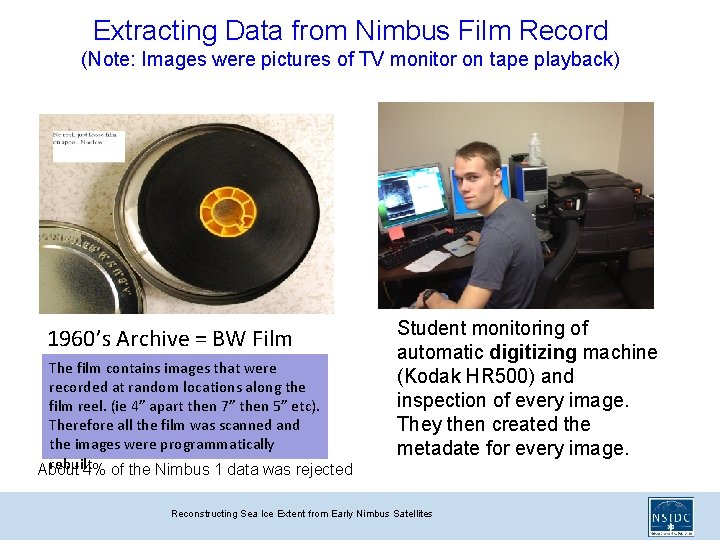
Extracting Data from Nimbus Film Record (Note: Images were pictures of TV monitor on tape playback) 1960’s Archive = BW Film The film contains images that were recorded at random locations along the film reel. (ie 4” apart then 7” then 5” etc). Therefore all the film was scanned and the images were programmatically rebuilt About 4% of the Nimbus 1 data was rejected Student monitoring of automatic digitizing machine (Kodak HR 500) and inspection of every image. They then created the metadate for every image. Reconstructing Sea Ice Extent from Early Nimbus Satellites
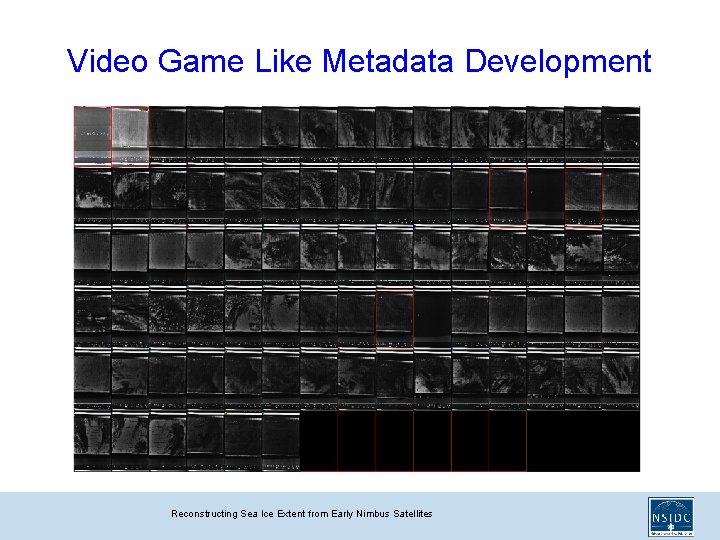
Video Game Like Metadata Development Reconstructing Sea Ice Extent from Early Nimbus Satellites
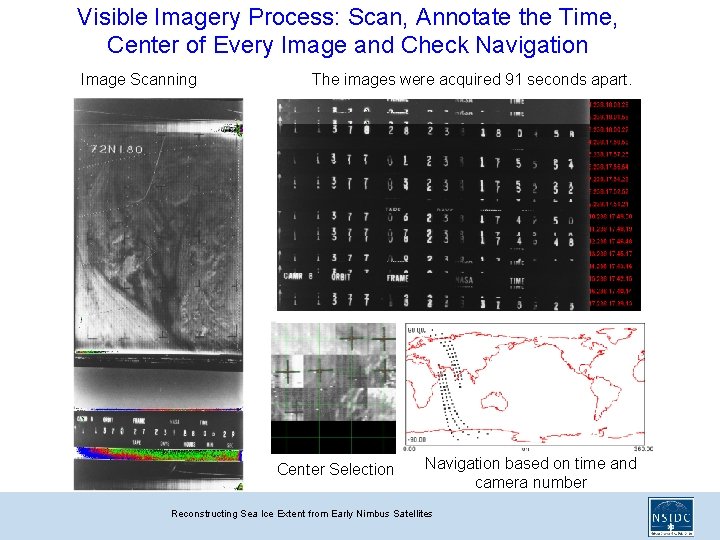
Visible Imagery Process: Scan, Annotate the Time, Center of Every Image and Check Navigation Image Scanning The images were acquired 91 seconds apart. Center Selection Navigation based on time and camera number Reconstructing Sea Ice Extent from Early Nimbus Satellites
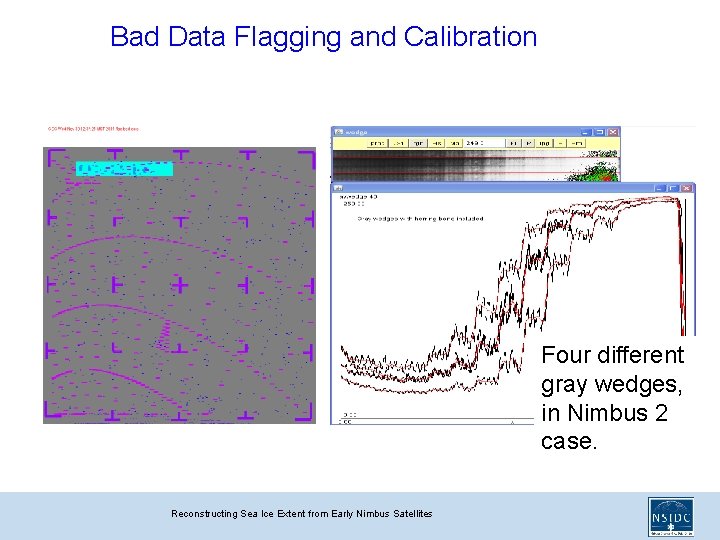
Bad Data Flagging and Calibration Four different gray wedges, in Nimbus 2 case. Reconstructing Sea Ice Extent from Early Nimbus Satellites
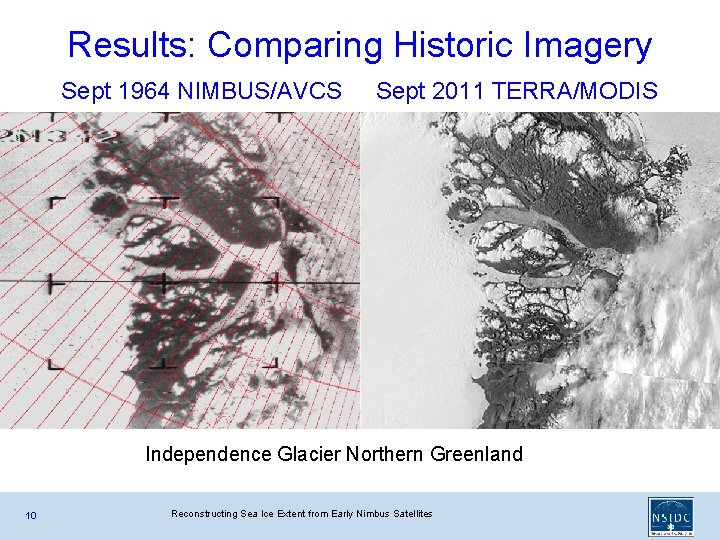
Results: Comparing Historic Imagery Sept 1964 NIMBUS/AVCS Sept 2011 TERRA/MODIS Independence Glacier Northern Greenland 10 Reconstructing Sea Ice Extent from Early Nimbus Satellites
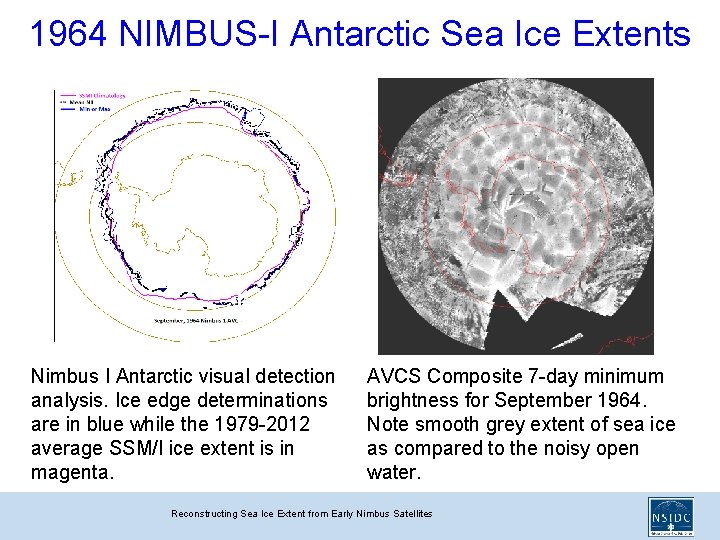
1964 NIMBUS-I Antarctic Sea Ice Extents Nimbus I Antarctic visual detection analysis. Ice edge determinations are in blue while the 1979 -2012 average SSM/I ice extent is in magenta. AVCS Composite 7 -day minimum brightness for September 1964. Note smooth grey extent of sea ice as compared to the noisy open water. Reconstructing Sea Ice Extent from Early Nimbus Satellites
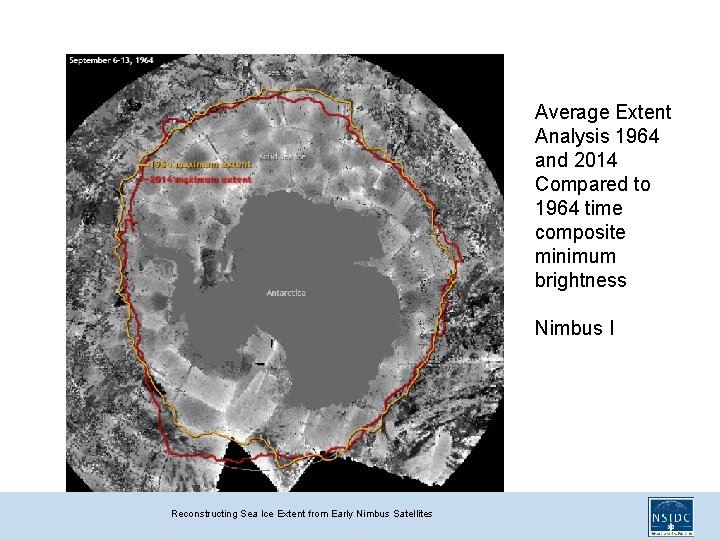
Average Extent Analysis 1964 and 2014 Compared to 1964 time composite minimum brightness Nimbus I Reconstructing Sea Ice Extent from Early Nimbus Satellites
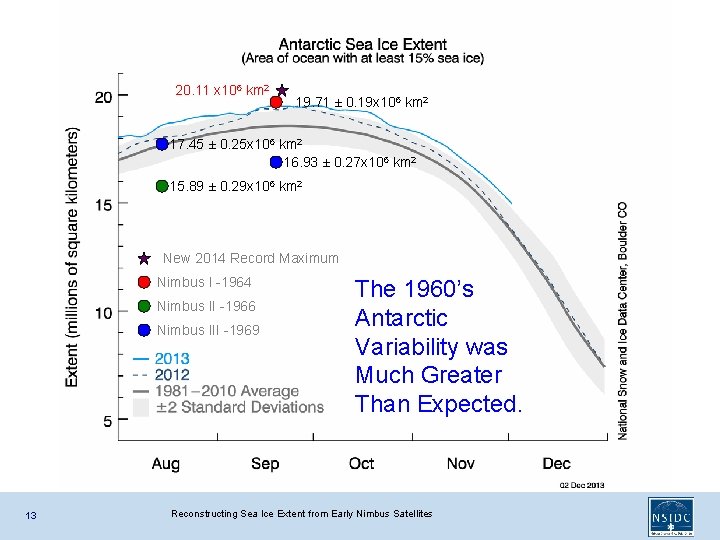
20. 11 x 106 km 2 19. 71 ± 0. 19 x 106 km 2 17. 45 ± 0. 25 x 106 km 2 16. 93 ± 0. 27 x 106 km 2 15. 89 ± 0. 29 x 106 km 2 New 2014 Record Maximum Nimbus I -1964 Nimbus II -1966 Nimbus III -1969 13 The 1960’s Antarctic Variability was Much Greater Than Expected. Reconstructing Sea Ice Extent from Early Nimbus Satellites
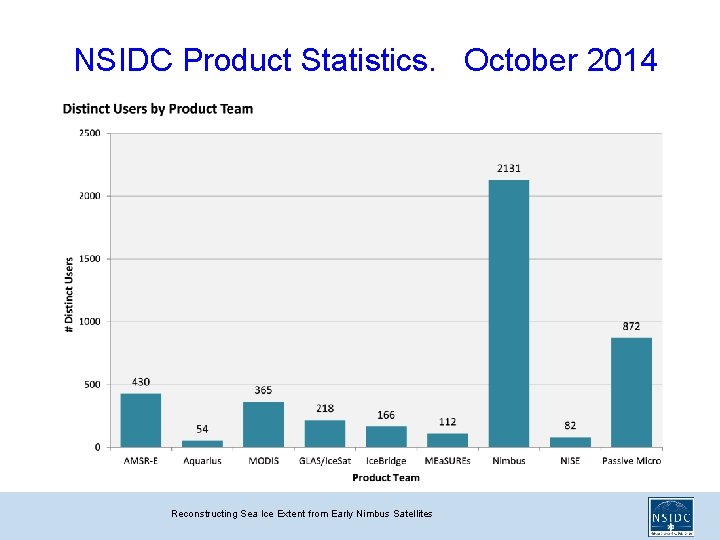
NSIDC Product Statistics. October 2014 Reconstructing Sea Ice Extent from Early Nimbus Satellites
Summary Data from these 1960’s satellites is generally forgotten as a data source. We have found the data was of reasonable quality but the output products were limited due to the computer processing technology of the era. The Nimbus data represents the oldest digital satellite data in NASA’s data holdings (both visible and infrared). These data are now stored in modern formats and are available for general use via NASA’s data access system: http: //reverb. echo. nasa. gov/reverb, and at http: //nsidc. org/data/nimbus/order-data. html The Nimbus Data Rescue Project: Nimbus I, III was supported by NASA contract #NNG 08 HZ 07 C as a subtask to NSIDC at the University of Colorado. 15 Reconstructing Sea Ice Extent from Early Nimbus Satellites
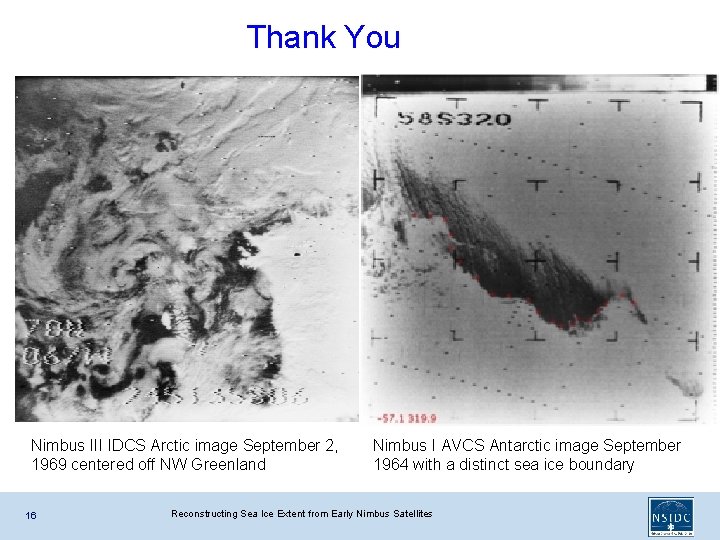
Thank You Nimbus III IDCS Arctic image September 2, 1969 centered off NW Greenland 16 Nimbus I AVCS Antarctic image September 1964 with a distinct sea ice boundary Reconstructing Sea Ice Extent from Early Nimbus Satellites
- Slides: 16