
Reconstitution of Solutions MAT 119 Chapter 12 Parts








- Slides: 30
Reconstitution of Solutions MAT 119 Chapter 12
Parts of Solutions 2
Terms Ø Solute – a substance to be dissolved or diluted Ø Solvent or Diluent – a substance (liquid) that dissolves another substance to prepare a solution. Ø Solution – the resulting mixture of a solute plus a solvent/diluent 3
Reconstitution Drug 4
Parenteral Solution from a Solid Solute Solvent or diluent 4. 8 m. L sterile water Solid solute Zithromax 500 mg 5 m. L reconstituted solution Zithromax 100 mg/m. L 5
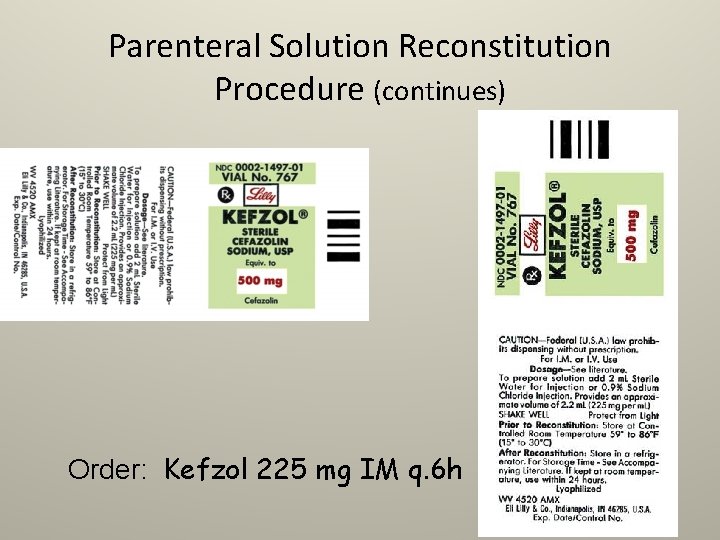
Parenteral Solution Reconstitution Procedure (continues) Order: Kefzol 225 mg IM q. 6 h 6
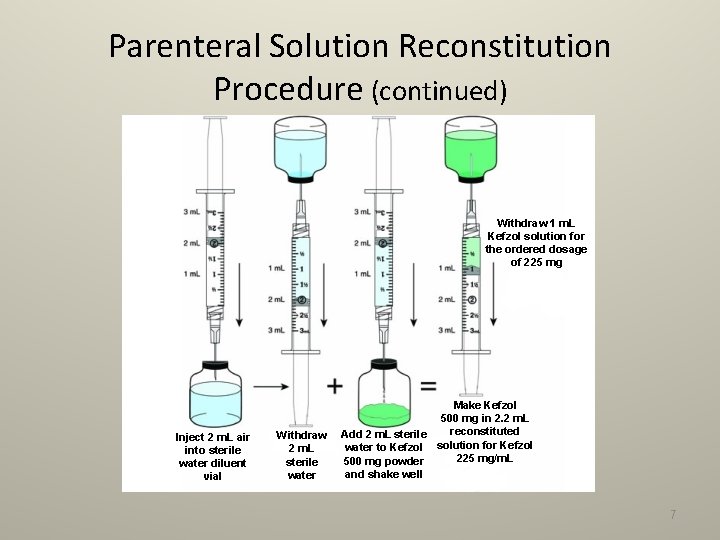
Parenteral Solution Reconstitution Procedure (continued) Withdraw 1 m. L Kefzol solution for the ordered dosage of 225 mg Inject 2 m. L air into sterile water diluent vial Withdraw 2 m. L sterile water Make Kefzol 500 mg in 2. 2 m. L reconstituted Add 2 m. L sterile water to Kefzol solution for Kefzol 225 mg/m. L 500 mg powder and shake well 7
Reconstitution Video • http: //www. youtube. com/watch? v=8 ECYui. HF Ob. U 8
Multiple-Strength Reconstitution Drug 9
Different IM and IV Reconstitution Instructions 10
Reconstitution Drug Order (continues) • Order: Solu-Medrol 200 mg IV q. 6 h 11
Reconstitution Drug Order (continued) • Supply: 500 mg vial of powdered Solu-Medrol for IM or IV injection with directions on the left side of the label that state, “Reconstitute with 8 m. L Bacteriostatic Water for Injection with Benzyl Alcohol. • When reconstituted as directed each 8 m. L contains: Methylprednisolone sodium succinate equivalent to 500 mg methylprednisolone (62. 5 mg per m. L). ” 12
Reconstitution Dosage Calculation (continues) • What do we know? – First, to fill the order, how much and what type of diluent must you add? The directions state to add 8 m. L of bacteriostatic water for injection with benzyl alcohol. – Second, what is the supply dosage of the reconstituted Solu-Medrol? When adding 8 m. L of diluent, the supply dosage is 62. 5 mg/m. L. 13
Reconstitution Dosage Calculation (continues) – Third, what is the resulting total volume of this reconstituted solution? The total volume is 8 m. L. You know this because 62. 5 mg/m. L × 8 m. L = 500 mg. – Finally, how many full doses of Solu-Medrol are available in this vial? The vial contains 500 mg and the order is for 200 mg. There are two full doses in the vial. 14
Reconstitution Dosage Calculation (continued) • This means that you have available a vial of 500 mg of Solu-Medrol to which you will add 8 m. L of diluent. • The final yield of the solution is 62. 5 mg per m. L, which is your supply dosage. Calculate one dose. – Step 1. Convert • No conversion is necessary • Order: Solu-Medrol 200 mg IV q. 6 h • Supply: 62. 5 mg/m. L 15
Reconstitution Dosage Calculation (continued) Step 2. Think • You want to give more than 1 m. L. In fact, you want to give more than three times 1 m. L. Step 3. Calculate 62. 5 mg = 200 mg 1 m. L X given intravenously every 6 hours 16
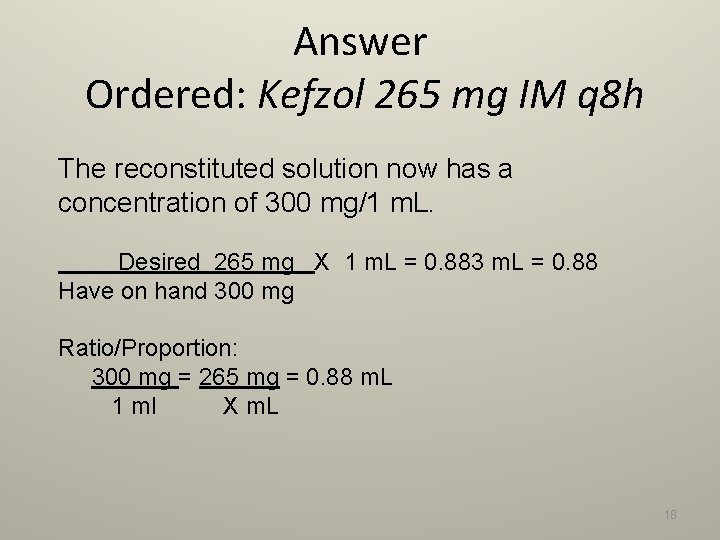
Problem • The physician ordered Kefzol 265 mg IM q 8 h. • The directions on the label state: “For IM use, add 2. 5 m. L of sterile water for injection and shake well. The resulting solution has an approximate volume of 3 m. L yielding a strength of 300 mg/m. L. ” • How many m. L will you administer to the patient? 17
Answer Ordered: Kefzol 265 mg IM q 8 h The reconstituted solution now has a concentration of 300 mg/1 m. L. Desired 265 mg X 1 m. L = 0. 883 m. L = 0. 88 Have on hand 300 mg Ratio/Proportion: 300 mg = 265 mg = 0. 88 m. L 1 ml X m. L 18
The prescriber ordered Cefotan (cefotetan disodium) 1500 mg IM q 12 h. How many milliliters of this antibiotic would you give the patient? 19
Problem • Prescriber order: penicillin G 250, 000 units IM daily • Directions on the label: Add 9. 6 m. L diluent = 100, 000 units/m. L • The correct dose based on the doctor's order and the directions on the label is ____ m. L. • What size syringe? What size needle? v 3 m. L syringe v 1 – 1 1/2 inch 20
Problem • Doctor's order: nafcillin 1 g IM • Directions on the label: Add 8 m. L diluent = 500 mg/m. L • The correct dose based on the doctor's order and the directions on the label is ____. • What size syringe? What size needle? v 3 m. L syringe v 1 – 1 1/2 inch needle 21
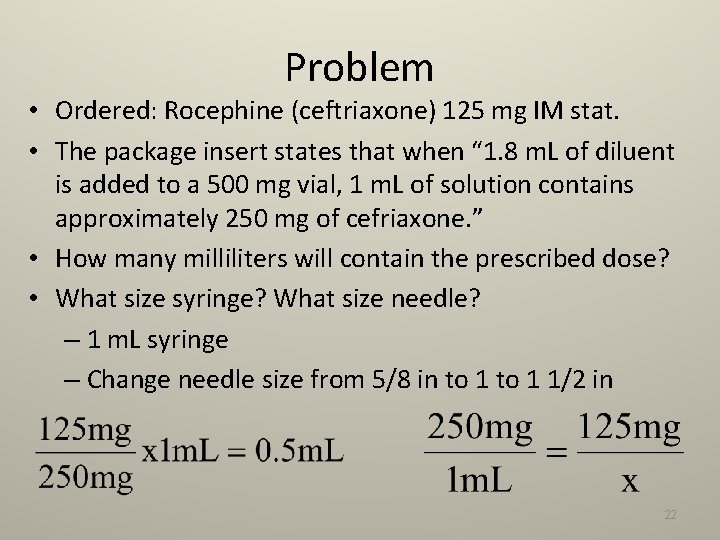
Problem • Ordered: Rocephine (ceftriaxone) 125 mg IM stat. • The package insert states that when “ 1. 8 m. L of diluent is added to a 500 mg vial, 1 m. L of solution contains approximately 250 mg of cefriaxone. ” • How many milliliters will contain the prescribed dose? • What size syringe? What size needle? – 1 m. L syringe – Change needle size from 5/8 in to 1 1/2 in 22
Math Tips • The diluent is used to dissolve the powdered medicine – becomes reconstituted. • Once you use the diluent, it is no longer part of the problem – It is never part of the equation to solve for amount of medication to give. • USE IT AND LOSE IT 23
Math Tip • When given the option of diluents in IM reconstitution, choose the amount <3 m. L. • Question may ask, what is the appropriate amount for an IM injection. • If a 1 m. L syringe is chosen, the needle must be changed from the 1/2 – 5/8 inch to 1/2 inch needle. 24
Solution Strength • When a fraction expresses the strength of a solution made from a liquid concentrate: – The numerator of the fraction is the number of parts of solute. – The denominator of the fraction is the total number of parts of total solution. – The difference between the denominator (final solution) and the numerator (parts of solute) is the number of parts of solvent. Numerator = number of parts of SOLUTE. Denominator = total number of parts of SOLUTION Solution – Solute = Solvent 25
Solution Strength (continued) • Example: strength nutritional formula – 1 part concentrate (solute) – 3 parts of total solution – 3 – 1 = 2 parts solvent (water) 26
Calculating Solutions • To prepare solutions: – apply ratio-proportion to find the amount of solute: – Quantity of desired solution – Amount of solute = Amount of solvent 27
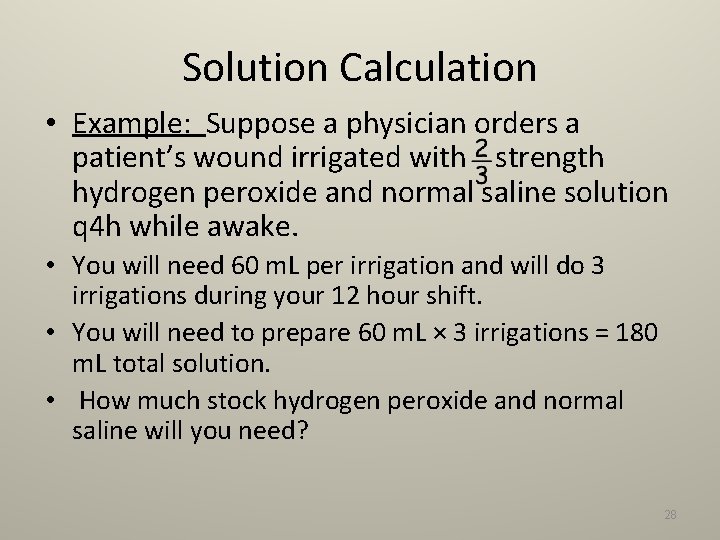
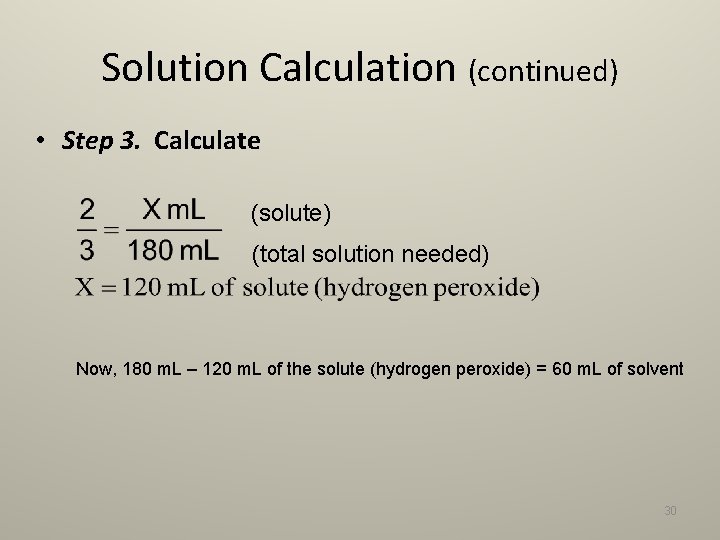
Solution Calculation • Example: Suppose a physician orders a patient’s wound irrigated with strength hydrogen peroxide and normal saline solution q 4 h while awake. • You will need 60 m. L per irrigation and will do 3 irrigations during your 12 hour shift. • You will need to prepare 60 m. L × 3 irrigations = 180 m. L total solution. • How much stock hydrogen peroxide and normal saline will you need? 28
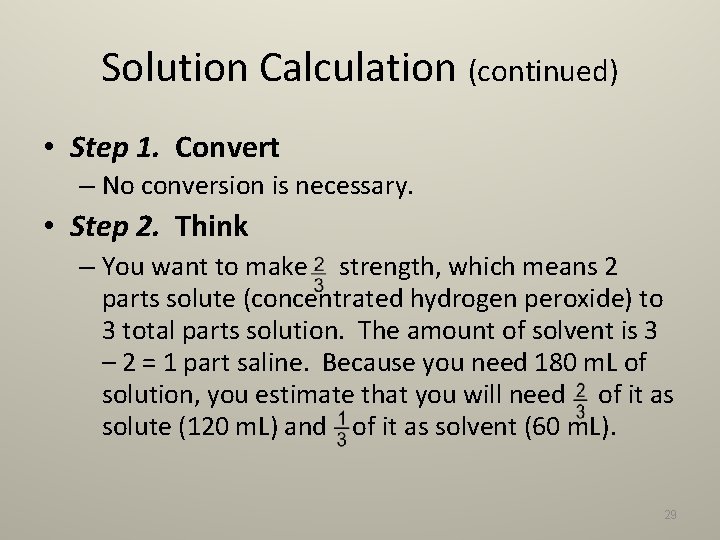
Solution Calculation (continued) • Step 1. Convert – No conversion is necessary. • Step 2. Think – You want to make strength, which means 2 parts solute (concentrated hydrogen peroxide) to 3 total parts solution. The amount of solvent is 3 – 2 = 1 part saline. Because you need 180 m. L of solution, you estimate that you will need of it as solute (120 m. L) and of it as solvent (60 m. L). 29
Solution Calculation (continued) • Step 3. Calculate (solute) (total solution needed) Now, 180 m. L – 120 m. L of the solute (hydrogen peroxide) = 60 m. L of solvent 30