
Recommendations of the Computer Science Strategic Implementation Plan

- Slides: 27
Recommendations of the Computer Science Strategic Implementation Plan Panel State Board of Education Meeting September 6, 2018 CALIFORNIA DEPARTMENT OF EDUCATION Tom Torlakson, State Superintendent of Public Instruction
Computer Science Strategic Implementation Plan • Education Code (EC) sections 53310 -53315 call for development of a computer science strategic implementation plan and the appointment and convening of an advisory panel to develop recommendations for that plan.
Two-Part Process 1. EC Section 53310(a) requires the State Superintendent of Public Instruction (SSPI) to convene a computer science strategic implementation advisory panel to develop recommendations for a computer science strategic implementation plan. - EC Section 53311(a) requires that the recommendations be submitted to the SSPI, the State Board of Education (SBE), and the Legislature on or before January 15, 2019. 2. EC Section 53313 requires the SSPI to develop, and the SBE to consider adopting, a computer science strategic implementation plan on or before July 15, 2019.
Computer Science Strategic Implementation Plan Panel (1) • • • Co-Chair appointed by the SSPI Co-Chair appointed by the President of the SBE Representative designated by the Senate Committee on Rules Representative designated by the Speaker of the Assembly Six K-12 current teacher representatives - two elementary - two middle school - two high school
Computer Science Strategic Implementation Plan Panel (2) Representatives from: • Commission on Teacher Credentialing (CTC) • Computer Science Teachers Association • Private sector technology industry • University of California • California State University • California Community Colleges • Private postsecondary educational institution
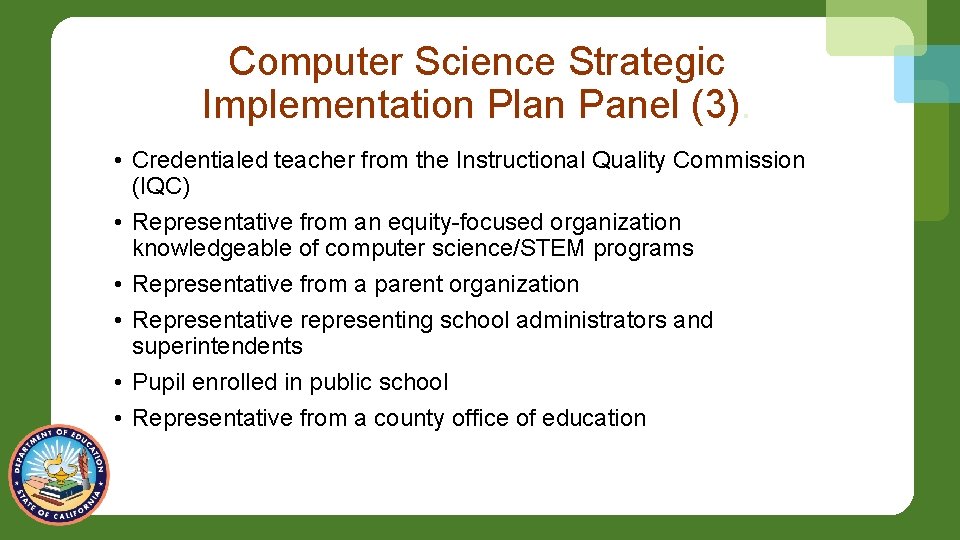
Computer Science Strategic Implementation Plan Panel (3). • Credentialed teacher from the Instructional Quality Commission (IQC) • Representative from an equity-focused organization knowledgeable of computer science/STEM programs • Representative from a parent organization • Representative representing school administrators and superintendents • Pupil enrolled in public school • Representative from a county office of education
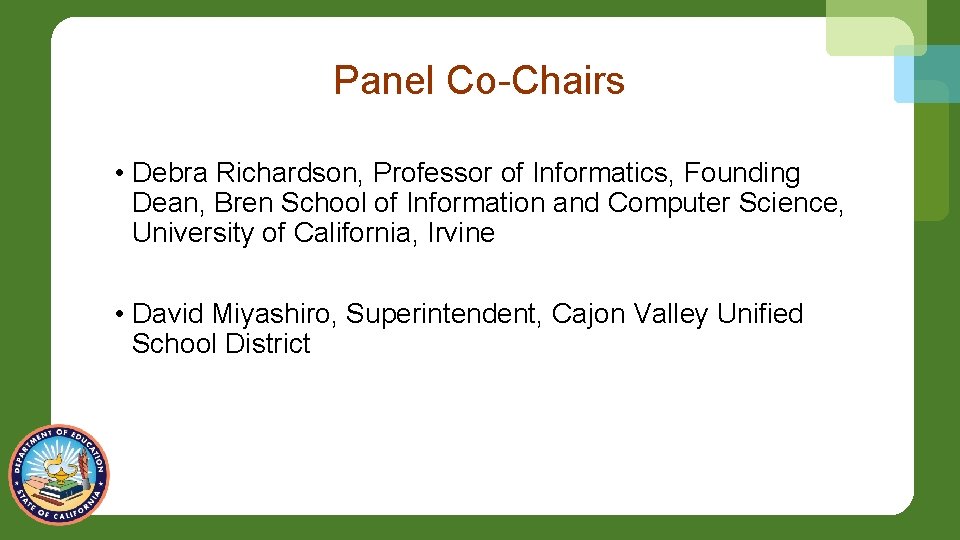
Panel Co-Chairs • Debra Richardson, Professor of Informatics, Founding Dean, Bren School of Information and Computer Science, University of California, Irvine • David Miyashiro, Superintendent, Cajon Valley Unified School District
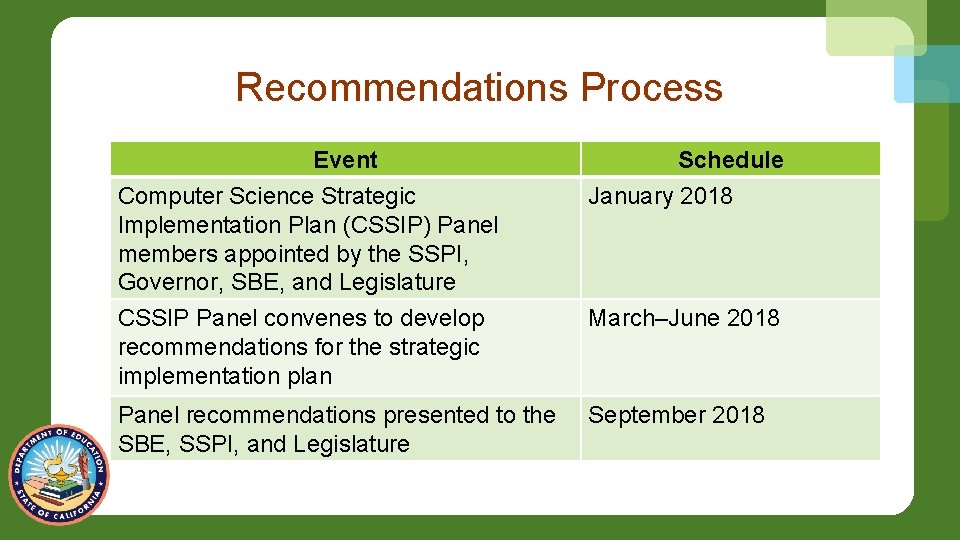
Recommendations Process Event Computer Science Strategic Implementation Plan (CSSIP) Panel members appointed by the SSPI, Governor, SBE, and Legislature CSSIP Panel convenes to develop recommendations for the strategic implementation plan Schedule January 2018 Panel recommendations presented to the SBE, SSPI, and Legislature September 2018 March–June 2018
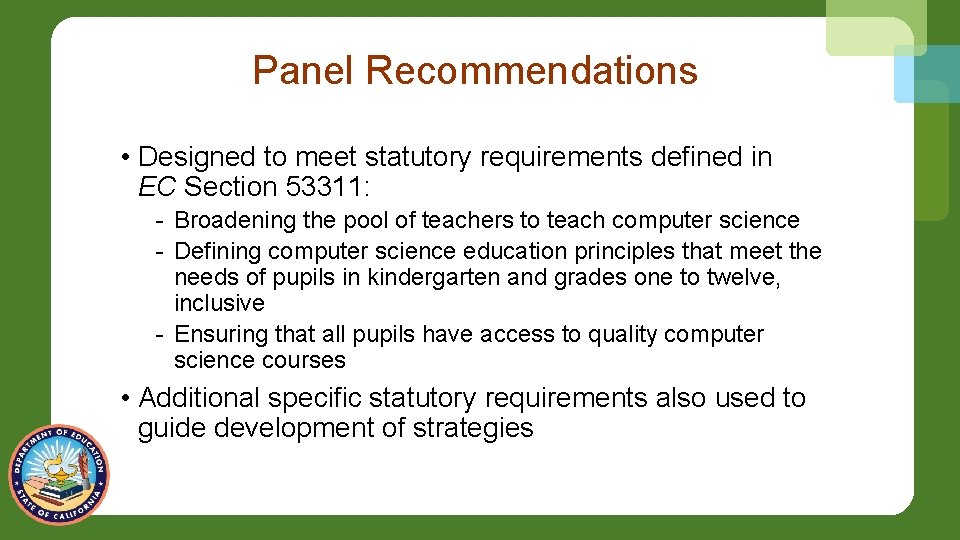
Panel Recommendations • Designed to meet statutory requirements defined in EC Section 53311: - Broadening the pool of teachers to teach computer science - Defining computer science education principles that meet the needs of pupils in kindergarten and grades one to twelve, inclusive - Ensuring that all pupils have access to quality computer science courses • Additional specific statutory requirements also used to guide development of strategies
Computer Science Education Vision California’s vision is to ensure that all students develop foundational knowledge and skills in computer science to prepare them for college, careers, and civic engagement.
Computer Science Education Mission • All schools offer rigorous and relevant computer science education equitably and sustainably throughout grades K– 12. • All teachers are adequately prepared to teach rigorous and relevant computer science aligned with California’s K– 12 computer science standards.
Computer Science Education Principles (1) • Every student and every teacher is capable of learning computer science. Access to, and achievement in, computer science should not be predicated on the basis of race, ethnicity, gender identity, socioeconomic status, language, religion, sexual orientation, cultural affiliation, learning differences, or special needs. • Every student in California should have equitable access to highquality computer science curriculum and instruction aligned to California’s K– 12 computer science standards. • Every student should have continuous opportunities and multiple entry points to engage in computer science education, including articulated pathways toward college, careers, and community engagement. 12
Computer Science Education Principles (2) • Computer science instruction should involve real-world, engaging, meaningful, and personally relevant activities for students that focus on problem-solving, critical thinking, and creativity while emphasizing the ethical impacts of computing. • Computer science should align with California’s K– 12 Computer Science Standards and be integrated, as appropriate, into other subject areas in grade bands K– 2, 3– 5, 6– 8, and 9– 12; computer science should be offered as standalone courses, from introductory to more advanced, in middle and high school. • All California schools should have the infrastructure to support computer science education (including hardware, software, and personnel). 13
Computer Science Education Principles (3) • Computer science content knowledge and relevant pedagogical practices should be included in all California teacher preparation programs, differentiated by multiple subject and single subject teaching credentials. The state budget should allocate funding for teachers to participate in ongoing, high-quality, and differentiated professional learning and support to assist them in implementing and integrating computer science education in their classrooms. • California should engage stakeholders including, but not limited to, members from K– 12 education, higher education, industry, local communities, parent organizations, and policy makers, to implement computer science statewide. 14
Three Sets of Recommendations • Ensuring Access and Equity for All Students in California Schools (Access and Equity) • Ensuring Appropriate Support for California Teachers and Administrators (Educator Support) • Scaling Up K– 12 Computer Science Education in California (Standards Implementation) 15
Organization of Recommendations Each recommendation includes: • Entity or entities responsible for implementation - State agencies Local educational agencies (LEAs) Legislature Institutions of higher education (IHEs) • Proposed strategy • Evidence of success • Suggested timeframe for implementation
Ensuring Access and Equity for All Students in California Schools (1) • Develop K– 8 pathways to prepare students for high school coursework in computer science (CS). • Provide professional development for educators on the CS standards. • Adopt a high school graduation requirement for CS. • Offer A-G approved course sequences and CS courses approved for areas other than “G”. 17
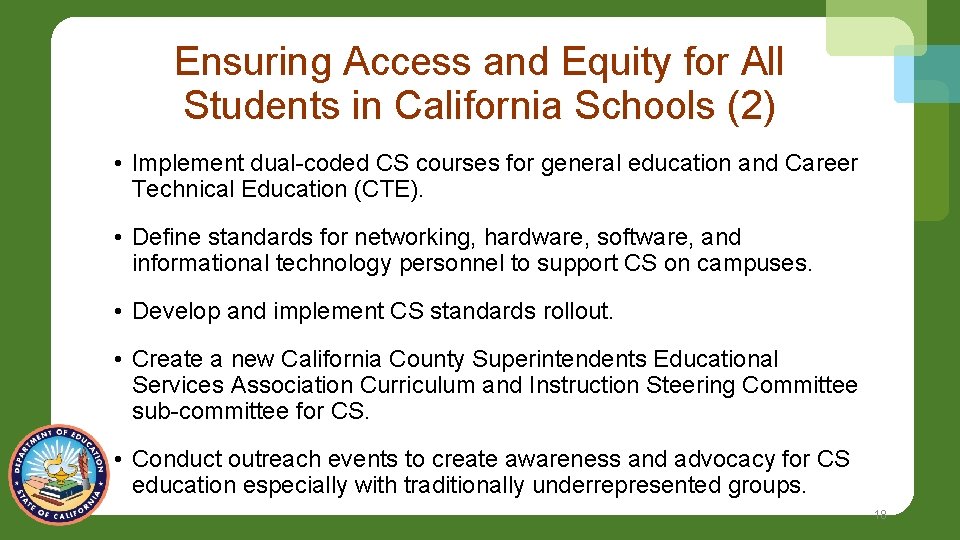
Ensuring Access and Equity for All Students in California Schools (2) • Implement dual-coded CS courses for general education and Career Technical Education (CTE). • Define standards for networking, hardware, software, and informational technology personnel to support CS on campuses. • Develop and implement CS standards rollout. • Create a new California County Superintendents Educational Services Association Curriculum and Instruction Steering Committee sub-committee for CS. • Conduct outreach events to create awareness and advocacy for CS education especially with traditionally underrepresented groups. 18
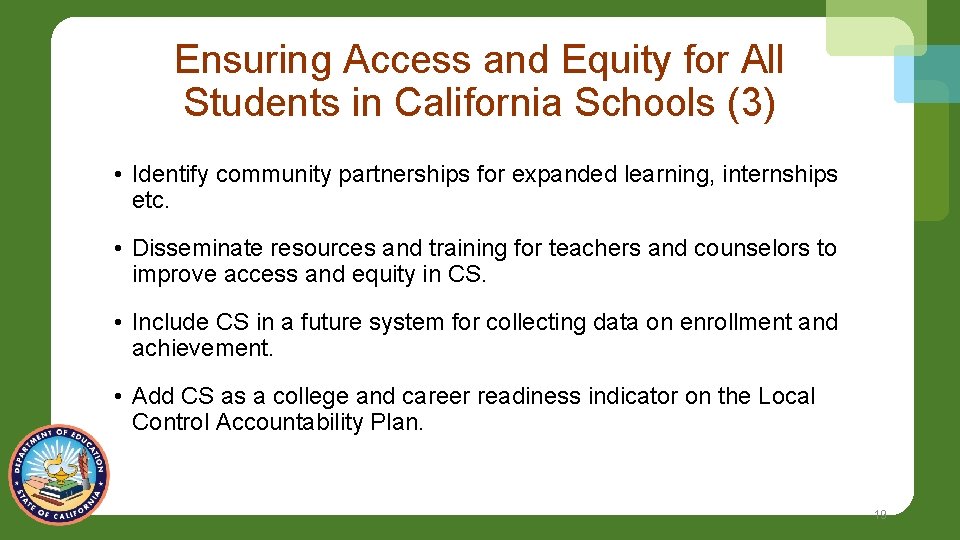
Ensuring Access and Equity for All Students in California Schools (3) • Identify community partnerships for expanded learning, internships etc. • Disseminate resources and training for teachers and counselors to improve access and equity in CS. • Include CS in a future system for collecting data on enrollment and achievement. • Add CS as a college and career readiness indicator on the Local Control Accountability Plan. 19
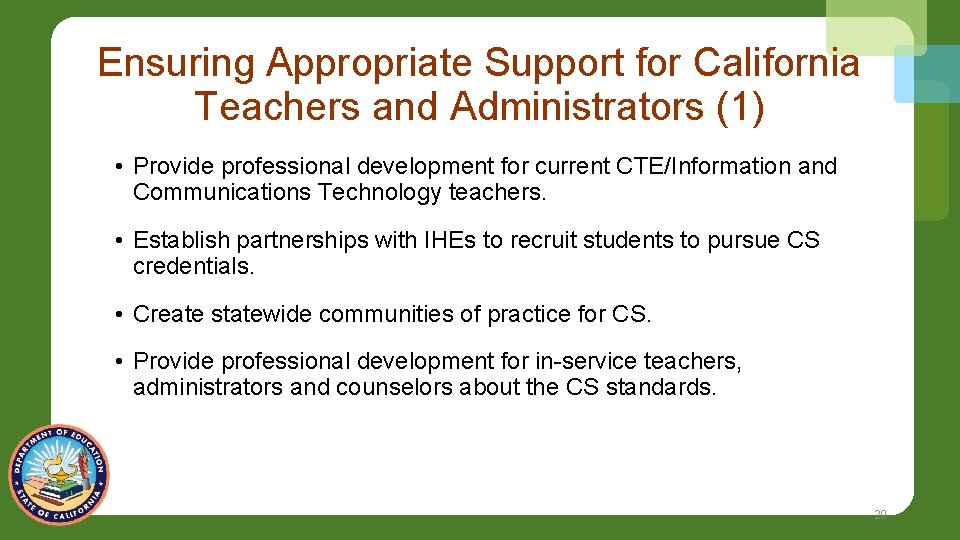
Ensuring Appropriate Support for California Teachers and Administrators (1) • Provide professional development for current CTE/Information and Communications Technology teachers. • Establish partnerships with IHEs to recruit students to pursue CS credentials. • Create statewide communities of practice for CS. • Provide professional development for in-service teachers, administrators and counselors about the CS standards. 20
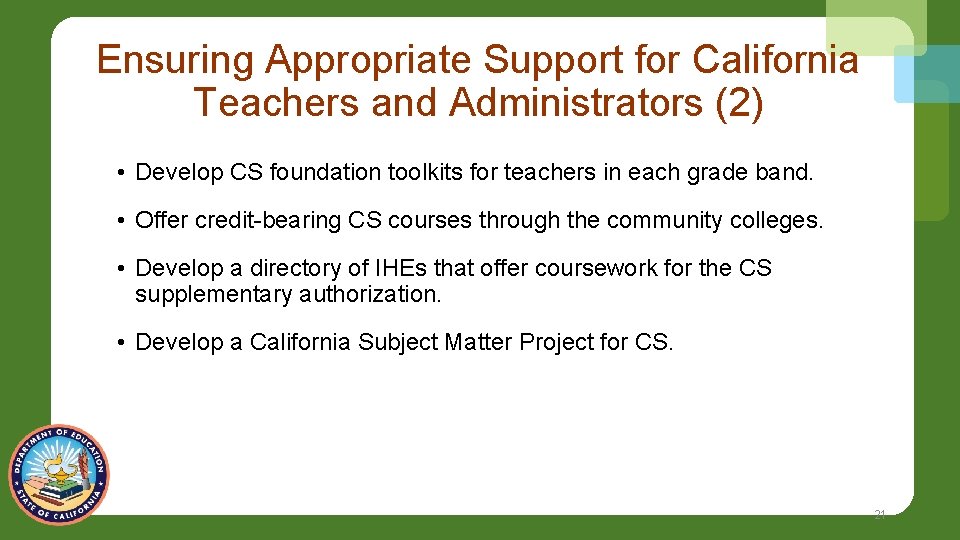
Ensuring Appropriate Support for California Teachers and Administrators (2) • Develop CS foundation toolkits for teachers in each grade band. • Offer credit-bearing CS courses through the community colleges. • Develop a directory of IHEs that offer coursework for the CS supplementary authorization. • Develop a California Subject Matter Project for CS. 21
Ensuring Appropriate Support for California Teachers and Administrators (3). • Fund a position at the California Department of Education (CDE) to support CS. • Extend the validity of the General Education Limited Authorization Program requirements for teachers working toward CS authorizations. • Fund the CTC to develop a CS single subject credential. • Recruit and train industry professionals to become CS teachers. • Establish grant and loan forgiveness programs for CS teachers.
Scaling Up K– 12 Computer Science Education in California (1) • Fund a multi-faceted campaign to communicate the new standards and implementation plan to stakeholders. • Provide sustained funding to LEAs for an initial implementation period of eight years. • Develop criteria for local evaluation of CS instructional materials. • Review the CS standards every seven years. • Encourage LEAs to create their own four-year implementation plans. 23
Scaling Up K– 12 Computer Science Education in California (2) • Identify and showcase LEAs with model implementation practices. • Dedicate funding for integrated computer science courses through the University of California Curriculum Integration (UCCI) program. 24
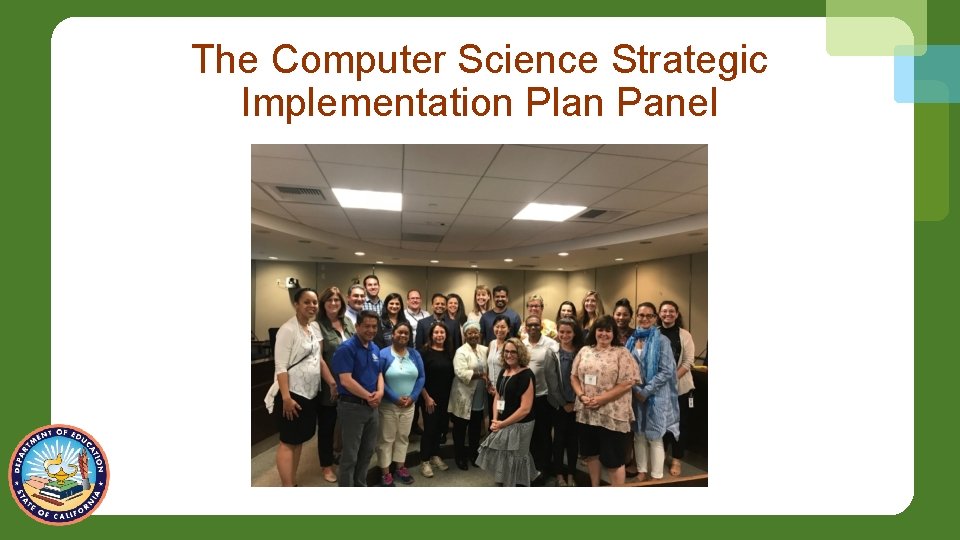
The Computer Science Strategic Implementation Plan Panel
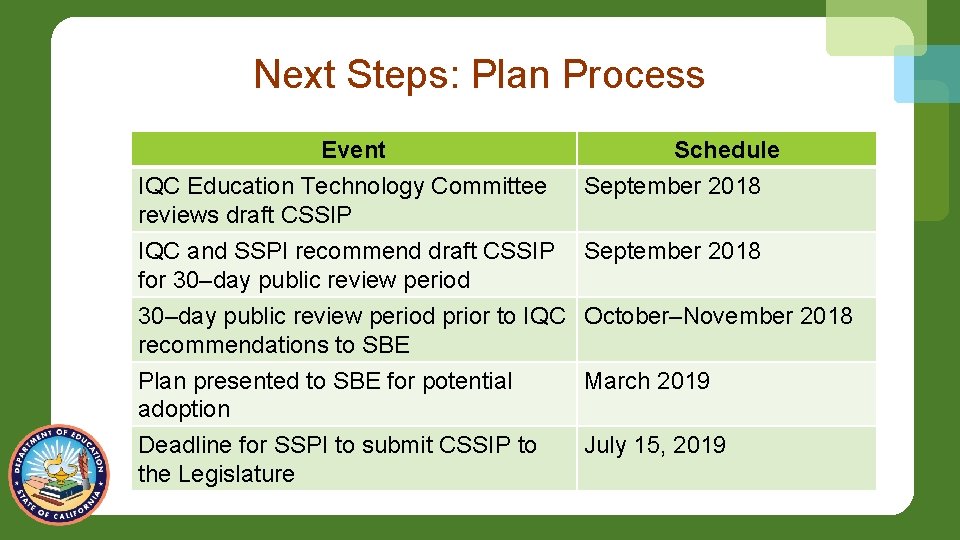
Next Steps: Plan Process Event IQC Education Technology Committee reviews draft CSSIP Schedule September 2018 IQC and SSPI recommend draft CSSIP September 2018 for 30–day public review period prior to IQC October–November 2018 recommendations to SBE Plan presented to SBE for potential adoption Deadline for SSPI to submit CSSIP to the Legislature March 2019 July 15, 2019
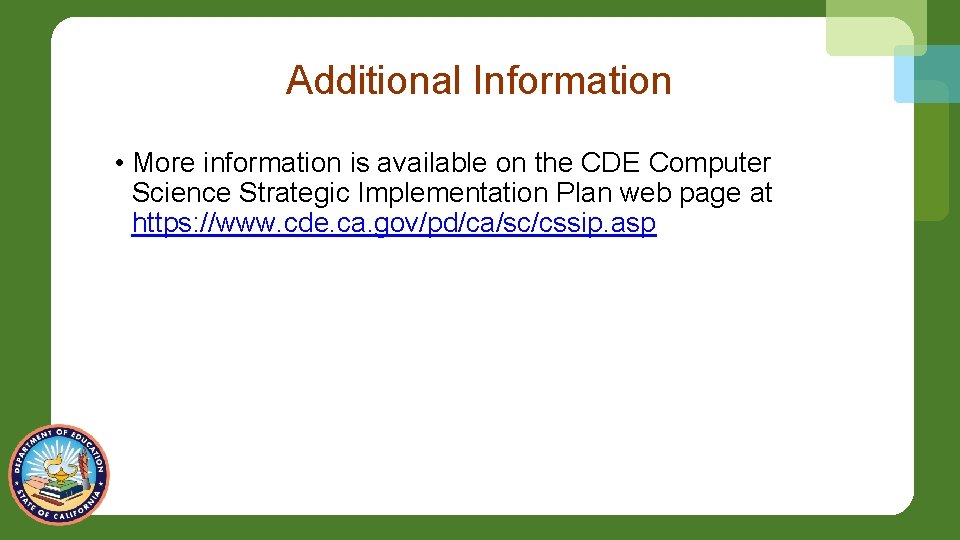
Additional Information • More information is available on the CDE Computer Science Strategic Implementation Plan web page at https: //www. cde. ca. gov/pd/ca/sc/cssip. asp