
Recommendations for using behavioural indicators to assess animal
Recommendations for using behavioural indicators to assess animal welfare impact of dog population management (DPM) interventions Lou Tasker 1 & Elly Hiby 2 1 Independent 2 Research Consultant International Companion Animal Management Coalition (ICAM) 1
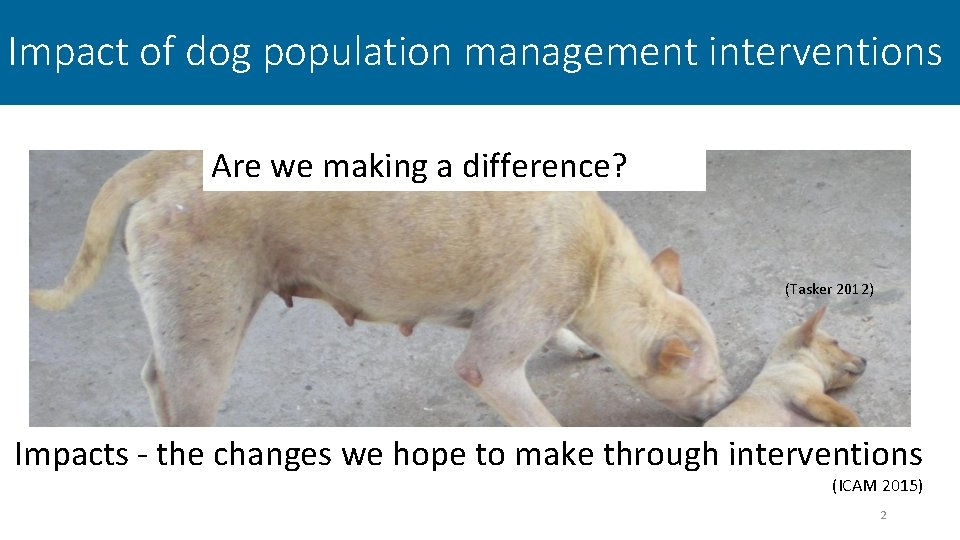
Impact of dog population management interventions Are we making a difference? (Tasker 2012) Impacts - the changes we hope to make through interventions (ICAM 2015) 2
8 Common impacts 1. 2. 3. 4. 5. 6. 7. 8. Improve dog welfare Improve care provided to dogs Reduce dog density/stabilise turnover Reduce risks to public health Improve public perception Improve rehoming centre performance Reduce negative impacts of dogs on wildlife Reduce negative impacts of dogs on livestock (ICAM 2015) 3
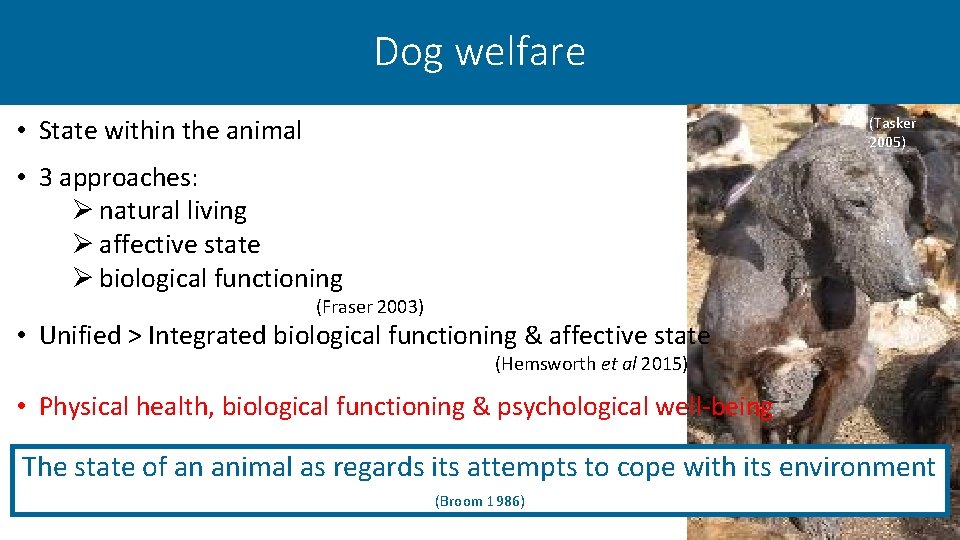
Dog welfare • State within the animal (Tasker 2005) • 3 approaches: Ø natural living Ø affective state Ø biological functioning (Fraser 2003) • Unified > Integrated biological functioning & affective state (Hemsworth et al 2015) • Physical health, biological functioning & psychological well-being The state of an animal as regards its attempts to cope with its environment (Broom 1986) 4
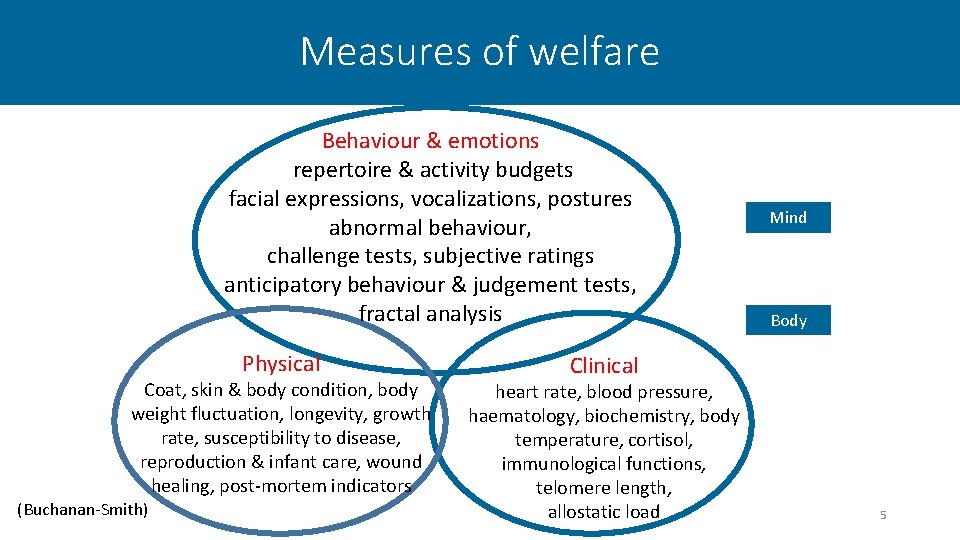
Measures of welfare Behaviour & emotions repertoire & activity budgets facial expressions, vocalizations, postures abnormal behaviour, challenge tests, subjective ratings anticipatory behaviour & judgement tests, fractal analysis Physical Coat, skin & body condition, body weight fluctuation, longevity, growth rate, susceptibility to disease, reproduction & infant care, wound healing, post-mortem indicators (Buchanan-Smith) Mind Body Clinical heart rate, blood pressure, haematology, biochemistry, body temperature, cortisol, immunological functions, telomere length, allostatic load 5
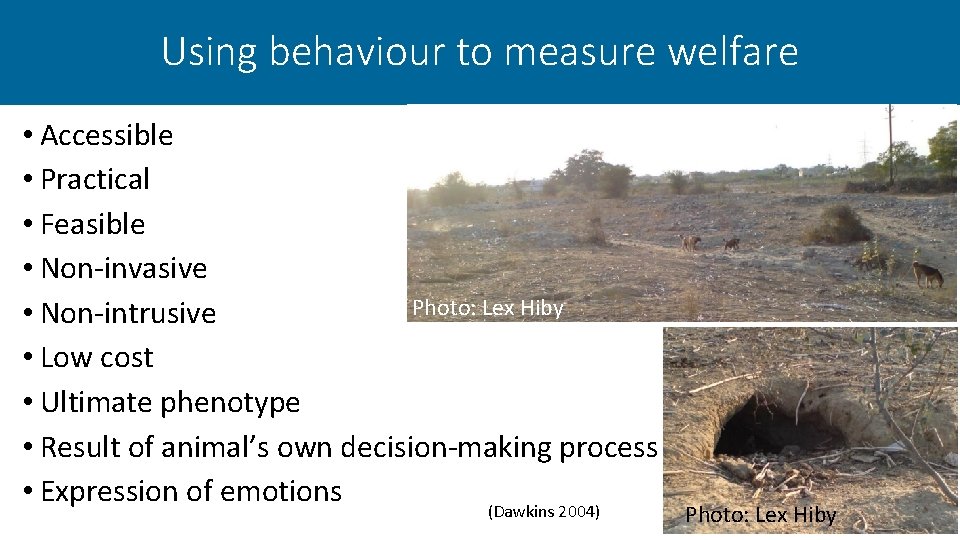
Using behaviour to measure welfare • Accessible • Practical • Feasible • Non-invasive Photo: Lex Hiby • Non-intrusive • Low cost • Ultimate phenotype • Result of animal’s own decision-making process • Expression of emotions (Dawkins 2004) Photo: Lex Hiby 6
Measuring behaviour The ultimate guide! • Quantifiable – monitor changes over time • Valid – reflect welfare, sensitive to detect changes in welfare state • Reliable – between observers & over time • Feasible – for measurement in the field Martin P & Bateson P 2007 Measuring Behaviour An Introductory Guide Cambridge University Press: Cambridge, UK 7
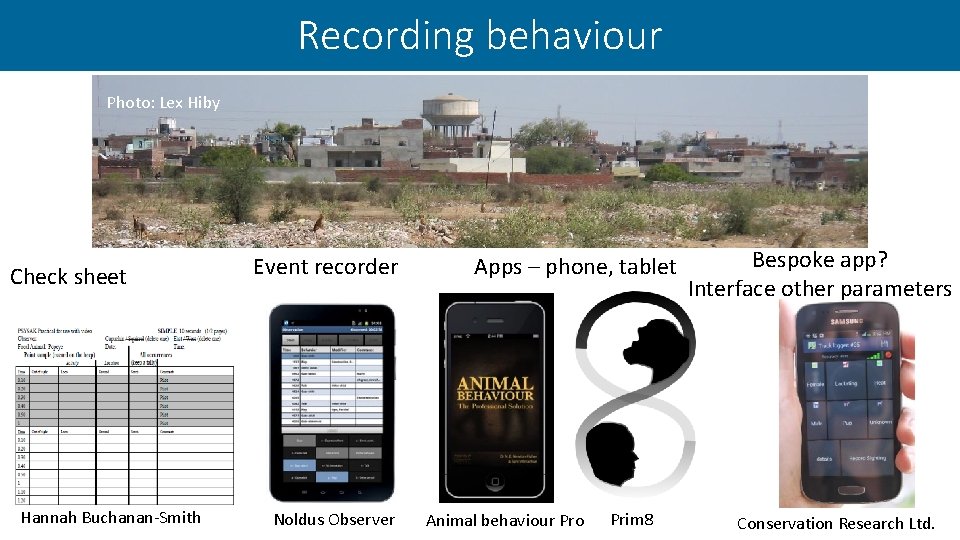
Recording behaviour Photo: Lex Hiby Check sheet Hannah Buchanan-Smith Event recorder Noldus Observer Apps – phone, tablet Animal behaviour Pro Prim 8 Bespoke app? Interface other parameters 8 Conservation Research Ltd.
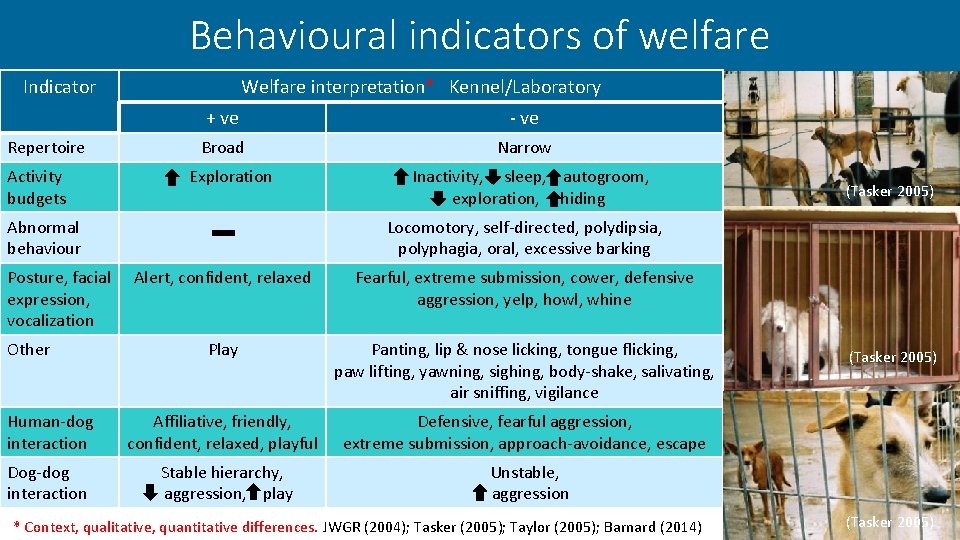
Behavioural indicators of welfare Indicator Repertoire Activity budgets Welfare interpretation* Kennel/Laboratory + ve - ve Broad Narrow Exploration Abnormal behaviour Posture, facial expression, vocalization Inactivity, sleep, autogroom, exploration, hiding Locomotory, self-directed, polydipsia, polyphagia, oral, excessive barking Alert, confident, relaxed Fearful, extreme submission, cower, defensive aggression, yelp, howl, whine Play Panting, lip & nose licking, tongue flicking, paw lifting, yawning, sighing, body-shake, salivating, air sniffing, vigilance Human-dog interaction Affiliative, friendly, confident, relaxed, playful Defensive, fearful aggression, extreme submission, approach-avoidance, escape Dog-dog interaction Stable hierarchy, aggression, play Unstable, aggression Other (Tasker 2005) * Context, qualitative, quantitative differences. JWGR (2004); Tasker (2005); Taylor (2005); Barnard (2014) (Tasker 2005) 9 (Tasker 2005)
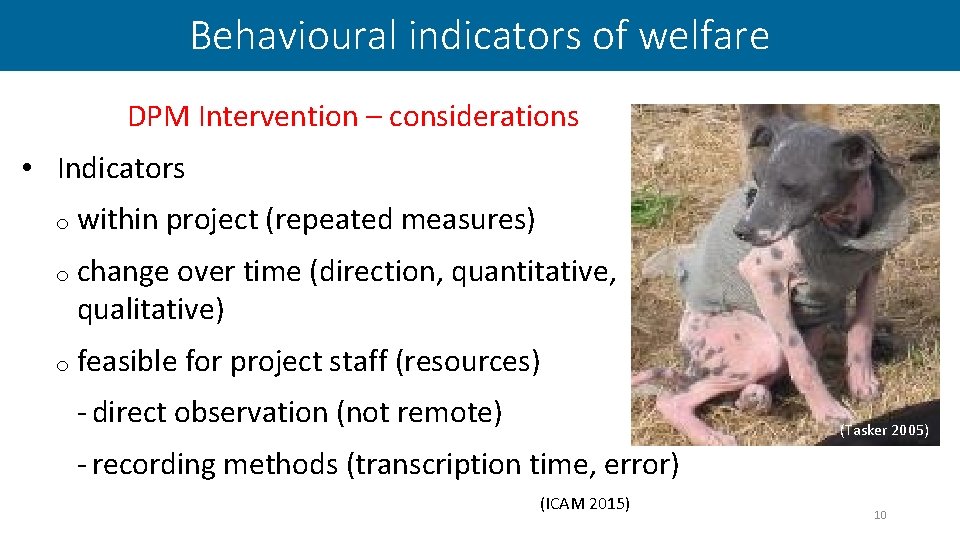
Behavioural indicators of welfare DPM Intervention – considerations • Indicators o within project (repeated measures) o change over time (direction, quantitative, qualitative) o feasible for project staff (resources) - direct observation (not remote) (Tasker 2005) - recording methods (transcription time, error) (ICAM 2015) 10
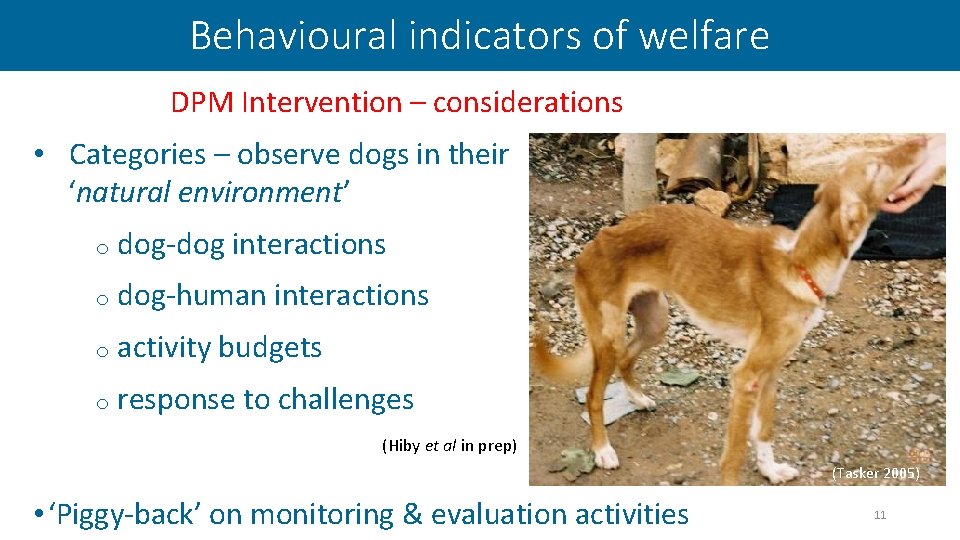
Behavioural indicators of welfare DPM Intervention – considerations • Categories – observe dogs in their ‘natural environment’ o dog-dog interactions o dog-human interactions o activity budgets o response to challenges (Hiby et al in prep) (Tasker 2005) • ‘Piggy-back’ on monitoring & evaluation activities 11
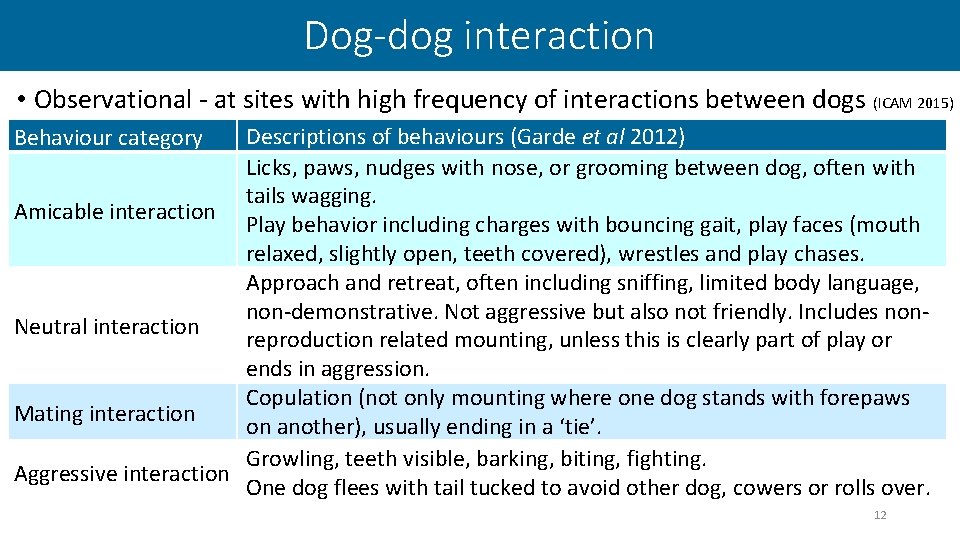
Dog-dog interaction • Observational - at sites with high frequency of interactions between dogs (ICAM 2015) Descriptions of behaviours (Garde et al 2012) Licks, paws, nudges with nose, or grooming between dog, often with tails wagging. Amicable interaction Play behavior including charges with bouncing gait, play faces (mouth relaxed, slightly open, teeth covered), wrestles and play chases. Approach and retreat, often including sniffing, limited body language, non-demonstrative. Not aggressive but also not friendly. Includes non. Neutral interaction reproduction related mounting, unless this is clearly part of play or ends in aggression. Copulation (not only mounting where one dog stands with forepaws Mating interaction on another), usually ending in a ‘tie’. Growling, teeth visible, barking, biting, fighting. Aggressive interaction One dog flees with tail tucked to avoid other dog, cowers or rolls over. Behaviour category 12
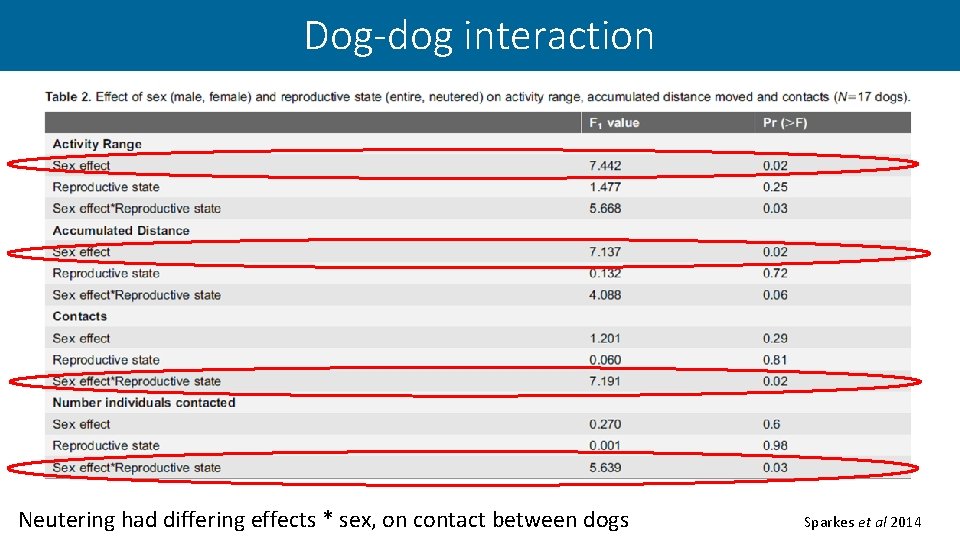
Dog-dog interaction Neutering had differing effects * sex, on contact between dogs 13 Sparkes et al 2014
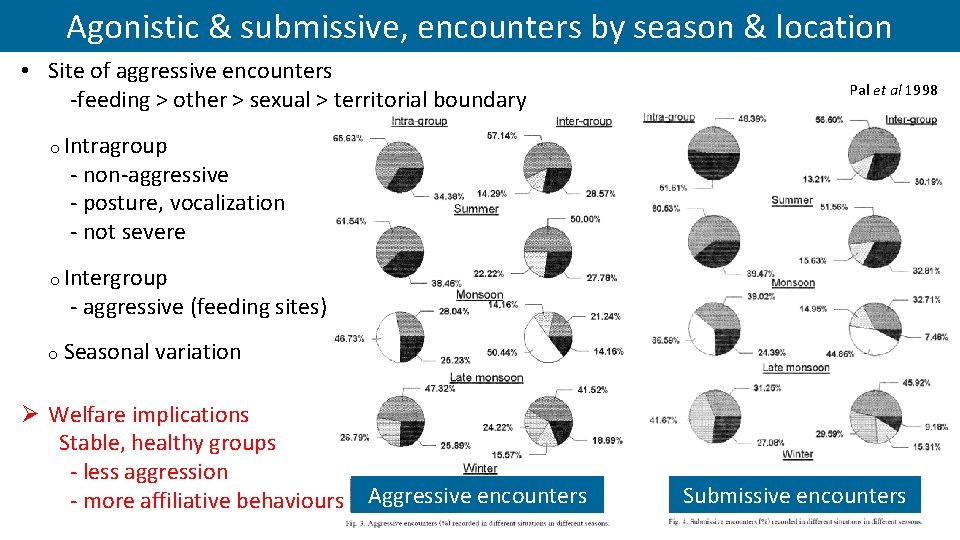
Agonistic & submissive, encounters by season & location • Site of aggressive encounters -feeding > other > sexual > territorial boundary Pal et al 1998 o Intragroup - non-aggressive - posture, vocalization - not severe o Intergroup - aggressive (feeding sites) o Seasonal variation Ø Welfare implications Stable, healthy groups - less aggression - more affiliative behaviours Aggressive encounters Submissive encounters 14
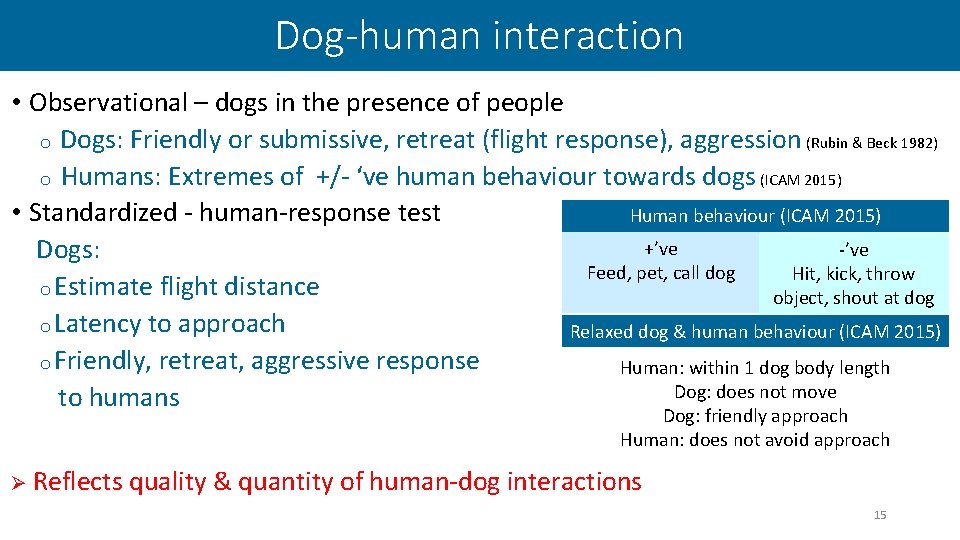
Dog-human interaction • Observational – dogs in the presence of people o Dogs: Friendly or submissive, retreat (flight response), aggression (Rubin & Beck 1982) o Humans: Extremes of +/- ‘ve human behaviour towards dogs (ICAM 2015) • Standardized - human-response test Human behaviour (ICAM 2015) +’ve -’ve Dogs: Feed, pet, call dog Hit, kick, throw o Estimate flight distance object, shout at dog o Latency to approach Relaxed dog & human behaviour (ICAM 2015) o Friendly, retreat, aggressive response Human: within 1 dog body length Dog: does not move to humans Dog: friendly approach Human: does not avoid approach Ø Reflects quality & quantity of human-dog interactions 15
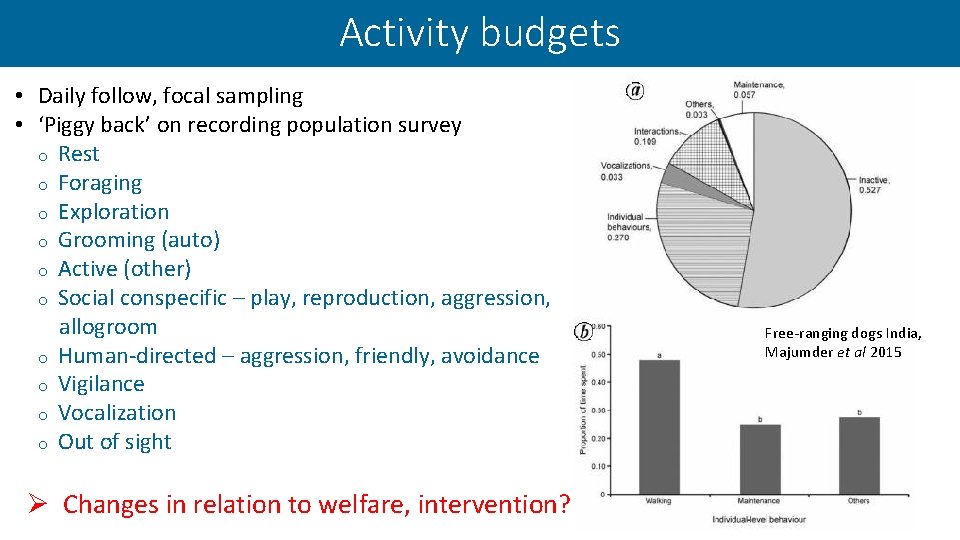
Activity budgets • Daily follow, focal sampling • ‘Piggy back’ on recording population survey o Rest o Foraging o Exploration o Grooming (auto) o Active (other) o Social conspecific – play, reproduction, aggression, allogroom o Human-directed – aggression, friendly, avoidance o Vigilance o Vocalization o Out of sight Ø Changes in relation to welfare, intervention? Free-ranging dogs India, Majumder et al 2015 16
Response to challenge Capture, handling, restraint - vaccination, mobile clinic (intervention) • Behavioural response (capture, handling, restraint, return) - Capture, handling o Latency to approach o Approach-avoidance, fearful, confident, aggressive o Subjective score ‘handleability’ (numerical rating scale) - Restraint examination/vaccination o Posture, facial expression, vocalization, etc. o Accept/refuse food reward - Upon return o Accept/refuse food reward o Approach-avoidance, escape ØReflects quality & quantity of human-dog interactions ØCoping style in response to stressor 17
Good welfare Good animal welfare ‘one (animal) which is alert and busy (shows a wide repertoire of behaviour), is able to rest in a relaxed manner, is confident (outward going and does not display fear towards trivial nonthreatening stimuli) and does not show abnormal behaviour’ Poole 1997, p 116. • Absence of sickness & injury 18
Recommendations • Assess animal welfare impact of DPM interventions • Behaviour o valid welfare indicator o multidimensional assessment (Tasker 2005) • Advantages Ø accessible, practical, feasible, valid (kennel) • Disadvantages Ø validity not established for DPM monitoring • Collaboration (academia + practitioners) Ø pilot testing, validation, method development Ø establish behavioural indicators 19
Acknowledgements • • • Financial support - IFAW Conference organisers & reviewers Collaborators – ICAM Coalition Prof Hannah M Buchanan-Smith, University of Stirling Images - Lex Hiby, Conservation Research Ltd. Tasker (2005) 20
- Slides: 20