
Recommendation Systems Recommender System What is Recommender System





- Slides: 24
Recommendation Systems
Recommender System ● What is Recommender System? ○ Information filtering system that predicts the user preference. ● Pros. and Cons. ○ ○ Online retailer, where the number of choices is overwhelming, that is why online retailer uses a filter, prioritize, and efficiently deliver relevant information in order to alleviate the problem of information overload, which has created a potential problem to many online users, Recommender system solves this issue by querying through a large volume of dynamically generated information to provide users with personalized content and services.
Real Time Application of Recommender System ● Recommender system has become increasingly popular in recent years, which utilizes in a variety of areas including movies, music, news, books, articles, search queries, social tags, and products in general. ● Examples of Application that uses recommender system. ○ ○ ○ You. Tube (Videos) Apple Music Product Recommendation (Amazon) Movie Recommendation (Netflix) News Articles
Question? Why do companies consider using a recommendation system?
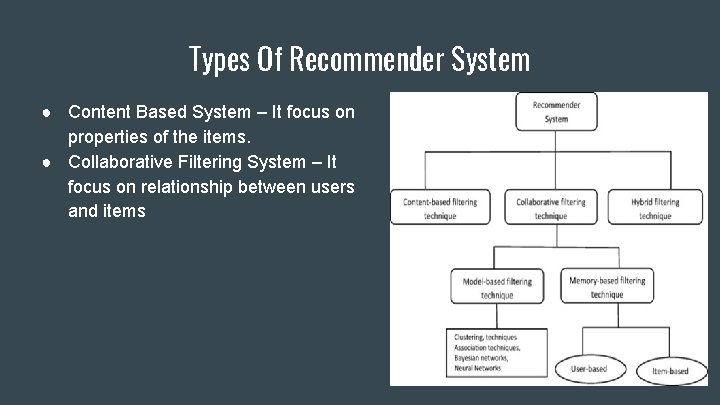
Types Of Recommender System ● Content Based System – It focus on properties of the items. ● Collaborative Filtering System – It focus on relationship between users and items
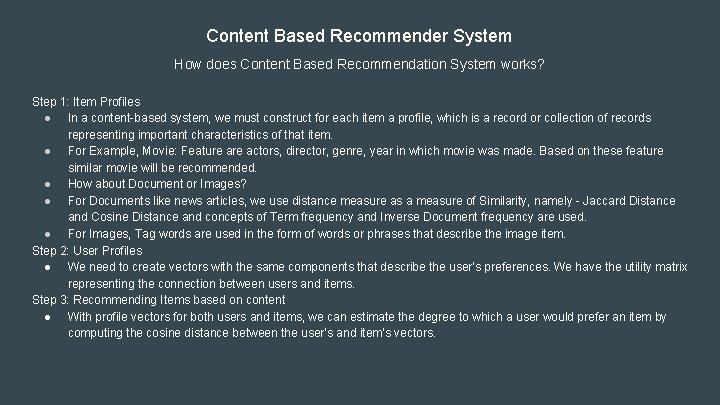
Content Based Recommender System How does Content Based Recommendation System works? Step 1: Item Profiles ● In a content-based system, we must construct for each item a profile, which is a record or collection of records representing important characteristics of that item. ● For Example, Movie: Feature actors, director, genre, year in which movie was made. Based on these feature similar movie will be recommended. ● How about Document or Images? ● For Documents like news articles, we use distance measure as a measure of Similarity, namely - Jaccard Distance and Cosine Distance and concepts of Term frequency and Inverse Document frequency are used. ● For Images, Tag words are used in the form of words or phrases that describe the image item. Step 2: User Profiles ● We need to create vectors with the same components that describe the user’s preferences. We have the utility matrix representing the connection between users and items. Step 3: Recommending Items based on content ● With profile vectors for both users and items, we can estimate the degree to which a user would prefer an item by computing the cosine distance between the user’s and item’s vectors.
Question? What are the concept used in Information Retrieval Systems?
Pro’s and Con’s of Content-based Filtering Pros : User Independence Transparency, Con’s : Limited content analysis: Over-specialization New user
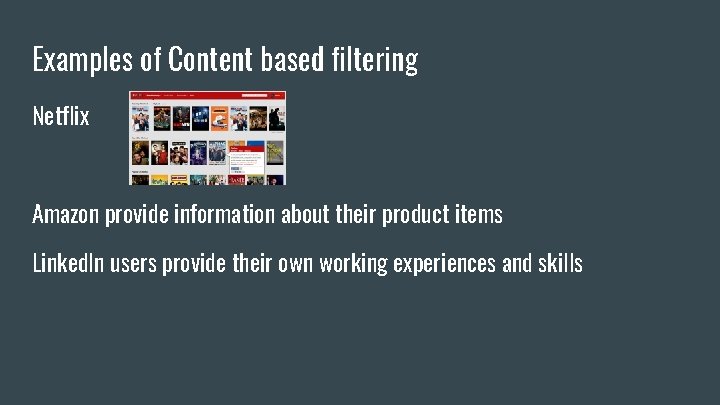
Examples of Content based filtering Netflix Amazon provide information about their product items Linked. In users provide their own working experiences and skills
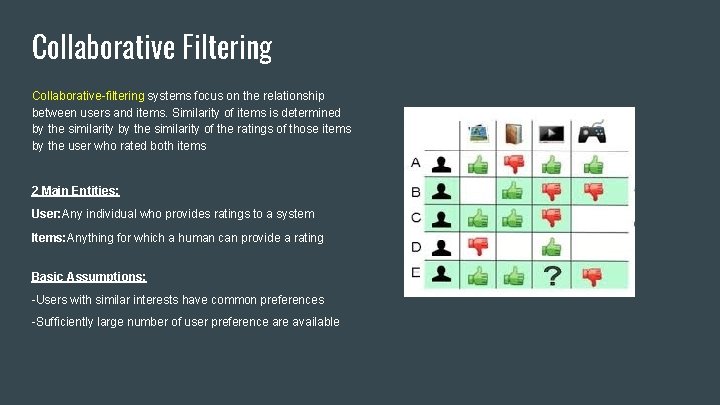
Collaborative Filtering Collaborative-filtering systems focus on the relationship between users and items. Similarity of items is determined by the similarity of the ratings of those items by the user who rated both items 2 Main Entities: User: Any individual who provides ratings to a system Items: Anything for which a human can provide a rating Basic Assumptions: -Users with similar interests have common preferences -Sufficiently large number of user preference are available
Collaborative Filtering - Types Collaborative filtering can be classified based on methodology and approach Types based on methodology 1. User-based collaborative filtering Look for users who share the same rating patterns with the active user (the user whom the prediction is for). Use the ratings from those like-minded users found in step 1 to calculate a prediction for the active user 1. Item-based collaborative filtering Build an item-item matrix determining relationships between pairs of items Infer the tastes of the current user by examining the matrix and matching that user's data
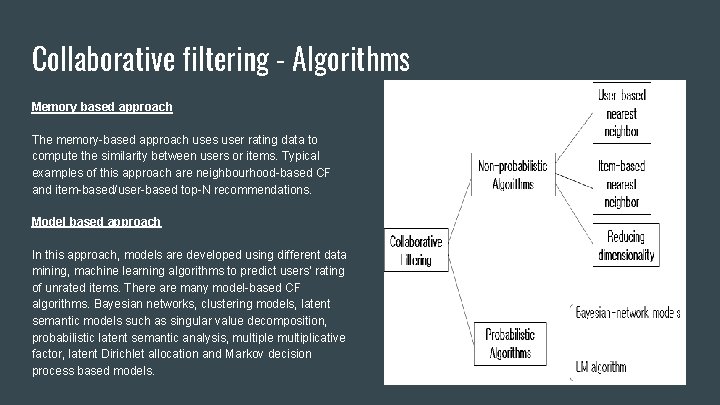
Collaborative filtering - Algorithms Memory based approach The memory-based approach uses user rating data to compute the similarity between users or items. Typical examples of this approach are neighbourhood-based CF and item-based/user-based top-N recommendations. Model based approach In this approach, models are developed using different data mining, machine learning algorithms to predict users' rating of unrated items. There are many model-based CF algorithms. Bayesian networks, clustering models, latent semantic models such as singular value decomposition, probabilistic latent semantic analysis, multiple multiplicative factor, latent Dirichlet allocation and Markov decision process based models.
Question Types of approaches for Collaborative filtering ? Different types of similarity measures ?
Pros and Cons of Collaborative Filtering Pros: Works for any kind of item because there is no feature selection needed. Cons: Cold Start Sparsity First rater Popularity bias
Examples Facebook Spotify
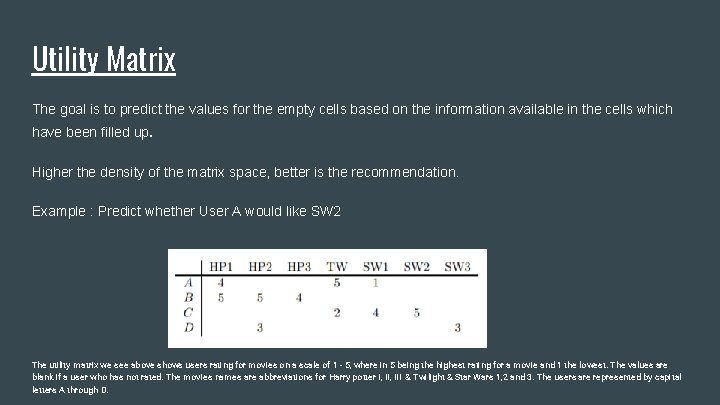
Utility Matrix The goal is to predict the values for the empty cells based on the information available in the cells which have been filled up. Higher the density of the matrix space, better is the recommendation. Example : Predict whether User A would like SW 2 The utility matrix we see above shows users rating for movies on a scale of 1 - 5, where in 5 being the highest rating for a movie and 1 the lowest. The values are blank if a user who has not rated. The movies names are abbreviations for Harry potter I, III & Twilight & Star Wars 1, 2 and 3. The users are represented by capital letters A through D.
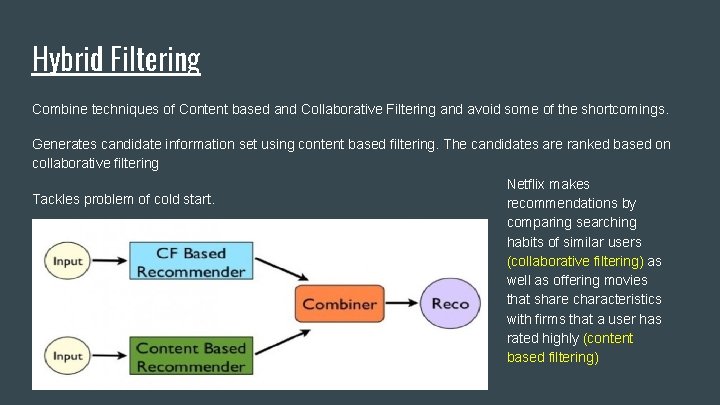
Hybrid Filtering Combine techniques of Content based and Collaborative Filtering and avoid some of the shortcomings. Generates candidate information set using content based filtering. The candidates are ranked based on collaborative filtering Netflix makes Tackles problem of cold start. recommendations by comparing searching habits of similar users (collaborative filtering) as well as offering movies that share characteristics with firms that a user has rated highly (content based filtering)
Question What is the goal of an Utility Matrix? Name one problem Hybrid filtering aims to overcome.
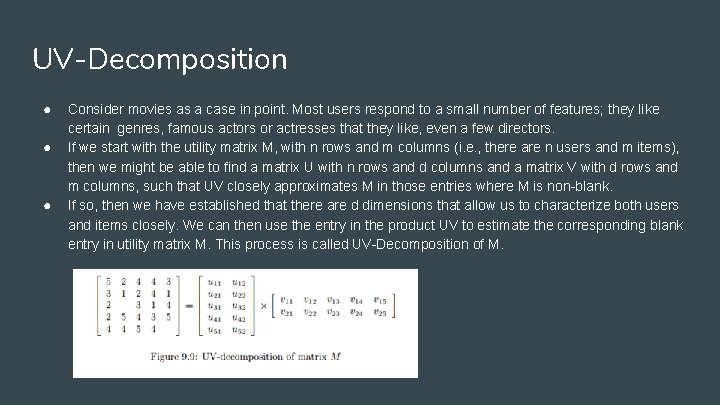
UV-Decomposition ● ● ● Consider movies as a case in point. Most users respond to a small number of features; they like certain genres, famous actors or actresses that they like, even a few directors. If we start with the utility matrix M, with n rows and m columns (i. e. , there are n users and m items), then we might be able to find a matrix U with n rows and d columns and a matrix V with d rows and m columns, such that UV closely approximates M in those entries where M is non-blank. If so, then we have established that there are d dimensions that allow us to characterize both users and items closely. We can then use the entry in the product UV to estimate the corresponding blank entry in utility matrix M. This process is called UV-Decomposition of M.
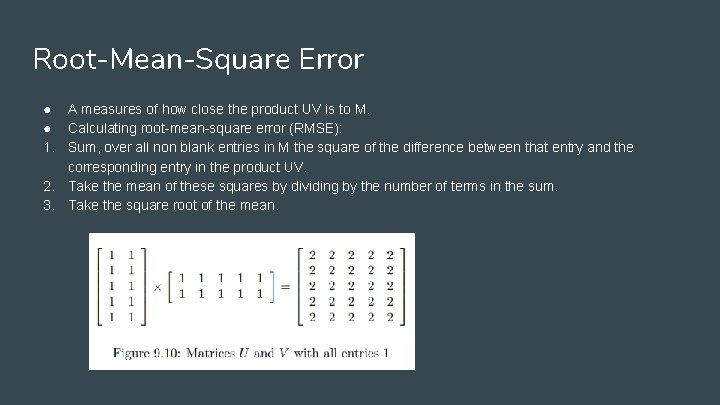
Root-Mean-Square Error ● A measures of how close the product UV is to M. ● Calculating root-mean-square error (RMSE): 1. Sum, over all non blank entries in M the square of the difference between that entry and the corresponding entry in the product UV. 2. Take the mean of these squares by dividing by the number of terms in the sum. 3. Take the square root of the mean.
Incremental Computation of a UV-Decomposition ● ● ● Finding the UV-decomposition with the least RMSE involves starting with some arbitrarily chosen U and V , and repeatedly adjusting U and V to make the RMSE smaller. We shall consider only adjustments to a single element of U or V , although in principle, one could make more complex adjustments. Whatever adjustments we allow, in a typical example there will be many local minima – matrices U and V such that no allowable adjustment reduces the RMSE. Unfortunately, only one of these local minima will be the global minimum – the matrices U and V that produce the least possible RMSE. To increase our chances of finding the global minimum, we need to pick many different starting points, that is, different choices of the initial matrices U and V
Question What are the applications of UV-Decomposition?
Implementation of Decision Tree System using ID 3 Google Drive Link for the video: https: //drive. google. com/file/d/1 Qjs. X 85 Yu. HEv. YTev. FKJsv. Yt. IBOUGEkx. IV/view? usp=sh aring
Any Questions?