
Recommendation Engines Summary of this lesson We all

- Slides: 53
Recommendation Engines
Summary of this lesson “We all make choices, but in the end our choices make us” -Ken Levine Are there events that always happen together? *This lesson refers to chapter 7 of the GIDS book Guide to Intelligent Data Science Second Edition, 2020 2
Content of this lesson - Association Rules - Itemset Mining - Generating Association Rules - Collaborative Filtering Guide to Intelligent Data Science Second Edition, 2020 3
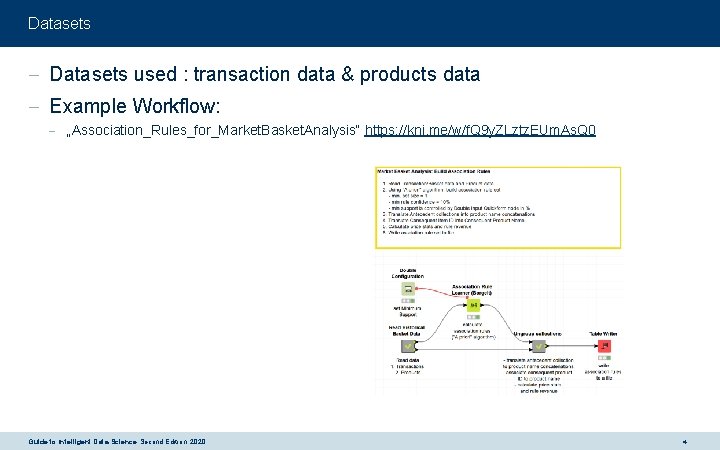
Datasets - Datasets used : transaction data & products data - Example Workflow: - „Association_Rules_for_Market. Basket. Analysis“ https: //kni. me/w/f. Q 9 y. ZLztz. EUm. As. Q 0 Guide to Intelligent Data Science Second Edition, 2020 4
Association Rules Guide to Intelligent Data Science Second Edition, 2020 5
Overview - Association Rules: Motivation - Item Set Mining - Breadth First Searching: The Apriori Algorithm - Depth First Searches: The Eclat Algorithm - (Compact) Representation of Itemsets - Finding Association Rules Guide to Intelligent Data Science Second Edition, 2020 6
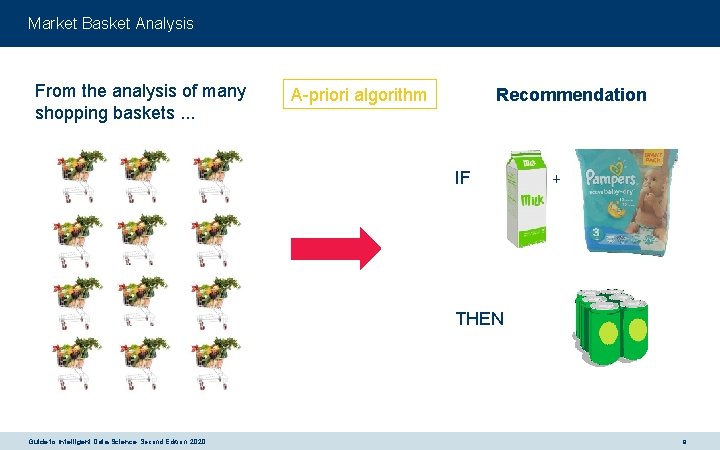
Association Rule Mining Association rule induction - Originally designed for market basket analysis. - Aims at finding patterns in the shopping behavior of customers of supermarkets, mail-order companies, on-line shops etc. More specifically: - Find sets of products that are frequently bought together. - Example of an association rule: - IF a customer buys bread and wine, - THEN she/he will probably also buy cheese. Guide to Intelligent Data Science Second Edition, 2020 7
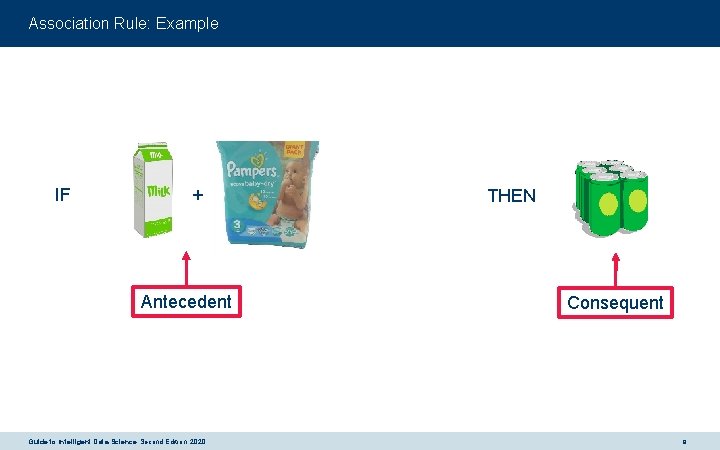
Association Rule: Example IF + Antecedent Guide to Intelligent Data Science Second Edition, 2020 THEN Consequent 8
Market Basket Analysis From the analysis of many shopping baskets. . . A-priori algorithm Recommendation IF + THEN Guide to Intelligent Data Science Second Edition, 2020 9
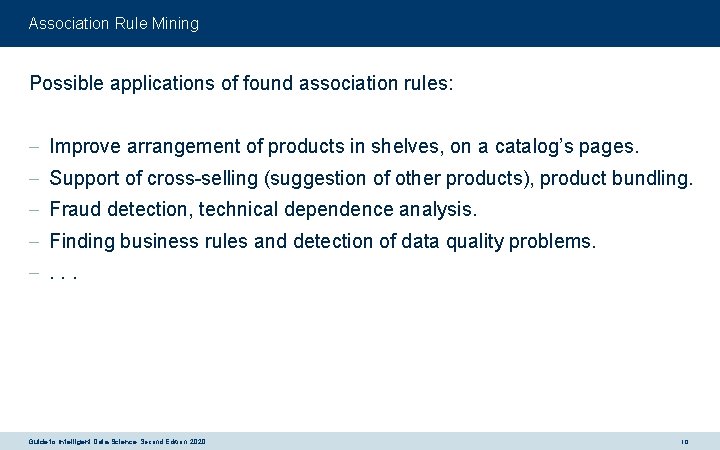
Association Rule Mining Possible applications of found association rules: - Improve arrangement of products in shelves, on a catalog’s pages. - Support of cross-selling (suggestion of other products), product bundling. - Fraud detection, technical dependence analysis. - Finding business rules and detection of data quality problems. -. . . Guide to Intelligent Data Science Second Edition, 2020 10
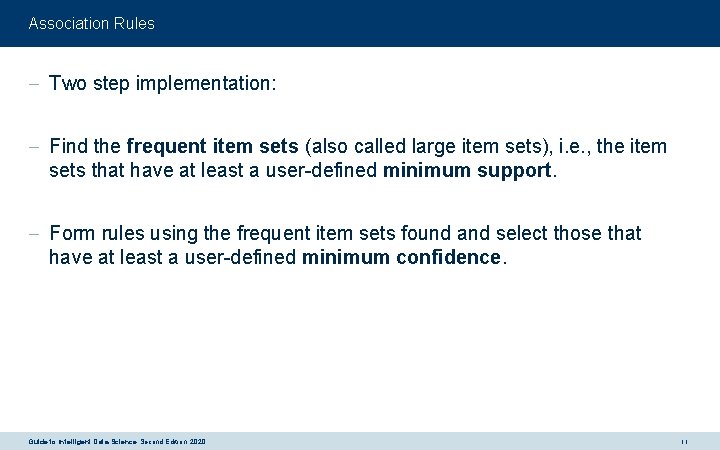
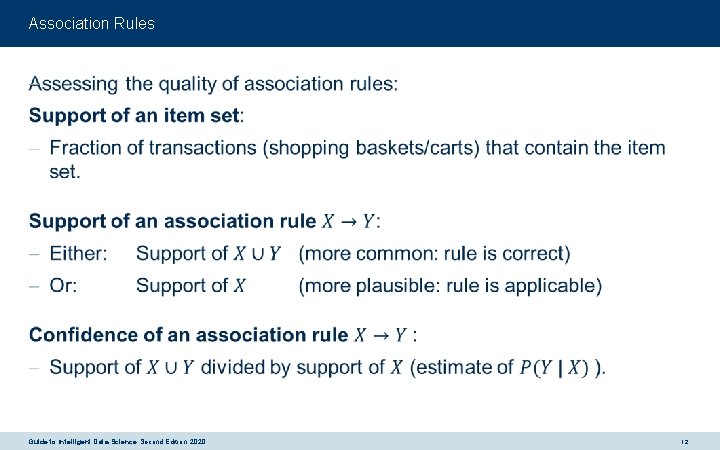
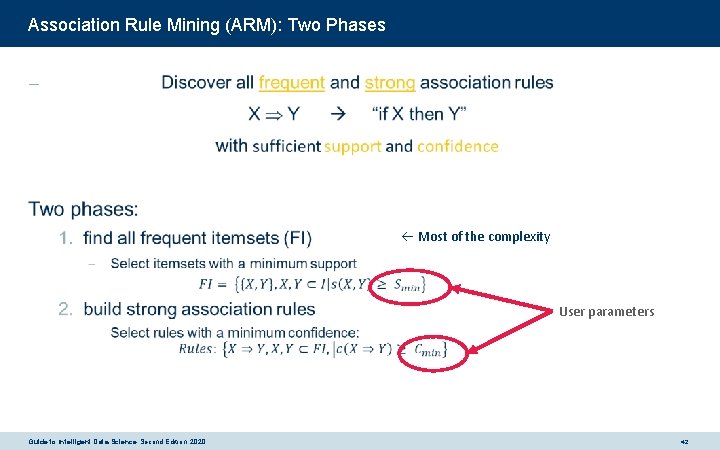
Association Rules - Two step implementation: - Find the frequent item sets (also called large item sets), i. e. , the item sets that have at least a user-defined minimum support. - Form rules using the frequent item sets found and select those that have at least a user-defined minimum confidence. Guide to Intelligent Data Science Second Edition, 2020 11
Association Rules - Guide to Intelligent Data Science Second Edition, 2020 12
Itemset Mining Guide to Intelligent Data Science Second Edition, 2020 13
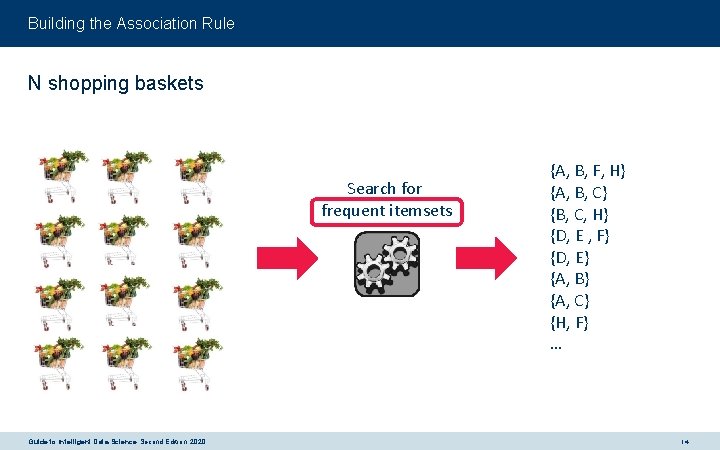
Building the Association Rule N shopping baskets Search for frequent itemsets Guide to Intelligent Data Science Second Edition, 2020 {A, B, F, H} {A, B, C} {B, C, H} {D, E , F} {D, E} {A, B} {A, C} {H, F} … 14
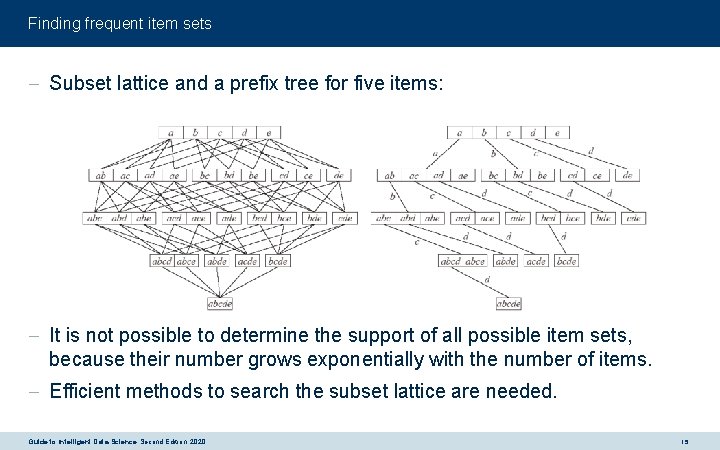
Finding frequent item sets - Subset lattice and a prefix tree for five items: - It is not possible to determine the support of all possible item sets, because their number grows exponentially with the number of items. - Efficient methods to search the subset lattice are needed. Guide to Intelligent Data Science Second Edition, 2020 15
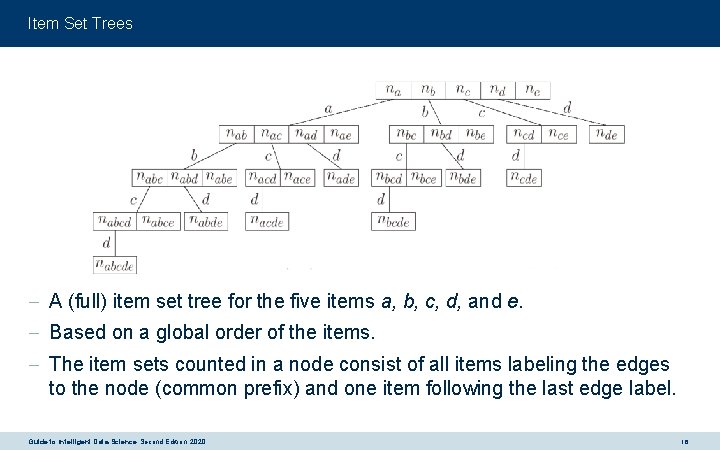
Item Set Trees - A (full) item set tree for the five items a, b, c, d, and e. - Based on a global order of the items. - The item sets counted in a node consist of all items labeling the edges to the node (common prefix) and one item following the last edge label. Guide to Intelligent Data Science Second Edition, 2020 16
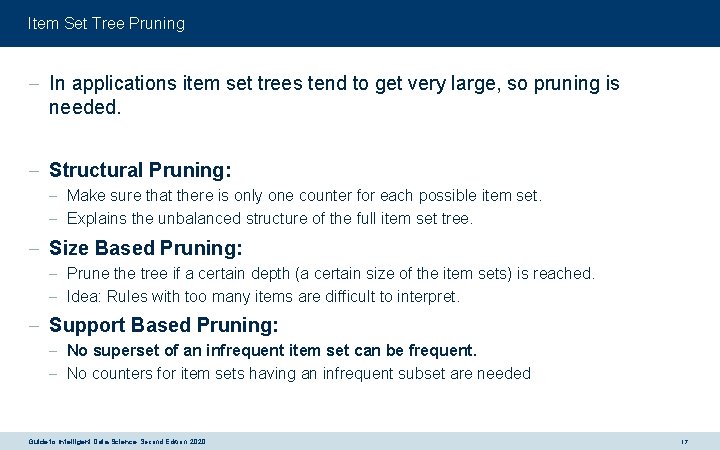
Item Set Tree Pruning - In applications item set trees tend to get very large, so pruning is needed. - Structural Pruning: - Make sure that there is only one counter for each possible item set. - Explains the unbalanced structure of the full item set tree. - Size Based Pruning: - Prune the tree if a certain depth (a certain size of the item sets) is reached. - Idea: Rules with too many items are difficult to interpret. - Support Based Pruning: - No superset of an infrequent item set can be frequent. - No counters for item sets having an infrequent subset are needed Guide to Intelligent Data Science Second Edition, 2020 17
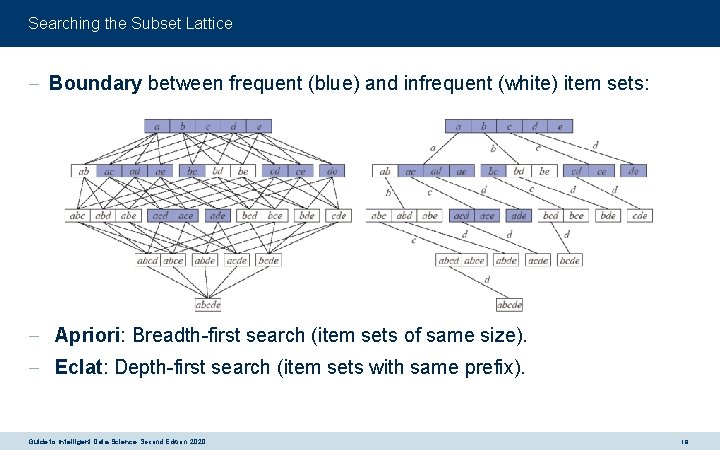
Searching the Subset Lattice - Boundary between frequent (blue) and infrequent (white) item sets: - Apriori: Breadth-first search (item sets of same size). - Eclat: Depth-first search (item sets with same prefix). Guide to Intelligent Data Science Second Edition, 2020 18
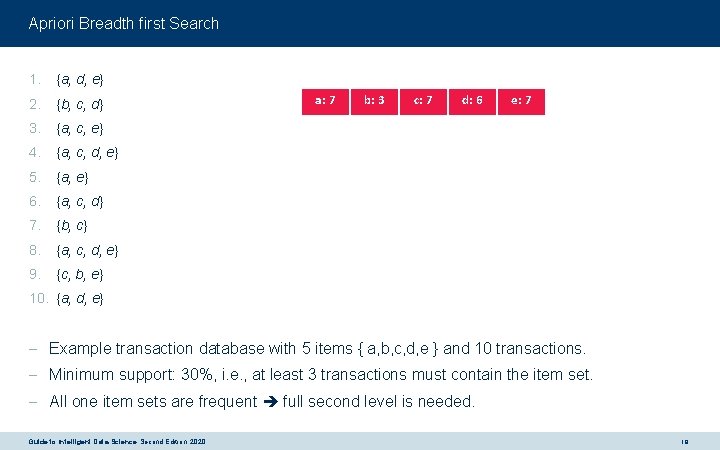
Apriori Breadth first Search 1. {a, d, e} 2. {b, c, d} 3. {a, c, e} 4. {a, c, d, e} 5. {a, e} 6. {a, c, d} 7. {b, c} 8. {a, c, d, e} 9. {c, b, e} a: 7 b: 3 c: 7 d: 6 e: 7 10. {a, d, e} - Example transaction database with 5 items { a, b, c, d, e } and 10 transactions. - Minimum support: 30%, i. e. , at least 3 transactions must contain the item set. - All one item sets are frequent full second level is needed. Guide to Intelligent Data Science Second Edition, 2020 19
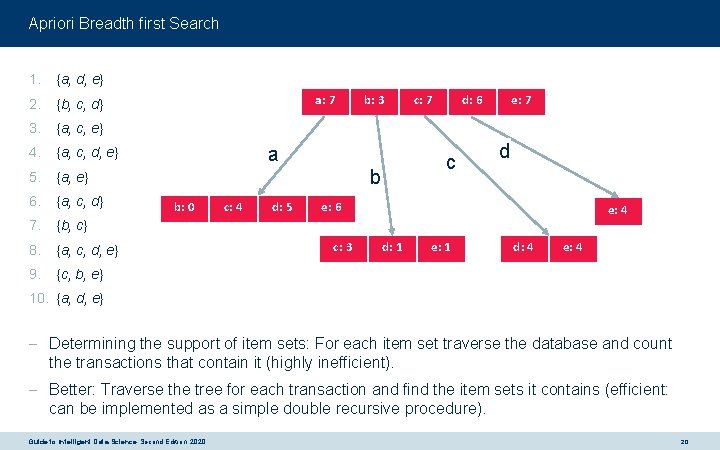
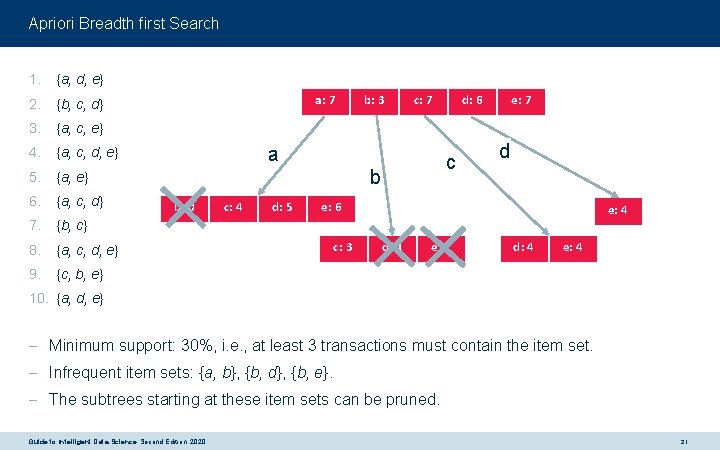
Apriori Breadth first Search 1. {a, d, e} 2. {b, c, d} 3. {a, c, e} 4. {a, c, d, e} 5. {a, e} 6. {a, c, d} 7. {b, c} 8. {a, c, d, e} 9. {c, b, e} a: 7 b: 3 a c: 4 d: 5 d: 6 c b b: 0 c: 7 e: 7 d e: 6 c: 3 e: 4 d: 1 e: 1 d: 4 e: 4 10. {a, d, e} - Determining the support of item sets: For each item set traverse the database and count the transactions that contain it (highly inefficient). - Better: Traverse the tree for each transaction and find the item sets it contains (efficient: can be implemented as a simple double recursive procedure). Guide to Intelligent Data Science Second Edition, 2020 20
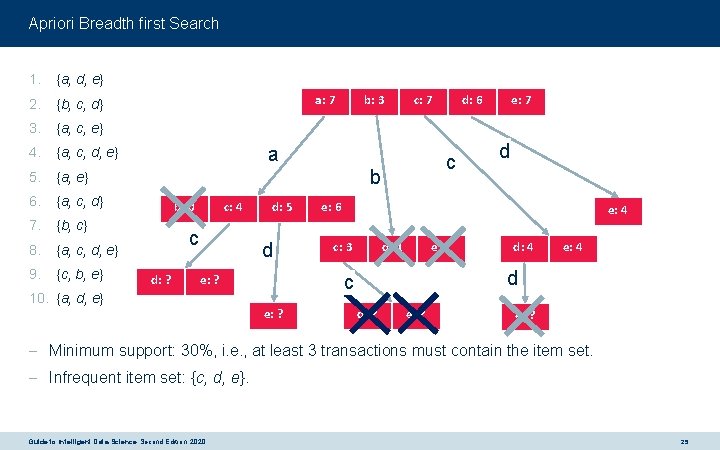
Apriori Breadth first Search 1. {a, d, e} 2. {b, c, d} 3. {a, c, e} 4. {a, c, d, e} 5. {a, e} 6. {a, c, d} 7. {b, c} 8. {a, c, d, e} 9. {c, b, e} a: 7 b: 3 c: 7 a c b b: 0 c: 4 d: 5 d: 6 e: 7 d e: 6 c: 3 e: 4 d: 1 e: 1 d: 4 e: 4 10. {a, d, e} - Minimum support: 30%, i. e. , at least 3 transactions must contain the item set. - Infrequent item sets: {a, b}, {b, d}, {b, e}. - The subtrees starting at these item sets can be pruned. Guide to Intelligent Data Science Second Edition, 2020 21
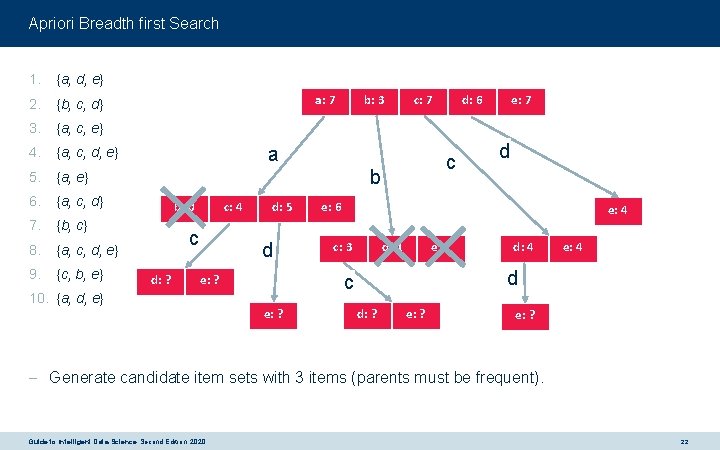
Apriori Breadth first Search 1. {a, d, e} 2. {b, c, d} 3. {a, c, e} 4. {a, c, d, e} 5. {a, e} 6. {a, c, d} 7. {b, c} 8. {a, c, d, e} 9. {c, b, e} a: 7 b: 3 c: 7 a c b b: 0 c: 4 c d: ? d: 5 d e: ? 10. {a, d, e} e: 7 d e: 6 e: 4 c: 3 d: 1 e: 1 d: 4 e: 4 d c e: ? d: 6 d: ? e: ? - Generate candidate item sets with 3 items (parents must be frequent). Guide to Intelligent Data Science Second Edition, 2020 22
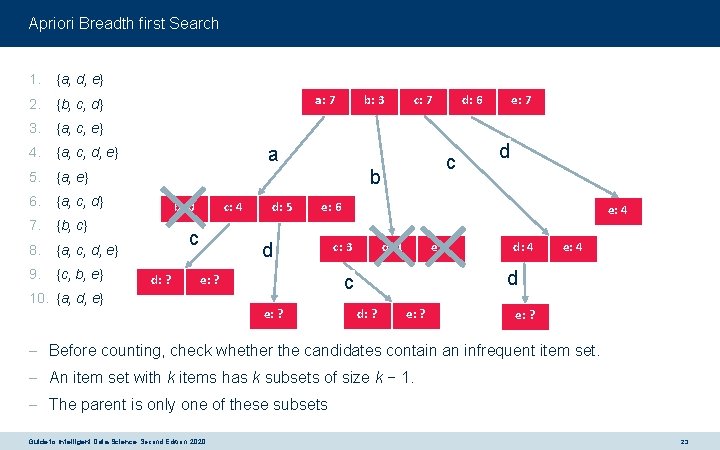
Apriori Breadth first Search 1. {a, d, e} 2. {b, c, d} 3. {a, c, e} 4. {a, c, d, e} 5. {a, e} 6. {a, c, d} 7. {b, c} 8. {a, c, d, e} 9. {c, b, e} a: 7 b: 3 c: 7 a c b b: 0 c: 4 c d: ? d: 5 e: 7 d e: 6 d e: ? 10. {a, d, e} d: 6 e: 4 c: 3 d: 1 e: 4 d c e: ? d: 4 d: ? e: ? - Before counting, check whether the candidates contain an infrequent item set. - An item set with k items has k subsets of size k − 1. - The parent is only one of these subsets Guide to Intelligent Data Science Second Edition, 2020 23
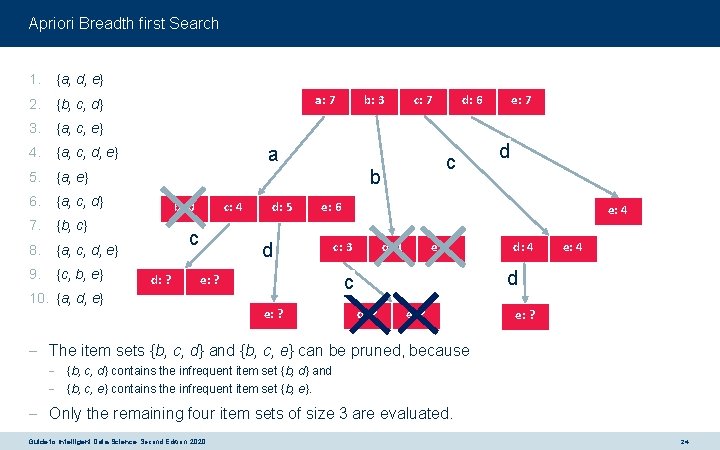
Apriori Breadth first Search 1. {a, d, e} 2. {b, c, d} 3. {a, c, e} 4. {a, c, d, e} 5. {a, e} 6. {a, c, d} 7. {b, c} 8. {a, c, d, e} 9. {c, b, e} a: 7 b: 3 c: 7 a c b b: 0 c: 4 c d: ? d: 5 e: 7 d e: 6 d e: ? 10. {a, d, e} d: 6 e: 4 c: 3 d: 1 e: 4 d c e: ? d: 4 d: ? e: ? - The item sets {b, c, d} and {b, c, e} can be pruned, because - {b, c, d} contains the infrequent item set {b, d} and - {b, c, e} contains the infrequent item set {b, e}. - Only the remaining four item sets of size 3 are evaluated. Guide to Intelligent Data Science Second Edition, 2020 24
Apriori Breadth first Search 1. {a, d, e} 2. {b, c, d} 3. {a, c, e} 4. {a, c, d, e} 5. {a, e} 6. {a, c, d} 7. {b, c} 8. {a, c, d, e} 9. {c, b, e} a: 7 b: 3 c: 7 a c b b: 0 c: 4 c d: ? d: 5 d e: ? 10. {a, d, e} e: 7 d e: 6 e: 4 c: 3 d: 1 e: 1 d: 4 e: 4 d c e: ? d: 6 d: ? e: ? - Minimum support: 30%, i. e. , at least 3 transactions must contain the item set. - Infrequent item set: {c, d, e}. Guide to Intelligent Data Science Second Edition, 2020 25
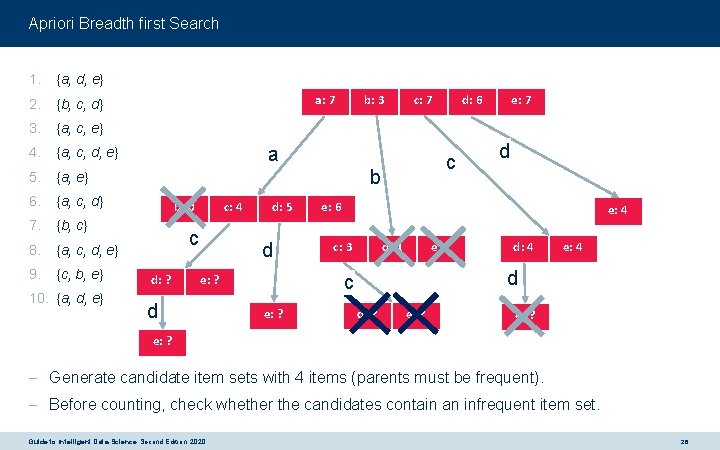
Apriori Breadth first Search 1. {a, d, e} 2. {b, c, d} 3. {a, c, e} 4. {a, c, d, e} 5. {a, e} 6. {a, c, d} 7. {b, c} 8. {a, c, d, e} 9. {c, b, e} 10. {a, d, e} a: 7 b: 3 c: 7 a c b b: 0 c: 4 c d: ? d: 5 d e: ? d e: 7 d e: 6 e: 4 c: 3 d: 1 e: 1 d: 4 e: 4 d c e: ? d: 6 d: ? e: ? - Generate candidate item sets with 4 items (parents must be frequent). - Before counting, check whether the candidates contain an infrequent item set. Guide to Intelligent Data Science Second Edition, 2020 26
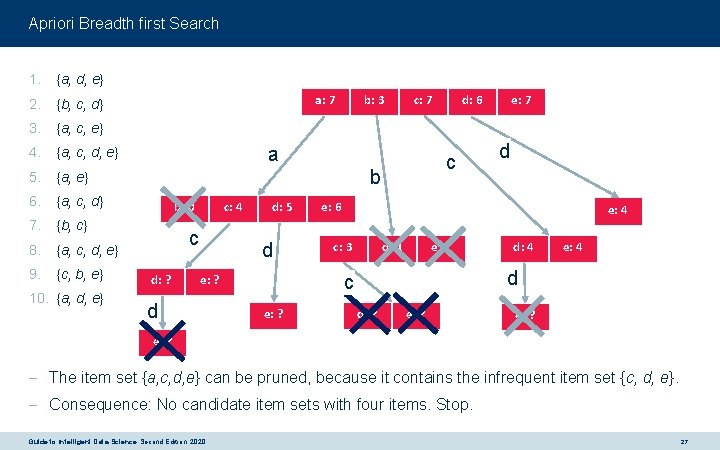
Apriori Breadth first Search 1. {a, d, e} 2. {b, c, d} 3. {a, c, e} 4. {a, c, d, e} 5. {a, e} 6. {a, c, d} 7. {b, c} 8. {a, c, d, e} 9. {c, b, e} 10. {a, d, e} a: 7 b: 3 c: 7 a c b b: 0 c: 4 c d: ? d: 5 d e: ? d d: 6 d e: 6 e: 4 c: 3 d: 1 e: 1 d: 4 e: 4 d c e: ? e: 7 d: ? e: ? - The item set {a, c, d, e} can be pruned, because it contains the infrequent item set {c, d, e}. - Consequence: No candidate item sets with four items. Stop. Guide to Intelligent Data Science Second Edition, 2020 27
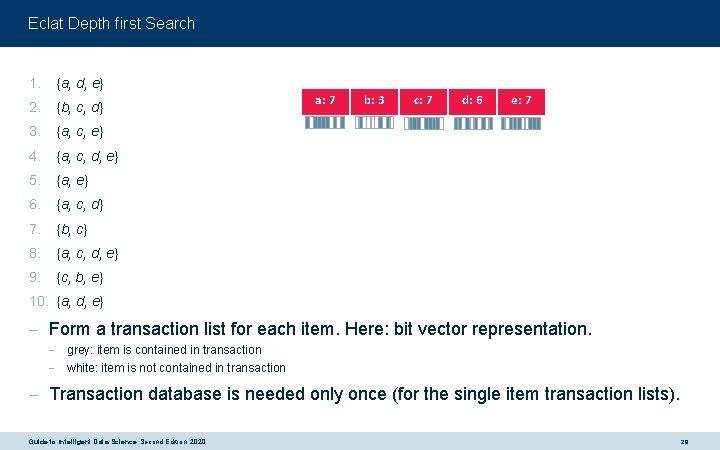
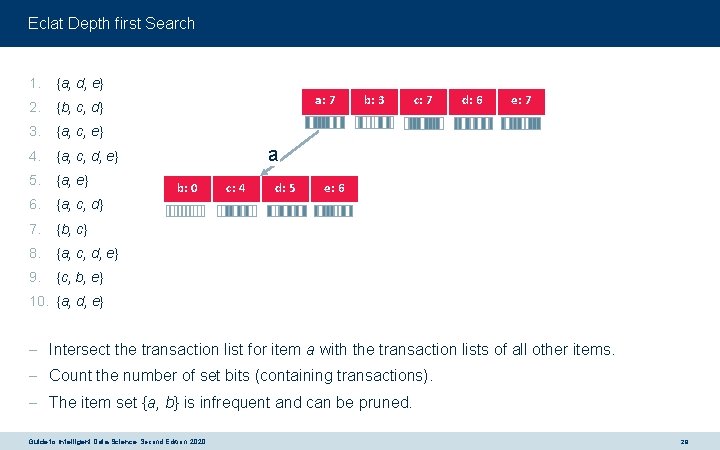
Eclat Depth first Search 1. {a, d, e} 2. {b, c, d} 3. {a, c, e} 4. {a, c, d, e} 5. {a, e} 6. {a, c, d} 7. {b, c} 8. {a, c, d, e} 9. {c, b, e} a: 7 b: 3 c: 7 d: 6 e: 7 10. {a, d, e} - Form a transaction list for each item. Here: bit vector representation. - grey: item is contained in transaction - white: item is not contained in transaction - Transaction database is needed only once (for the single item transaction lists). Guide to Intelligent Data Science Second Edition, 2020 28
Eclat Depth first Search 1. {a, d, e} 2. {b, c, d} 3. {a, c, e} 4. {a, c, d, e} 5. {a, e} 6. {a, c, d} 7. {b, c} 8. {a, c, d, e} 9. {c, b, e} a: 7 b: 3 c: 7 d: 6 e: 7 a b: 0 c: 4 d: 5 e: 6 10. {a, d, e} - Intersect the transaction list for item a with the transaction lists of all other items. - Count the number of set bits (containing transactions). - The item set {a, b} is infrequent and can be pruned. Guide to Intelligent Data Science Second Edition, 2020 29
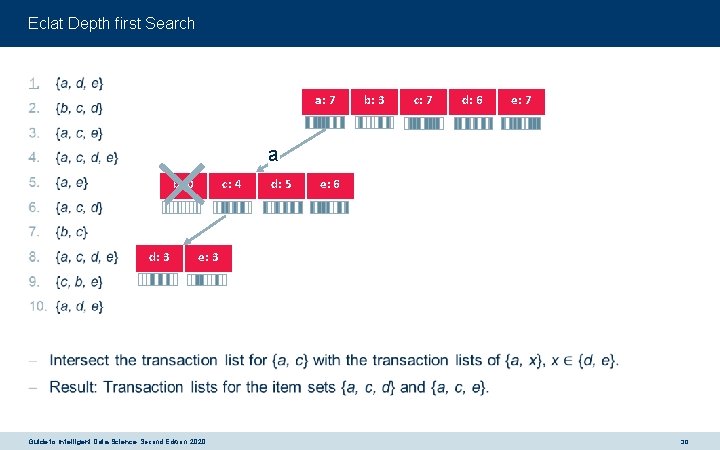
Eclat Depth first Search - a: 7 b: 3 c: 7 d: 6 e: 7 a b: 0 d: 3 c: 4 d: 5 e: 6 e: 3 Guide to Intelligent Data Science Second Edition, 2020 30
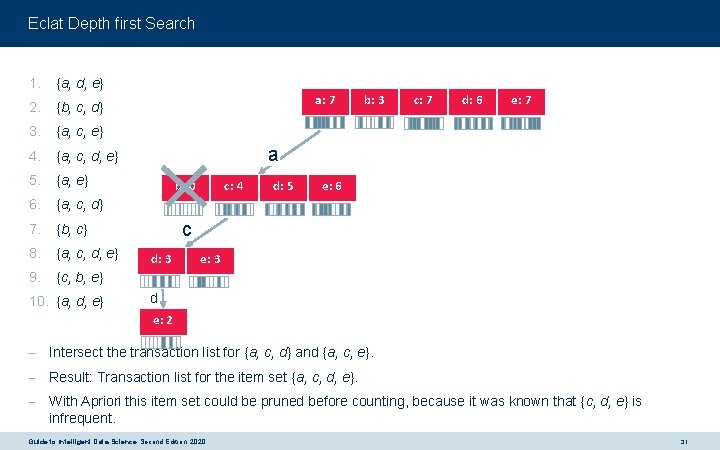
Eclat Depth first Search 1. {a, d, e} 2. {b, c, d} 3. {a, c, e} 4. {a, c, d, e} 5. {a, e} 6. {a, c, d} 7. {b, c} 8. {a, c, d, e} 9. {c, b, e} 10. {a, d, e} a: 7 b: 3 c: 7 d: 6 e: 7 a b: 0 c: 4 d: 5 e: 6 c d: 3 e: 3 d e: 2 - Intersect the transaction list for {a, c, d} and {a, c, e}. - Result: Transaction list for the item set {a, c, d, e}. - With Apriori this item set could be pruned before counting, because it was known that {c, d, e} is infrequent. Guide to Intelligent Data Science Second Edition, 2020 31
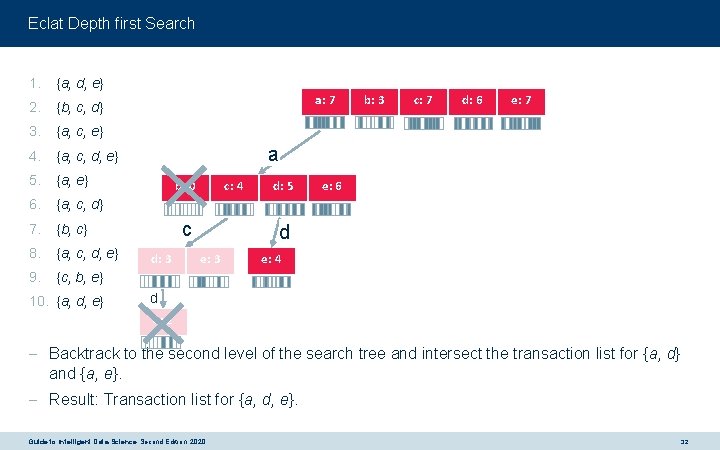
Eclat Depth first Search 1. {a, d, e} 2. {b, c, d} 3. {a, c, e} 4. {a, c, d, e} 5. {a, e} 6. {a, c, d} 7. {b, c} 8. {a, c, d, e} 9. {c, b, e} 10. {a, d, e} a: 7 b: 3 c: 7 d: 6 e: 7 a b: 0 c: 4 c d: 3 d: 5 e: 6 d e: 3 e: 4 d e: 2 - Backtrack to the second level of the search tree and intersect the transaction list for {a, d} and {a, e}. - Result: Transaction list for {a, d, e}. Guide to Intelligent Data Science Second Edition, 2020 32
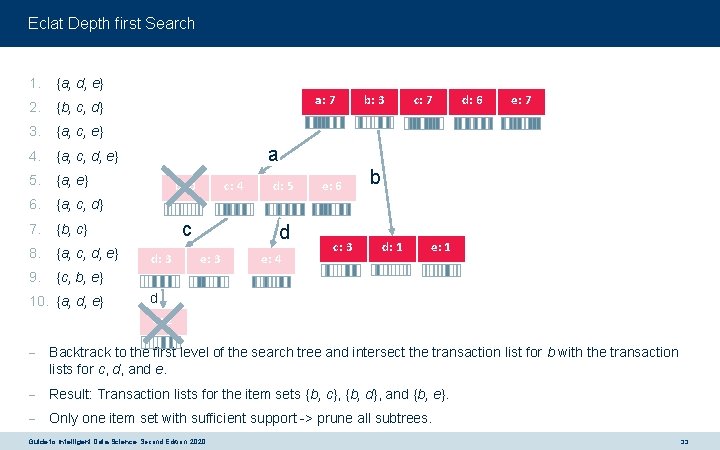
Eclat Depth first Search 1. {a, d, e} 2. {b, c, d} 3. {a, c, e} 4. {a, c, d, e} 5. {a, e} 6. {a, c, d} 7. {b, c} 8. {a, c, d, e} 9. {c, b, e} 10. {a, d, e} a: 7 b: 3 c: 7 d: 6 e: 7 a b: 0 c: 4 c d: 3 d: 5 d e: 3 e: 4 e: 6 c: 3 b d: 1 e: 1 d e: 2 - Backtrack to the first level of the search tree and intersect the transaction list for b with the transaction lists for c, d, and e. - Result: Transaction lists for the item sets {b, c}, {b, d}, and {b, e}. - Only one item set with sufficient support -> prune all subtrees. Guide to Intelligent Data Science Second Edition, 2020 33
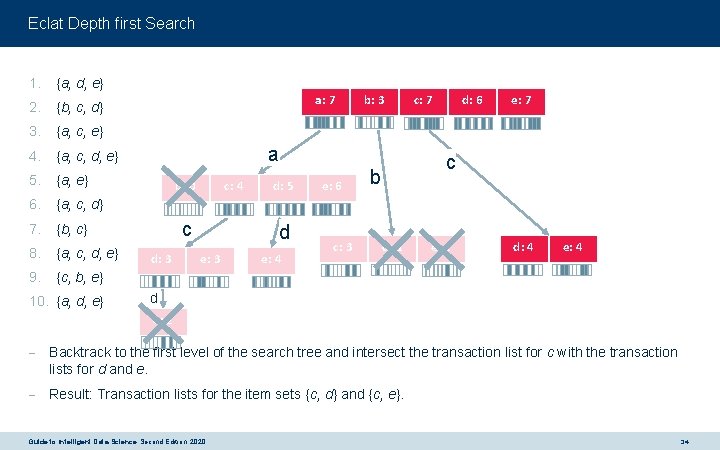
Eclat Depth first Search 1. {a, d, e} 2. {b, c, d} 3. {a, c, e} 4. {a, c, d, e} 5. {a, e} 6. {a, c, d} 7. {b, c} 8. {a, c, d, e} 9. {c, b, e} 10. {a, d, e} a: 7 b: 3 a b: 0 c: 4 c d: 3 d: 5 d e: 3 e: 4 e: 6 c: 3 c: 7 d: 6 e: 7 c b d: 1 e: 1 d: 4 e: 4 d e: 2 - Backtrack to the first level of the search tree and intersect the transaction list for c with the transaction lists for d and e. - Result: Transaction lists for the item sets {c, d} and {c, e}. Guide to Intelligent Data Science Second Edition, 2020 34
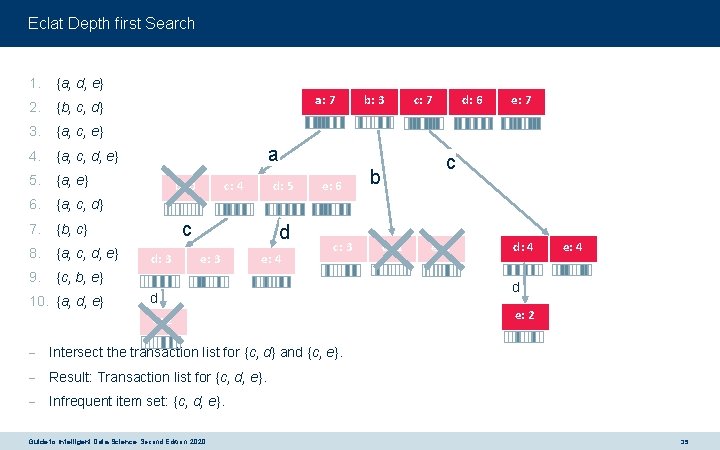
Eclat Depth first Search 1. {a, d, e} 2. {b, c, d} 3. {a, c, e} 4. {a, c, d, e} 5. {a, e} 6. {a, c, d} 7. {b, c} 8. {a, c, d, e} 9. {c, b, e} 10. {a, d, e} a: 7 b: 3 a b: 0 c: 4 d: 5 c d: 3 d e: 3 e: 4 e: 6 c: 3 d e: 2 c: 7 d: 6 e: 7 c b d: 1 e: 1 d: 4 e: 4 d e: 2 - Intersect the transaction list for {c, d} and {c, e}. - Result: Transaction list for {c, d, e}. - Infrequent item set: {c, d, e}. Guide to Intelligent Data Science Second Edition, 2020 35
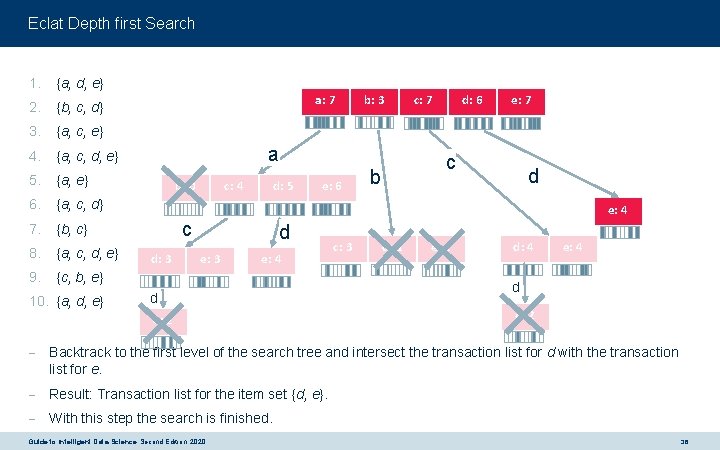
Eclat Depth first Search 1. {a, d, e} 2. {b, c, d} 3. {a, c, e} 4. {a, c, d, e} 5. {a, e} 6. {a, c, d} 7. {b, c} 8. {a, c, d, e} 9. {c, b, e} 10. {a, d, e} a: 7 b: 3 a b: 0 c: 4 d: 5 e: 6 c: 7 d: 6 e: 7 c b d e: 4 c d: 3 d e: 3 e: 4 d e: 2 c: 3 d: 1 e: 1 d: 4 e: 4 d e: 2 - Backtrack to the first level of the search tree and intersect the transaction list for d with the transaction list for e. - Result: Transaction list for the item set {d, e}. - With this step the search is finished. Guide to Intelligent Data Science Second Edition, 2020 36
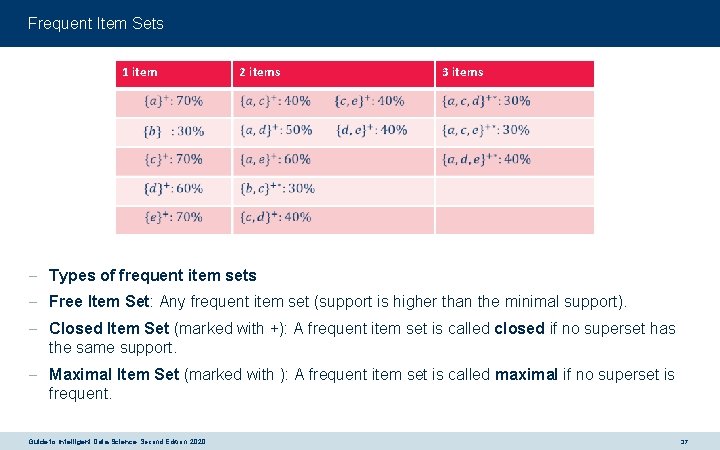
Frequent Item Sets 1 item 2 items 3 items - Types of frequent item sets - Free Item Set: Any frequent item set (support is higher than the minimal support). - Closed Item Set (marked with +): A frequent item set is called closed if no superset has the same support. - Maximal Item Set (marked with ): A frequent item set is called maximal if no superset is frequent. Guide to Intelligent Data Science Second Edition, 2020 37
Generating Association Rules Guide to Intelligent Data Science Second Edition, 2020 38
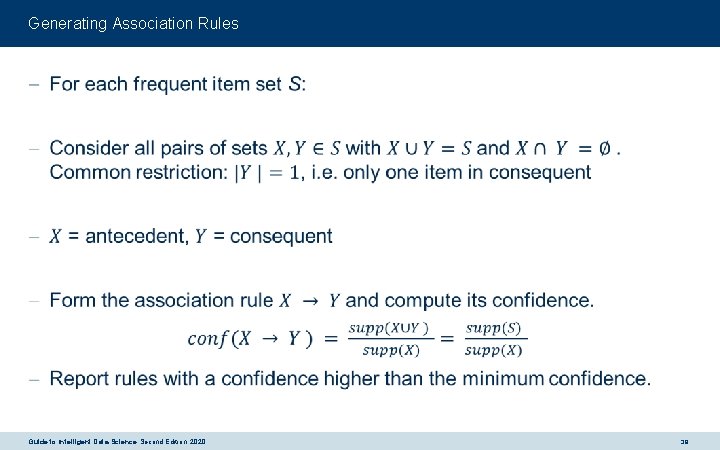
Generating Association Rules - Guide to Intelligent Data Science Second Edition, 2020 39
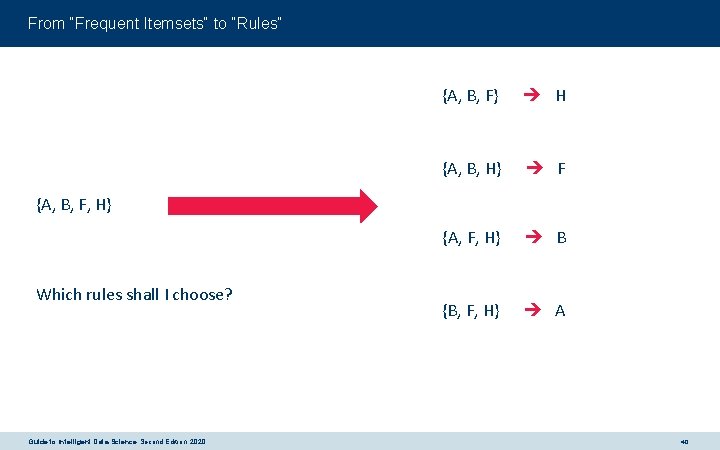
From “Frequent Itemsets“ to “Rules“ {A, B, F} H {A, B, H} F {A, F, H} B {B, F, H} A {A, B, F, H} Which rules shall I choose? Guide to Intelligent Data Science Second Edition, 2020 40
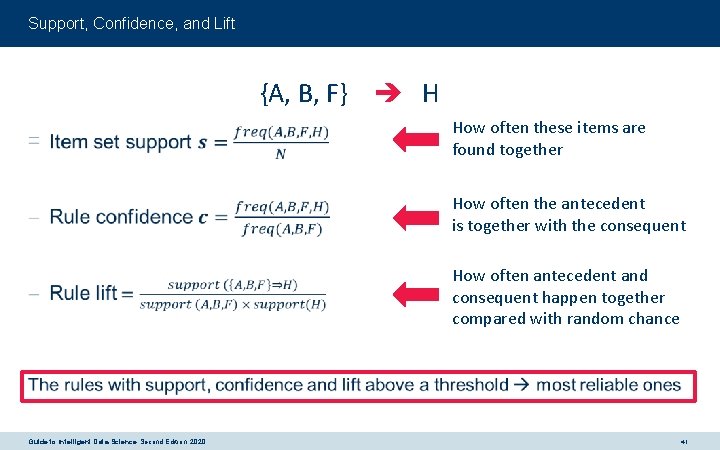
Support, Confidence, and Lift {A, B, F} H - How often these items are found together How often the antecedent is together with the consequent How often antecedent and consequent happen together compared with random chance Guide to Intelligent Data Science Second Edition, 2020 41
Association Rule Mining (ARM): Two Phases - Most of the complexity User parameters Guide to Intelligent Data Science Second Edition, 2020 42
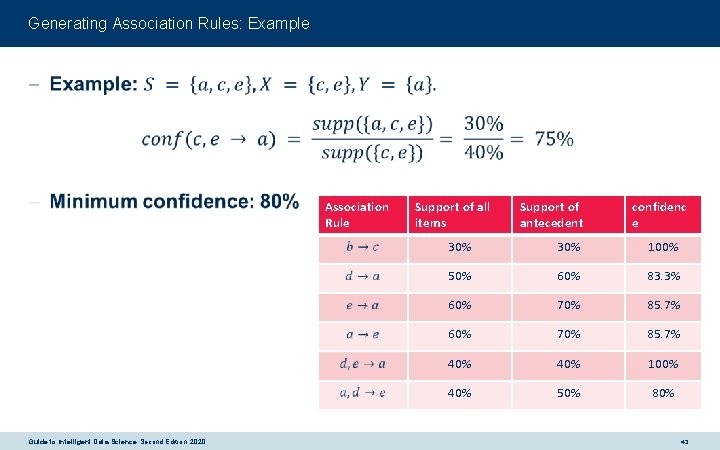
Generating Association Rules: Example - Association Rule Guide to Intelligent Data Science Second Edition, 2020 Support of all items Support of antecedent confidenc e 30% 100% 50% 60% 83. 3% 60% 70% 85. 7% 40% 100% 40% 50% 80% 43
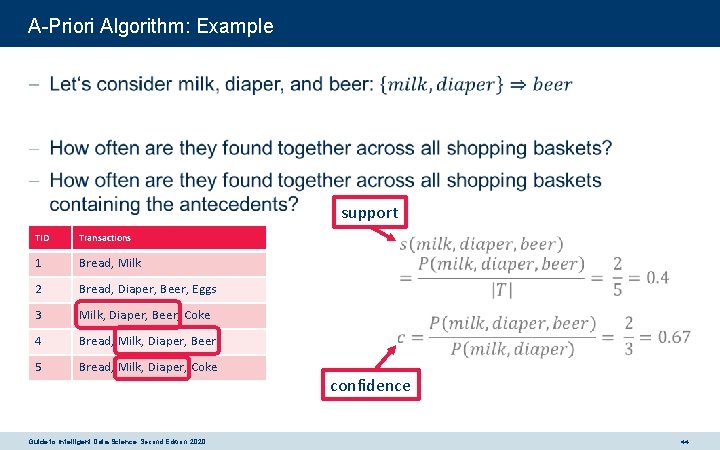
A-Priori Algorithm: Example - support TID Transactions 1 Bread, Milk 2 Bread, Diaper, Beer, Eggs 3 Milk, Diaper, Beer, Coke 4 Bread, Milk, Diaper, Beer 5 Bread, Milk, Diaper, Coke Guide to Intelligent Data Science Second Edition, 2020 confidence 44
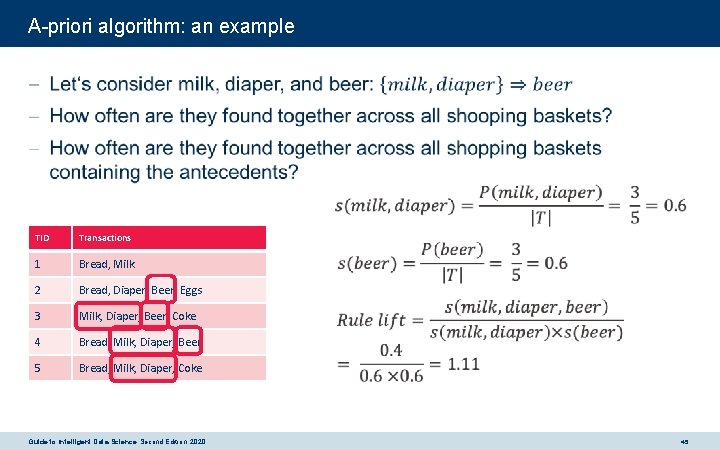
A-priori algorithm: an example - TID Transactions 1 Bread, Milk 2 Bread, Diaper, Beer, Eggs 3 Milk, Diaper, Beer, Coke 4 Bread, Milk, Diaper, Beer 5 Bread, Milk, Diaper, Coke Guide to Intelligent Data Science Second Edition, 2020 45
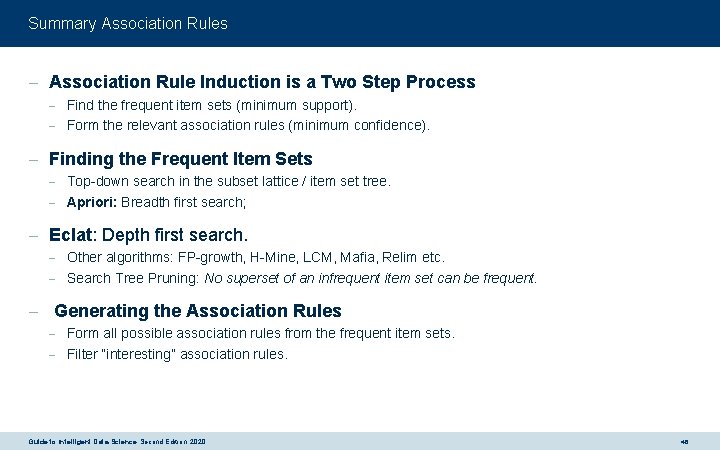
Summary Association Rules - Association Rule Induction is a Two Step Process - Find the frequent item sets (minimum support). - Form the relevant association rules (minimum confidence). - Finding the Frequent Item Sets - Top-down search in the subset lattice / item set tree. - Apriori: Breadth first search; - Eclat: Depth first search. - Other algorithms: FP-growth, H-Mine, LCM, Mafia, Relim etc. - Search Tree Pruning: No superset of an infrequent item set can be frequent. - Generating the Association Rules - Form all possible association rules from the frequent item sets. - Filter “interesting” association rules. Guide to Intelligent Data Science Second Edition, 2020 46
Collaborative Filtering Guide to Intelligent Data Science Second Edition, 2020 47
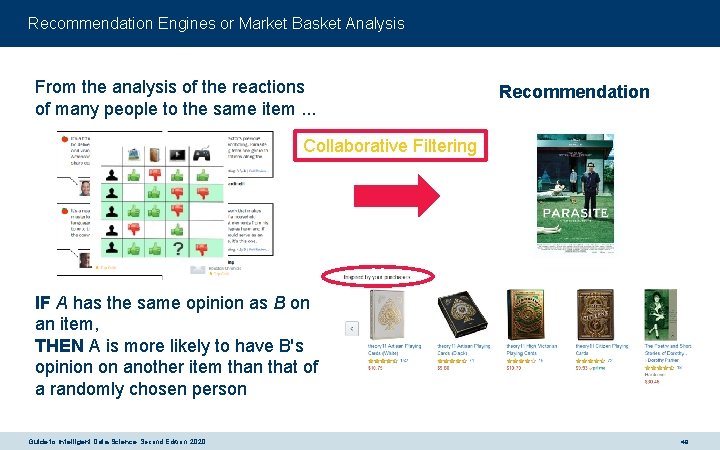
Recommendation Engines or Market Basket Analysis From the analysis of the reactions of many people to the same item. . . Recommendation Collaborative Filtering IF A has the same opinion as B on an item, THEN A is more likely to have B's opinion on another item than that of a randomly chosen person Guide to Intelligent Data Science Second Edition, 2020 48
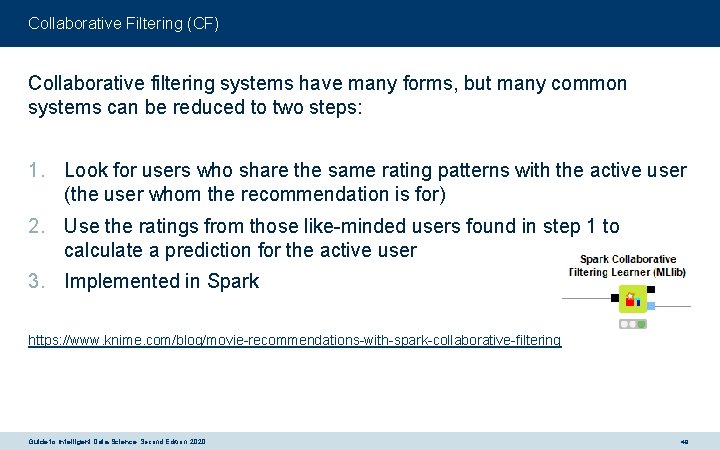
Collaborative Filtering (CF) Collaborative filtering systems have many forms, but many common systems can be reduced to two steps: 1. Look for users who share the same rating patterns with the active user (the user whom the recommendation is for) 2. Use the ratings from those like-minded users found in step 1 to calculate a prediction for the active user 3. Implemented in Spark https: //www. knime. com/blog/movie-recommendations-with-spark-collaborative-filtering Guide to Intelligent Data Science Second Edition, 2020 49
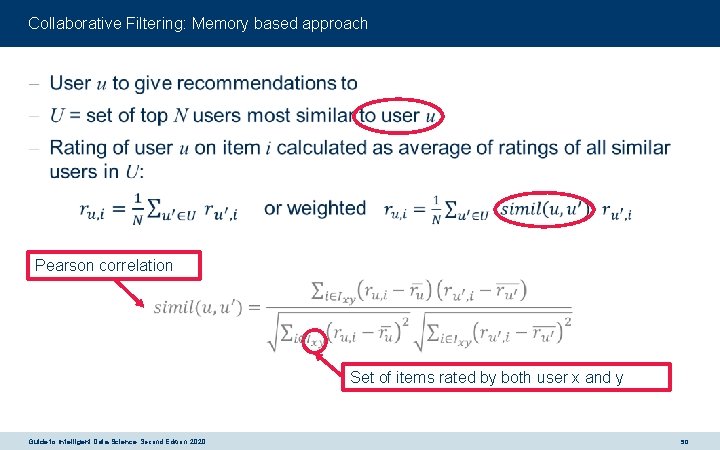
Collaborative Filtering: Memory based approach - Pearson correlation Set of items rated by both user x and y Guide to Intelligent Data Science Second Edition, 2020 50
Practical Examples with KNIME Analytics Platform Guide to Intelligent Data Science Second Edition, 2020 51
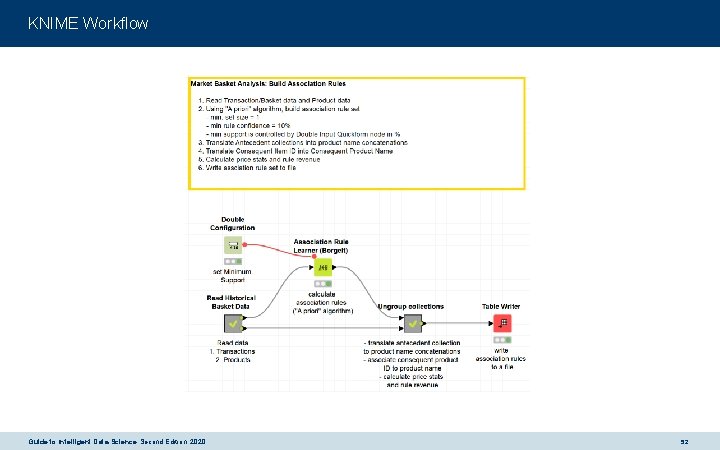
KNIME Workflow Guide to Intelligent Data Science Second Edition, 2020 52
Thank you For any questions please contact: education@knime. com Guide to Intelligent Data Science Second Edition, 2020 53