
Recombination Definitions Models Mechanisms Definition of recombination Breaking
Recombination Definitions Models Mechanisms

Definition of recombination • Breaking and rejoining of two parental DNA molecules to produce new DNA molecules

Types of recombination Homologous or general Nonhomologous or illigitimate Site-specific A+ B+ C+ A+ B- C- A- B+ C+ A B C A B F D E C l l att A B C Transposable element l att E. coli att Replicative recombination, transposition integrase transposase A att B C

Recombination • Breaking and rejoining of two parental DNA molecules to produce new DNA molecules • Reciprocal recombination: new DNA molecules carry genetic information from both parental molecules. • Gene conversion: one way transfer of information, resulting in an allele on one parental chromosome being changed to the allele from the other homologous chromosome
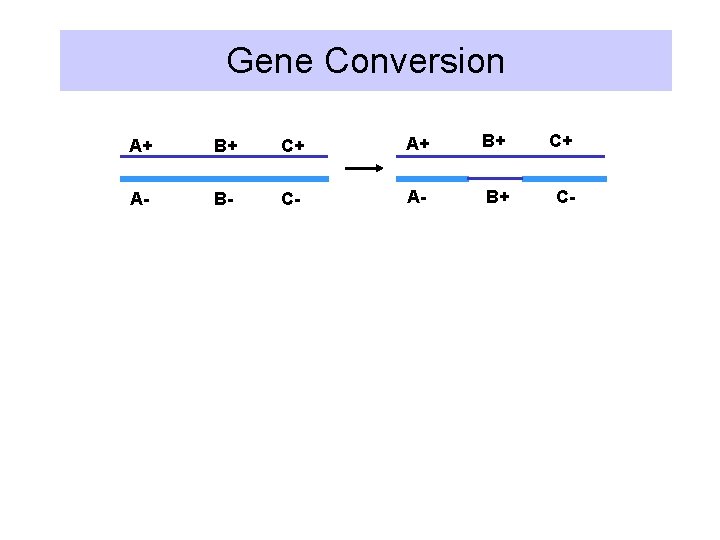
Gene Conversion A+ B+ C+ A- B- C- A- B+ C-
Recombination occurs when two homologous chromosomes are together • Homologous or general recombination: – Bacterium with two viruses – Bacterium after conjugal transfer of part of a chromosome – At chiasmata during meiosis of eukaryotic cells – Post-replication repair via retrieval system • Other types of recombination – Site specific : Integration of bacterial, viral or plasmid DNA into cellular chromosome – Replicative : Transposition
B. Meiotic recombination • Recombination appears to be needed to keep maternal and paternal homologs of chromosomes together prior to anaphase of meiosis I – Zygotene: Pairing of maternal and paternal chromosomes (each has 2 sister chromatids) – Pachytene: Crossing over between maternal and paternal chromosomes – Diplotene: Centromeres of maternal and paternal chromosomes separate, but chromosomes are held together at chiasmata (cross-overs) – Anaphase I: Homologous chromosomes separate and move to 2 daughter cells. • Results in >1 exchange between pairs of homologous chromosomes in each meiosis. • Failure to keep homologous chromosomes together prior to anaphase I can lead to aberrant numbers of chromosomes, e. g. trisomy for chromosomes 15, 18, 21
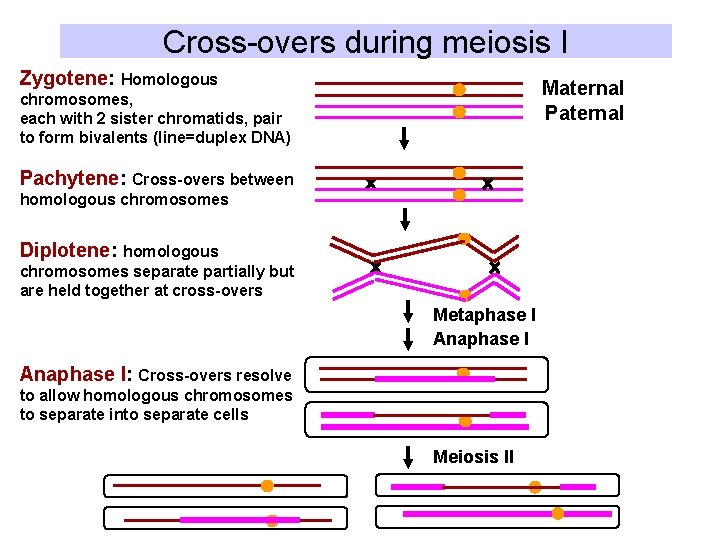
Cross-overs during meiosis I Zygotene: Homologous Maternal Paternal chromosomes, each with 2 sister chromatids, pair to form bivalents (line=duplex DNA) Pachytene: Cross-overs between homologous chromosomes Diplotene: homologous chromosomes separate partially but are held together at cross-overs Metaphase I Anaphase I: Cross-overs resolve to allow homologous chromosomes to separate into separate cells Meiosis II

Benefits of recombination • Greater variety in offspring: Generates new combinations of alleles • Negative selection can remove deleterious alleles from a population without removing the entire chromosome carrying that allele • Essential to the physical process of meiosis, and hence sexual reproduction – Yeast and Drosophila mutants that block pairing are also defective in recombination, and vice versa!!!!
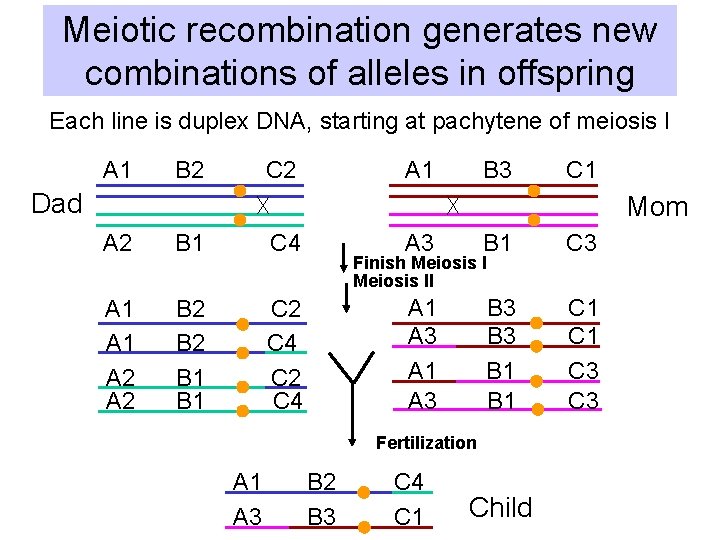
Meiotic recombination generates new combinations of alleles in offspring Each line is duplex DNA, starting at pachytene of meiosis I A 1 B 2 C 2 A 1 B 3 C 1 Dad Mom A 2 B 1 C 4 A 1 A 2 B 2 B 1 C 2 C 4 A 3 B 1 C 3 A 1 A 3 B 3 B 1 C 1 C 3 Finish Meiosis II Fertilization A 1 A 3 B 2 B 3 C 4 C 1 Child
Analysis of individual DNA strands during recombination in fungi • During spore formation of some fungi, (e. g. Ascomycetes), the chromosomes are replicated after meiosis. • Thus each DNA chain (strand) of the chromosomes produced during meiosis becomes a duplex DNA in a spore. • The 8 spores are ordered in the ascus like the initial homologous chromosomes at the beginning of meiosis. • Heterozygotes usually produce a 4: 4 parental ratio for spores carrying each allele
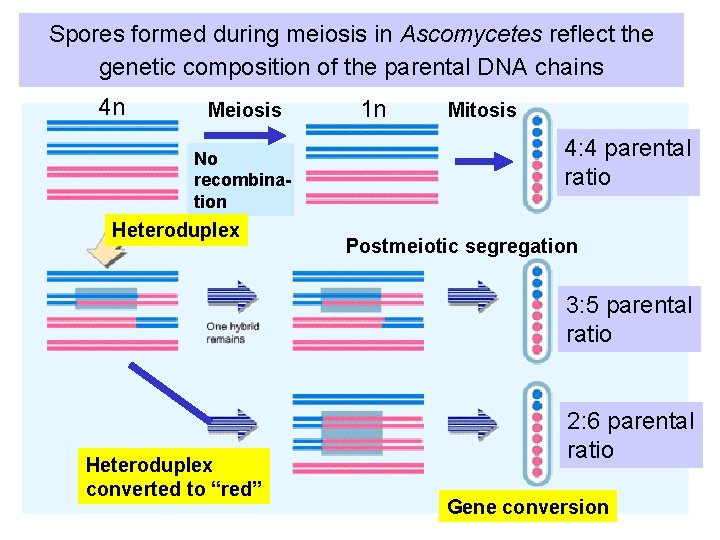
Spores formed during meiosis in Ascomycetes reflect the genetic composition of the parental DNA chains 4 n Meiosis No recombination Heteroduplex 1 n Mitosis 4: 4 parental ratio Postmeiotic segregation 3: 5 parental ratio Heteroduplex converted to “red” 2: 6 parental ratio Gene conversion
Proof of heteroduplex formation in fungi • Deviation from a 4: 4 ratio is explained by the presence of heteroduplex DNA after separation of homologous chromosomes during anaphase of meiotic division I. • Replication of heteroduplex: – a 3: 5 ratio (3 “blue”: 5 “red”) indicates that a patch of heteroduplex DNA remained in one of the recombined chromosomes. – The two strands of the heteroduplex were separated by post-meiotic segregation. • Alternatively, gene conversion results in a 2: 6 ratio.
Holliday model for recombination • Pairing: align homologous duplexes • Single strand invasion: – Endonuclease nicks at corresponding regions of the same strands of homologous chromosomes – Ends generated by the nicks invade the other, homologous duplex – Ligase seals nicks to form a joint molecule. – (“Holliday intermediate” or “Chi structure”) • Branch migration expands heteroduplex region.

Holliday Model: single strand invasion
Resolution of joint molecules • Can occur in one of two ways • The Holliday junction can be nicked in the same strands that were initially nicked = “horizontal resolution. ” This results in NO recombination of flanking markers. • The Holliday junction can be nicked in the strands that were not initially nicked = “vertical resolution. ” This results in RECOMBINATION of flanking markers.
Vertical & horizontal resolution or
Animations of Holliday structures Check out http: //www. wisc. edu/genetics/Holliday/index. html
Double strand break model: Evidence • This model provides a better explanation for recombination events in yeast: • A double strand break precedes recombination. • One DNA molecule is used preferentially as the donor of genetic information. • Gapped substrates can initiate recombination and in the process be repaired (probl. 8. 13)
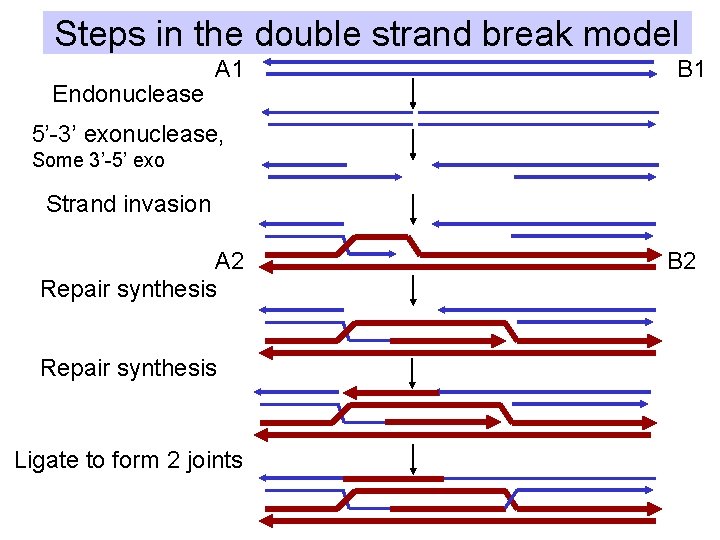
Steps in the double strand break model Endonuclease A 1 B 1 5’-3’ exonuclease, Some 3’-5’ exo Strand invasion A 2 Repair synthesis Ligate to form 2 joints B 2

Double strand break model: resolution A 1 Conver- Het Joint Het sion A 2 Resolve by cuts B 1 B 2 Same sense A 2 A 1 B 2 B 1 Horizontal- A 1 horizontal A 2 B 1 B 2 Verticalvertical No recombination of flanking markers.
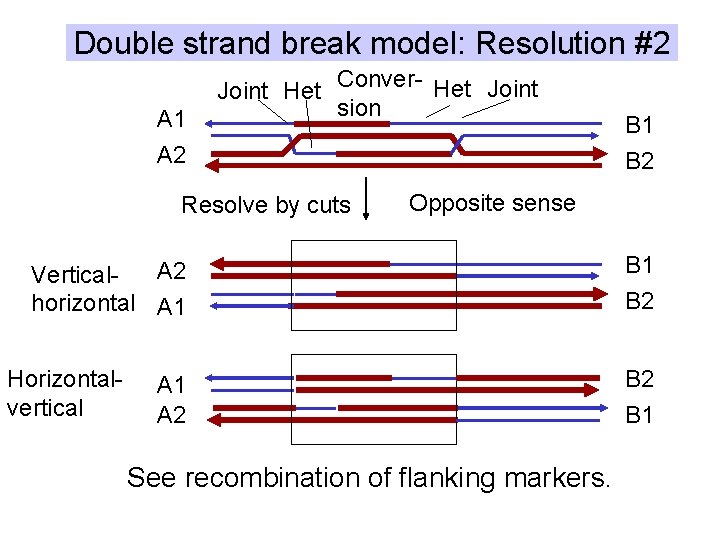
Double strand break model: Resolution #2 A 1 Joint Het Conver- Het Joint sion A 2 Resolve by cuts B 2 Opposite sense A 2 Verticalhorizontal A 1 Horizontalvertical B 1 A 2 See recombination of flanking markers. B 1 B 2 B 1
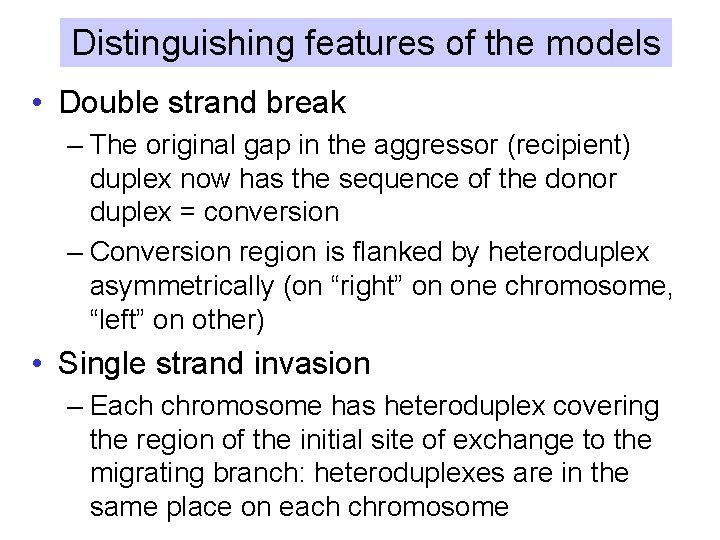
Distinguishing features of the models • Double strand break – The original gap in the aggressor (recipient) duplex now has the sequence of the donor duplex = conversion – Conversion region is flanked by heteroduplex asymmetrically (on “right” on one chromosome, “left” on other) • Single strand invasion – Each chromosome has heteroduplex covering the region of the initial site of exchange to the migrating branch: heteroduplexes are in the same place on each chromosome
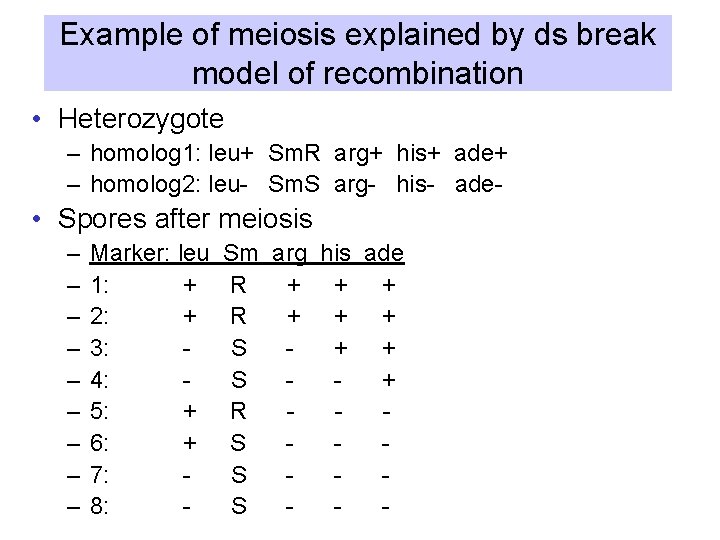
Example of meiosis explained by ds break model of recombination • Heterozygote – homolog 1: leu+ Sm. R arg+ his+ ade+ – homolog 2: leu- Sm. S arg- his- ade- • Spores after meiosis – – – – – Marker: leu 1: + 2: + 3: 4: 5: + 6: + 7: 8: - Sm arg his ade R + + + S + R S S S -
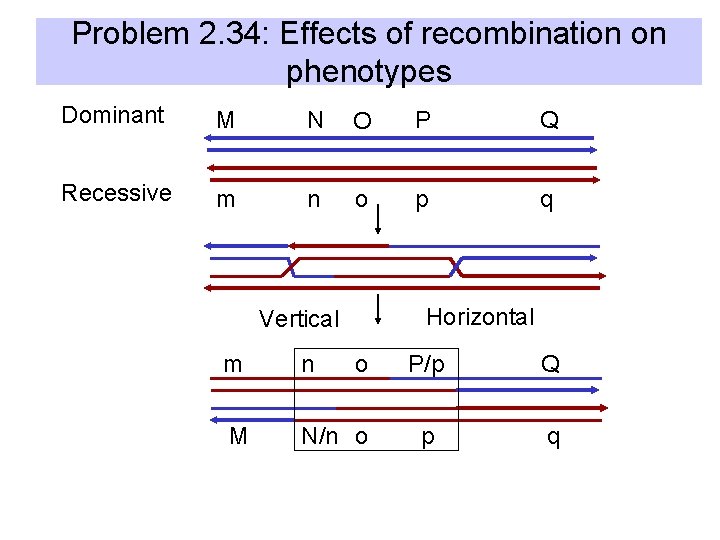
Problem 2. 34: Effects of recombination on phenotypes Dominant M N O P Q Recessive m n o p q Horizontal Vertical m n o M N/n o P/p Q p q
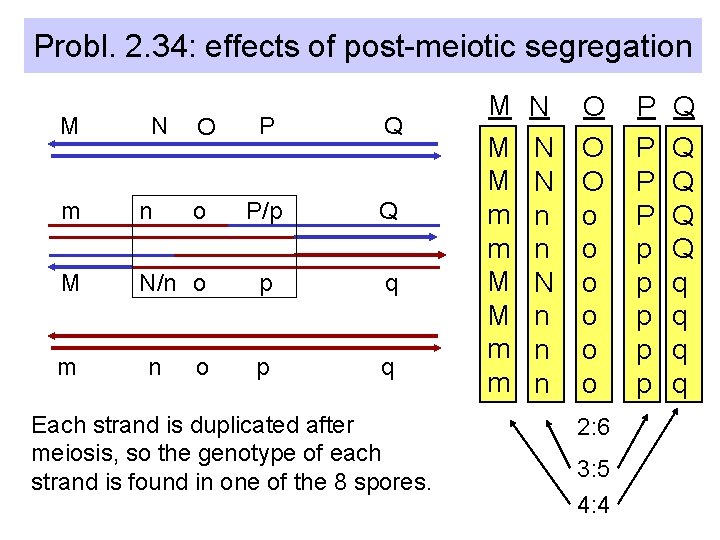
Probl. 2. 34: effects of post-meiotic segregation M N O P Q o P/p Q p q m n M N/n o m n o Each strand is duplicated after meiosis, so the genotype of each strand is found in one of the 8 spores. M M M m m N N N n n n O O O o o o 2: 6 3: 5 4: 4 P P p p p Q Q Q q q
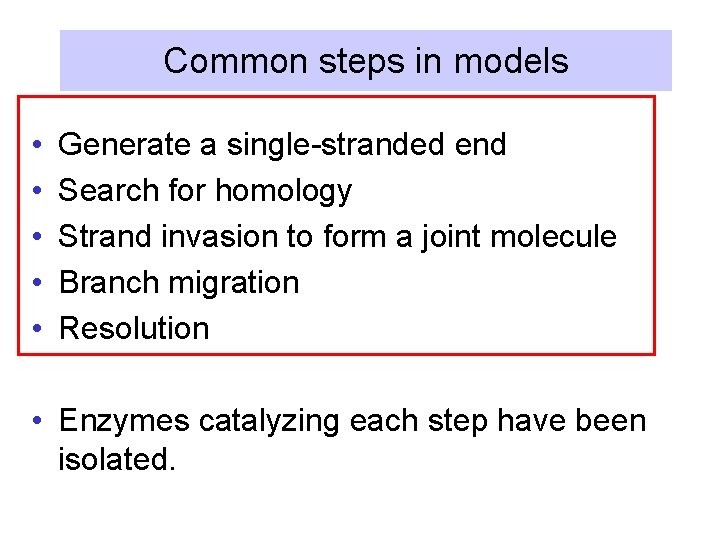
Common steps in models • • • Generate a single-stranded end Search for homology Strand invasion to form a joint molecule Branch migration Resolution • Enzymes catalyzing each step have been isolated.
- Slides: 27