
Recombinasemediated toolbox CreLox system Cre recombinase recombines a
Recombinase-mediated toolbox Cre-Lox system: • Cre recombinase recombines a pair of short target sequences (Lox. P sites) • Depending on the location and orientation of the lox. P sites, Cre recombinase can initiate deletions, inversions, and translocations of the floxed locus. • The most widely used site-specific recombinase system for genome manipulation in mice. Because it is more efficient than other systems. Flp-FRT system: Flp is analogous to cre and FRT to lox. P. Dre-rox system: Dre is analogous to cre and rox to lox. P.
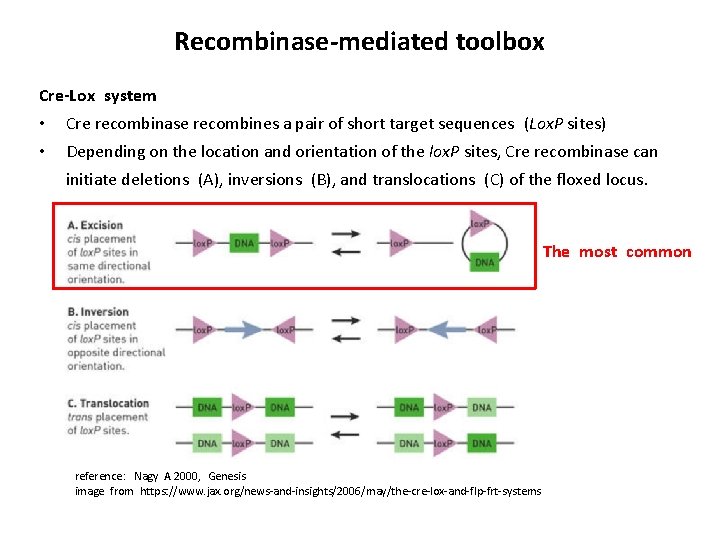
Recombinase-mediated toolbox Cre-Lox system • Cre recombinase recombines a pair of short target sequences (Lox. P sites) • Depending on the location and orientation of the lox. P sites, Cre recombinase can initiate deletions (A), inversions (B), and translocations (C) of the floxed locus. The most common reference: Nagy A 2000, Genesis image from https: //www. jax. org/news-and-insights/2006/may/the-cre-lox-and-flp-frt-systems
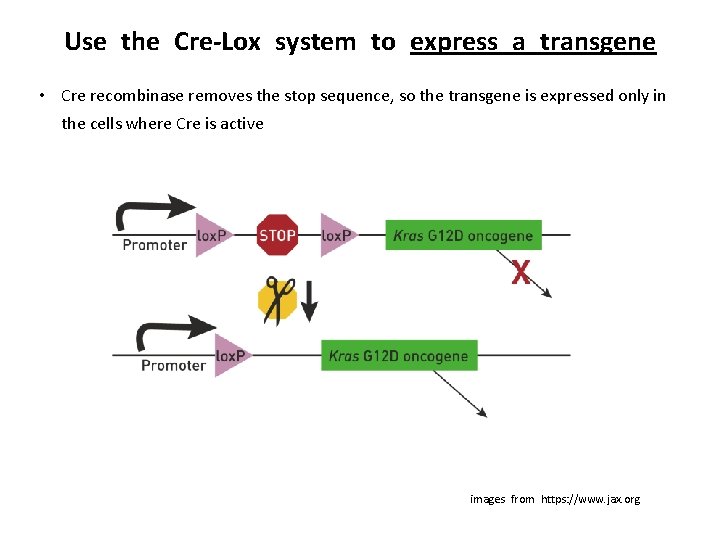
Use the Cre-Lox system to express a transgene • Cre recombinase removes the stop sequence, so the transgene is expressed only in the cells where Cre is active images from https: //www. jax. org
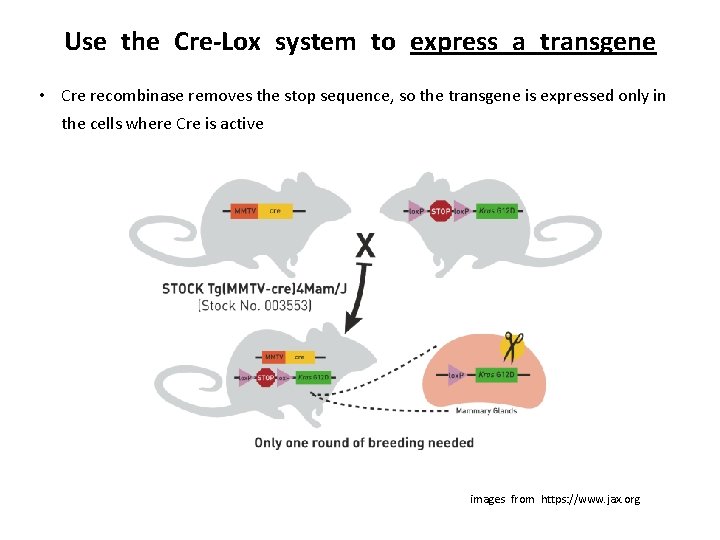
Use the Cre-Lox system to express a transgene • Cre recombinase removes the stop sequence, so the transgene is expressed only in the cells where Cre is active images from https: //www. jax. org
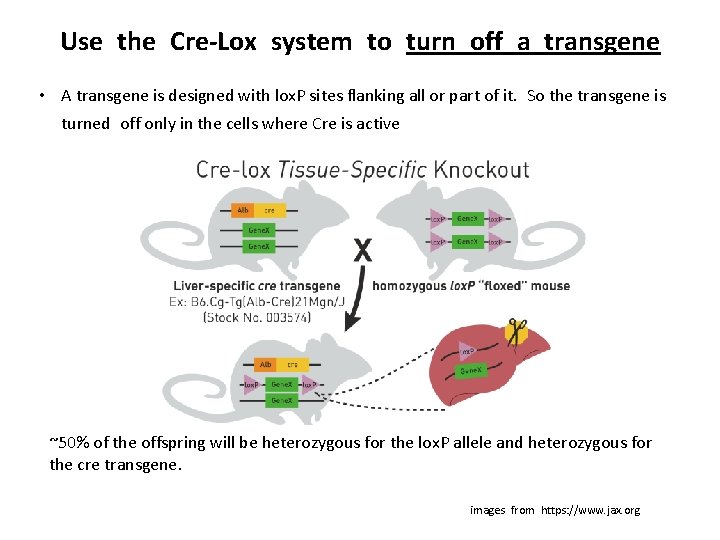
Use the Cre-Lox system to turn off a transgene • A transgene is designed with lox. P sites flanking all or part of it. So the transgene is turned off only in the cells where Cre is active ~50% of the offspring will be heterozygous for the lox. P allele and heterozygous for the cre transgene. images from https: //www. jax. org
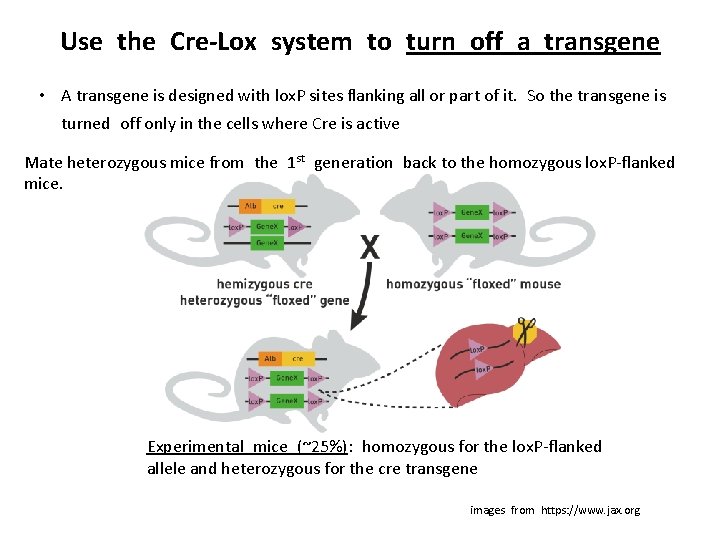
Use the Cre-Lox system to turn off a transgene • A transgene is designed with lox. P sites flanking all or part of it. So the transgene is turned off only in the cells where Cre is active Mate heterozygous mice from the 1 st generation back to the homozygous lox. P-flanked mice. Experimental mice (~25%): homozygous for the lox. P-flanked allele and heterozygous for the cre transgene images from https: //www. jax. org
Inducibility: allows temporal control of gene manipulation • The tamoxifen-inducible cre alleles: the most common inducible Cre variety. Cre is expressed as a fusion protein with a modified estrogen receptor (ER) ligand binding domain. Binding to tamoxifen allows the Cre-ER fusion protein to translocate to the nucleus where the recombinase takes effect. • The RU-486 inducible cre alleles: : cre is expressed as a fusion protein with a modified progesterone receptor, allowing induction with the progesterone analog RU 486. • The TMP-inducible cre alleles: cre is expressed as a fusion protein with a modified E. coli dihydrofolate reductase (DHFR) protein, which can be induced by the common antibiotic trimethoprim (TMP).

Use multiple recombinases for sophisticated manipulation • As Cre, Flp, and Dre recognize different target sequences, the combined use of these recombinases would facilitate more sophisticated genetic manipulation of restricted cell populations. • Example 1: Intersectional control by either Cre/Flp or Cre/Dre recombinases, driven by different promoters (P 1 or P 2), on a doubly regulated reporter line. Reference: Madisen L et al. , 2015 Neuron; Imayoshi I et al. , 2011 Front. Neurosci.
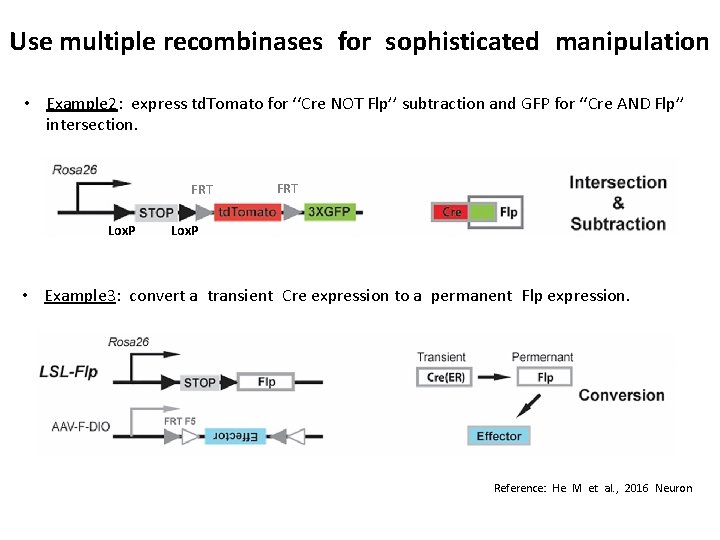
Use multiple recombinases for sophisticated manipulation • Example 2: express td. Tomato for ‘‘Cre NOT Flp’’ subtraction and GFP for ‘‘Cre AND Flp’’ intersection. FRT Lox. P • Example 3: convert a transient Cre expression to a permanent Flp expression. Reference: He M et al. , 2016 Neuron
- Slides: 9