
Recombinant Inbred Strains Step 1 Initial Mendelian Cross
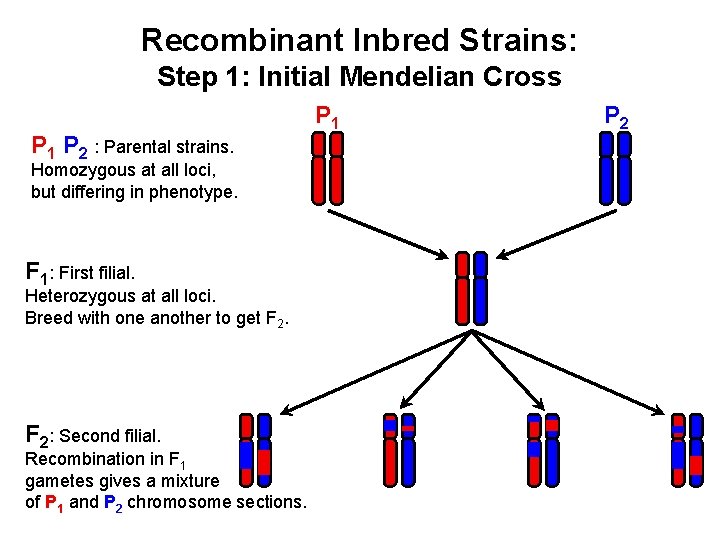
Recombinant Inbred Strains: Step 1: Initial Mendelian Cross P 1 P 2 : Parental strains. Homozygous at all loci, but differing in phenotype. F 1: First filial. Heterozygous at all loci. Breed with one another to get F 2: Second filial. Recombination in F 1 gametes gives a mixture of P 1 and P 2 chromosome sections. P 1 P 2
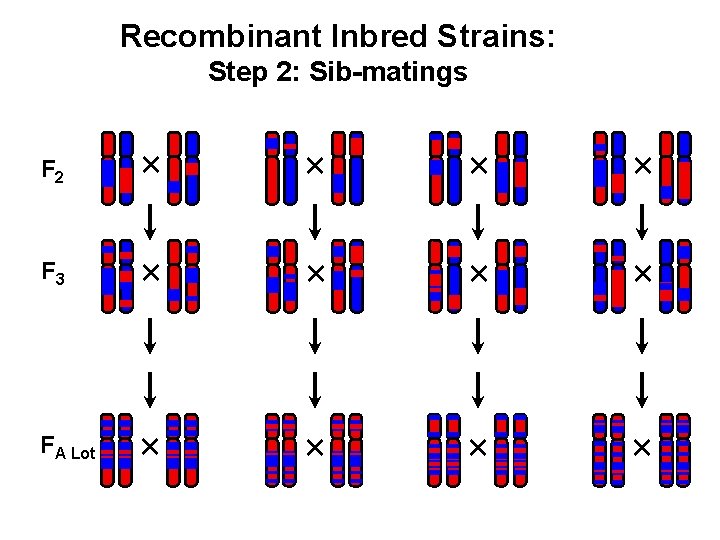
Recombinant Inbred Strains: Step 2: Sib-matings F 2 × × F 3 × × FA Lot × ×
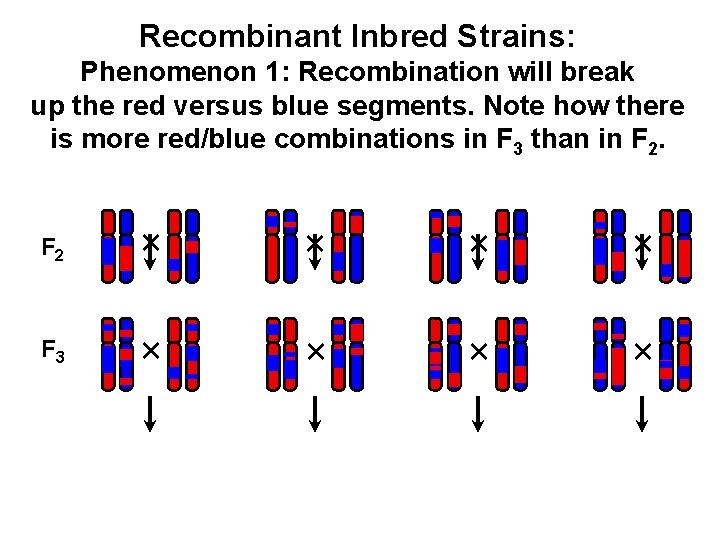
Recombinant Inbred Strains: Phenomenon 1: Recombination will break up the red versus blue segments. Note how there is more red/blue combinations in F 3 than in F 2 × × F 3 × ×

Recombinant Inbred Strains: Phenomenon 2: Sib matings increase homozygosity. After a large number of generations (20 is close to “large”), one creates inbred strains that are identical at all loci. F 3 × × FA Lot × ×
Common Sense Explanation: Recombination breaks up the red versus blue areas. But within a line of sib matings, the SAME red/blue combinations are transmitted and, after a long time, become homozygous. .

Recombinant Inbred Strains: Linkage Analysis At each locus, ½ of the strains should be rr and the other 1/2 will be bb. Do a t-test using phenotypic scores as the dependent variable and genotype ( rr versus bb) as the group variable. If the test is significant, then that gene (or more likely, a gene close to the genotyped locus) influences the phenotype. A more complicated approach would use haplotypes.
- Slides: 6