
Recognizing Different Sports Injuries Chapter 13 Pages 315
- Slides: 8
Recognizing Different Sports Injuries Chapter 13 Pages 315 -334
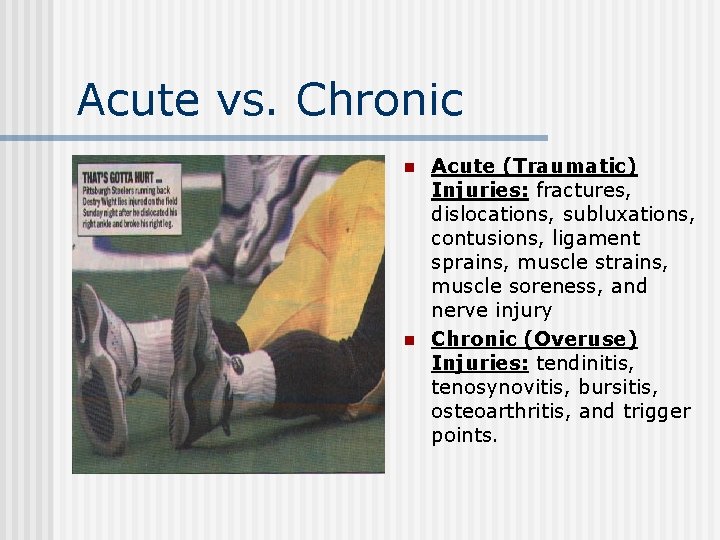
Acute vs. Chronic n n Acute (Traumatic) Injuries: fractures, dislocations, subluxations, contusions, ligament sprains, muscle strains, muscle soreness, and nerve injury Chronic (Overuse) Injuries: tendinitis, tenosynovitis, bursitis, osteoarthritis, and trigger points.
Acute Injury: Fractures n n Anatomy of a Long Bone: diaphysis, epiphysis, articular cartilage, and periosteum. Signs and symptoms: obvious deformity, point tenderness, swelling, pain with ROM, and/or crepitus. Fractures can occur via the following forces: tension, compression, bending, twisting, and shear. Fracture Healing n n n n Open vs. closed fractures. Immobilization for period of 3 -6 weeks. Osteoblasts must lay down extra bone formation and form a callus. Osteoclasts help to reshape the bone in response to normal stresses and strains. Types of fractures with pictures available in your text on pages 300 -301. http: //www. youtube. com/watch? v=l. KH 4 -2 -O 1 EI http: //www. youtube. com/watch? v=FQkt 6 ZDt. VS 4&feature=related
Acute Injury: Dislocations and Subluxations n Dislocation – a bone is forced out of alignment and stays out until it is either manually or surgically put back into place or reduced. n n Subluxation – a bone pops out of its normal articulation but then goes right back into place. n n n n Commonly occur at the shoulder, elbow, and fingers. Commonly occur at the shoulder and patella. Dislocations and subluxations may result in a rupture of stabilizing ligaments and tendons surrounding the joint. Compare bilaterally. Dislocations should never be reduced immediately and considered a potential fracture. Other concerns: avulsion fracture, growth plate injury, and/or damage to nerve/blood vessels. http: //www. youtube. com/watch? v=k. K 52 APq. Mji. A&feature=related http: //www. youtube. com/watch? v=Kj. Ji_FCRhl 0&feature=related
Acute Injury: Ligament Sprains n n n n Sprain – injury to a ligament that connects bone to bone. A ligament is a tough, inelastic band of tissue that connects one bone to another. Anatomy of a synovial joint: articular/hyaline cartilage, joint capsule, synovial membrane, and synovial fluid. Mechanoreceptors - located in muscles, tendons, ligaments, and joints - provides information regarding the position of a joint. Meniscus The anatomical position of a ligament determines what motions a joint is capable of making. Classification of ligament sprains: Grade 1 sprain, Grade 2 sprain, and Grade 3 sprain.
Acute Injury: Muscle Injuries n Muscle strain – a stretch, tear, or rip in the muscle or tendon. n n n Severity of damage: grade 1, grade 2, and grade 3 muscle strains. Muscle cramps – involuntary muscle contraction. Muscle guarding – muscle contraction in response to pain. Muscle soreness: acute-onset muscle soreness and delayed-onset muscle soreness (DOMS) Contusion – results when soft tissues are compressed between bone and external force. Nerve Injuries n n Nerve injuries usually involve compression or tension; Trauma can result in hypoesthesia, hyperesthesia, and/or paraesthesia. Neuritis – chronic nerve irritation.
Chronic Overuse Injuries n n n Tendinitis – inflammation of a tendon. Tenosynovitis – inflammation of a tendon and its synovial sheath. Bursitis – inflammation of the bursa sac. Osteoarthritis – a wearing down of hyaline cartilage. Myofascial trigger point – area of tenderness in a tight band of muscle.
Healing Process n Inflammatory Response Phase n n Fibroblastic Repair Phase n n Most critical phase of healing process; begins immediately following injury; phagocytes eat debris; chemicals released; 2 -4 days Fibroplasia; hours to weeks; signs and symptoms associated with inflammation begin to decrease; injury still tender to touch and painful with ROM Maturation-Remodeling Phase n Long-term process; realignment of scar tissue per tensile forces placed on scar