RECOGNIZING CRANIOSYNOSTOSE ERN CRANIO This powerpoint can help
- Slides: 8
RECOGNIZING CRANIOSYNOSTOSE ERN CRANIO This powerpoint can help to recognize the diagnosis craniosynostosis. Whenever there is doubt about the diagnosis, seek advise at a center of expertise on craniosynostosis.
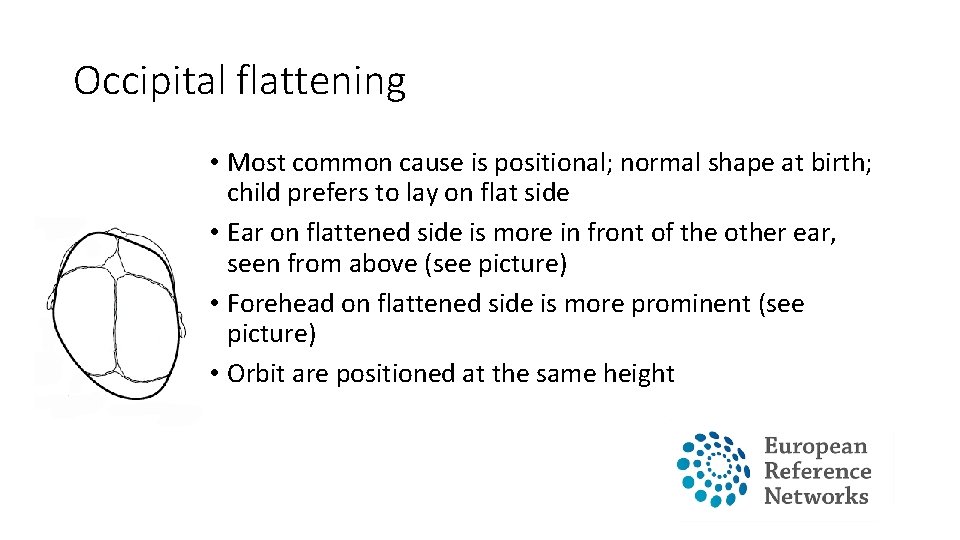
Occipital flattening • Most common cause is positional; normal shape at birth; child prefers to lay on flat side • Ear on flattened side is more in front of the other ear, seen from above (see picture) • Forehead on flattened side is more prominent (see picture) • Orbit are positioned at the same height
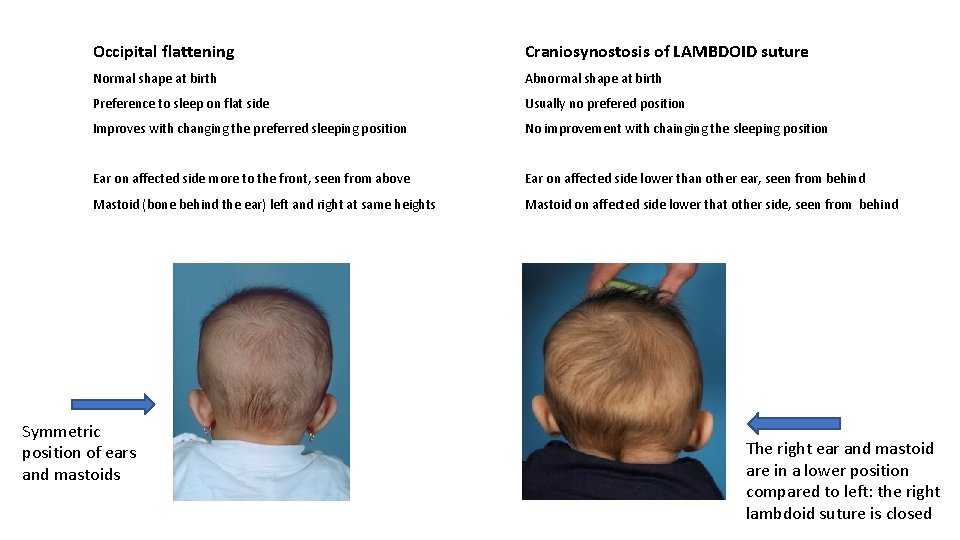
Occipital flattening Craniosynostosis of LAMBDOID suture Normal shape at birth Abnormal shape at birth Preference to sleep on flat side Usually no prefered position Improves with changing the preferred sleeping position No improvement with chainging the sleeping position Ear on affected side more to the front, seen from above Ear on affected side lower than other ear, seen from behind Mastoid (bone behind the ear) left and right at same heights Mastoid on affected side lower that other side, seen from behind Symmetric position of ears and mastoids The right ear and mastoid are in a lower position compared to left: the right lambdoid suture is closed
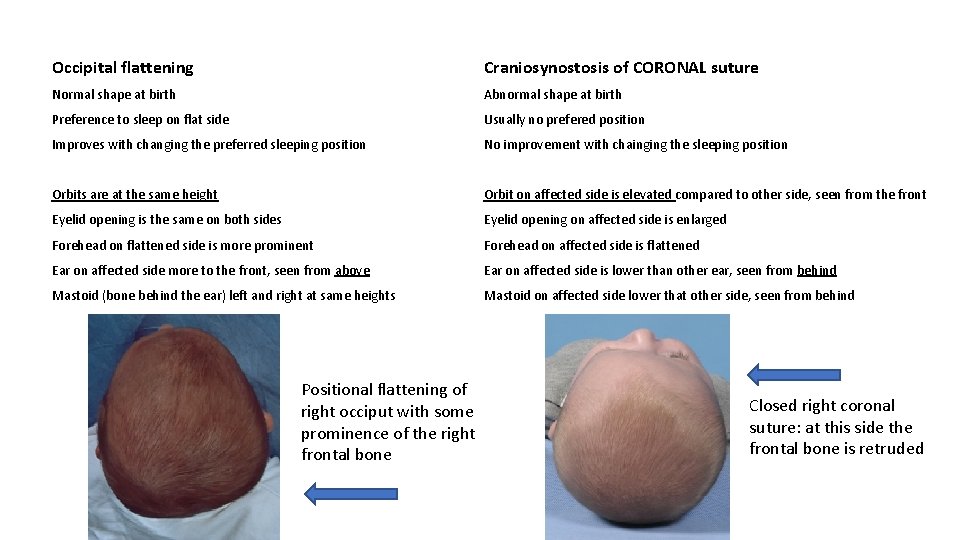
Occipital flattening Craniosynostosis of CORONAL suture Normal shape at birth Abnormal shape at birth Preference to sleep on flat side Usually no prefered position Improves with changing the preferred sleeping position No improvement with chainging the sleeping position Orbits are at the same height Orbit on affected side is elevated compared to other side, seen from the front Eyelid opening is the same on both sides Eyelid opening on affected side is enlarged Forehead on flattened side is more prominent Forehead on affected side is flattened Ear on affected side more to the front, seen from above Ear on affected side is lower than other ear, seen from behind Mastoid (bone behind the ear) left and right at same heights Mastoid on affected side lower that other side, seen from behind Positional flattening of right occiput with some prominence of the right frontal bone Closed right coronal suture: at this side the frontal bone is retruded
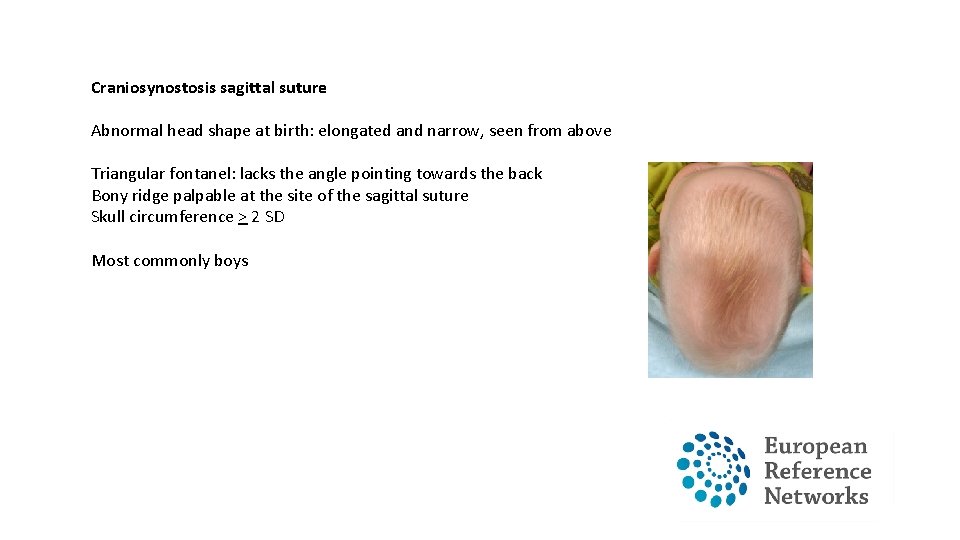
Craniosynostosis sagittal suture Abnormal head shape at birth: elongated and narrow, seen from above Triangular fontanel: lacks the angle pointing towards the back Bony ridge palpable at the site of the sagittal suture Skull circumference > 2 SD Most commonly boys
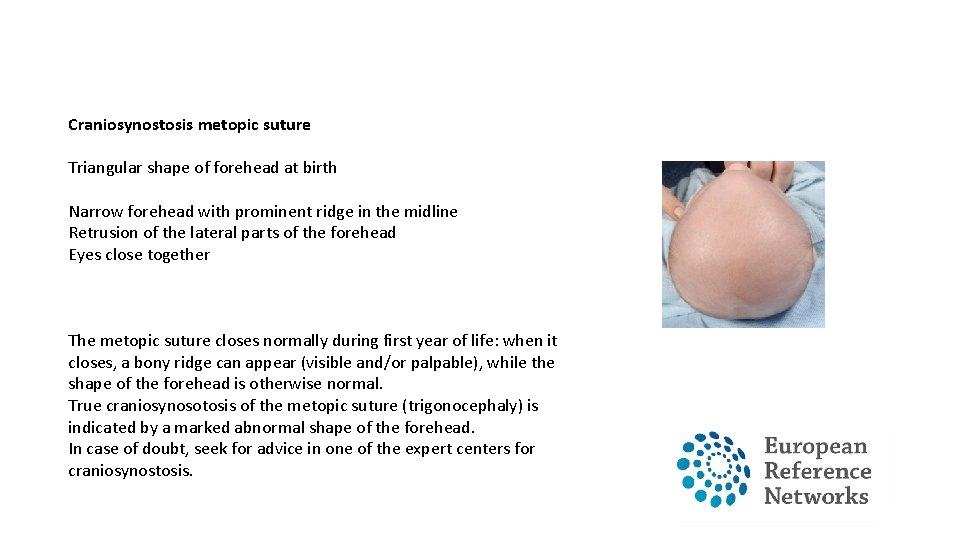
Craniosynostosis metopic suture Triangular shape of forehead at birth Narrow forehead with prominent ridge in the midline Retrusion of the lateral parts of the forehead Eyes close together The metopic suture closes normally during first year of life: when it closes, a bony ridge can appear (visible and/or palpable), while the shape of the forehead is otherwise normal. True craniosynosotosis of the metopic suture (trigonocephaly) is indicated by a marked abnormal shape of the forehead. In case of doubt, seek for advice in one of the expert centers for craniosynostosis.
Craniosynostosis of both coronal sutures Abnormal head shape at birth: flattened forehead (especially at the level of the eyebrows) and a broad skull Usually, the fontanel has less prominent angles toward the sides Check for additional congenital anomalies (for instance webbing between fingers and toes, low position of one or both eyelids, abnormal shape of the ears etc), which may indicate a syndromic form of craniosynostosis
ABNORMAL FINDINGS DURING EXAMINATION OF THE HEAD Early closure of the anterior fontanel If the head shape and skull growht curve are normal, then this finding in itself is not worrying; following up on normal growth of the skull is warranted. If the closed fontanel forms a bulge, or when growth curve declines, referral is required to exclude raised intracranial pressure. Skull circumference < 2. 5 SD If the skull growht continues on this curve, no special concerns regarding craniosynostosis are needed. Consider referral to a pediatric neurologist if a delay in neurodevelopment is suspected. Skull circumference growth curve is declining Referral is required to an expert center for craniosynostosis to exclude raised intracranial pressure; head shape may be normal when all sutures close too early after birth (pansynostosis).