
Recognizing Clinical Reasoning Errors Heidi Chumley MD Associate

- Slides: 20
Recognizing Clinical Reasoning Errors Heidi Chumley, MD Associate Professor, Family Medicine
Session Objectives • At the end of this session, participants should be able to: – Outline the steps of the clinical reasoning process. – Define cognitive dispositions to respond (CDRs) and describe several CDRs seen with diagnostic reasoning errors. – Recognize clinical reasoning errors in common educational settings.
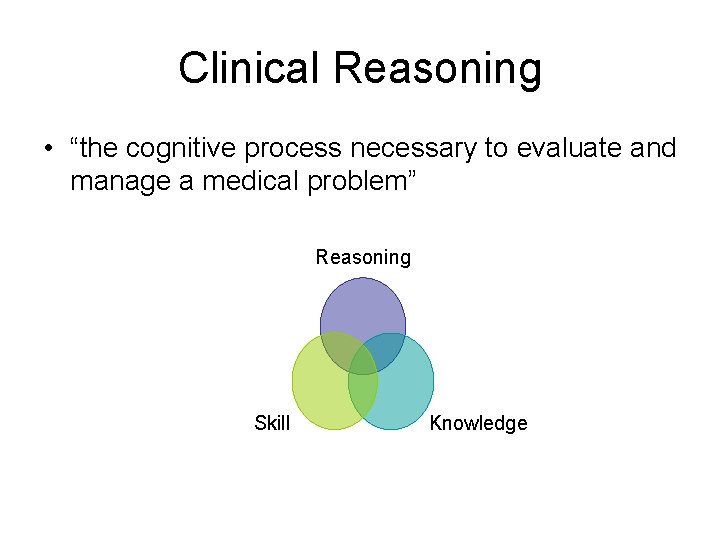
Clinical Reasoning • “the cognitive process necessary to evaluate and manage a medical problem” Reasoning Skill Knowledge
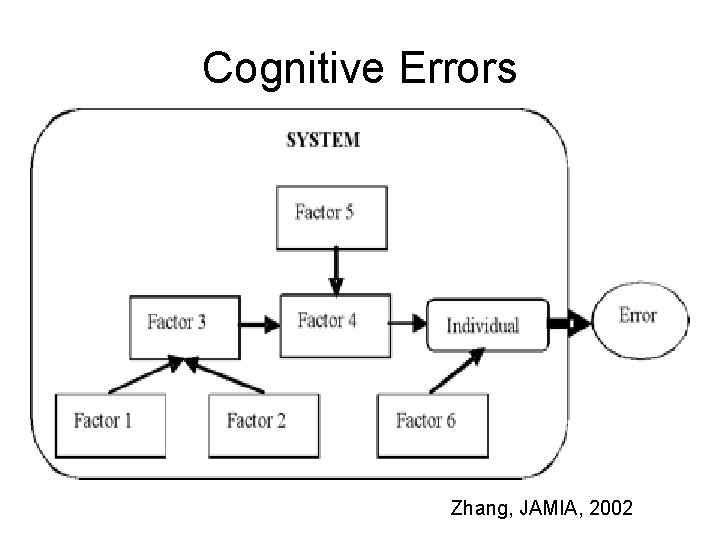
Medical Errors • 44, 000 to 98, 000 deaths per year due to medical errors • Many systematic and individual factors contribute to medical errors • Recent attention on cognitive errors (clinical reasoning, diagnostic reasoning, decision-making)
Cognitive Errors Zhang, JAMIA, 2002
Cognitive Errors • Of 301 Malpractice claims, 59% involved diagnostic errors that led to poor outcomes – Gandhi, 2006 • Of patients admitted with 10 days of outpatient visit, 10% due to diagnostic error – Singh, 2007 • Autopsy series showed 24% missed diagnosis – Shojania, 2003
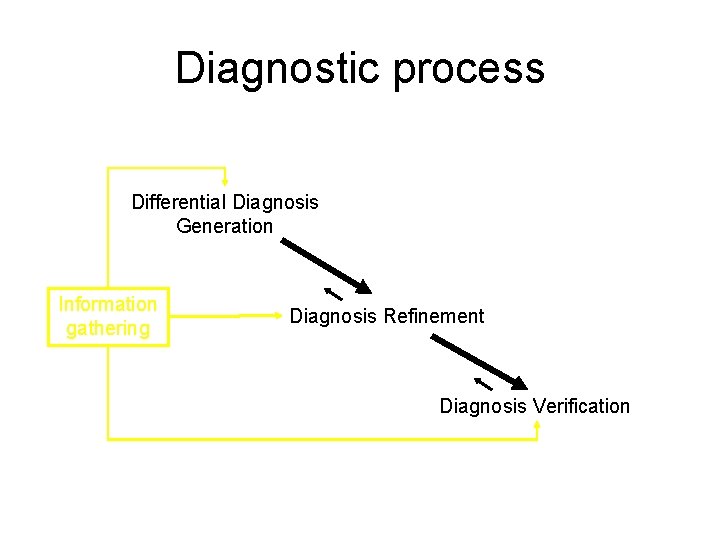
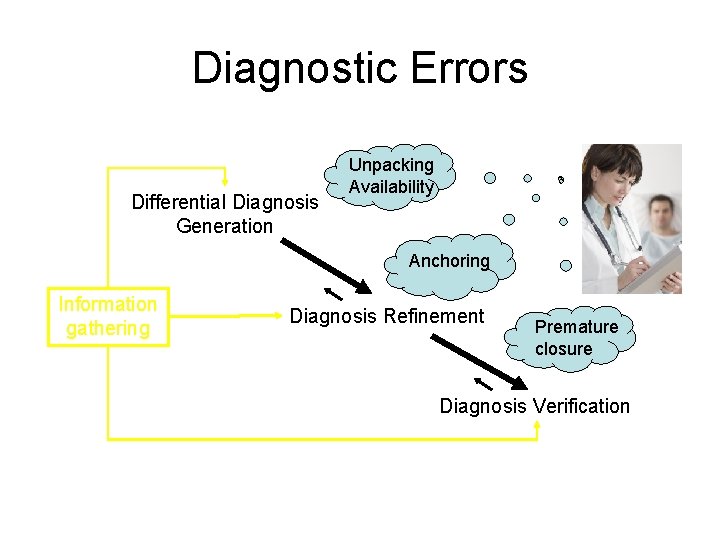
Diagnostic process Differential Diagnosis Generation Information gathering Diagnosis Refinement Diagnosis Verification
Why are errors made? • Failure/delay of eliciting information – Singh, 2007 • Suboptimal weighing of critical pieces of information from H&P – Singh, 2007 • Overreliance on diagnostic testing – Bordage, 1999
Cognitive Dispositions to Respond • Biases that can lead to diagnostic errors • Mental shortcuts running amuck • Croskerry defines 32, Acad Med, 2003: 78(8)
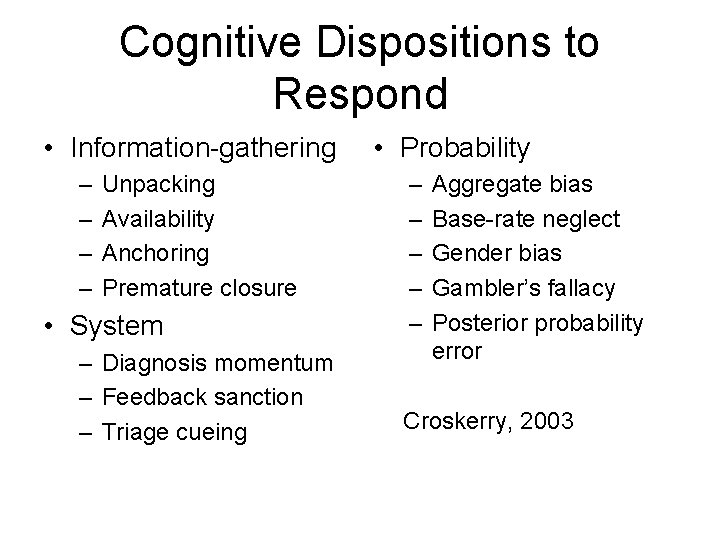
Cognitive Dispositions to Respond • Information-gathering – – Unpacking Availability Anchoring Premature closure • System – Diagnosis momentum – Feedback sanction – Triage cueing • Probability – – – Aggregate bias Base-rate neglect Gender bias Gambler’s fallacy Posterior probability error Croskerry, 2003
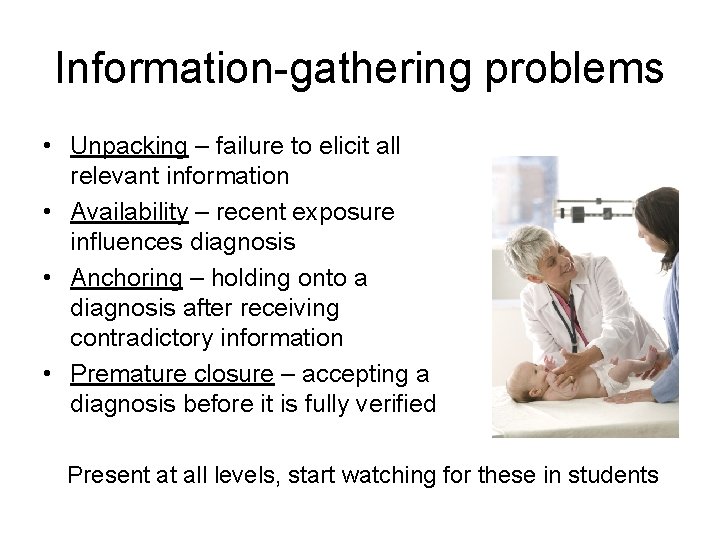
Information-gathering problems • Unpacking – failure to elicit all relevant information • Availability – recent exposure influences diagnosis • Anchoring – holding onto a diagnosis after receiving contradictory information • Premature closure – accepting a diagnosis before it is fully verified Present at all levels, start watching for these in students
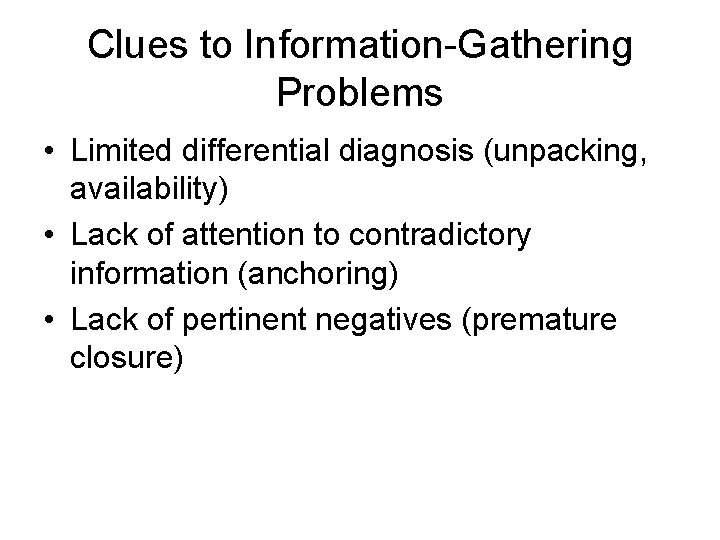
Clues to Information-Gathering Problems • Limited differential diagnosis (unpacking, availability) • Lack of attention to contradictory information (anchoring) • Lack of pertinent negatives (premature closure)
Diagnostic Errors Differential Diagnosis Generation Unpacking Availability Anchoring Information gathering Diagnosis Refinement Premature closure Diagnosis Verification
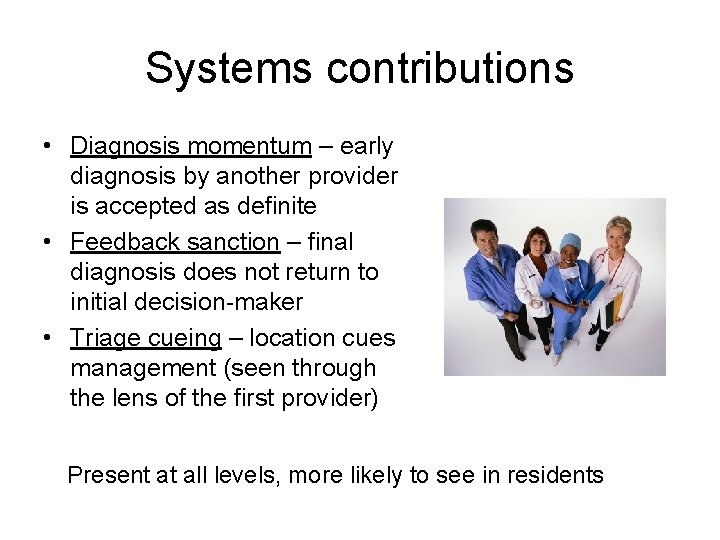
Systems contributions • Diagnosis momentum – early diagnosis by another provider is accepted as definite • Feedback sanction – final diagnosis does not return to initial decision-maker • Triage cueing – location cues management (seen through the lens of the first provider) Present at all levels, more likely to see in residents
Clues to System Contributors • Lack of primary symptom data (diagnostic momentum) • Inattention to closing the loop (feedback sanction) • Non diagnoses: non-cardiac chest pain; no gynecologic cause for lower abdominal pain (triage cueing)
Probability Pitfalls • Aggregate bias – aggregate data do not apply to my patients • Base-rate neglect – ignoring the true prevalence • Gender bias – gender inappropriately colors probability • Gambler’s fallacy – sequence of same diagnoses will not continue • Posterior probability – sequence of same diagnoses will continue Best seen during continuity experiences, residency
Clues to Probability Pitfalls • Didn’t meet criteria, but I…(aggregate) • Rare diagnoses high on list, increased testing (base-rate neglect) • Comments about probability (Gambler’s fallacy, posterior probability)
Two Others • Representative restraint – ruled out because the presentation is not typical • Search satisfying – search is called off when something is found
Summing Up • Reasoning errors are common • Identifying/naming the CDRs is an important part of reflection • No gold standard for assessing reasoning in our learners – nothing to replace our conversations and helping them think about how they are thinking • Are cognitive errors treatable? Yes
Questions?