
RECOGNIZING AND AVOIDING FINANCIAL CONFLICTS OF INTEREST A
- Slides: 17
RECOGNIZING AND AVOIDING FINANCIAL CONFLICTS OF INTEREST A PROFESSIONAL STAFF ACTIVITY CONCERNING FINANCIAL RELATIONSHIPS BETWEEN HEALTH CARE PROFESSIONALS AND INDUSTRY 1
Why Conflicts of Interest Matter Financial relationships may compromise professional objectivity and integrity, undermining one’s ethical obligation to put the interests of patients first. A conflict of interest may result in: • Physical harm to patients • A conflict of commitment • Bias, loss of objectivity and integrity, and departure from professional standards • A loss of trust in physicians, and a loss of public trust in VA 1 2
Ways that Industry Has Tried to Influence Physicians • Ghostwriting articles to shape the medical literature 3 • Sponsoring drug detailing to prescribers ($15 Billion in 2012)4, 5 • Illegally promoting off-label use through payments to physicians for advisory board memberships, consulting, meetings, medical education events, and cultivating thought leaders 6 3
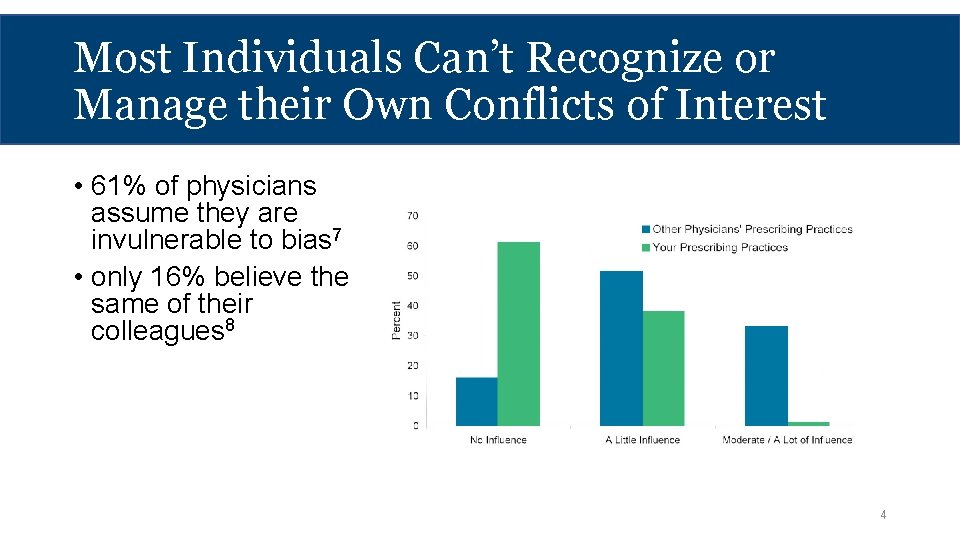
Most Individuals Can’t Recognize or Manage their Own Conflicts of Interest • 61% of physicians assume they are invulnerable to bias 7 • only 16% believe the same of their colleagues 8 4
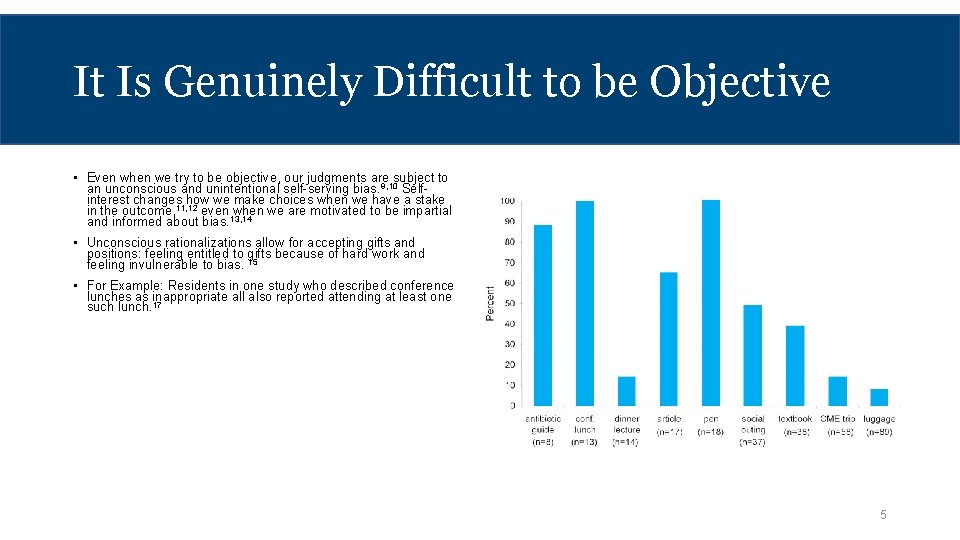
It Is Genuinely Difficult to be Objective • Even when we try to be objective, our judgments are subject to an unconscious and unintentional self-serving bias. 9, 10 Selfinterest changes how we make choices when we have a stake in the outcome, 11, 12 even when we are motivated to be impartial and informed about bias. 13, 14 • Unconscious rationalizations allow for accepting gifts and positions: feeling entitled to gifts because of hard work and feeling invulnerable to bias. 15 • For Example: Residents in one study who described conference lunches as inappropriate all also reported attending at least one such lunch. 17 5
Impact of Conflict of Interest on Physician Behavior • Gifts of less than $20 are shown to affect physicians 18 • Industry sponsored research is 3. 6 times more likely to reach conclusions favorable to industry than non-sponsored studies 19 • Physicians who accepted money from a drug company are 19 times more likely to request formulary additions from that company than physicians who didn’t take money 20 • Contact with industry reps is associated with higher prescribing frequency, higher costs, or lower prescribing quality 21 6
What Kinds of Relationships Could Constitute a Conflict? Any relationship that may lead you to put your own personal gain, or a close family member’s personal gain above your duty to your patients: • Membership on a pharmaceutical company’s Speaker’s Bureau • Compensation for speaking at an event for a third party educational group • Agreeing to collaborate with an industry physician on a research project, • Attending an industry-sponsored or industry proxy group-sponsored dinner for leading physicians • Dinner lectures featuring faculty speakers • Funding for Travel to a CME conference 7
Conflict of Interest Policies Are Common Across Health Care • AMA and other organizations have conflict of interest policies for both members and those serving in leadership or decision-making roles • The American Medical Students Association rates medical schools on 14 areas in their COI policies • The Pew Charitable Trusts publishes best practices for conflict of interest policies at public and private medical centers 8
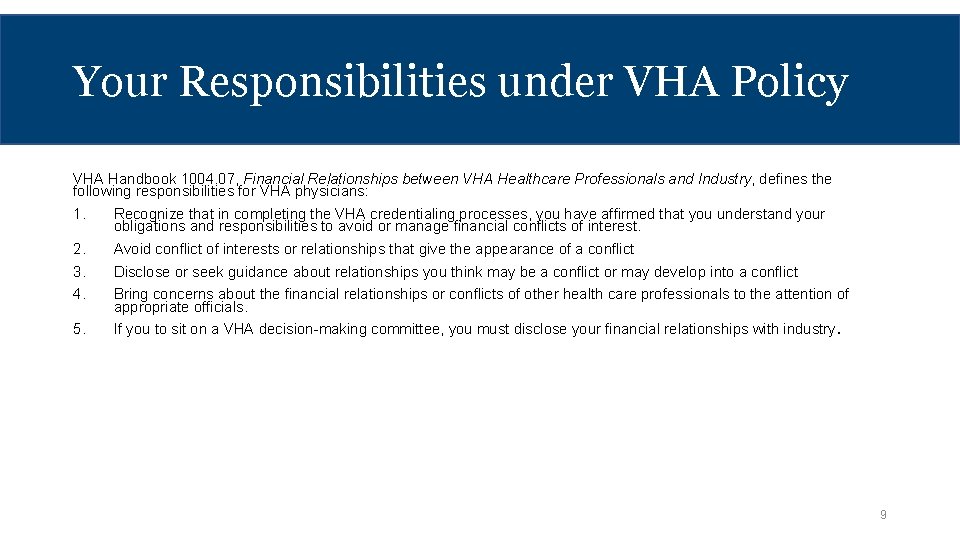
Your Responsibilities under VHA Policy VHA Handbook 1004. 07, Financial Relationships between VHA Healthcare Professionals and Industry, defines the following responsibilities for VHA physicians: 1. Recognize that in completing the VHA credentialing processes, you have affirmed that you understand your obligations and responsibilities to avoid or manage financial conflicts of interest. 2. 3. 4. Avoid conflict of interests or relationships that give the appearance of a conflict 5. If you to sit on a VHA decision-making committee, you must disclose your financial relationships with industry. Disclose or seek guidance about relationships you think may be a conflict or may develop into a conflict Bring concerns about the financial relationships or conflicts of other health care professionals to the attention of appropriate officials. 9
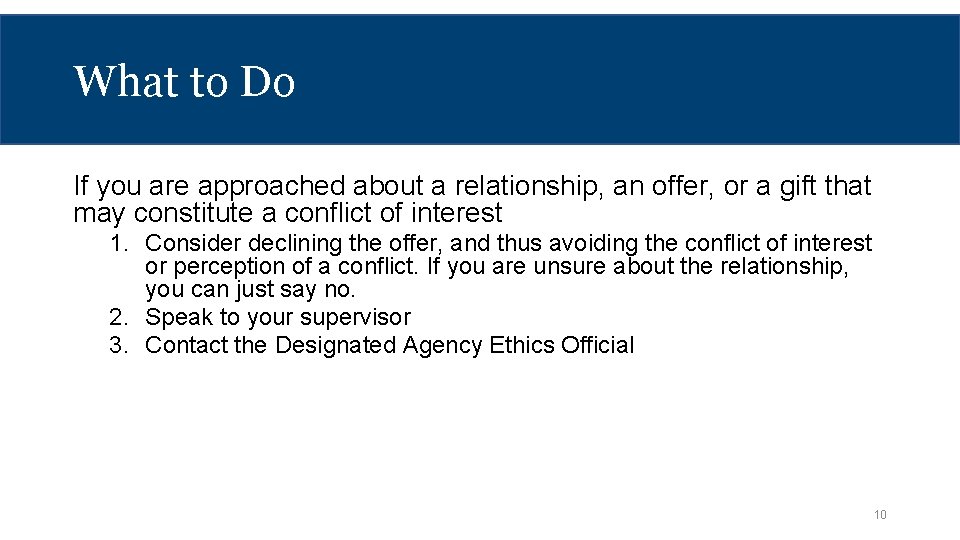
What to Do If you are approached about a relationship, an offer, or a gift that may constitute a conflict of interest 1. Consider declining the offer, and thus avoiding the conflict of interest or perception of a conflict. If you are unsure about the relationship, you can just say no. 2. Speak to your supervisor 3. Contact the Designated Agency Ethics Official 10
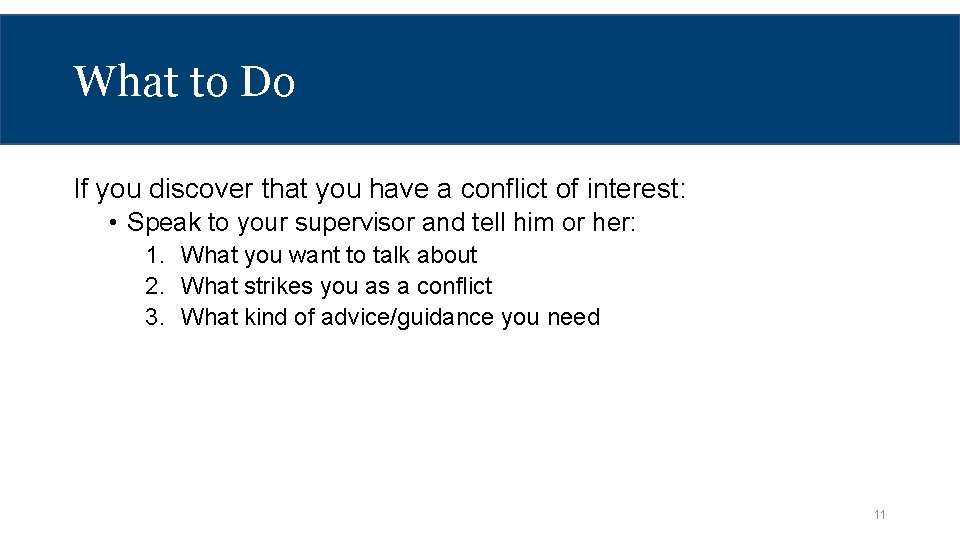
What to Do If you discover that you have a conflict of interest: • Speak to your supervisor and tell him or her: 1. What you want to talk about 2. What strikes you as a conflict 3. What kind of advice/guidance you need 11
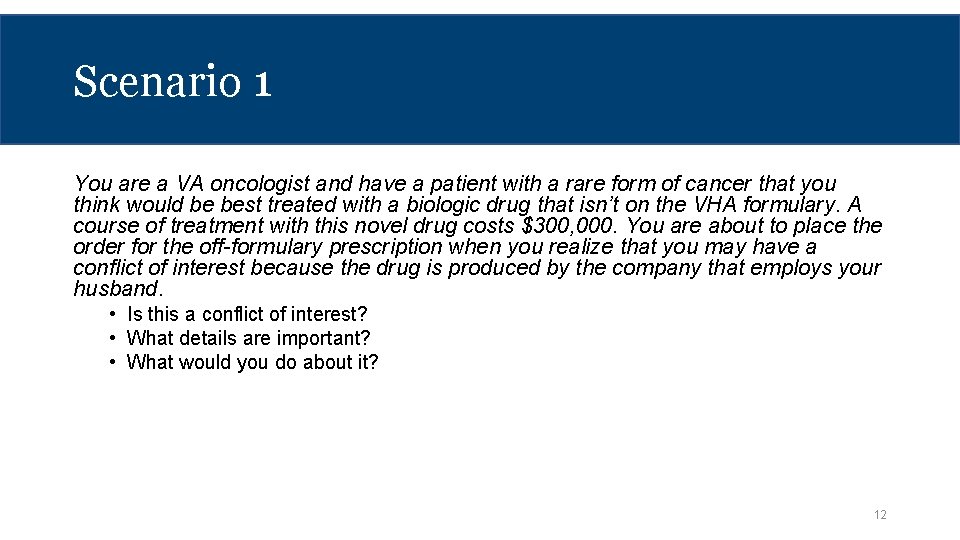
Scenario 1 You are a VA oncologist and have a patient with a rare form of cancer that you think would be best treated with a biologic drug that isn’t on the VHA formulary. A course of treatment with this novel drug costs $300, 000. You are about to place the order for the off-formulary prescription when you realize that you may have a conflict of interest because the drug is produced by the company that employs your husband. • Is this a conflict of interest? • What details are important? • What would you do about it? 12
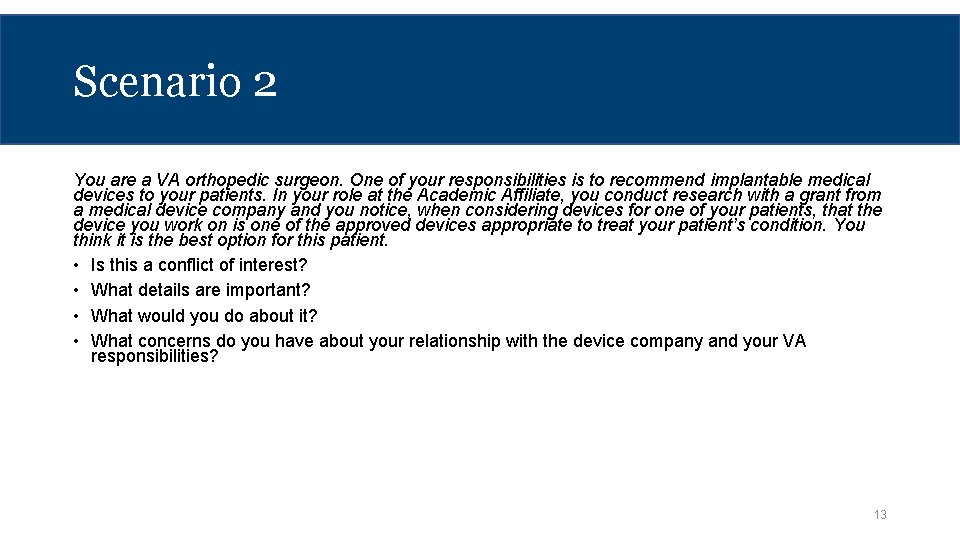
Scenario 2 You are a VA orthopedic surgeon. One of your responsibilities is to recommend implantable medical devices to your patients. In your role at the Academic Affiliate, you conduct research with a grant from a medical device company and you notice, when considering devices for one of your patients, that the device you work on is one of the approved devices appropriate to treat your patient’s condition. You think it is the best option for this patient. • Is this a conflict of interest? • What details are important? • What would you do about it? • What concerns do you have about your relationship with the device company and your VA responsibilities? 13
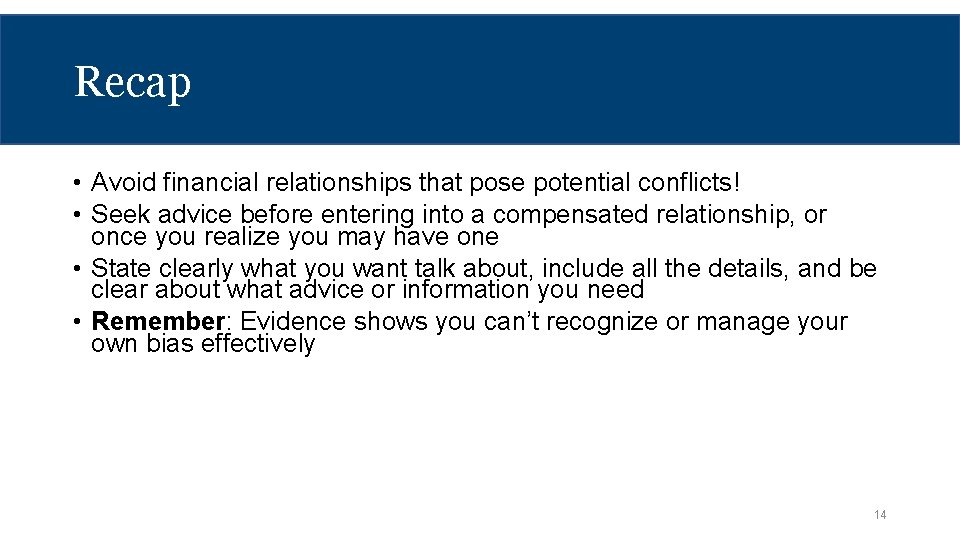
Recap • Avoid financial relationships that pose potential conflicts! • Seek advice before entering into a compensated relationship, or once you realize you may have one • State clearly what you want talk about, include all the details, and be clear about what advice or information you need • Remember: Evidence shows you can’t recognize or manage your own bias effectively 14
References 1. United States Department of Veterans Affairs. National Center for Ethics in Health Care. Compensation to Health Care Professionals from the Pharmaceutical Industry. 2006. 6. Steinman, MA, Bero, LA, Chren, M, & Landefeld, S. Narrative review: The promotion of gabapentin: An analysis of internal industry documents. Annals of Internal Medicine 2006; 145(4): 284 -294. 2. Sah S. Conflicts of interest and your physician: psychological processes that cause unexpected changes in behavior. J Law Med Ethics 2012; 40(3): 482 -7. 7. Sah S. , 486. 3. Ross, JS, Hill, KP, Egilman, DS, Krumholz, HM Guest authorship and ghostwriting in publications related to rofecoxib: A case study of industry documents from rofecoxib litigation. JAMA 2008; 299(15): 1800 -1812. 4. Cegedim Strategic Data. (2013). 2012 U. S. Pharmaceutical promotion spending. 5. Reidy, J. Hard Sell: The Evolution of a Viagra Salesman. Kansas City: Mc. Meel Publishing, 2005. 8. Steinman MA, Shlipak MG, Mc. Phee SJ. Of principles and pens: attitudes and practices of medicine housestaff toward pharmaceutical industry promotions. Am J Med. 2001; 110(7): 554. 9. Dana J, Loewenstein G. A social science perspective on gifts to physicians from industry, JAMA 2003; 290: 252– 55. 10. Weber LJ, Wayland MT, Holton B. Health care professionals and industry: Reducing conflicts of interest and established best practices, Archives of Physical Medicine & Rehabilitation 2001; 82, Suppl 2: S 20–S 24. 15
References, Continued 11. Dana J, Loewenstein G. 12. Bazerman MH, Loewenstein G, Moore DA. Why good accountants do bad audits, Harvard Business Review 2002; November: 97– 102. 13. Dana J, Loewenstein G. 14. Weber LJ, Wayland MT, Holton B. 15. Sah, S. 484. 16. Keller F, Marczewski K, Pavlović D. The relationship between the physician and pharmaceutical industry: background ethics and regulation proposals. Croat Med J. 2016; 57(4): 398. 17. Steinman MA, Shlipak MG, Mc. Phee SJ. 554. 18. Patwardhan AR. Physicians-Pharmaceutical sales representatives interactions and conflict of interest: challenges and solutions. Inquiry. 2016 53: 3. 19. Bekelman JE, Li Y, Gross CP. Scope and impact of financial conflicts of interest in biomedical research: a systematic review. JAMA. 2003; 289(4): 456. 20. Chren MM, Landefeld CS. Physicians' behavior and their interactions with drug companies. A controlled study of physicians who requested additions to a hospital drug formulary. JAMA. 1994; 271(9): 684 -9. 21. Spurling GK, Mansfield PR, Montgomery BD, et al. Information from pharmaceutical companies and the quality, quantity, and cost of physicians’ prescribing: a systematic review. PLo. S Med 2010; 7(10): e 1000352. 16
Thanks for Attending! • Reach the Designated Agency Ethics Official at: Government. Ethics@va. gov • NCEHC website has more information about Conflict of Interest and other ethics topics 17