
Recognition of spoken words in L 2 speech





- Slides: 15
Recognition of spoken words in L 2 speech using L 1 probabilistic phonotactics: Evidence from Cantonese -English bilinguals Michael C. W. Yip The Education University of Hong Kong
INTRODUCTION Listening to spoken language seems easy, but to correctly recognize each individual word in running speech may not be that easy sometimes. For examples: to wreck a nice beach or to recognize speech two lips or tulips
SPEECH SEGMENTATION PROBLEM How do we know where one word ends and another word begins in running speech? What kinds of cues we will use to know the likely word boundary in speech that can facilitate spoken word recognition?
POSSIBLE CUES Acoustic cue: aspiration of word-initial phoneme (e. g. , the /l/ in two lips) lengthening of word-final syllables (e. g. to wreck a nice beach) Prosodic cue: stress in English (most English content words begin with stressed syllables)
PROBABILISTIC CUE Probabilistic phonotactics: some sounds occur more often at the beginning position or ending position in a language than the other sounds (e. g. in Dutch, lots of words beginning with /sp/ sound but only very few words start with /ks/ sound) So, these kinds of probabilistic information of syllables would cue the likely locations of syllable boundaries in running speech. Supported by different monolingual studies from different languages (Dutch, French, English and Cantonese)
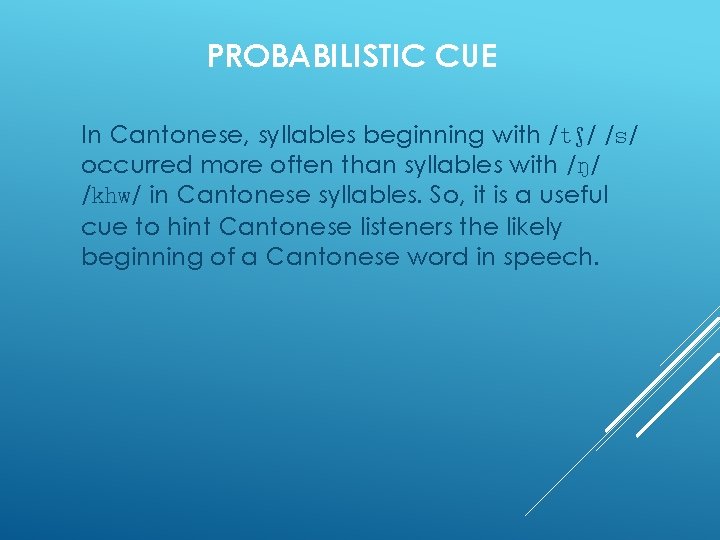
PROBABILISTIC CUE In Cantonese, syllables beginning with /t. S/ /s/ occurred more often than syllables with /N/ /khw/ in Cantonese syllables. So, it is a useful cue to hint Cantonese listeners the likely beginning of a Cantonese word in speech.
PRESENT STUDY So far, only a very few studies examining the same issue in a bilingual environment that involved a tone language, such as Cantonese-English bilinguals. Therefore, the present study aims to investigate the use of L 1 probabilistic phonotactics in L 2 listening from a crosslanguage perspective. Question: Do Cantonese-English bilingual listeners make use of the probabilistic phonotactics in their L 1 (Cantonese) to recognize words in L 2 (English) speech?
EXPERIMENT Participants. Two groups of listeners 1) 36 Cantonese-English fluent bilinguals 2) 36 Native English monolingual listeners (control)
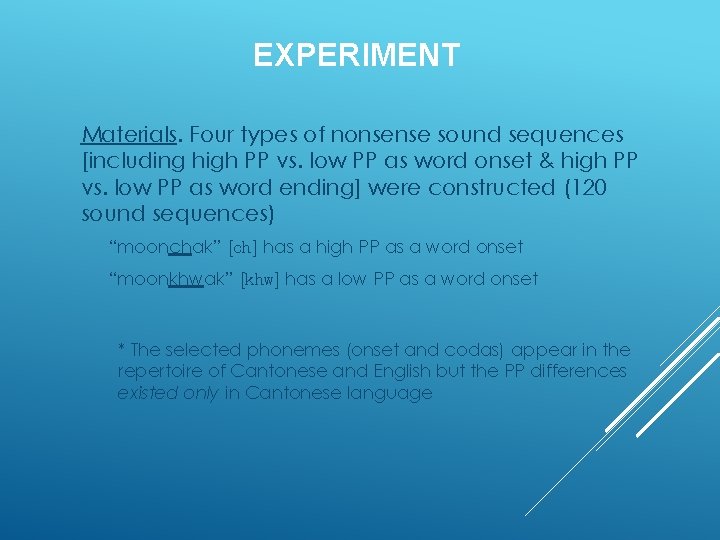
EXPERIMENT Materials. Four types of nonsense sound sequences [including high PP vs. low PP as word onset & high PP vs. low PP as word ending] were constructed (120 sound sequences) “moonchak” [ch] has a high PP as a word onset “moonkhwak” [khw] has a low PP as a word onset * The selected phonemes (onset and codas) appear in the repertoire of Cantonese and English but the PP differences existed only in Cantonese language
PROCEDURE OF WORD-SPOTTING TASK
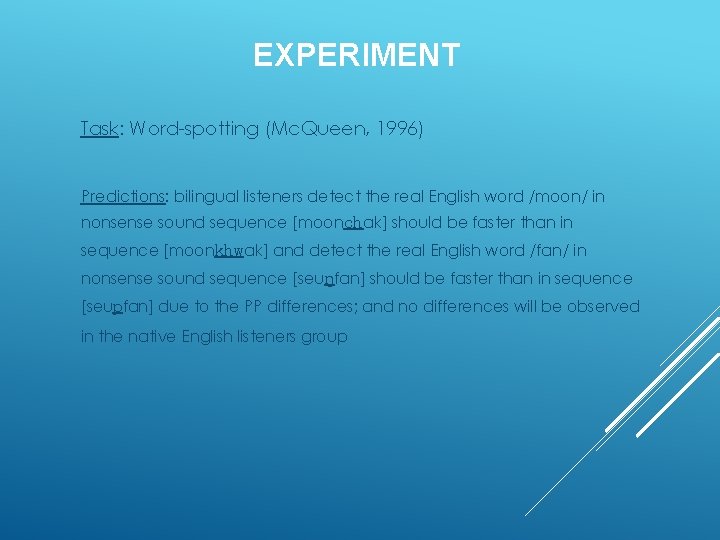
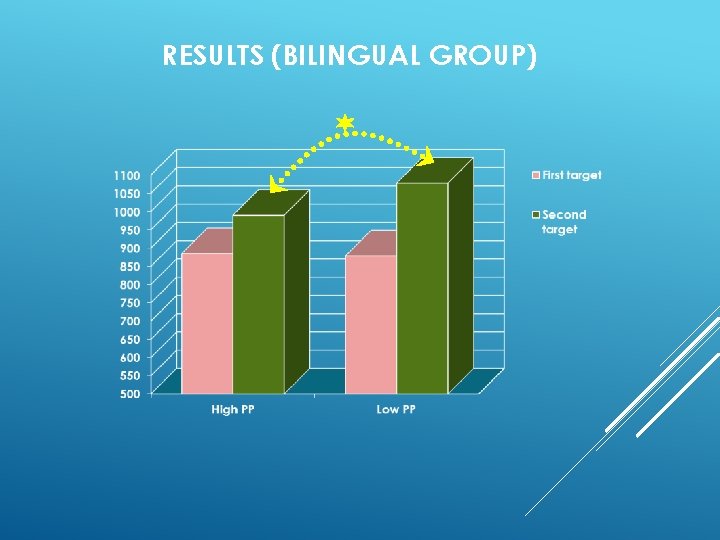
EXPERIMENT Task: Word-spotting (Mc. Queen, 1996) Predictions: bilingual listeners detect the real English word /moon/ in nonsense sound sequence [moonchak] should be faster than in sequence [moonkhwak] and detect the real English word /fan/ in nonsense sound sequence [seu. Nfan] should be faster than in sequence [seupfan] due to the PP differences; and no differences will be observed in the native English listeners group
RESULTS (BILINGUAL GROUP)
RESULTS (NATIVE ENGLISH GROUP)
CONCLUSION 1) Cantonese-English bilingual listeners were indeed sensitive to their L 1 probabilistic phonotactics of a word's ending portion to hint the likely boundary between English words (L 2) in speech. 2) However, the results did not support that Cantonese-English bilingual listeners would make use of the probabilistic information provided in the beginning sound of their L 1 repertoire to hint the likely word boundary. 3) The results are further supported by the null effects from the native English group.
Thank you very much!!