
Recognition of ADHD in MRI Images Together with
- Slides: 1
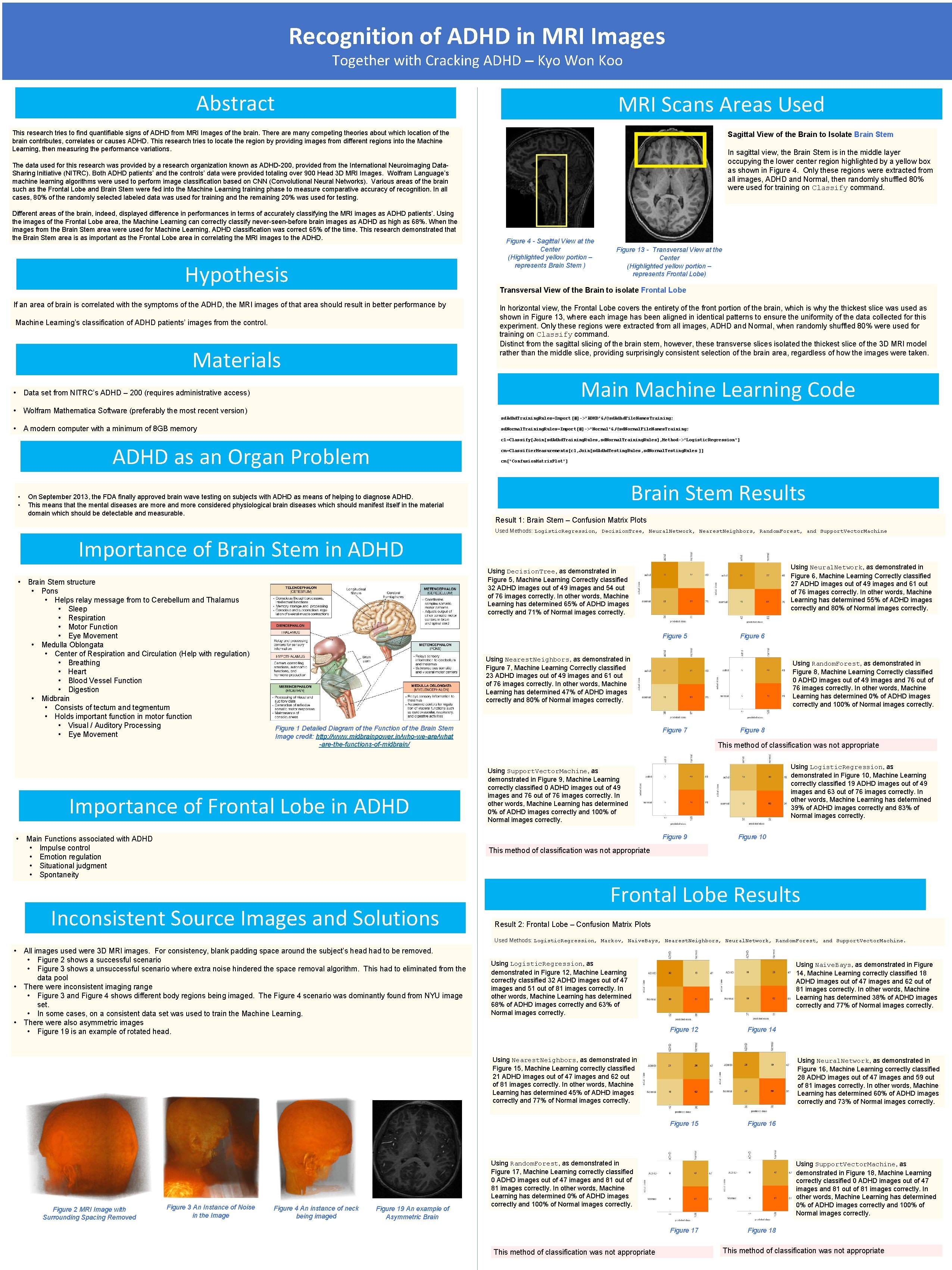
Recognition of ADHD in MRI Images Together with Cracking ADHD – Kyo Won Koo Abstract MRI Scans Areas Used This research tries to find quantifiable signs of ADHD from MRI Images of the brain. There are many competing theories about which location of the brain contributes, correlates or causes ADHD. This research tries to locate the region by providing images from different regions into the Machine Learning, then measuring the performance variations. Sagittal View of the Brain to Isolate Brain Stem In sagittal view, the Brain Stem is in the middle layer occupying the lower center region highlighted by a yellow box as shown in Figure 4. Only these regions were extracted from all images, ADHD and Normal, then randomly shuffled 80% were used for training on Classify command. The data used for this research was provided by a research organization known as ADHD-200, provided from the International Neuroimaging Data. Sharing Initiative (NITRC). Both ADHD patients’ and the controls’ data were provided totaling over 900 Head 3 D MRI Images. Wolfram Language’s machine learning algorithms were used to perform image classification based on CNN (Convolutional Neural Networks). Various areas of the brain such as the Frontal Lobe and Brain Stem were fed into the Machine Learning training phase to measure comparative accuracy of recognition. In all cases, 80% of the randomly selected labeled data was used for training and the remaining 20% was used for testing. Different areas of the brain, indeed, displayed difference in performances in terms of accurately classifying the MRI images as ADHD patients’. Using the images of the Frontal Lobe area, the Machine Learning can correctly classify never-seen-before brain images as ADHD as high as 68%. When the images from the Brain Stem area were used for Machine Learning, ADHD classification was correct 65% of the time. This research demonstrated that the Brain Stem area is as important as the Frontal Lobe area in correlating the MRI images to the ADHD. Hypothesis Figure 4 - Sagittal View at the Center (Highlighted yellow portion – represents Brain Stem ) Figure 13 - Transversal View at the Center (Highlighted yellow portion – represents Frontal Lobe) Transversal View of the Brain to isolate Frontal Lobe If an area of brain is correlated with the symptoms of the ADHD, the MRI images of that area should result in better performance by Machine Learning’s classification of ADHD patients’ images from the control. Materials In horizontal view, the Frontal Lobe covers the entirety of the front portion of the brain, which is why the thickest slice was used as shown in Figure 13, where each image has been aligned in identical patterns to ensure the uniformity of the data collected for this experiment. Only these regions were extracted from all images, ADHD and Normal, when randomly shuffled 80% were used for training on Classify command. Distinct from the sagittal slicing of the brain stem, however, these transverse slices isolated the thickest slice of the 3 D MRI model rather than the middle slice, providing surprisingly consistent selection of the brain area, regardless of how the images were taken. Main Machine Learning Code • Data set from NITRC’s ADHD – 200 (requires administrative access) • Wolfram Mathematica Software (preferably the most recent version) sd. Adhd. Training. Rules=Import [#]->"ADHD"&/@sd. Adhd. File. Names. Training; • A modern computer with a minimum of 8 GB memory sd. Normal. Training. Rules=Import[#]->"Normal"&/@sd. Normal. File. Names. Training; cl=Classify[Join[sd. Adhd. Training. Rules, sd. Normal. Training. Rules], Method->"Logistic. Regression"] ADHD as an Organ Problem • • cm=Classifier. Measurements[cl, Join[sd. Adhd. Testing. Rules, sd. Normal. Testing. Rules ]] cm["Confusion. Matrix. Plot"] On September 2013, the FDA finally approved brain wave testing on subjects with ADHD as means of helping to diagnose ADHD. This means that the mental diseases are more and more considered physiological brain diseases which should manifest itself in the material domain which should be detectable and measurable. Brain Stem Results Result 1: Brain Stem – Confusion Matrix Plots Used Methods: Logistic. Regression, Decision. Tree, Neural. Network, Nearest. Neighbors, Random. Forest, and Support. Vector. Machine Importance of Brain Stem in ADHD • Brain Stem structure • Pons • Helps relay message from to Cerebellum and Thalamus • Sleep • Respiration • Motor Function • Eye Movement • Medulla Oblongata • Center of Respiration and Circulation (Help with regulation) • Breathing • Heart • Blood Vessel Function • Digestion • Midbrain • Consists of tectum and tegmentum • Holds important function in motor function • Visual / Auditory Processing • Eye Movement Using Neural. Network, as demonstrated in Figure 6, Machine Learning Correctly classified 27 ADHD images out of 49 images and 61 out of 76 images correctly. In other words, Machine Learning has determined 55% of ADHD images correctly and 80% of Normal images correctly. Using Decision. Tree, as demonstrated in Figure 5, Machine Learning Correctly classified 32 ADHD images out of 49 images and 54 out of 76 images correctly. In other words, Machine Learning has determined 65% of ADHD images correctly and 71% of Normal images correctly. Figure 5 Figure 6 Using Nearest. Neighbors, as demonstrated in Figure 7, Machine Learning Correctly classified 23 ADHD images out of 49 images and 61 out of 76 images correctly. In other words, Machine Learning has determined 47% of ADHD images correctly and 80% of Normal images correctly. Figure 1 Detailed Diagram of the Function of the Brain Stem Image credit: http: //www. midbrainpower. in/who-we-are/what -are-the-functions-of-midbrain/ Importance of Frontal Lobe in ADHD Using Random. Forest, as demonstrated in Figure 8, Machine Learning Correctly classified 0 ADHD images out of 49 images and 76 out of 76 images correctly. In other words, Machine Learning has determined 0% of ADHD images correctly and 100% of Normal images correctly. Figure 7 This method of classification was not appropriate Using Logistic. Regression, as demonstrated in Figure 10, Machine Learning correctly classified 19 ADHD images out of 49 images and 63 out of 76 images correctly. In other words, Machine Learning has determined 39% of ADHD images correctly and 83% of Normal images correctly. Using Support. Vector. Machine, as demonstrated in Figure 9, Machine Learning correctly classified 0 ADHD images out of 49 images and 76 out of 76 images correctly. In other words, Machine Learning has determined 0% of ADHD images correctly and 100% of Normal images correctly. Figure 9 • Main Functions associated with ADHD • Impulse control • Emotion regulation • Situational judgment • Spontaneity Figure 8 Figure 10 This method of classification was not appropriate Inconsistent Source Images and Solutions Frontal Lobe Results Result 2: Frontal Lobe – Confusion Matrix Plots Used Methods: Logistic. Regression, Markov, Naive. Bays, Nearest. Neighbors, Neural. Network, Random. Forest, and Support. Vector. Machine. • All images used were 3 D MRI images. For consistency, blank padding space around the subject’s head had to be removed. • Figure 2 shows a successful scenario • Figure 3 shows a unsuccessful scenario where extra noise hindered the space removal algorithm. This had to eliminated from the data pool • There were inconsistent imaging range • Figure 3 and Figure 4 shows different body regions being imaged. The Figure 4 scenario was dominantly found from NYU image set. • In some cases, on a consistent data set was used to train the Machine Learning. • There were also asymmetric images • Figure 19 is an example of rotated head. Using Logistic. Regression, as demonstrated in Figure 12, Machine Learning correctly classified 32 ADHD images out of 47 images and 51 out of 81 images correctly. In other words, Machine Learning has determined 68% of ADHD images correctly and 63% of Normal images correctly. Using Naive. Bays, as demonstrated in Figure 14, Machine Learning correctly classified 18 ADHD images out of 47 images and 62 out of 81 images correctly. In other words, Machine Learning has determined 38% of ADHD images correctly and 77% of Normal images correctly. Figure 12 Figure 14 Using Nearest. Neighbors, as demonstrated in Figure 15, Machine Learning correctly classified 21 ADHD images out of 47 images and 62 out of 81 images correctly. In other words, Machine Learning has determined 45% of ADHD images correctly and 77% of Normal images correctly. Using Neural. Network, as demonstrated in Figure 16, Machine Learning correctly classified 28 ADHD images out of 47 images and 59 out of 81 images correctly. In other words, Machine Learning has determined 60% of ADHD images correctly and 73% of Normal images correctly. Figure 15 Figure 2 MRI Image with Surrounding Spacing Removed Figure 3 An Instance of Noise in the Image Figure 4 An instance of neck being imaged Figure 19 An example of Asymmetric Brain Figure 16 Using Random. Forest, as demonstrated in Figure 17, Machine Learning correctly classified 0 ADHD images out of 47 images and 81 out of 81 images correctly. In other words, Machine Learning has determined 0% of ADHD images correctly and 100% of Normal images correctly. Using Support. Vector. Machine, as demonstrated in Figure 18, Machine Learning correctly classified 0 ADHD images out of 47 images and 81 out of 81 images correctly. In other words, Machine Learning has determined 0% of ADHD images correctly and 100% of Normal images correctly. Figure 17 This method of classification was not appropriate Figure 18 This method of classification was not appropriate