
Recognition Learning Psychology 3926 Introduction Basically Differential responding

Recognition Learning Psychology 3926
Introduction • Basically Differential responding to something previously experienced • Could be responding in some special way the first time a certain stimulus shows up
Habituation • Decrease in responding over time • Not too much generalization, though there is some • More presentations the better • Learning vs performance and habituation below zero • Gilette and Bellingham (1982) showed that rats learn about a stimulus
Effects on behaviour • Can be very broad, gill withdrawal to a decline in exploration • Sherrington’s Model (S-R) • Sokolov’s Model (Comparator) • Wagner’s Model (SOP)
Perceptual Learning • Characteristics of stimuli, not their relationship to each other • Gibson and Walk (1956) • Could be learning to associate the individual features with each other • William James thought so!
Imprinting • Lorenz said this was special as it – Has a critical period – Is irreversible – Affects behaviour well into the future – Generalizes to all members of the species
Conditions for imprinting • Bateson’s running wheel • Simple exposure is enough usually • Sometimes it is certain features, say like the head and neck in the Burmese Red Junglefowl • The longer the exposure the better
Is this just associative learning? • Well sorta • Shows blocking, overshadowing • Still different though, sensory period, competitive exclusion • Reversible, but not totally, depends on stimulus • With sexual imprinting you can get combining • Sexual imprinting probably isn’t….

Altruism • • • I thought genes were selfish Well you thought right Kin selection (Hamilton) Reciprocal altruism (Trivers) Nicest example of the effect of genetic relationships is in eusocial insects
Eusociality • For Eusociality we need – Overlapping generations – Cooperative care of the young – Sterile castes • In insects, euscociality occurs in: – Hymenoptera • Ants • Bees • wasps
Eusociality • Isoptera – Termites • Homoptera – Aphids • Some say that these two are not truly eusocial, but if you look at that definition, you could, under certain circumstances, say bees were not eusocial!
Haplodiploidy • Eusociality has evolved 11 separate times just in Hymenoptera! • Why? – Sterile females are usually very closely related – Basically, it does not pay to have young, it pays more to take care of your sisters, as they are more closely related to you than any potential offspring!
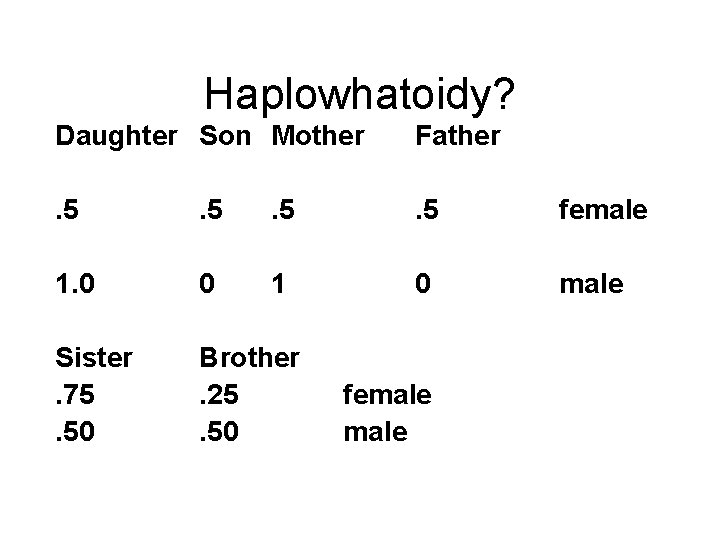
Haplowhatoidy? Daughter Son Mother Father . 5 . 5 female 1. 0 0 1 0 male Sister. 75. 50 Brother. 25. 50 female
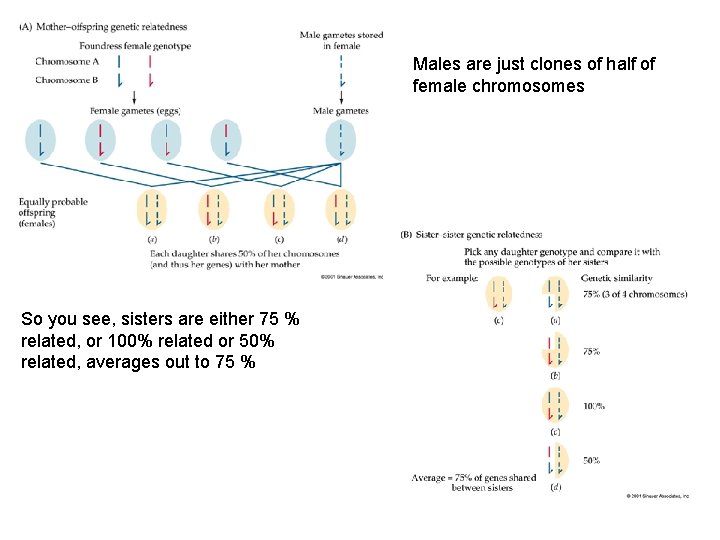
Males are just clones of half of female chromosomes So you see, sisters are either 75 % related, or 100% related or 50% related, averages out to 75 %
How are kin recognized? • • Directly? Probably not Indirectly seems more likely Cross fostering experiments Belding’s ground squirrels, for example, treat familiar as kin Not the whole story though Phenotype matching MHC genes Reciprocal altruism and vampire bats
In conclusion • Recognition learning has some characteristics that other forms of learning do • And the opposite of that is true…
- Slides: 16