
Recognition and Management of Elbow Injuries Olecranon bursitis

Recognition and Management of Elbow Injuries
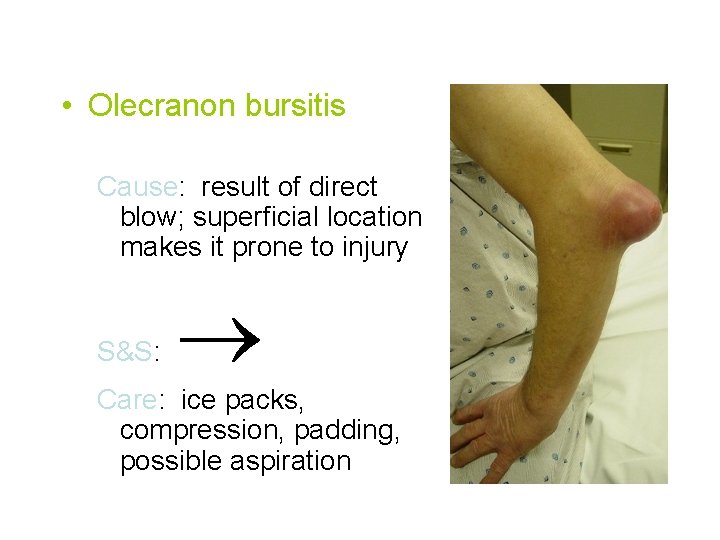
• Olecranon bursitis Cause: result of direct blow; superficial location makes it prone to injury S&S: Care: ice packs, compression, padding, possible aspiration
• Elbow strains Cause: excessive resisted motion such as a fall on outstretched hand with elbow in extension that forces joint into hyperextension S&S: pain with active and resistive movement, point tenderness in muscle, tendon or muscle belly Care: RICE; rehab, modalities, x-ray if loss of motion
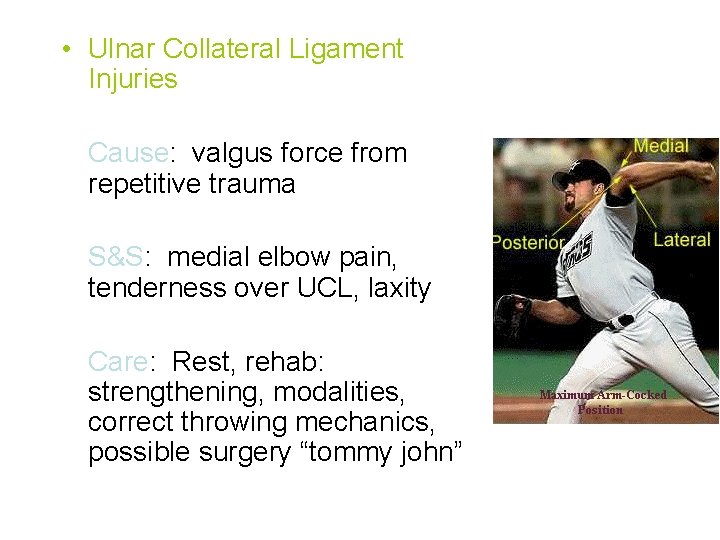
• Ulnar Collateral Ligament Injuries Cause: valgus force from repetitive trauma S&S: medial elbow pain, tenderness over UCL, laxity Care: Rest, rehab: strengthening, modalities, correct throwing mechanics, possible surgery “tommy john”
• Epicondylitis Cause: repeated forearm flexion and extension movements; small micro-tears at muscle attachments S&S: pain at epicondyles during forced wrist flexion/extension; radiating pain, point tenderness, mild swelling Care: rest, modalities for pain, rehab, brace

• Elbow dislocation Cause: fall on outstretched arm with elbow in hyperextension, twist with elbow in flexion S&S: Care: call 9 -1 -1, referral for reduction, sling, ice
• Little League Elbow Cause: occurs in 10 -25% young pitchers; caused by repetitive microtrauma that occurs from throwing and not from the type of pitch thrown; includes many disorders of growth in the pitching elbow that may include: – an accelerated apophyseal growth region plus a delay in the medial epicondylar growth plate – A traction apophysitis with a possible fragmentation of the medial epicondylar apophysis – An avulsion of the medial epicondyle of the radial head – Osteochondrosis of the humeral capitellum – A nonunion stress fx of the olecranon epiphysis
S&S: onset is usually slow, in the beginning the athlete may have a flexion contraction, with tightness of anterior joint capsule and weakness of triceps muscle, complains of locking or catching, ROM of forearm supination/pronation Care: RICE, NSAIDs, no throwing until full ROM, stretching, triceps strengthening, correct throwing techniques
The Forearm, Wrist, Hand Fingers
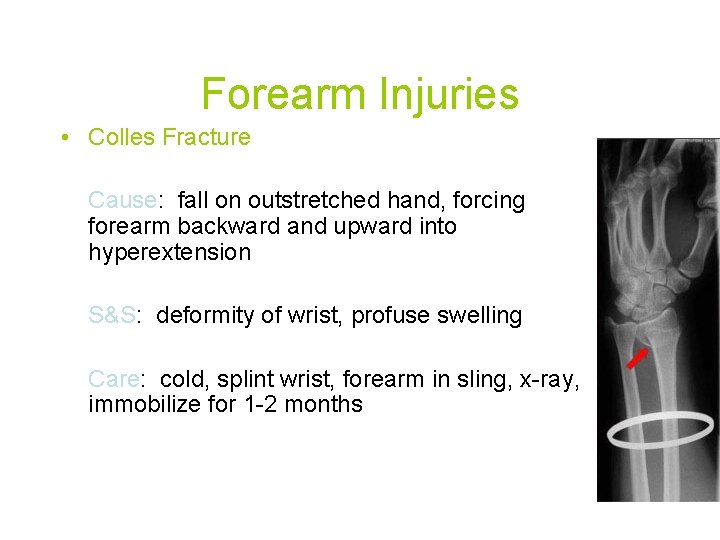
Forearm Injuries • Colles Fracture Cause: fall on outstretched hand, forcing forearm backward and upward into hyperextension S&S: deformity of wrist, profuse swelling Care: cold, splint wrist, forearm in sling, x-ray, immobilize for 1 -2 months
Injuries to the Wrist • Sprains/Strains Cause - sprain most common, most poorly managed; abnormal forced movements or falling on hyperextended wrist S&S: generalized swelling, tenderness, limited range of motion Care: RICE, modalities, rehab: strengthening, taping
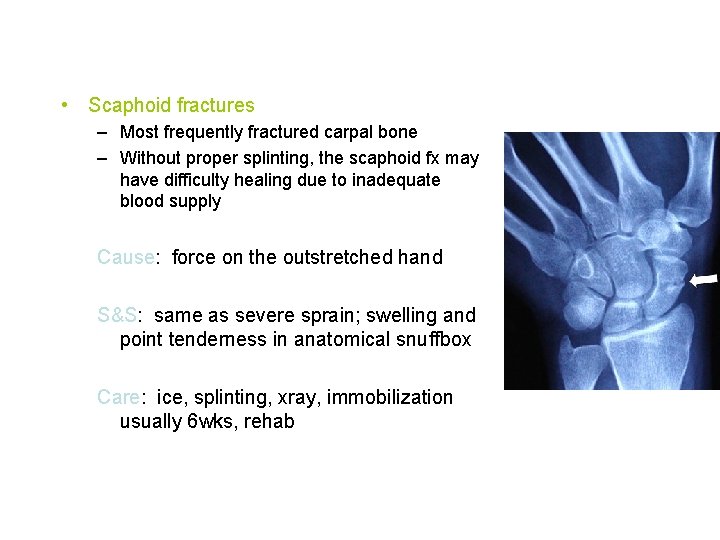
• Scaphoid fractures – Most frequently fractured carpal bone – Without proper splinting, the scaphoid fx may have difficulty healing due to inadequate blood supply Cause: force on the outstretched hand S&S: same as severe sprain; swelling and point tenderness in anatomical snuffbox Care: ice, splinting, xray, immobilization usually 6 wks, rehab
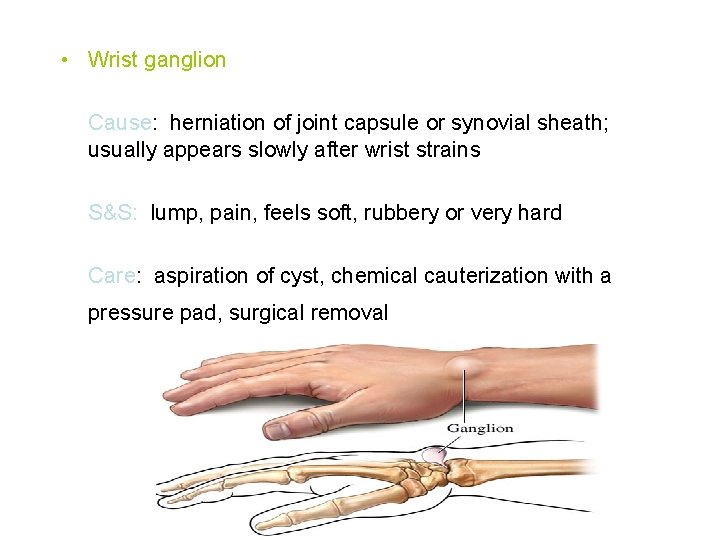
• Wrist ganglion Cause: herniation of joint capsule or synovial sheath; usually appears slowly after wrist strains S&S: lump, pain, feels soft, rubbery or very hard Care: aspiration of cyst, chemical cauterization with a pressure pad, surgical removal
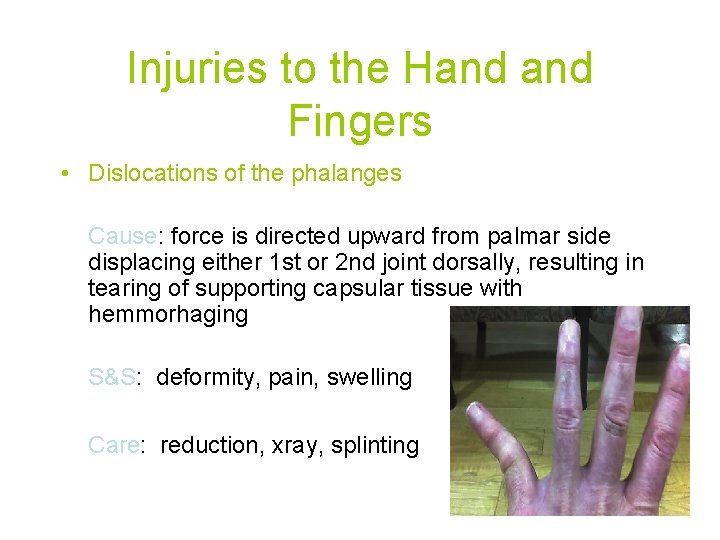
Injuries to the Hand Fingers • Dislocations of the phalanges Cause: force is directed upward from palmar side displacing either 1 st or 2 nd joint dorsally, resulting in tearing of supporting capsular tissue with hemmorhaging S&S: deformity, pain, swelling Care: reduction, xray, splinting

• Gamekeeper’s Thumb (UCL sprain of MCP joint) Cause: forceful abduction combined with hyperextension S&S: pain over UCL, weak and painful pinch, tenderness, swelling Care: refer to orthopedic, splint usually 3 wks, rehab, taping
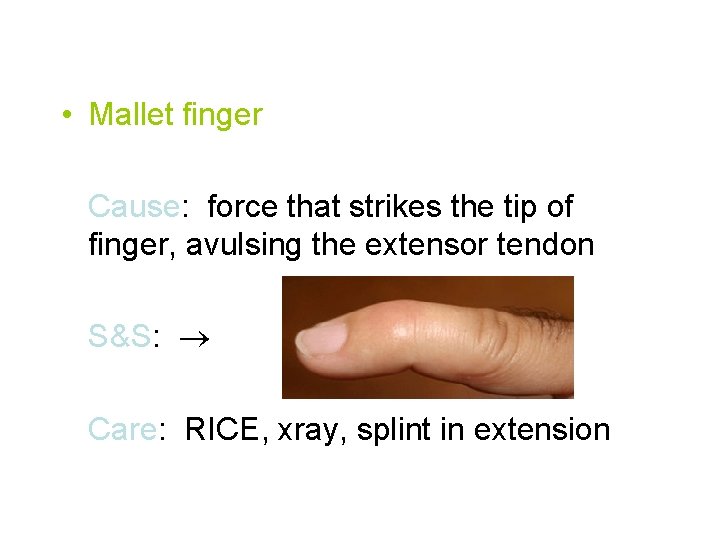
• Mallet finger Cause: force that strikes the tip of finger, avulsing the extensor tendon S&S: Care: RICE, xray, splint in extension
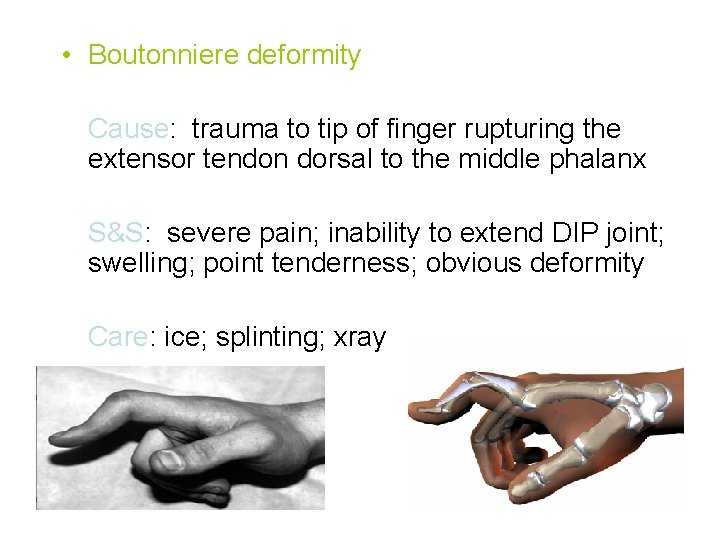
• Boutonniere deformity Cause: trauma to tip of finger rupturing the extensor tendon dorsal to the middle phalanx S&S: severe pain; inability to extend DIP joint; swelling; point tenderness; obvious deformity Care: ice; splinting; xray
- Slides: 17