
Recognising Symptoms at End of Life Common Symptoms

- Slides: 24
+ Recognising Symptoms at End of Life Common Symptoms Jill Davies, Diana Gibson & Pauline Love End of Life Care Development Facilitators
+ What are the top 5 common symptoms at the end of life? n. Flip Chart – write down what you think are the 5 common symptoms we should plan for at the end of life
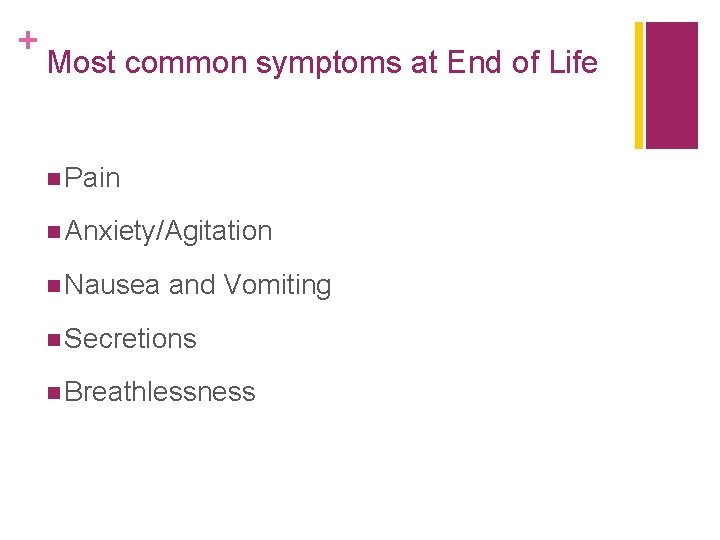
+ Most common symptoms at End of Life n Pain n Anxiety/Agitation n Nausea and Vomiting n Secretions n Breathlessness
+ Pain n An unpleasant sensory and emotional experience associated with actual or potential tissue damage n Pain can be physical, emotional, spiritual and social (Total pain) n Some people experience more that one pain (multiple sites and types of pain), requiring different types of pain relief
+ n A small number of people experience pain that does not respond to drugs n Symptoms of pain can be very distressing and frightening for patients and their family and friends n Not all dying people experience pain.
+ Treatment of Pain n In depth assessment – (SOCRATES assessment – Site, Onset, Character, Radiation, Associations, Time Course, Exacerbating/relieving factors, Severity) n Regular use of pain relief n Pain relief usually given by mouth where possible in the form of tablets or liquids. It can also be given using patches stuck onto the skin. If patient is unable to take medications by mouth/is at end of life, can be given by injections or by using a syringe driver. n Patient can experience side effects. Nausea, constipation and drowsiness are most common side effects.
+ What can you do to help manage pain? n Monitor for signs of pain when giving care n If possible report site and severity of pain to family or Nurse, so painkillers can be given in a timely manner n If appropriate assist patient into a comfortable position n Be calm and reassuring. Talk to patient, try to get them to relax, controlled breathing, distraction techniques
+ Nausea and Vomiting n Can be caused by many drugs n Gastric problems such as inflammation or ulcers n Bowel obstruction caused by untreated constipation n Some types of cancer more likely to cause people to feel sick and vomit n Need for in depth assessment and patterns as this will assist in obtaining the correct treatment
+ Treating Nausea and Vomiting n Regular use of anti sickness medication (various types used depending on the cause), oral or injections n Eat little and often n Eat bland, dry foods n Sip fizzy drinks n Eat warm or cold foods, hot foods smell stronger n Can try foods containing ginger n Positioning of person
+ Constipation n A major problem for people who are dying n Often ignored n A major cause of pain and distress n If untreated will lead to nausea, vomiting and bowel obstruction n Can cause lethargy, exhaustion and anxiety/agitation
+ n Can be caused by medications, reduced mobility and reduced fluid intake n Can be treated with regular laxatives n Increased fluid intake (not always possible) n Needs careful monitoring n Important to document at each visit if bowels are open. n Document type and quantity of stool n Report concerns to Nurse
+ Loss of Appetite & Weight Loss n Common to lose interest in food n Change in ability to taste food following chemotherapy n Likely to lose weight, even if eating well n Medications can cause loss of appetite n Near end of life, metabolism slows down, body not able to absorb nutrients. n Distressing for patient and family
+ Managing Loss of Appetite n Cannot stop patient from losing weight n Small frequent meals/fortify where possible n Diet supplements(if tolerated) and nourishing drinks n Avoid strong smells, make food look attractive, cool or warm rather than hot n Snacks n Don’t force patients to eat/drink. Food and fluid is to maintain comfort only
+ Breathlessness n Some people more prone to breathlessness (chronic lung condition, lung cancer) n Can be caused by infection or fluid in or around the lungs n Anaemia can cause breathlessness n Can be FRIGHTENING!
+ Treating Breathlessness n Treat chest infections with antibiotics if appropriate n Treat build up of fluid if appropriate with diuretic/water tablets n Use of medications to help patient to relax n Distraction
+ n Conserve energy, pace activities and accept assistance with certain tasks n Loose fitting clothing n Well ventilated room/fan n Relax shoulders n Encourage patient to slow breathing, ask patient to concentrate on breathing out slowly n Opiate drugs /Lorazepam
+ Mouth Problems n Soreness, ulcerations, oral thrush n Dry mouth n Can be caused by medications or due to reduced ability to fight infection n Poor oral hygiene
+ Management of Mouth Problems n Encourage good oral hygiene n Twice daily brushing of teeth with a soft toothbrush if able. n Rinse mouth regularly during day with fresh water or mouthwash if prescribed n Regular mouth care from carers if patient unable to perform this activity n Treat any infections with prescribed medications n Consider ill fitting dentures/refer to dentist
+ Other symptoms n Infection - Treat with antibiotics if appropriate to relieve symptoms of discomfort n Cough - can be managed with good positioning n Swollen tummy (ascites). Can be distressing. Sometimes treated with water tablets. Sometimes treated with insertion of a drain n Anaemia (low blood count) can cause patient to be tired and breathless. Consider blood transfusion if appropriate to promote comfort
+ Recognising the Dying Phase: Last Days of Life n Can be difficult to predict exactly what will happen or how quickly as each persons experience of the last days of life will be different n Becoming very weak n Reduced energy n Struggling to move from bed or chair and spending more time in bed n Feeling drowsy and sleeping more
+ n Not wanting to eat or drink n Loss of interest in surroundings and family n Feeling disorientated, not sure if you are dreaming n May develop agitation, restlessness, confusion, shouting, twitching (important to rule out reversible causes) n Unable to take oral medications due to weakness or not drinking fluids
+ n Person unable to verbalise pain. Need to monitor for non verbal signs of pain: screwing up their face, sweating, fast breathing n Breathing changes. Breathing may be more noisy, due to collection of fluid in airways, not usually distressing for the patient, but relatives do find this distressing
+ n Some patients become incontinent of urine and faeces. This needs to be managed with use of continence products n Some patients struggle to pass urine (urine retention) and usually are unable to verbalise the discomfort. May become agitated and restless. Lower abdomen will become distended and it should be clearly documented at each intervention that patient has not passed urine
+ n If patient is showing any signs of distress a visit from the GP/OOHs/District Nurse/CNS Palliative Care must be requested to assess symptoms and to treat appropriately. n Talk to relatives and explain what’s happening/what to expect n Plan ahead – ‘just in case’ medicines, DNACPR, Recognising Dying form, Re. SPECT