
Recognising Opportunities Trend Analysis Generating ideas 1 Choosing
- Slides: 15
� Recognising Opportunities: � Trend Analysis: � Generating ideas: 1. Choosing an Idea: (a) Idea must not only be good for the market, but good for the project and for the entrepreneurs. (b) It should be manageable by the entrepreneur without much dependence on others. (c) Develop five or ten in parallel until one idea emerges so appropriate that it begins to dominate your thoughts and fantasies.
�Sources 1. 2. 3. 4. 5. of generating ideas: Consumers Existing product and services Distribution channels- market intermediaries Government Research and Development
� v v v Methods of generating ideas: Focus groups: 6 -12 members, belonging to various socio- economic background- new product idea. Facilitated by a moderator. Brainstorming : General guidelines to be followed are: Generate as many ideas as possible Be creative, freewheeling, and imaginative Build upon piggyback, extend or combine earlier ideas. Withhold criticism of other’s ideas. Problem Inventory Analysis: It not only generates ideas, but also identifies the problems the product faces.
�Day in life research �Encouraging focal point for ideas and creativity at the firm level �Protecting ideas from being lost or stolen
� Opportunity identification/ product identification/project identification : It is concerned with collection, compilation and analysis of economic data for the eventual purpose of locating possible opportunities for investment and with the development of such opportunities. � Opportunity selection: it starts where the opportunity identification ends. opportunities are analysed – existing economic condition, Govt Policy. SWOT Analysis
� According to Drucker there are three kinds of opportunities: (a) Additive- it enables the decision maker to better utilise the existing resources without in any way involving a change in the character of business. (b) Complimentary : it involve the introduction of new ideas and also leads to certain amount of change in the existing structure. (c) Breakthrough: it involves fundamental changes in both the structure and character of business.
�Criteria for selecting a particular project: ØInvestment size ØLocation ØTechnology ØEquipment ØMarketing
�Project ideas- Scanning of Business Environment and Identifying a Project: Ø Success story of a friend/ relative Ø Experience of others in manufacture/ sale of product. Ø Demand for the certain products Ø Chances of producing a substitute of an article imported for which there is good demand. Ø Motivation , background and the skill of the entrepreneur and his associates.
� Importance of project identification: Ø They become catalytic agent for economic development. Ø They initiate the process of development. Ø They have beneficial consequences. Ø It provides the framework of the future pattern of activities and services. Ø It involves substantial financial outlays. Ø They initiate development of basic infrastructure and environment. Ø Project commitments cannot be easily reversed. Ø It brings the necessary changes. Ø It accelerate the process of socio cultural development.
� The Enterprise Development Centre- the integrated method for facilitating the formation of new enterprises. It comprises five principle components Ø Intrapreneurship centre – conducts research, creates skill and appropriate environment. Ø Venture capital exchange- seed capital Ø Innovation centre- theological evaluation, entrepreneurial assessment, project planning, evaluation, commercial feasibility studies and the product development assistance. Ø Incubation centre- provides the needed impetus to new enterprises to succeed and grow.
v Definition: Taking a first a look carefully and critically at project by an entrepreneur to build up an allround beneficial to project after carefully weighing its various components. v It is formulated by the entrepreneur with the assistance of specialists or consultants. v Its aim is to derive maximum benefits from minimum expenses in a short span of time.
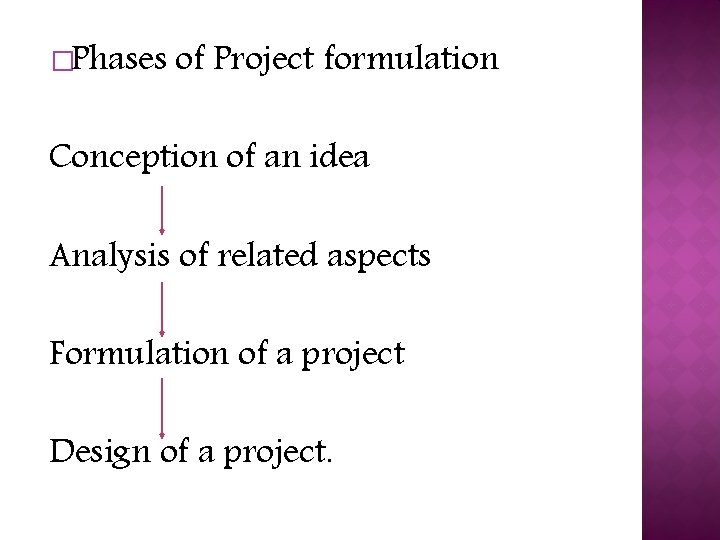
�Phases of Project formulation Conception of an idea Analysis of related aspects Formulation of a project Design of a project.
�Feasibility analysis �Techno – Economic analysis �Project Design and Network analysis �Input analysis �Financial analysis �Cost – Benefit analysis �Pre- investment analysis.
�Product selection �Capacity utilization estimates. �Market study �Technology selection �Location selection �Selection of ownership form
STEPS IN SETTING UP OF A SMALL BUSINESS ENTERPRISE � Information collection � Information organisation � Acquiring required / vocational skills � Financial requirements � Market assessment � Provision for crisis.