
RECN 344 Event Management Week 12 Lecture 1
- Slides: 28
RECN 344: Event Management Week 12 Lecture 1: Exam preparation help session (Part 1)
Exam details Assessment 4: Final Exam Friday 21 st June 9. 05 am -12. 05 pm Length: 3 hours Venue: AER 008 Weighting: 40% Practice Exam is on Learn Structure (out of 40 marks): Section A: 5 short answer questions; Answer ALL of these (worth 4 marks each = 20 marks in total) Section B: 8 essay questions (all of equal value); Answer any TWO of these (worth 10 marks each = 20 marks in total)
A system’s approach to events What is a systems approach? “A group of interrelated, interdependent and interacting elements that together form a single functional structure” (Weaver and Lawton, 2006, p. 23). • Hierarchical • Composed of subsystems • Flows & energy exchanges
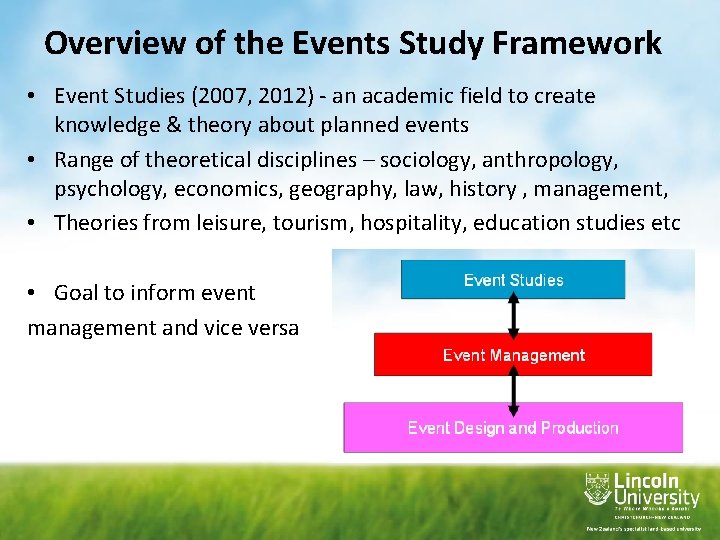
Overview of the Events Study Framework • Event Studies (2007, 2012) - an academic field to create knowledge & theory about planned events • Range of theoretical disciplines – sociology, anthropology, psychology, economics, geography, law, history , management, • Theories from leisure, tourism, hospitality, education studies etc • Goal to inform event management and vice versa
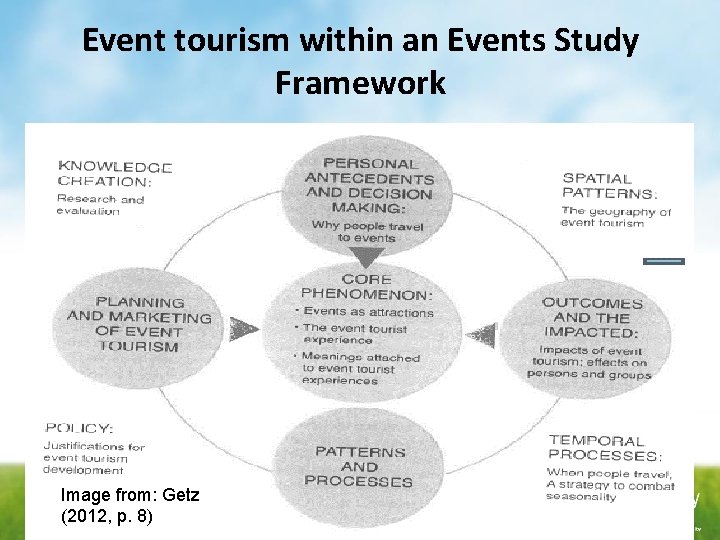
Event tourism within an Events Study Framework Image from: Getz (2012, p. 8)
Overview of the Events Study Framework • Core phenomenon of Event studies: • All planned events • The experience of events for all stakeholders • Organisers, volunteers, government agencies, participants, spectators, surrounding community/nation • Meanings attached to events • e. g. entertainment, education, national pride etc • Meanings are personal, socio-cultural (and political) constructs, shaped by organisers
Overview of the Events Study Framework • Core phenomenon of Event studies: • All planned events • The experience of events for all stakeholders • Organisers, volunteers, government agencies, participants, spectators, surrounding community/nation • Meanings attached to events • e. g. entertainment, education, national pride etc • Meanings are personal, socio-cultural (and political) constructs, shaped by organisers
Overview of the Events Study Framework § Antecedents & decision making § All the factors shaping individual & collective need or demand for events § How are choices to participate/attend made? § Constraints to participation § Planning, design & management § General the subject of traditional event management texts, EMBOK etc § Part of destination strategy
Overview of the Events Study Framework § Patterns & processes § Focusing on the wider aspects of the events ‘system’ – global processes & impacts § Changing patterns of events over time § “Where do events come from and how do they evolve over time”? § Policy decisions
Overview of the Events Study Framework § Outcomes & the impacted § Consequences of events (sometimes a starting point, i. e. a goal) § Personal outcomes Global outcomes § Economic, social, cultural, political, environmental
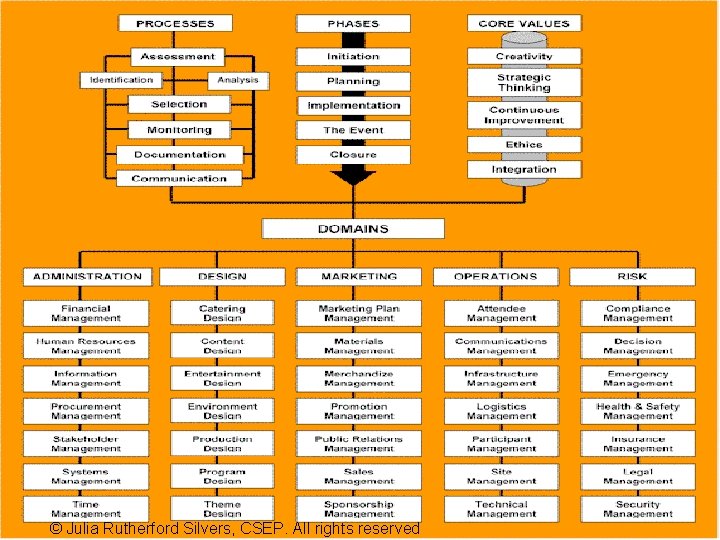
Overview of EMBOK § EMBOK underpinned by Core Values: § Continuous improvement § Creativity § Ethics § Strategic thinking § Sustainability (earlier versions Integration)
Overview of EMBOK § Event management is a process § Sequential and iterative process § Dynamic § Moves through five phases
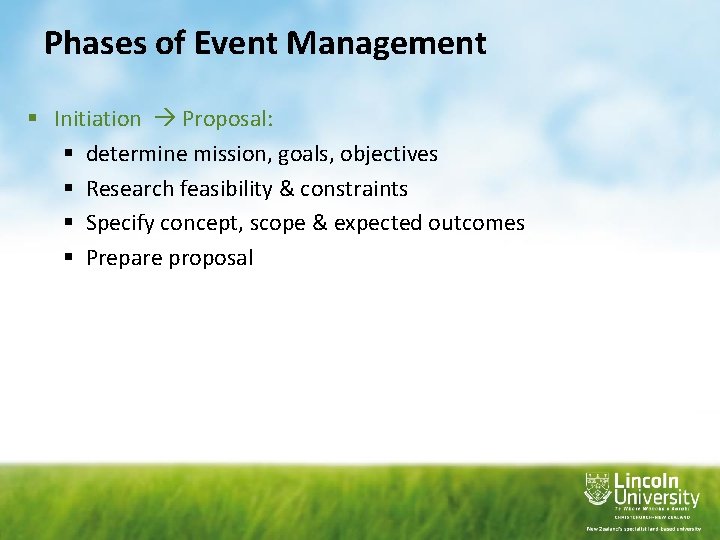
Phases of Event Management § Initiation Proposal: § determine mission, goals, objectives § Research feasibility & constraints § Specify concept, scope & expected outcomes § Prepare proposal
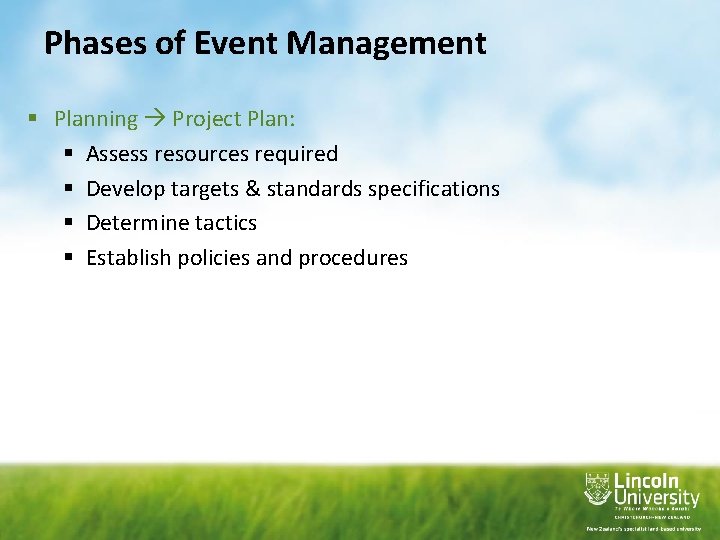
Phases of Event Management § Planning Project Plan: § Assess resources required § Develop targets & standards specifications § Determine tactics § Establish policies and procedures
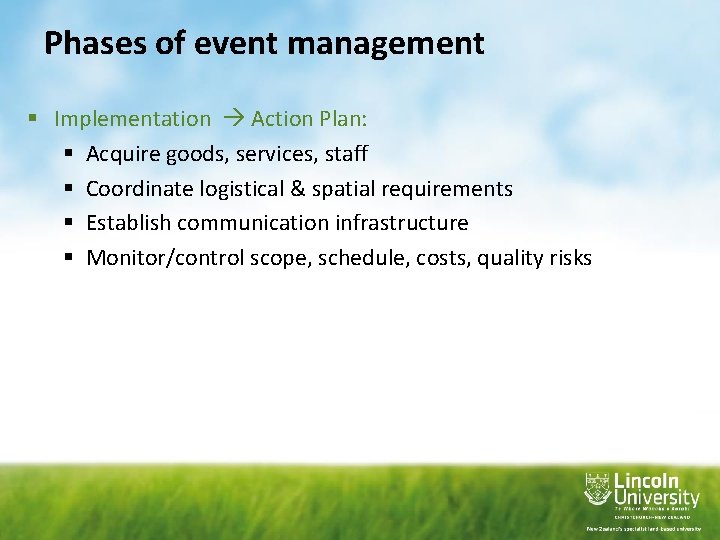
Phases of event management § Implementation Action Plan: § Acquire goods, services, staff § Coordinate logistical & spatial requirements § Establish communication infrastructure § Monitor/control scope, schedule, costs, quality risks
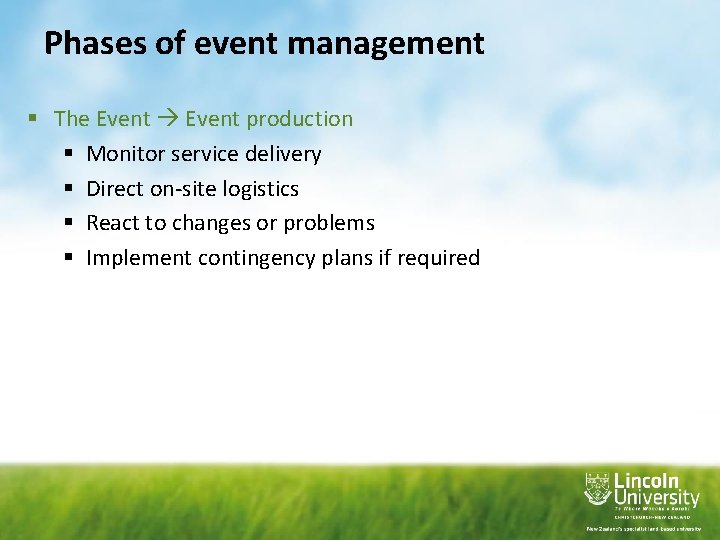
Phases of event management § The Event production § Monitor service delivery § Direct on-site logistics § React to changes or problems § Implement contingency plans if required
Phases of event management § Closure Event report § Supervise event shutdown & obligation fulfilment § Collect data and feedback § Analyse and evaluate outcomes § Compile final report
The processes of event management § Closely related to the phases § Part of a dynamic, iterative system of event management: § Assess - needs and issues § Select –best choice, available options, implement § Monitor –proactively observe progress & respond § Integrate –recognise linkages, impacts, merge & synthesise § Document –keep a record of actions/decisions, collect data
Knowledge domains of EMBOK • Represents the functions or areas of activity within events management • Reflect scope & range of responsibilities of event organizers in five broad domains: • Administration • Design • Marketing • Operations • Risk • Under each of these, many functional units (or classes)
© Julia Rutherford Silvers, CSEP. All rights reserved
Understanding motivation • • • “A decision to attend an event is a directed action which is triggered by a desire to meet a need” (Crompton & Mc. Kay, 1997, p. 425 ) Identifying and prioritising motives is key to understanding the decision making process Understanding motives helps in design of event experiences Understanding motives can help us explain behaviour Motivation is closely related to satisfaction
Terminology • Intrinsic motivation: • individual and unique personal needs & values that motivate people to attend or participate in an event • Extrinsic motivation: • broader conditioning factors (society, culture) that shape attitudes, preferences and perceptions.
Motivational theories • Needs-based approaches • Human needs motivate human behaviour – hierarchy of needs (e. g. Maslow) • People choose to attend events to satisfy certain needs
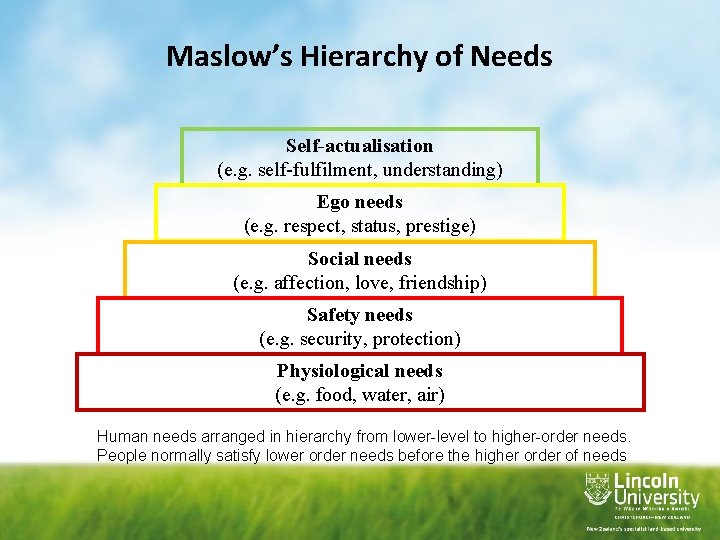
Maslow’s Hierarchy of Needs Self-actualisation (e. g. self-fulfilment, understanding) Ego needs (e. g. respect, status, prestige) Social needs (e. g. affection, love, friendship) Safety needs (e. g. security, protection) Physiological needs (e. g. food, water, air) Human needs arranged in hierarchy from lower-level to higher-order needs. People normally satisfy lower order needs before the higher order of needs
Iso-Ahola’s model • Two elements: • Optimal arousal theory • Stimuli differ in their ‘arousal potential’ • Individuals differ in their need for this arousal • People seek environments providing preferred levels of arousal • Approach-Avoidance theory • Much behaviour is produced by opposing motives (cause organisms to both ‘approach’ and ‘avoid’ stimuli)
Iso-Ahola’s model • In event context, individuals seek different levels of stimulation • Share need to avoid over-stimulation (mental & physical exhaustion) or boredom (too little stimulation) • Needs change with event, lifestyle/lifestage, etc • Motivation is ‘seeking-escaping’ behaviour (or ‘push’ – ‘pull’)
Push-Pull theories • Push-pull approaches • Push factors: motivational factors from within individual, or social context (intrinsic and extrinsic) • Pull factors: features of an event likely to attract people • Event pull is a response to motivational push
RECN 344: Event Management See you tomorrow for exam preparation help session (Part 2)!