
Recipes A recipe is a set of directions
- Slides: 19
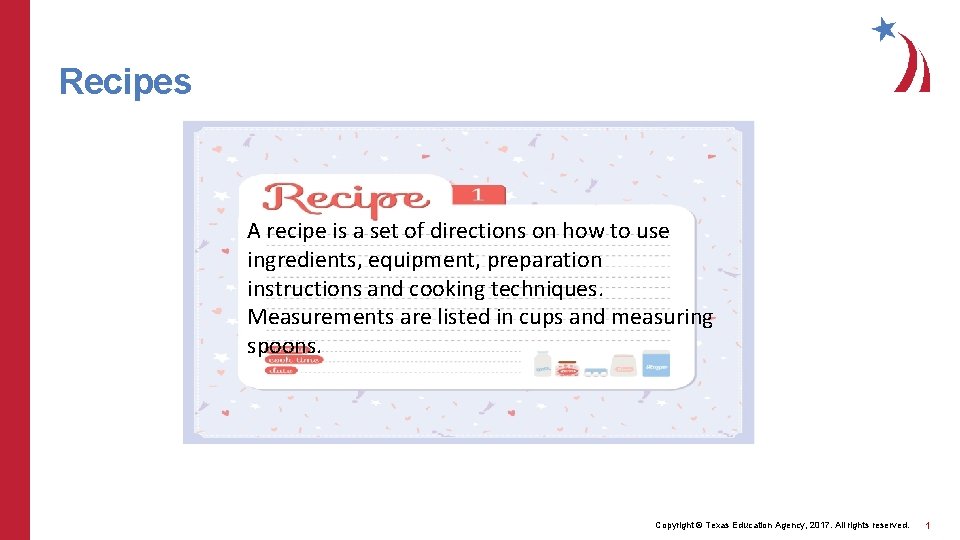
Recipes A recipe is a set of directions on how to use ingredients, equipment, preparation instructions and cooking techniques. Measurements are listed in cups and measuring spoons. Copyright © Texas Education Agency, 2017. All rights reserved. 1
Standardized Recipes Copyright © Texas Education Agency, 2017. All rights reserved. 2
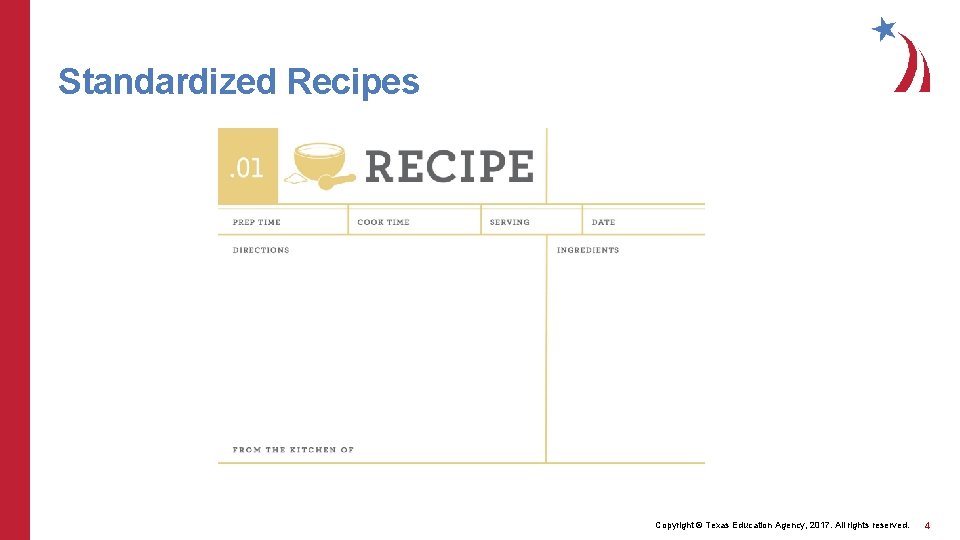
Standardized Recipes A standardized recipe describes the exact measurable amount of ingredients and the method of preparation needed to consistently produce a high-quality product. The exact procedures are written down, and the type of equipment and the quantity and quality of ingredients are listed. Measurements are listed in weight and volume. Copyright © Texas Education Agency, 2017. All rights reserved. 3
Standardized Recipes Copyright © Texas Education Agency, 2017. All rights reserved. 4
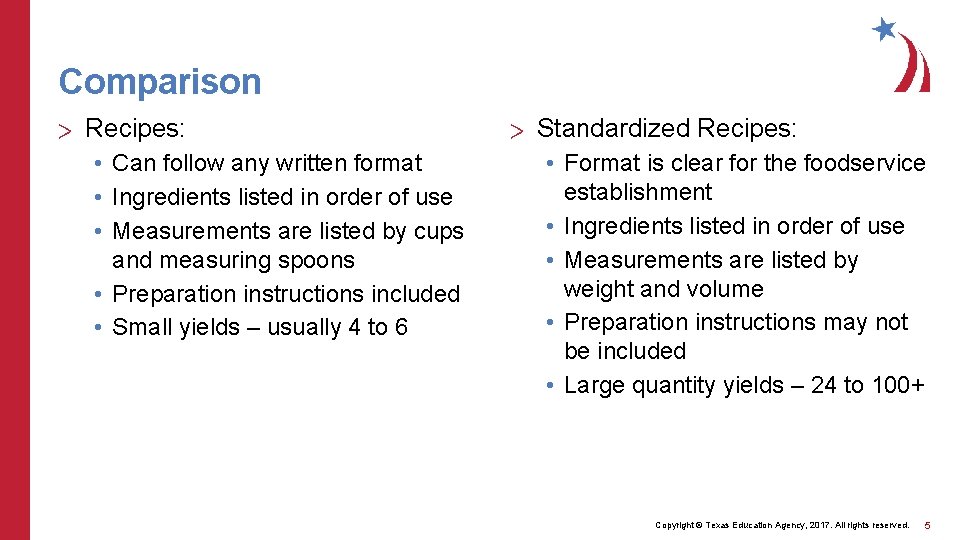
Comparison > Recipes: • Can follow any written format • Ingredients listed in order of use • Measurements are listed by cups and measuring spoons • Preparation instructions included • Small yields – usually 4 to 6 > Standardized Recipes: • Format is clear for the foodservice establishment • Ingredients listed in order of use • Measurements are listed by weight and volume • Preparation instructions may not be included • Large quantity yields – 24 to 100+ Copyright © Texas Education Agency, 2017. All rights reserved. 5
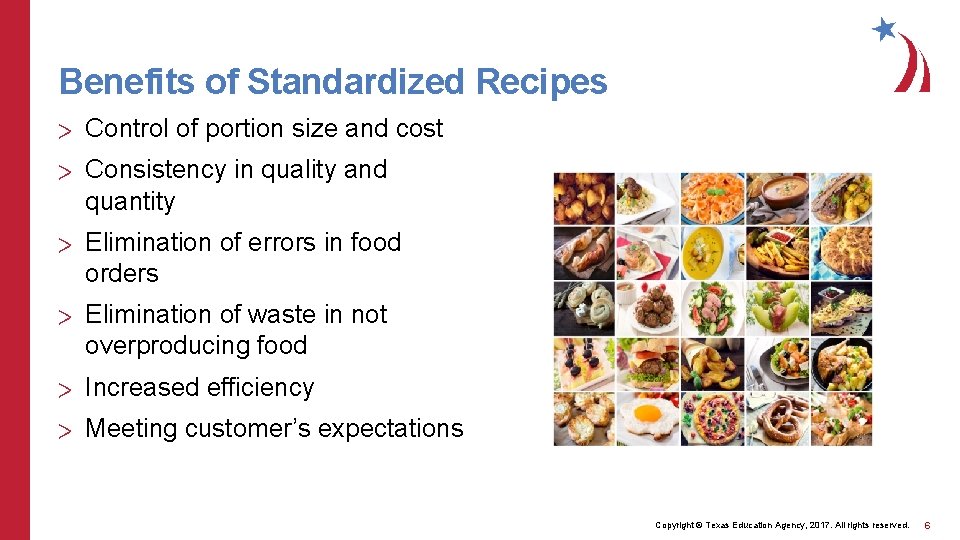
Benefits of Standardized Recipes > Control of portion size and cost > Consistency in quality and quantity > Elimination of errors in food orders > Elimination of waste in not overproducing food > Increased efficiency > Meeting customer’s expectations Copyright © Texas Education Agency, 2017. All rights reserved. 6
Components of a Standardized Recipe 1. Recipe name - the name on the recipe and on the menu should reflect the same product 2. Yield - the number of servings or portions the recipe produces 3. Portion size – the amount or size of an individual serving 4. Ingredient quantity – the measured portion of each ingredient 5. Preparation procedures – the step by step directions to produce recipe 6. Cooking temperatures – used for range tops and ovens where preheating may be required 7. Cooking time – important to cook the food the recommended time Copyright © Texas Education Agency, 2017. All rights reserved. 7
Other items that may be included: • chef notes • equipment and utensils • plating instructions Copyright © Texas Education Agency, 2017. All rights reserved. 8
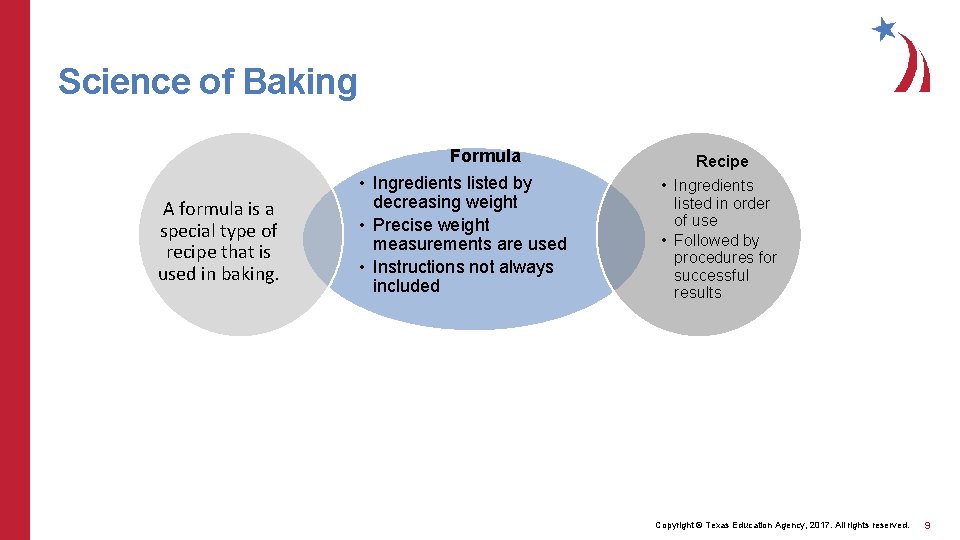
Science of Baking Formula A formula is a special type of recipe that is used in baking. • Ingredients listed by decreasing weight • Precise weight measurements are used • Instructions not always included Recipe • Ingredients listed in order of use • Followed by procedures for successful results Copyright © Texas Education Agency, 2017. All rights reserved. 9
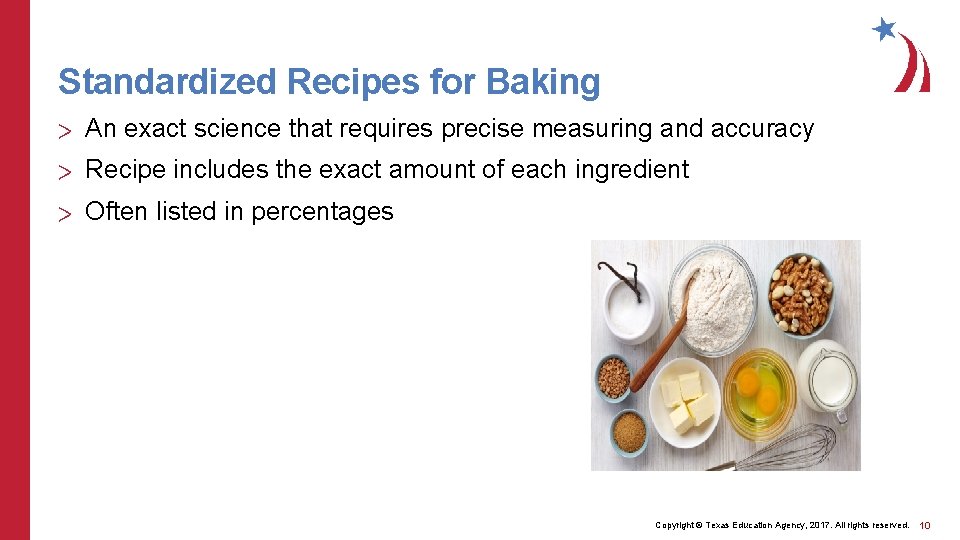
Standardized Recipes for Baking > An exact science that requires precise measuring and accuracy > Recipe includes the exact amount of each ingredient > Often listed in percentages Copyright © Texas Education Agency, 2017. All rights reserved. 10
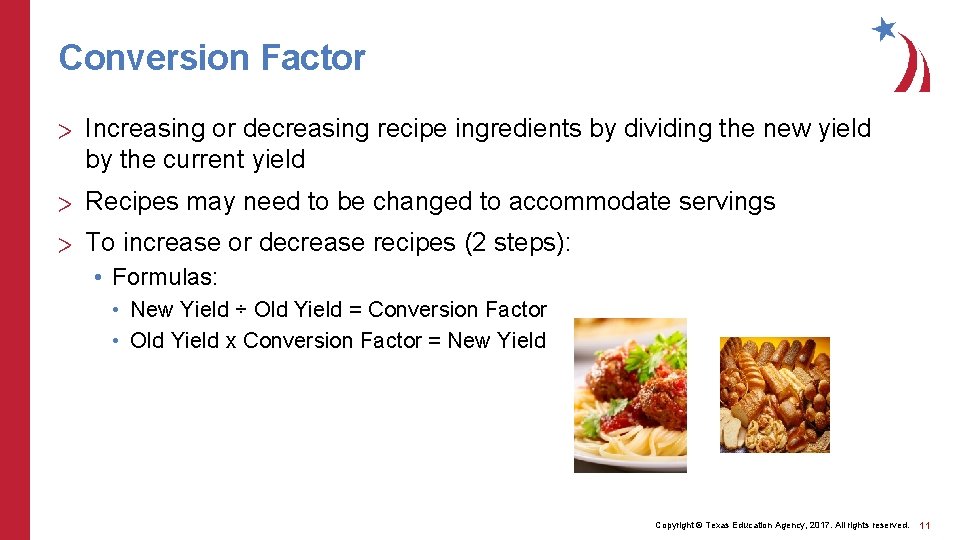
Conversion Factor > Increasing or decreasing recipe ingredients by dividing the new yield by the current yield > Recipes may need to be changed to accommodate servings > To increase or decrease recipes (2 steps): • Formulas: • New Yield ÷ Old Yield = Conversion Factor • Old Yield x Conversion Factor = New Yield Copyright © Texas Education Agency, 2017. All rights reserved. 11
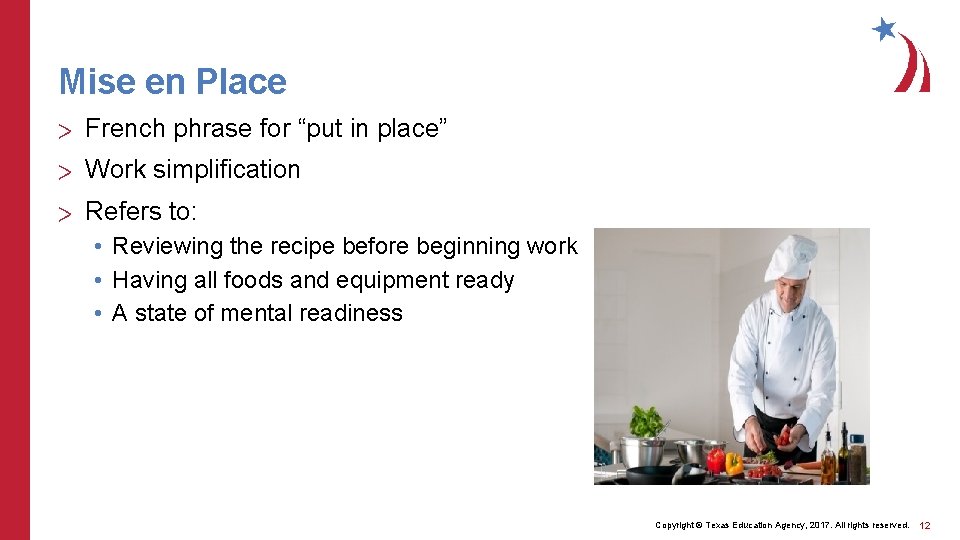
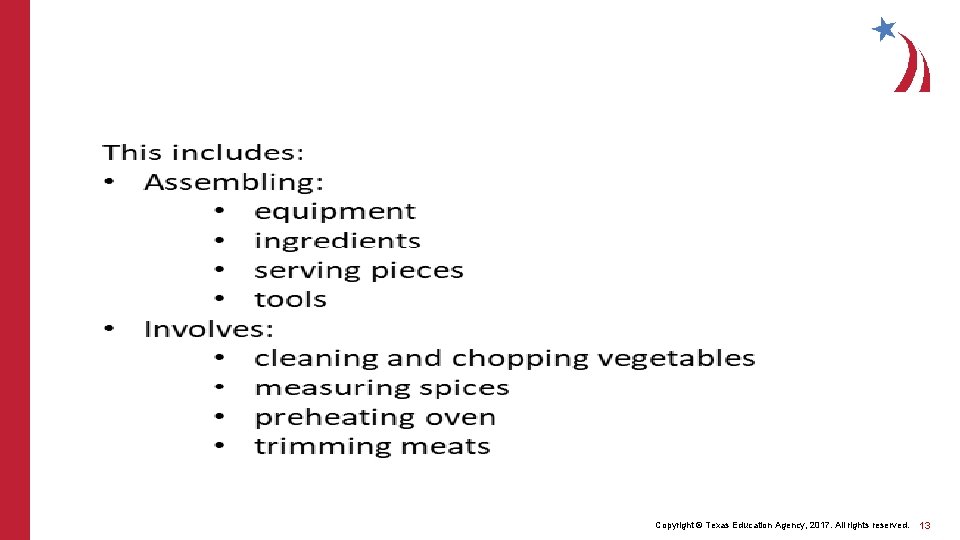
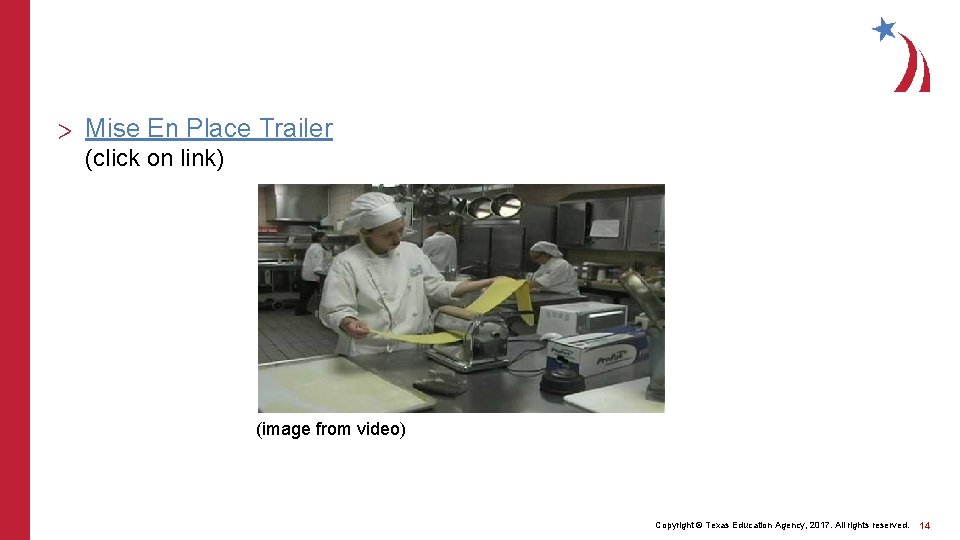
Mise en Place > French phrase for “put in place” > Work simplification > Refers to: • Reviewing the recipe before beginning work • Having all foods and equipment ready • A state of mental readiness Copyright © Texas Education Agency, 2017. All rights reserved. 12
Copyright © Texas Education Agency, 2017. All rights reserved. 13
> Mise En Place Trailer (click on link) (image from video) Copyright © Texas Education Agency, 2017. All rights reserved. 14
Copyright © Texas Education Agency, 2017. All rights reserved. 15
Let’s Review! 1. What is a standardized recipe? 2. What are some benefits of standardized recipes? 3. List the components of a standardized recipe. 4. What is a conversion factor? 5. What are the formulas to decrease or increase recipes? 6. What is mise en place? 7. How can a chef use work simplification in cooking? 8. What is mental readiness? Copyright © Texas Education Agency, 2017. All rights reserved. 16
Questions? Copyright © Texas Education Agency, 2017. All rights reserved. 17
References and Resources > Images: • Shutterstock™ images. Photos obtained with subscription. (Slides 1, 3, 4, 6, 7, 9, 10, 11, 13, 15) > Textbooks: • Culinary essentials. (2010). Woodland Hills, CA: Glencoe/Mc. Graw-Hill. • Draz, J. , & Koetke, C. (2014). The culinary professional. Tinley Park, IL: Goodheart. Willcox Company. • Foundations of restaurant management & culinary arts. (2011). Boston, MA: Prentice Hall. > Websites: • Institute of Child Nutrition Part of the School of Applied Science at The University of Mississippi, is the only federally funded national center dedicated to applied research, education and training, and technical assistance for child nutrition programs. It is funded by a grant administered through the United States Department of Agriculture (USDA), Food and Nutrition Service (FNS). Copyright © Texas Education Agency, 2017. All rights reserved. http: //www. nfsmi. org/ 18
References and Resources > Websites: • What’s Cooking: USDA Mixing Bowl Food, Nutrition and Consumer Services works to harness the Nation's agricultural abundance to end hunger and improve health in the United States. http: //www. whatscooking. fns. usda. gov/ > You. Tube™: • Mise En Place Trailer The title of the documentary comes from the French culinary term Mise En Place, the expression for everything in place the rigorous preparation of ingredients and equipment that leads to success in the kitchen. The documentary will follow Team Delhi as they learn that Mise En Place applies not only in the kitchen, but in life. https: //youtu. be/k 411 Bjq. GKUU Copyright © Texas Education Agency, 2017. All rights reserved. 19